All posts by Lars Walker

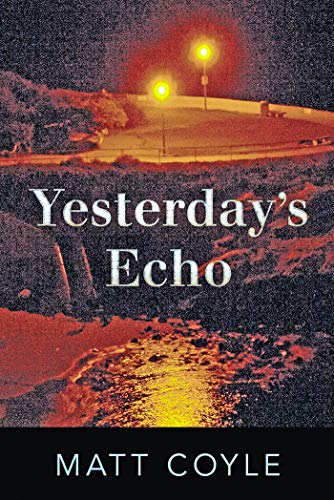
‘Yesterday’s Echo,’ by Matt Coyle

I recognized the house from my infrequent trips up to the cross at the top of the Mount Soledad. Unassuming from the front, its backside hung off a cliff, splayed out like a giant glass-and-copper crab ready to pounce.

I think it was President Truman who said, “If you want a friend, get a dog.”

That might be the motto of Rick Cahill, hero of Matt Coyle’s hard-boiled California mystery series, of which Yesterday’s Echo is the first installment.

Rick’s life has been a series of betrayals. First when his policeman father, whom he worshiped, was thrown off the force for corruption. Then, after he himself became a cop, trying to restore the family honor, his wife was killed and he was blamed. He was never convicted, but he was fired, losing all his friends but one. That’s his old buddy Rusty, who runs a steakhouse and bar in La Jolla. Rick manages it now, and studiously keeps away from most relationships and anybody’s problems. He spends quality time with his black Labrador, Midnight, and that’s enough for now.

Until Melody Malana, a beautiful TV news reporter, walks into the bar and is accosted by a couple drunks. Rick steps in to protect her, and they begin a relationship – the first one Rick has really cared about since his wife died.

Then a couple of guys surprise him and beat him up, demanding to know where Melody is. And Melody is arrested for murder. Rick goes back into cop mode to try to clear her, but only manages to become the subject of an arrest warrant himself. The (corrupt) La Jolla police department is taking its orders from very high places, and Rick is working against the clock and very short of friends.

I mentioned narrative voice in hard-boiled fiction in a recent review. For me, that Philip Marlowe voice, slightly scratchy from cigarettes in one’s imagination, is almost a necessary element of hard-boiled. I’m sure good hard-boiled in the third person has been produced, but I like that imaginary voice-over. Rick Cahill has an excellent hard-boiled voice. I took to him from the start. The writing was crisp and evocative in the classic Chandler style.

My main reservation is that this book is very dark, and presents a world with very little hope in it. I enjoyed reading Yesterday’s Echo, but it left me sad.

Oddly enough, I didn’t notice much objectionable language. There were a couple misspelled words.
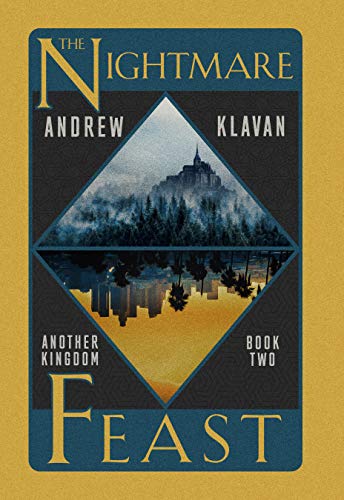
‘tHe Nightmare Feast,’ by Andrew Klavan

He was smiling in that friendly way friendly fascists smile in California. I guess the sunshine makes our fascists mellow.

Andrew Klavan continues his Another Kingdom fantasy series with The Nightmare Feast.

If you recall the plot of the previous book, Another Kingdom, Austin Lively is a pretty unremarkable Hollywood loser, working as a studio script reader. All that really distinguishes him is his dysfunctional background – neglectful academic parents who ignored him and his little sister but heaped attention on his golden boy older brother. Only recently has he learned the full extent of their betrayal – they are part of a world-wide conspiracy organized by a power-hungry multibillionaire, Serge Orosgo.

But Austin has chanced to get a look at a rare manuscript, a book called Another Kingdom, which Orosgo will go to any lengths to get his hands on. Austin’s brief reading of it somehow bestows on him the power to pass through portals into a medieval world called Galiana. In Galiana, Austin has become a knight and been sent on a quest to deliver a plea for aid to the distant Emperor. On the way he must fight monsters and magicians and sinister illusions (interrupted, of course, by unexpected forays back into our own world, generally just at the moment someone is trying to kill him). In our own world, after somehow eluding multiple assassination attempts, Austin comes face to face with Orosgo himself, and draws closer to locating his sister, who is in hiding with the manuscript.

Andrew Klavan is a past master at plotting an exciting story – readers of The Nightmare Feast will need to make time to catch their breath, because the author gives them none. Granted, as a fantasy snob who approves very few authors besides Tolkien, Howard, and myself, I found the fantasy elements just a little thin, though at least the horse gets a rubdown this time out. Anyway, stuff keeps happening so fast, who has time to nitpick details?

I got a kick out of The Nightmare Feast, and eagerly await the next volume. Not for younger kids.

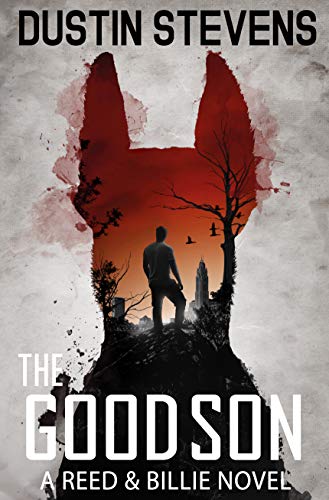
‘The Good Son,’ by Dustin Stevens

This is the second book in a series of police procedurals by Dustin Stevens. The first was The Boat Man, which I reviewed here. Now comes The Good Son.

Reed Mattox is a detective on the Columbus, Ohio police force. He suffers from PTSD since the killing of his (female) partner. But he continues working the night shift, which allows him to operate mostly alone, except for his new K-9 partner, a Belgian Malinois named Billie.

During a stretch of blistering summer heat, EMTs are called to an old woman’s house. She’s dead when they get there, but what’s curious is that someone called 911 for her, though there’s no one in the house and no phone in the room where she died in bed. Soon there are other deaths – by different means, but always with a 911 call. Somebody is killing people but summoning help.

As Reed and Billie hunt for clues where none can be found, we also observe the unnamed murderer, whose back story is as pathetic as his motives are opaque. Reed will have to work with other cops (something he’s reluctant to do) and take some risks to catch the killer.

As a non-cop, I got the impression of a pretty high level of realism in this book. Sadly, that also tends to make the book less exciting than its competition – Reed spends a lot of time doing the mundane shoe leather work and paper work that real policing demands. However, the dramatic tension does rise steadily, and the payoff is fairly satisfying. There is a problem of homonym confusion — close-sounding words used in each others’ places. A copy editor would be helpful.

I’m not over the moon about The Good Son, but it wasn’t bad.

Fall of giants

Col. Hans C. Heg

Today’s big news in the Norwegian-American community is sadly something we might have seen coming. The Bolshevik mob in Madison, Wisconsin, in its zeal to judge people by the color of their skin, not the content of their character, has torn down, decapitated, and drowned (in Lake Monona) the memorial statue of Civil War officer and abolitionist Col. Hans Christian Heg.

Col. Heg was born in Lier, Buskerud, Norway in 1829. He came to America with his parents in 1840, spent time in the California gold fields, and then returned to Wisconsin.

A fervent opponent of slavery (like most Norwegian immigrants), he joined the Free Soil Party, and  the Republicans after that, becoming the Wisconsin state prison commissioner. He was the first Norwegian-American to be elected to state-wide office in that state. As an abolitionist, he joined the Wide-Awakes, an anti-slave-catcher militia. He sheltered fellow Wisconsin abolitionist Sherman Booth, who had incited a jail break to free an arrested escaped slave.

My friend Mari Anne Næsheim Hall, co-author of the book, Rogalendinger i den Amerikanske Borgerkrigen (Rogalanders in the American Civil War, ©2012), writes of Heg (who was not a Rogalander) (my translation):

Later in the fall several prominent Norwegian immigrants gathered in Madison, resolving then and there to organize a Scandinavian regiment to contribute to the civil war. They recommended to the governor that Hans Heg should be appointed colonel and regimental commander…. Hans Heg was a well-known figure in the immigrant community with many friends, and of course he made use of his influence. “The country which we immigrants have made our homeland has received us with friendship and hospitality. We have the same rights as those who were born here. Let us show ourselves deserving of this, and demonstrate that we are descended from the Norse heroes.” This was part of what he said in his speeches. Hans Heg came originally from Lier in Drammen, and a monument has been raised there in his honor. We find this same impressive monument outside the capitol in Madison. The monument in Lier is actually a copy of the original in Wisconsin.

Further on:

The regiment participated in no less that 27 major battles. Losses were great, and the 15th Wisconsin was one of the units in the northern army to lose the most soldiers. But it was not in battle that the regiment suffered most. Many more actually died of disease than from southern bullets. Officially the regiment lost 33% of its full strength, but a notation attached to the regimental banner in the historical museum in Madison says that the total loss was all of 38%. It states that fully 345 soldiers of the regiment died, either in battle, of illness, or due to accidents. Col. Hans Heg was one of the many who never returned to his Gunhild, his beloved wife. He was killed in the great battle of Chickamauga, together with many other soldiers of the regiment. No fewer than 49 soldiers of the 15th Wisconsin died in the famed Andersonville death camp in Georgia….”

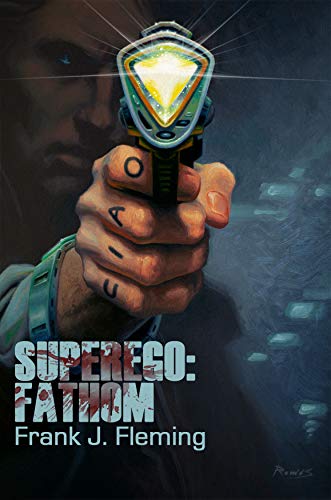
‘Superego: Fathom,’ by Frank J. Fleming

“Don’t threaten people while you’re bleeding on the floor,” I interrupted. “It comes off as insincere.”

Intergalactic hit man, genetically engineered psychopath, and inadvertent hero Rico Vargas is back in his second satirical Sci Fi thriller, Superego: Fathom.

In the previous book, Rico brought down the criminal syndicate that was taking over the Galactic Alliance. Now the remnants of that alliance are faced with an even greater threat – the Fathom. The Fathom is a mysterious organization nobody knows anything about for sure, except that they have dangerous agents who seem to appear anywhere at will, and a huge mother ship with tentacles. They are rumored to be aliens with strange powers.

Rico finds himself in the unusual – for him uncomfortable – position of working with a team. One of them is Diane, the woman he’s unwillingly fallen in love with, and from whom he’s been trying to distance himself, for her own good. He maintains his strength, speed, and lightning reflexes, but now he suffers from a handicap. Due to a dose of a powerful drug, he now suffers excruciating pain after even the slightest injury. Which means he’s only good on the offensive, and needs back-up.

Also, he’s about to sink to moral depths he’s never reached before: he’s going to become a politician.

As the story proceeds, there are plots within plots, wheels within wheels, and every fresh surprise only sets the stage for a larger surprise to come. The final payoff is very gratifying for the reader, only it’s not the final payoff.

Lots of fun, and very funny, with serious spiritual themes underlying the black comedy. I enjoyed Superego: Fathom very much. Something different for your light reading.

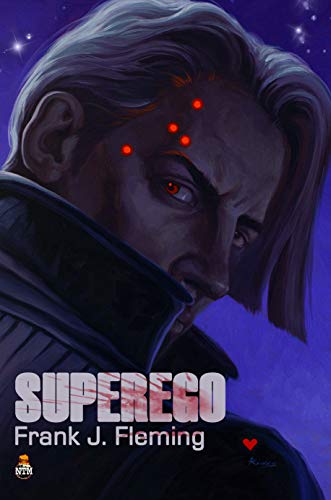
‘Superego,’ by Frank J. fleming

I like honesty. You hardly ever see real honesty in the universe. Nothing scares people more.

Rico, the hero of Frank J. Fleming’s novel, Superego, is an intergalactic hit man in the distant future. He is particularly good at his job due to being genetically engineered. First of all, he’s remarkably strong, with extremely fast reflexes. Secondly, his brain is wired for multitasking. Thirdly, and most importantly, he has no empathy at all. To him, innocent bystanders are just part of the furniture, entirely expendable.

Until one day, on a planet where a major interplanetary conference is about to start, he kills a group of terrorists and (wholly unintentionally) saves many innocent lives. Suddenly, Rico is a hero – which gives him no pleasure. The local police ask for his help (though, annoyingly, they keep taking his guns away), and he finds himself working with a police woman named Diane. Diane doesn’t trust him (which only shows her good sense). But gradually – as they survive several other hairy situations and become even bigger heroes – he starts having feelings for her. This has never happened before, and he hadn’t thought it was possible. Which only complicates his life, which is already complicated enough as one surprise after another begins to reveal the true scope of the corruption within the Galactic Alliance.

I’ve known author Frank J. Fleming for many years – first through his hilarious blog, IMAO, and more recently as a leading light at America’s new Paper of Record, The Babylon Bee. I wasn’t sure what kind of a novelist he’d be. But I was pleasantly surprised.

Superego provides a fusion of Hard-Boiled thriller and space opera, and works extremely well on both levels. But what makes the book really work (as with all great Hard-Boiled) is the voice of the narrator. Rico’s psychopathy gives the ironic tone an extra punch, and Frank J.’s signature sense of humor provides many a (black comedy) laugh.

Oh yes, there are Christian themes here too – Diane is a Christian and attends church, and Rico even attends a Bible study. His awkwardness with that social situation exactly corresponded to my own experience, by the way, and that gave me a moment’s pause even as I laughed.

Recommended. There’s a sequel, too.

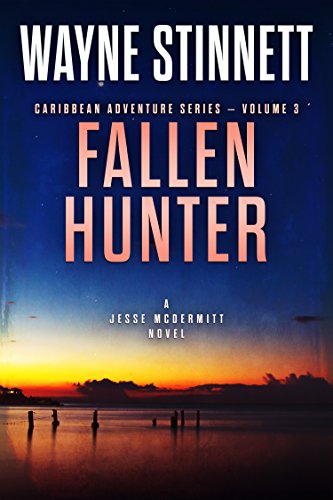
‘Fallen Hunter,’ by Wayne Stinnett

Saying that a series is losing my interest is not precisely the same thing as saying it’s lost its way. I have definite (and limited) tastes; lots of books that don’t interest me have wide and enthusiastic followings. So what I’m about to say about Wayne Stinnett’s Fallen Hunter shouldn’t be taken as a condemnation.

Series hero Jesse McDermitt is back on his private little island as Fallen Hunter begins. He’s still recovering from a personal loss, but now he feels ready to start engaging the world again. A friend’s wife tells him of a problem in her family. Her father, a shrimp fisherman, has gotten himself into trouble. He agreed to make a few deliveries for a drug smuggler to get his business over a tight spot, but now he wants out and the smugglers won’t let him go. In fact, they’re talking about more dangerous goods.

Jesse arranges to take over the shrimping operation for a while, presenting himself as an enthusiastic scoundrel eager to play ball with the smugglers. Then he learns that the “more dangerous” cargo they’re talking about is armaments for a terrorist group. That sends Jesse to his covert operations buddies, and they draft a plan to stop the terrorists.

In his spare time, Jesse meets an attractive local woman and begins dreaming of a new future.

My personal problem with Fallen Hunter was that it shifted the series (not surprisingly, in light of the previous book) into military thriller territory. As a large number of fighting men (and women) converge on Jesse’s island and start doing their operational stuff, I began to grow bored. That the second half of this book consisted largely of people pretending to be on a diving vacation, doing rather languid tourist things while waiting for the action to start, did not increase the suspense.

I was also annoyed, as before, by Jesse’s over-willingness to confide in people he hardly knows. And the final climax of the book was pretty melodramatic.

Still, I like the character enough to give him another chance. I’ll probably read the next book. But not right away.

Amazon Prime old film review: ‘The Mystery of the 13th Guest’

Tonight, just to shake things up, I’m going to review a very bad film, The Mystery of the 13th Guest (1943).

Aside from reading mysteries, I’ve also been watching several old B movies on Amazon Prime. This is my futile strategy for avoiding total despair. If the end is coming, I want it to catch me totally unprepared. Why should I perish all stressed out?

Anyway, I caught this old stinker, The Mystery of the 13th Guest. It stars an actor named Dick Purcell, who delivers probably the best performance of the film, which tells you nothing at all. He would later distinguish himself, sort of, playing Captain America.

The premise is that old Grandfather Morgan, 13 years ago, gathered his relatives and a couple close associates in his home, arranging them around the big dinner table. There were 13 places set, but only 12 people present. He tells them that he plans to leave his entire fortune to his granddaughter Marie, the only one of the lot who’s worth a plugged nickel. She’s only eight now, but he has entrusted his will to his lawyer, for Marie to open when she turns 21, 13(!} years from now.

Right on time, Marie arrives at the gloomy old mansion on her 21st birthday, and finds the electricity is still hooked up and the phone still working. She finds the table arranged just as it was 13(!) years ago. Then there’s a murder, and soon Private Eye Johnny Smith (Purcell) is on the case, dashing through hallways and secret rooms, running rings around the police.

What was awful about this film? The writing was terrible. The dialogue was awkward, and it got no help from the wooden actors.

The dumbest thing, however, was the portrayal of the police. One understands that every Sherlock Holmes needs a plodding Lestrade to show off against. But these cops belong in a home for the mentally deficient. If they’re the best brains on the force, the uniform guys must have trouble getting their pants on in the morning. The senior member of the team (played by Tim Ryan (also the main writer), a classic mugger who married Irene Ryan, best known as Granny Clampett on The Beverly Hillbillies) thinks he’s smart, but he’s really in awe of the amazing Johnny Smith. His subordinate, played by Frank Faylen (later Dobie Gillis’s father on TV) is barely sentient and keeps dozing off. Fortunately, Johnny is good buddies with the District Attorney, so he just takes over the investigation. And they let him. He even orders patrol cars dispatched, and the police hop to obedience.

Terrible movie. Just the thing to transport me to a simpler, less judgmental time, and give me a short respite from the Apocalypse.

You’ll like it, if you have sarcastic friends to watch it with, and do an MSTK3000 treatment.

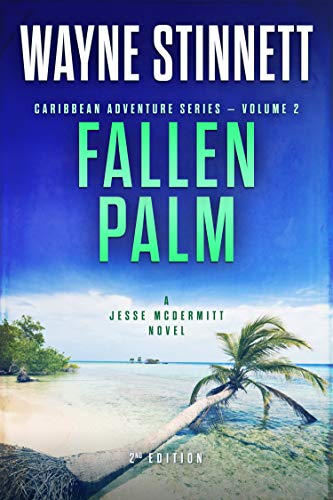
‘Fallen Palm,’ by Wayne Stinnett

The second book in Wayne Stinnett’s Jesse McDermitt series was actually the first one published. I think there are some signs in Fallen Palm that the author is not yet completely sure of himself, but it’s nevertheless a pretty good story.

Jesse, retired Marine sniper, is living a solitary life on his private island in the Florida Keys, fishing, diving, and taking occasional charter jobs with his fishing boat. Jesse gets a visit from the son of the Marine who trained him and had been his good friend. His father, says “Deuce” the son, drowned while diving. Which makes no sense. He was too good and careful a diver to have gotten into that kind of trouble. He had been diving with a young partner, and that partner turns out to have sinister connections. Then Deuce tells him he’s part of a very hush-hush commando unit fighting the war on terror. Later (in the kind of coincidence that author Stinnett is prone to) that mysterious diving partner turns up in a terrorism probe. On top of that, Deuce’s boss in Washington very much wants to recruit Jesse for their unit.

Meanwhile, a fascinating woman, a fellow fishing professional, comes into Jesse’s life and touches him in a way he has not experienced in many years.

Fallen Palm is an enjoyable story, though I’m not sure Jesse’s character has been fully developed yet. I’m particularly troubled by Jesse’s approach to security – he reveals his secrets too easily, I think. And a shocking event at the end was no surprise to me at all.

Oh yes, Jesse gets a dog in this one. That part worked really well.

Recommended. I don’t recall if there was offensive language or not, so it can’t have been too shocking. Attitudes toward sexual morality and marriage are thoroughly secular.

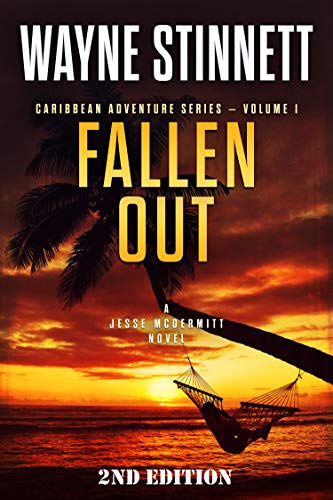
‘Fallen Out,’ by Wayne Stinnett

I like stories about boats on the ocean. Not boats on lakes, which are commonplace where I live, but boats on the deep sea. Perhaps it’s an atavism out of being descended from Norwegian islanders, or more likely it’s just a quirk. In any case, such stories make me feel good. Bernard Cornwell used to write such books, but they didn’t sell, certainly not like the historical novels he moved on to.

I also miss John D. MacDonald and his Travis McGee series. I’m always looking out for a new McGee substitute; nobody quite fills the bill. But Wayne Stinnett’s Jesse McDermitt gives me some of the same vibe.

Fallen Out is the prequel (now the first volume) to the Jesse McDermitt series of thrillers. As it opens, we observe Gunnery Sergeant McDermitt retiring from the Marine Corps. He has a fair amount of money from an inheritance, but is unsure what to do with himself. As he notes, his chief job skill is killing people from up to a mile away.

But he has an old Marine Buddy running a bar in the Florida Keys, and he heads south to see him. While he’s visiting, someone mentions being a fishing charter captain to him. On a whim, he purchases a very nice, large boat, complete with souped-up motors, confiscated from drug runners, at a government auction. He also buys a very small island, planning to build a home there. Soon he’s becoming part of the Conch community, and enjoying his new life. Except that, sometimes, he misses the action.

Then one day he and a friend rescue a couple women from a group of men he suspects might be human traffickers. In time he becomes close to one of them. Then he and some of his friends move their boats into a river mooring to ride out a hurricane. And the traffickers show up again.

Fallen Out wasn’t great literature, but it was a fun story which I enjoyed a lot. Pure entertainment reading. And a very satisfying climax. I recommend it. Cautions for language and adult themes.