The Ao Naga are a tribal group in northeastern India. They were converted to Christianity in the late 1870s. This is the Ao Naga Choir with the Passion hymn, “O Sacred Head, Now Wounded.”
“O Sacred Head” is a very old Latin hymn traditionally attributed to St. Bernard of Clairvaux. However (I’m disappointed to learn) it’s now generally attributed to a 13th Century poet named Arnulf of Leuven (whose name suggests Norman ancestry).
Arrangement by J. S. Bach.
I love this hymn. For Lutherans (and, of course, for many others) Christocentricity is the chief test of theology. If Jesus isn’t the Center, then it’s wrong.
Through all history, people have sought the secret of the universe. Christians declare that the secret is not an equation, not a formula, not a hidden talisman or precious stone or treasure, but a Person. When you get to the end of all questions, when you draw back the final curtain of the universe, you find Personality.
And of course, we always knew this was right. All our great stories declared that the King must save his people; the Father must save his child; the Prince must save the princess. The answer is Someone.
Today is Maundy Thursday in the church calendar. The word “maundy” is related to the Latin root of the word “mandate,” meaning command. It’s a reference to Christ’s words at the Last Supper: “A new commandment I give you, to love one another as I have loved you.”
This is a day for Holy Communion in many churches. Most traditional Lutherans aren’t doing the sacrament until the quarantine is over, though. Because we believe actual physical presence is necessary. (My own church is doing virtual communion online, but we’re kind of outlaws.)
April 9 is a sad day in Norwegian history. 80 years ago today, German troops marched into Oslo. They actually expected to be greeted as saviors, protecting the Norwegians from the British, who’d been violating Norwegian neutrality in various ways. The Norwegian government wasn’t quite sure what to do with them at first — after all, Hitler was (for the moment) allied with Stalin, who was a friend and benefactor to Norway’s ruling Labor Party. When the troops marched in, they got a police escort.
However, on that same day, Norwegian troops at Oscarsborg Fortress on the Oslofjord, under the command of Col. Birger Eriksen, fired on a German battleship. The Blucher was a brand-new ship; many of its crew were raw recruits on their first voyage. But among the personnel on board were Gestapo officers and other personnel whose assignment was to capture the Norwegian royal family and government. Because the ship had refused to respond to warning shots, Col. Eriksen determined that whoever they were (he didn’t know at that point), they were hostile and it was his duty to fire on them. His words were, “Either I will be decorated or I will be court-martialled. Fire!” His guns and ammunition were old, but they performed admirably. Both his battery’s shots hit, and the Blucher began burning. Further shots from secondary batteries caused further damage, and the Blucher sank with the loss of 650-800 soldiers and sailors (1,400 survived). The delay caused by the sinking gave the royal family and the government time to escape the city, and ultimately to flee to exile in England.
Aside from Atlantic Crossing, which I’ve told you about, I’ve done some other work having to do with Norway in World War II, which I still can’t tell you about. I hope they’re released eventually. I’m quite proud of them.
The line of the Norwegian kings, art by Anders Kvale Rue
I’ve mentioned that I got some new translation work recently. One of these jobs is to translate a series of short articles on the Viking Age rulers of Norway, for Saga Publishers, the publishers of Viking Legacy. It’s an ongoing project, but my first translation went up today, here.
Unanimous saga tradition regards the Oppland king Halvdan the Black as the progenitor of the eventual Norwegian royal dynasty. The same tradition also relates that he was the first Norwegian petty king to secure for himself a trans-regional power base spanning eastern and western Norway, through a marriage alliance with Ragnhild Haraldsdotter, the daughter of a petty king in Sogn. Their son, Harald, according to custom, would have been fostered up in Sogn at the home of his grandfather, Harald Goldbeard.
The series will be updated with fresh kings, as I understand it, a couple times a week.
In response to this, Gregory’s mouth flapped open and closed in outrage, like a fish that had been slapped in the face with another fish.
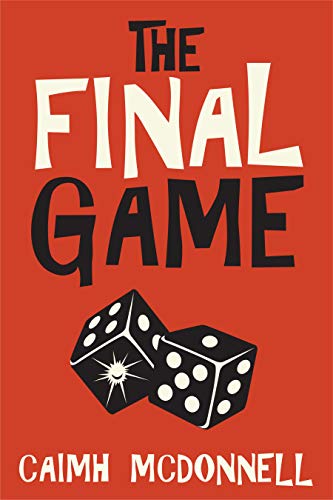
Caimh McDonnell’s comic mystery novels are an ongoing entertainment of a pretty high order. They began with the adventures of Paul Mulchrone and Brigit Conroy (called a trilogy, of which this is something like the fifth), amateur private detectives, who hook up with Bunny McGarry, a Falstaffian old policeman, to solve crime. Bunny has been spun off into his own series of adventures in America, but Paul and Brigit soldier on, acquiring in this book, The Final Game, the assistance of James Stewart, a retired cop who (unlike Bunny) does not drink, but keeps falling over anyway, due to an inner ear problem.
Dorothy Graham is a character we know from earlier books in the series. She was a feisty old woman who became Paul’s surrogate mother when he was doing volunteer work with the elderly. She was a brilliant and aggressive player of board games, and immensely rich.
Sadly, Paul comes out of an undercover job to learn that Dorothy is dead. She fell down her stairway while alone. Paul is devastated by the news. But he’ll soon be flabbergasted by her will.
The old woman had a flair for the dramatic, and utter contempt for the idle and self-indulgent step-grandchildren who are in line to inherit her wealth. So she did one better than the old video will gag, where the deceased gets the chance to get the last word on their assembled relatives.
Dorothy has spared no expense to turn the settlement of her estate into a world-class production – literally. She has arranged to make the inheritance a competition. The heirs are to compete in teams of two, in something like a TV reality show, handling various ridiculous and embarrassing challenges. And it’s all to be podcast over the internet.
To Paul’s astonishment, he and Brigit are designated as one of the teams. Dorothy tells them, on video, that she wants them to win the money, rather than her obnoxious step-family. Paul reluctantly agrees, even though it means wearing pink jump suits and Mexican wrestler masks.
But when he learns that Dorothy might have been murdered, it becomes a game of life and death.
Caimh McDonnell excels at this kind of ridiculous story, and the laughs are frequent. It’s also remarkable that there are actually a few really touching moments in the story. The characters are vivid, and we come to care about them (or hate them, depending on which they are).
McDonnell is as funny in his own way as P. G. Wodehouse, and I had a very good time with The Final Game. My only quibble is that he leans pretty heavily on the “smart, tough girls vs. dumb, feckless men” trope, which has been overdone lately. It’s not as new a trope as one might think (it wasn’t even new for Wodehouse), but these days it’s lost all its power through overuse. It’s become a cliché. It’s predictable.
Still, I highly recommend The Final Game. Cautions for language, gross humor, and adult themes.
Years ago, for some reason (perhaps a college assignment I’ve forgotten), I picked up a copy of Boccaccio’s Decameron.
This is not a review of that book.
I started reading the Decameron, for some reason, years later in Florida, when I was sick in bed and looking for reading material. Back before I could summon books magically through the ether with my Amazon Fire.
I didn’t finish it. It’s one of those books I just couldn’t get into.
Anyway, it’s a collection of 100 stories, supposedly told by a group of ladies and gentlemen who’ve fled Florence during the Black Death in the 14th Century.
I tell you all of that just to ease into my real subject – I have a very brief Plague Story of my own today.
Buoyed by the prospect of money coming in from my recent translation job, I decided to throw some patronage at a restaurant I like, but haven’t been to for a while. I called in an order for pick-up.
When I got there, rocking my stylish Black Bart Stagecoach Robber bandana mask, the cashier told me it would be just a minute. I said sure.
There was another guy there, sitting on a bench. A middle-aged guy (which makes him younger than me, I shudder to think) who seemed to be waiting for a large order.
“Sure never thought I’d see times like this in America,” he said to me, keeping his distance as the law prescribes.
I agreed, pretty much echoing the same sentiment back to him. “I feel bad for the small business owners,” I added. “A lot of those people don’t have a lot of margin to fall back on.”
He told me he was a small businessman himself. He owned two neighborhood bars. “I’m doing OK,” he said. “But I feel bad for my employees. Some of them are in real bad shape.”
We went on to talk about various theories about the Coronavirus thing. He’d heard that people get immunity from sunlight exposure in summer. I said I’d heard it was temperatures over 80 degrees and humidity.
“If it’s heat and humidity,” he asked, “how come it doesn’t die on your body? What’s warmer and humider than your body?”
I admitted he had a point.
Then the cashier came out with my food. As I stepped toward the counter, the guy said, “Hey, Mister, forget it. It’s on me. It was a pleasure to talk to somebody new after all these days at home.”
I’ll share a little-known personal secret with you – I almost never turn down free stuff. I thanked him and gave the cashier a big tip. We were all happy for a moment.
As I left he asked my name, and gave me his. Which, of course, I’ve forgotten already.
I should have asked the names of his bars, so I could recommend them to any locals who may read this – after they re-open on VC day. But I didn’t think of that. And I don’t drink myself.
Well, fortunately he’ll never be able reproach me for my ingratitude. He never saw my face without a mask.
By Hesse1309 – Own work, CC BY-SA 3.0, https://commons.wikimedia.org/w/index.php?curid=487491
The picture above isn’t one of mine. It’s in Norway, though. I think I may have seen this sign on one of my journeys; I know I saw one like it. We take our trolls seriously, we Norwegians. If they kidnap a princess or two, well, that’s the price of living in the most beautiful place in the world.
It was quite a weekend, friends. I was intensely engaged with the Norwegian language. I will not tell you what translation project I was working on, and I’ll not tell you whom it was for. It was a script. You can guess the medium for yourself.
But I had a lot of work to do, and a deadline to meet. I was a little insecure about meeting it, but it turned out I’d underestimated myself. The work went faster than I’d looked for. The thing didn’t get delivered as soon as I hoped, due to a glitch that appeared and wiped away a whole lot of work that had to be done all over again. But I got up early and worked late, and delivered everything well before I’d estimated.
It’s a little disconcerting that I haven’t heard anything back from the client (checking again to see that my email with the files actually went out; yes, it did). But if my product had been awful, I suspect somebody would have said something. I take comfort in that thought.
After all these months, it was sweet to open up the First Draft app and do that voodoo that I do so adequately. It was fun, in the same sense that being a rodeo rider or a cage fighter is fun. It takes its toll, but you come out stimulated. While all around me people were going batty with cabin fever, I was in my element, growing as a craftsman. It was, frankly, the best weekend I’ve had in quite a long time.
I’ve become a little cautious about discussing translation work. So suffice it to say that I snagged a nice one, and there’s a deadline coming on, and I can’t really spend much time on a blog post.
But rejoice with me that I’ve found work, when better men are filing for unemployment. Whatever my project is, it’s interesting. Have a good weekend. Don’t do anything I wouldn’t do (that ought to keep you pretty safe).
Vincent Malone, hero of Ted Clifton’s Santa Fe Mojo, was once a hotshot lawyer in Dallas, until alcohol trashed both his career and his marriage. He drifted to Denver, where he found his niche as a legal investigator. Then he developed gout, and missed too much work. Figuring a warmer climate would help, he headed for Albuquerque, and cheap housing. But in a diner in Santa Fe he saw an ad for a job driving a customer van for a bed and breakfast. On a whim, he applied for the job.
Vincent is a misanthrope, a man who’s seen the worst in people and has distanced himself from them. But the couple who hire him are annoyingly nice. He doesn’t know what to do with them, but he kind of likes working there as he gets used to it.
They’re excited to greet their first guests at the B&B, but something is wrong. The rooms were booked by a major sports agent who lives locally, for a group of his top clients and their spouses. But when they hold a meeting, it ends in shouting and threats.
The next morning the police come. The agent has been murdered. Vincent can tell that the sheriff’s department would like to hang something on him, but they quickly settle one of the clients – a major league baseball player. Security video shows the two men fighting in the agent’s front yard, a few hours before the murder.
Vincent, though, based on his investigative experience, thinks the cops haven’t looked far enough. They found an easy suspect and stopped detecting. The accused’s lawyer shows up, and he’s the accused’s uncle and Vincent’s spiritual twin – a hard man who got rich defending whoever paid him, using any kind of trick he could get away with. But he’s older now, and thinking it might be nice to form some kind of bond with his only surviving relative. At least he forms a bond with Vincent, who shares his bemusement at discovering morality late in life.
Santa Fe Mojo straddles the line between cozy mystery and hard-boiled, and does it pretty well, I think. The gradual softening of Vincent’s hard shell in the warmth of human friendship provides an enjoyable sub-plot. I enjoyed Santa Fe Mojo quite a lot. Cautions for language, mostly.
Sarah Hoyt is a Facebook friend and a fellow Baen author. Aside from her SF work, she has produced, under the nom de plume (a particularly appropriate term in this case) Sarah D’Almeida, a seies of novels about Alexandre Dumas’s Three Musketeers. These are mysteries, and have been inserted directly into the timeline of that classic novel. The Musketeer’s Seamstress, second in the series, occurs shortly after D’Artagnon meets his swashbuckling friends, but (if I understand correctly) before all the bother about the queen’s diamonds.
Aramis, the romantic musketeer destined for the church, is at the palace, dallying with his mistress, a lady of the court whom he refers to with his friends as his “seamstress.” He steps out of the chamber for a moment. When he returns, he finds her dead, a dagger through her heart. Like so many idiots in mysteries, he pulls the dagger out, getting blood all over his hands. When he hears people at the door, he makes a leap from the balcony onto a convenient tree and then manages to get away over a wall – stark naked. He is fortunate enough to find his friends Athos, Porthos, and D’Artagnon at guard at one of the gates, and they help make his escape. Cardinal Richelieu, who seems to cherish a particular dislike for Aramis, sets a hunt going, but Aramis manages to get away to his home estate, while his friends try to uncover how an “impossible” murder was committed.
The author, I think, did an interesting job with the familiar characters. She invents back story material for them that Dumas only hinted at, and as far as I can remember it’s pretty consistent with his portrayals. I particularly like the character of Porthos, who is envisioned as a man not stupid, but simply plain-minded and practical. Which makes it possible for him – sometimes – to see things his subtler friends miss.
I felt a certain tension in the insertion of a whodunnit into what is essentially an action/adventure setting. The action is quite good when it happens, but a lot of the book involves people just thinking and discussing matters, which struck me as a little incongruous. However, as I said, I liked what was done with the characters, so such scenes were not without interest.
I wouldn’t rate The Musketeer’s Seamstress as a top-shelf book, either as an actioner or a mystery, but it was an enjoyable read, and I had a good time reacquainting myself with what is, perhaps, the archetypal male-bonding group in all literature.
During the later part of the war, the government issued a pamphlet on how to recognize changelings. Violet read it (a green tinge of the features; propensity to cruelty) and laughed. The real signs had been far more pervasive, far less clear. Sometimes she thought she had only realized she wasn’t human when she was fourteen. Sometimes she thought she had always known.
That’s the first paragraph of a story called “More Full of Weeping Than You Can Understand,” possibly my favorite among the stories in Rosamund Hodge’s delightful collection, Desires and Dreams and Powers.
A friend sent me a copy as a gift, and I’m extremely
grateful to him. As I’ve often said, I don’t much care for most modern fantasy.
But when someone gets it exactly right – as in the cases of Walter Wangerin,
and Mark Helprin, and Leif Enger, the result is delight of an exquisite sort.
The stories in Desires and Dreams and Powers are of diverse kinds, within the general fantasy genre. There is urban fantasy, and tales of witches, and tales of monsters. But most of them (at least as I recall them) are faery stories. And that’s like a birthday present to me.
Ever since I read Tolkien’s essay, “On Faery Stories,” I’ve wanted to write faeries properly. I tried it in Troll Valley – which I think is a pretty good book, but I’m not at all sure I got the Faery/Huldre thing right. Susanna Clark got it right, I think, in Jonathan Strange & Mr Norrell. And now I declare, by the powers vested in me, that Rosamund Hodge gets it right too. The strangeness, the danger, the alien unreason of the faeries is as well depicted here as it ever has been. Kudos to the author.
I can’t recommend this book highly enough. On top of the imaginative genius, the prose is first class. Cautions are in order – not for the usual “adult” material, but for the weird and the alien and the disturbing (and the cruel). But read it, if you’re a grown-up and not overly sensitive. There may be a Christian element here too, though it’s not at all explicit.
Websites store cookies to enhance functionality and personalise your experience. You can manage your preferences, but blocking some cookies may impact site performance and services.
Essential cookies enable basic functions and are necessary for the proper function of the website.
Name
Description
Duration
Cookie Preferences
This cookie is used to store the user's cookie consent preferences.
30 days
These cookies are needed for adding comments on this website.
Name
Description
Duration
comment_author
Used to track the user across multiple sessions.
Session
comment_author_email
Used to track the user across multiple sessions.
Session
comment_author_url
Used to track the user across multiple sessions.
Session
These cookies are used for managing login functionality on this website.
Name
Description
Duration
wordpress_logged_in
Used to store logged-in users.
Persistent
wordpress_sec
Used to track the user across multiple sessions.
15 days
wordpress_test_cookie
Used to determine if cookies are enabled.
Session
Statistics cookies collect information anonymously. This information helps us understand how visitors use our website.
Google Analytics is a powerful tool that tracks and analyzes website traffic for informed marketing decisions.
Used to monitor number of Google Analytics server requests
10 minutes
__utmb
Used to distinguish new sessions and visits. This cookie is set when the GA.js javascript library is loaded and there is no existing __utmb cookie. The cookie is updated every time data is sent to the Google Analytics server.
30 minutes after last activity
__utmc
Used only with old Urchin versions of Google Analytics and not with GA.js. Was used to distinguish between new sessions and visits at the end of a session.
End of session (browser)
__utmz
Contains information about the traffic source or campaign that directed user to the website. The cookie is set when the GA.js javascript is loaded and updated when data is sent to the Google Anaytics server
6 months after last activity
__utmv
Contains custom information set by the web developer via the _setCustomVar method in Google Analytics. This cookie is updated every time new data is sent to the Google Analytics server.
2 years after last activity
__utmx
Used to determine whether a user is included in an A / B or Multivariate test.
18 months
_ga
ID used to identify users
2 years
_gali
Used by Google Analytics to determine which links on a page are being clicked
30 seconds
_ga_
ID used to identify users
2 years
_gid
ID used to identify users for 24 hours after last activity
24 hours
_gat
Used to monitor number of Google Analytics server requests when using Google Tag Manager
1 minute
_gac_
Contains information related to marketing campaigns of the user. These are shared with Google AdWords / Google Ads when the Google Ads and Google Analytics accounts are linked together.
90 days
Marketing cookies are used to follow visitors to websites. The intention is to show ads that are relevant and engaging to the individual user.
A video-sharing platform for users to upload, view, and share videos across various genres and topics.
Registers a unique ID on mobile devices to enable tracking based on geographical GPS location.
1 day
VISITOR_INFO1_LIVE
Tries to estimate the users' bandwidth on pages with integrated YouTube videos. Also used for marketing
179 days
PREF
This cookie stores your preferences and other information, in particular preferred language, how many search results you wish to be shown on your page, and whether or not you wish to have Google’s SafeSearch filter turned on.
10 years from set/ update
YSC
Registers a unique ID to keep statistics of what videos from YouTube the user has seen.
Session
DEVICE_INFO
Used to detect if the visitor has accepted the marketing category in the cookie banner. This cookie is necessary for GDPR-compliance of the website.
179 days
LOGIN_INFO
This cookie is used to play YouTube videos embedded on the website.