All posts by Lars Walker

‘A Man With One of Those Faces,” by Caimh McDonnell

A Man With One of Those Faces

She was not a bad looking woman, truth be told; a couple of years older than himself, short brown bobbed hair, decent figure – she wouldn’t be launching a thousand ships any time soon but she’d undoubtedly create a fair bit of interest in a chip shop queue.

Paul Mulchrone is “A Man With One of Those Faces” – a face so ordinary that people frequently mistake him for other people. This comes in handy when he helps out in a Dublin hospice, sitting with dying old people, holding their hands, letting them imagine he’s a family member or a friend. He does this to fulfill the terms of his aunt’s will, which allows him to live in her house on a small stipend so long as he puts in a certain number of public service hours every month. It’s all fine until one night when Nurse Brigid Conroy persuades him to stay a little beyond his time with a particular old man, in return for a drive home. In the event, the old man tries to murder Paul with a knife he’s somehow acquired, and then drops dead.

Turns out the old man is a gangster whom everyone thought dead years ago, one who was involved in a legendary unsolved kidnapping. And his old partners in crime don’t know what he might have told Paul in those last moments. Best to kill him, just to be on the safe side. And Nurse Brigid too. Continue reading ‘A Man With One of Those Faces,” by Caimh McDonnell →

In memory yet Green

Roger Lancelyn Green

My friend Dale Nelson recently sent me a couple old articles on Tolkien he thought might be of interest. One of them was from Amon Hen, the journal of the Tolkien Society, #44, May 1980. It was a piece by Roger Lancelyn Green, in which he reminisced on his friendship with the professor. Green has sometimes been identified as a member of the Inklings, but he does not claim that honor (or honour). His article includes the following delightful paragraph:

I never saw The Lord of the Rings before it was published, but heard a good deal about it from Lewis, who kept saying that if only Tolkien would finish it, it would be one of the great books of the century – “But Tollers just won’t finish it! Every time he gives himself a month’s holiday to do so, he begins by reading over what he has already written, and sees how he can better that, and spends most of his month on revising!”

‘Ready Player One,’ by Ernest Cline

Ready Player One

An online friend urged me to read Ready Player One, by Ernest Cline. He wanted to know how I’d react to it.

Well, having read it, I’d say it’s a geek fest – a video gamer’s fantasy wish-fulfillment story…

But it’s an excellent gamer’s fantasy wish-fulfillment story.

Wade Watts is a teenager living in a mid-21st Century American dystopia, in Oklahoma City. The world’s fossil fuels have run out, and the alternative technologies haven’t kept pace. So multitudes of Americans, like Wade, live in “the Stacks,” mobile home parks where the trailers are stacked high on steel racks. He shares a trailer with his aunt and several renters, but most of his time is spent in a hiding place, where he lives a virtual life in OASIS. OASIS is a sort of virtual-reality Facebook, where you can live an entire, ultra-realistic digital life, except for taking care of the most basic physical needs.

Most of his time is spent studying the life and work of James Halliday, the genius who developed OASIS. Halliday died several years earlier, and instead of a will he left a game. Clues, he said on a final video, are hidden in the world of OASIS. They lead to three keys, and the keys in turn lead to an “Easter Egg.” Whoever finds the Easter Egg first will inherit Halliday’s entire fortune and control of his company. Continue reading ‘Ready Player One,’ by Ernest Cline →

‘Cold Granite,’ by Stuart MacBride

Cold Granite

Behind the approaching van the North Sea raged, grey and huge, the frigid wind making its first landfall since the Norwegian fjords.

I like to tell you right off when I think a book is well done. Cold Granite, by Stuart MacBride, is an extremely well done mystery/thriller, a book that handles a troubling subject about as well as any writer could.

Detective Sergeant Logan McRae has been nicknamed “Lazarus” by his fellow officers. It’s his first day back on the job, after a long convalescence from knife wounds received from a serial killer. He’s hoping to take it easy for the first few weeks, as he still feels some pain.

No hope of that. The first day a three-year-old boy is found murdered and mutilated in a flooded ditch. Soon other children go missing – or are discovered dead. Long hours will be required, in the extremely unpleasant weather of Aberdeen, Scotland in December (the rotten weather is a major character in t this book). Logan will have to deal with sniping associates, demanding (or lazy) superiors, maddening defense attorneys, and persistent news reporters (one of whom attaches himself to Logan as his special project). Apparent connections between murders prove illusory, while apparently separate murders turn out to be linked. It’s one step forward, two steps back all the way to a pretty cinematic climax.

The writing is top-notch, vivid and epigrammatic. The characters of Logan, his fellow officers, and a variety of scaly suspects are well drawn. What particularly impressed me about the story is the way author MacBride conveys the frustrations of the work of policing – I began to wonder why anyone puts up with it. There is no attempt to soften the horrific suffering and deep grief involved in the crimes, but he makes it endurable through a kind of slapstick – Logan’s many frustrations, disappointments, and injuries are not laughable, but they’re presented in a way that lightens the mood and keeps the whole effort from being too much for the reader to bear.

I very much enjoyed Cold Granite, and look forward to reading further Logan McRae mysteries. Many cautions are in order – language, sexual themes, and very disturbing crimes against children.

Where dragons walked

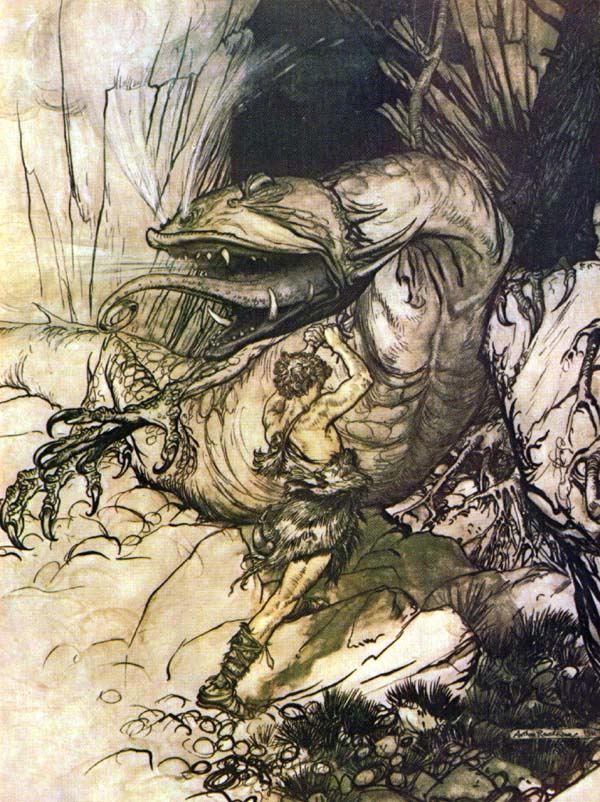
Siegfried and the dragon
Siegried slays the dragon, in an illustration by Arthur Rackham. This is one of the set of illustrations for Wagner’s Ring operas that fascinated C.S. Lewis as a boy.

An article at Wonders and Marvels suggests that the legends of medieval dragons in Germany, most particularly that of Siegfried the Dragonslayer, may arise from fossil tracks still visible in that country.

Notably, conspicuous fossil trackways of two types of massive dinosaurs are found in Germany. In 1941, the German paleontologist H. Kirchner speculated that observations of Triassic dinosaur tracks in sandstone near Siegfriedsburg in the Rhine Valley of western Germany might have been the inspiration for the legend about the dragon Fafnir’s footprints.

I share this, of course, purely for your amusement. All sensible people know that dragons survived in Europe well into the early medieval period, when they were slain by Christian saints.

Hat tip: Mirabilis.

Writing report, 2/1/17

Today was an unusual day, but not a bad one (which was fairly surprising. To me, it’s an axiom that Change is Bad).

I had to take a half vacation day, because it was the seasonal feast of the Sacred HVAC Inspection. The spirit of Natural Gas must be appeased, lest he smite the firstborn (that’s me) with carbon monoxide poisoning. Because this solemnity requires carving out a whole afternoon for the sake of about a half an hour of actual service, I figured I could do some writing. Somewhat to my surprise, I did.

My latest book is a challenge. I don’t know if I just got out of the habit of novel writing during my 2 ½ year detour Through the Looking Glass (i.e., in academia), or if I’m just getting old, my eye dimmed and my natural force abated.

But this week has been good. I’m facing one of those plot intervals that I hate. You’ve got a Big Event coming up (in this case an actual historical event that I can’t move around), and a space of time to fill leading up to it. Various plot threads need to be developed in that space, but it’s like building a bridge across a broad canyon – there’s a big space to fill and not a whole lot of attachment points.

But I’ve been working manfully on bridging that space this week, and – not easily, but steadily – I’ve been making progress. “Having once got my method by the end,” as John Bunyan said, “then ever as I pulled, it came.” The pulling can be hard, but the story is coming. And I think some of the stuff isn’t bad.

I’ve got a long way to go, though.

New ‘Viking’ trailer

I’m weary of the world tonight. Can’t think of anything to write that I wouldn’t regret tomorrow.

So here’s the latest trailer for the new Russian Viking movie. My reenactor friends complain that the costumes aren’t accurate, but in my view they look punctilious compared to the costumes on the History Channel.

The latest news I’ve seen says international rights have been sold, but there’s been no announcement of a US release date.

‘The Unexpected Enlightenment of Rachel Griffin,’ by L. Jagi Lamplighter

The Unexpected Enlightenment of Rachel Griffin

I am manifestly on record as mistrusting a) books by women (in my experience they tend to do male characters badly), and b) modern Christian fantasy books (because by and large they are amateurish).

The Unexpected Enlightenment of Rachel Griffin by L. Jagi Lamplighter is both. And I loved it.

So sue me.

A kind of cross between Harry Potter and The Chronicles of Narnia (with just a tincture of Jane Austin), The Unexpected Enlightenment takes us to a world where, familiarly, a school of sorcery exists out of sight of the ordinary (here called Unwise) world. But there are differences – one being that, although the culture is recognizably like ours, nobody has ever heard of monotheism.

Rachel Griffin is the daughter of an English duke who is an important official in the Magical World. She is sent to Roanoke Academy for the Sorcerous Arts, which exists invisibly on an island in the Hudson River in New York. Rachel is a gifted child, younger than the other freshmen. She has never had serious friends, and dreams of acquiring real ones, like in the books she reads. She also hungers for knowledge – any and all knowledge. One of her gifts is a photographic memory.

At Roanoke she does make friends – and some Mean Girl enemies. Her friends include an Australian (!) princess, a boy who slew a dragon and sleeps on a bed of gold, and an aspiring reporter. Rachel’s memory gives her an advantage most magicians lack – when she reviews her memories, she can see invisible things that she missed the first time through. By means of this power, she is able to identify sinister, magical activities, and manages to save a friend from an assassination attempt. Trying to figure out the reason for this crime sets her on an investigation of mysterious currents moving beneath the surface of the school’s day by day activities. Eventually she realizes that something very big and very bad is being planned by someone… even as she falls for a handsome upperclassman… who may be evil. Continue reading ‘The Unexpected Enlightenment of Rachel Griffin,’ by L. Jagi Lamplighter →

‘Conan the Barbarian,’ by Robert E. Howard

Conan the Barbarian

Is it possible to be a great writer without being a good writer? I guess it depends on what you mean by great and good.

I consider Robert E. Howard one of the great fantasy writers, on a level lower than Tolkien but higher than most of the others. And yet his writing has many, many weaknesses. The whole, however, is greater than the sum of the parts.

Like most Baby Boomer Howard fans, I first discovered Conan – warrior, thief, pirate, mercenary, and king – through the old Lancer series of paperbacks, most of them with amazing Frazetta covers. That series printed all the Conan stories in what the editors considered proper biographical order. What purists don’t like about them is that the publishers, sensing a cash cow, padded the series out. Unfinished Conan stories were “completed.” Non-Conan Howard stories that could be wedged into the timeline were rewritten to make them Conan stories. And they added pure pastiches done by the editors.

This present collection, Conan the Barbarian, takes a bibliographical approach. All the Conan stories published in Howard’s lifetime are here, in the order published. That means that we begin with two stories of Conan at his pinnacle, as king of Aquilonia, then turn aside to a number of stories about his earlier adventures, and finally conclude with the novel The Hour of the Dragon, a last tale of King Conan (and in my opinion the best Conan story). The collection concludes with Howard’s essay, “The Hyborian Age,” in which he explains the rise and fall of the imaginary prehistoric world in which Conan lived, loved, and slew. Continue reading ‘Conan the Barbarian,’ by Robert E. Howard →

On quoting the Old Testament

The refugee issue is one that perplexes me. I recognize the Christian duty of hospitality, and the Old Testament injunction to welcome the stranger and the sojourner.

But I’m not entirely sure the biblical situation is exactly analogous to our own. I’m not sure the Lord intended the Israelites to go out and bring in thousands upon thousands of Amalekites. And I’m pretty sure He never meant the welcome to expand to the point it has in Europe, where the strangers and sojourners are inexorably replacing the indigenous people.

I could be wrong, of course.

But what really surprises me is the liberal Christians I see on Facebook, who post Old Testament verses in support of their position.

Wh-what?

These are the same people who, for decades now, have been telling me that if I appeal to the Old Testament on any moral issue, I’m rationally obligated to stone people to death for wearing blended fabrics.

Have they noticed that they’ve just demolished 75 percent of their religious argument for homosexual marriage?