All posts by Lars Walker

Lessons of history

Purim
Illustration by Jim Padgett, courtesy of Sweet Publishing, Ft. Worth, TX, and Gospel Light, Ventura, CA. Copyright 1984, under Creative Commons license, CC-BY-SA 3.0

I was thinking about the Book of Esther.

You know the story – the orphan girl selected for the king’s harem, how she gained his favor and used it to reveal a plot to annihilate all the Jews in the Persian Empire. Thus saving her people.

But what particularly struck me was the means by which her people were saved.

The king’s law could not be revoked. Haman’s edict allowed anyone in the empire to kill the Jews and take their property, and that edict had to stand.

But Esther got permission for her uncle, Mordecai, to enact a counter-law:

“And he wrote in the name of King Ahasuerus… saying that the king allowed the Jews who were in every city to gather and defend their lives, to destroy, to kill, and to annihilate any armed force of any people or province that might attack them….”

You often hear people say, “Violence never solves anything.” It’s a stupid statement, demonstrably false. Jews, especially, ought to understand this. It wasn’t peace that saved the Jews. It was the basic human right of self-defense. The Jews of Persia weren’t frightened by their enemies – once they knew they were allowed to fight for their lives. “Just give us swords, and leave the rest to us.”

“And in every province and in every city, wherever the king’s command and his edict reached, there was gladness and joy among the Jews, a feast and a holiday.”

And the Jews have been celebrating it ever since – every Purim.

Distinguished medical care

Odd what you turn up when you’re doing research. I’ve been gathering some information for the seminary at work, and I ran across a name that tripped a memory switch. And thus I learned a little more about a chapter in my own family’s history – a Walker brush with fame. Or eminence, anyway.

When I was growing up, I often heard stories about the struggles my dad’s family endured. They suffered many shocks, both in finances and health. Dad lost a brother (born with a heart defect) and a sister (died of complications following appendix surgery). And my grandfather suffered all his life from a spinal injury he received as a young man. Through all these travails they were cared for by the family doctor, referred to with hushed respect as “Dr. Hanson.” Dr. Hanson, I was told, invented a specialized surgical tool in order to operate on Grandpa’s neck. Grandma saved a letter of condolence he wrote after the death of my aunt. Apparently he did a lot of his work for the Walkers with little payment, or at least with delayed payment. “He even,” they said, “discovered some kind of hormone.”

And it’s true. He did discover some kind of hormone. I found the record.

Dr. Adolph M. Hanson (I can’t find his biographical dates now, but as I recall he died in 1957) was the grandson of Pastor Østen Hanson, first pastor of my home parish. In 1923, he discovered the parathyroid hormone in his home laboratory in Faribault, Minn. This article tells about it.

One of these scientists was Adolph Hanson, a small-town doctor from Minnesota who conducted his experiments in a makeshift lab in the basement of his home. Hanson reported in 1923 that, using cattle parathyroid glands he had collected from a slaughterhouse, he had isolated the active compound from the parathyroids that can prevent the convulsions that occur when these glands are removed from dogs. The renowned Canadian biochemist James B. Collip independently isolated the same active extract in 1925…

My late great-aunt told me that one of her sisters had made a concerted effort to get Dr. Hanson as a husband, but he failed to succumb.

I may have even met him. I expect he would have attended Grandpa’s funeral. But I don’t remember him.

Not neutral

Over the weekend, one person I don’t approve of killed a lot of other people I don’t approve of.

That doesn’t make me happy.

The reasons for my disapproval of the groups are beside the point at a time like this. People are grieving. Real human beings have lost their lives, or been crippled or maimed for life. To talk doctrine just now would be un-Christlike.

But I’m angry nonetheless. I’m angry because further lives have been lost to the worthless, statist institution of the Gun Free Zone.

Orlando isn’t a case of equal and opposite evils. The moment any person takes it upon himself to murder defenseless people, he automatically becomes the Greater Evil. Decent people will all side against him. I hope.

Some of my Facebook friends have been posting graphics supporting a group called “Pink Pistols.” Its purpose, I gather, is to encourage members of the homosexual community to take responsibility for their own safety through arming themselves.

That’s one “gay” initiative I can support wholeheartedly.

I take it as a given that one of the threats this group was originally organized to counter was the threat of people like me. Conservative Christians. Well, you know what? If some conservative “Christian” actually decides he’s got special license from God to murder people because he disapproves of their sins, he deserves the pink bullet he’ll get for it. Let him explain to Jesus how he justifies flouting the greatest commandment for the sake of a lesser commandment.

Meanwhile, may God have mercy.

‘The Last King’

I figure I’d better share this film trailer with you, though I’m a little torn. I shall explain below.

The story of the Birkebeiners and the little king is a classic set piece of Norwegian history. The Birkebeiners were a political party/fighting group, mostly based in northern Norway. Baby King Haakon Haakonsson (his actual patrimony is somewhat in doubt, but that was more the rule than the exception in Norway during the dynastic wars) was spirited over the mountains by two faithful retainers on skis, to save his life from the forces of the Bagler party. In time he survived to be king and end the civil wars.

The Birkebeiners (birchlegs) got their name from a legend that they were so poor at the beginning that they had to wrap birch bark around their legs for warmth in the winter. The Bagler party, which had its strength in the south, was more aristocratic and was allied with the church. “Bagler” comes from the word for a bishop’s crosier.

I personally have long had Bagler sympathies, as one of their leaders was a nobleman who lived at a place where some of my ancestors came from. Thus I like to think he was an ancestor.

On the other hand, Haakon Haakonsson built the big stone church at Avaldsnes, where my great-grandfather was baptized. So I guess I can suspend my partisanship for a couple hours and see this movie.

Coming June 17. It won’t be in a lot of theaters, but it will be available on Netflix.

‘The Song of the Mockingbird,’ by Bill Cronin

There are some books you read, and you salute the author’s intentions. But you have to conclude that his reach exceeds his grasp. So it is with Bill Cronin’s The Song of the Mockingbird.

The book opens in 1995, when bestselling author Jack McNamara’s life is falling apart. His creativity has been blocked for months, and a publisher’s deadline is fast approaching, after which he’ll have to return a million dollar advance. On top of that his wife, whom he loves, has left him. To prove to her he’s trying to solve his problem, he sees a therapist, who tells him his problems seem to center on the summer of 1961, when he was a young teenager.

1961 was a whiplash year for Jack. He sold his first short story, to his mother’s great pride. He suddenly learned he had a half-sister, who moved in and quickly became his best friend. And he acquired a girlfriend.

Then his hero, Ernest Hemingway, committed suicide, fulfilling a prophecy made by his emotionally abusive father. And his half-sister left suddenly, without explanation. And he lost his girlfriend due to a horrible crime.

Jack returns to his childhood home, Hollywood, Florida, to try to pick up the threads of the past and learn what really happened, what secrets were hidden from him.

I appreciate the attempt author Cronin makes with this book. But the novel we have is not the novel he’s trying to deliver.

First of all, when a narrator tells us he’s a bestselling author, and that Hemingway is his hero and role model, he needs to write a book that’s Hemingwayesque. The Song of the Mockingbird is not Hemingwayesque. Cronin is too wordy, too inexact with his word choices. His prose, especially his dialogue, does not snap with perfect lines as Hemingway’s does. He fires a verbal shotgun, not a rifle.

Also, an intended Big Surprise about 2/3 of the way through was obvious to me a mile off. And the book’s characters display conventional (for our day) reverse sexism – of the three male characters in a female-dominated book, one is a black man (who obviously gets a pass), and another is sheer stereotype, more bigoted than Archie Bunker. Every female is admirable.

I was interested enough in the story to read it through to the end. But I’m not interested enough to buy the two sequels. Nice try, but this is not a successful work.

‘Once Was Lost,’ by Matthew Iden

Once Was Lost

This is the latest Marty Singer novel, and it just came out. I grabbed it right away. I’m enjoying this series by Matthew Iden, and Once Was Lost doesn’t disappoint.

Marty Singer, ex-Washington DC cop and cancer survivor, gets asked for a favor by his adopted daughter, Amanda. She works at a women’s shelter, and a guy who’s been doing handyman work there needs serious help. He was a low-level gangster, but he decided to testify against his boss, who’s also his uncle. Then he was betrayed, and he barely got away alive with his son when his police protectors were murdered. Now he’s had enough of gangsters and cops. He wants to run away and disappear. Can Marty help him? Can he keep the father and son safe from both the crooks and a (possibly) corrupt US marshal?

Well, it’s not easy. And Marty doesn’t much like his new “client,” Tommy Donlan, who’s arrogant, whiny, and ungrateful. But his kid is nice, and Tommy’s genuinely devoted to him. So Marty, along with Amanda, his girlfriend, and a computer geek buddy, gets to work trying to disappear Tommy.

It works. And then there’s a twist, and he needs to find the guy he’s helped to vanish.

As always, author Iden writes a tight, gripping tale. A particular excellence of this book is his development of the character of Tommy. Tommy’s very off-putting, but Iden skillfully gives him just enough humanity to make us root for him. It’s interesting that a book called Once Was Lost includes a character named Grace. There’s grace in this story, but also many reversals and surprises. Amazing, you might say.

Cautions for language. Recommended.

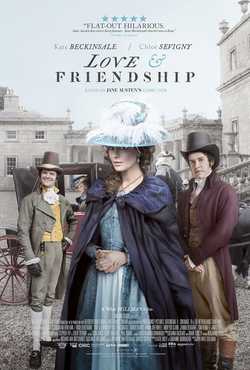
Film review: Whit Stillman’s ‘Love & Friendship’

Love & Friendship

I am fond of Jane Austen, though I’ve only read two of her novels. I’m a huge fan of Whit Stillman. So when I review his latest effort, Love & Friendship (which looks like it might be the big hit he’s deserved for so long) my perspective is that of viewing Austen-land from Stillman-land. This is probably fairly unusual.

People have noted the similarities between Stillman’s work and Austen’s books from the beginning. Metropolitan, his first movie, is self-consciously Austenian, a point paradoxically emphasized by the main character’s insistence that he’s never read Jane Austen because he prefers to read literary criticism of her. That’s an exquisitely Austenian comment on Austen.

And that’s what we also have in Love & Friendship, based on an Austen novella, Lady Susan. It’s meta-Austen. It tells its story, comments on the story, and laughs gently at its comments. It’s a lot of fun. It might be the perfect movie through which to introduce an intelligent consumer who’s not familiar with Austen’s work (I’m sure there are such people; I’m almost one of them) to her world.

Lady Susan (Kate Beckinsale), the main character, is “the most notorious flirt in England.” A young and beautiful widow, we meet her in a silent-movie preface (with subtitles) in which she is driven from the home of a relation, having broken hospitality by seducing the man of the house (she thinks this response shockingly unjust). She then goes to stay with other relations, where she attempts to win a handsome younger man as her own husband while scheming to marry her virtuous daughter off to the stupidest man in England, James Martin (Tom Bennett). Bennett’s scenes are the funniest in the movie – he’s Wodehousian in his affable ignorance. He’s certain there are Twelve Commandments (general ignorance of the Ten Commandments is a running joke in this movie – a comment, I assume, on our own times). Lady Susan is Donald Trumpian in her invincible self-regard and lack of concern for the feelings of others. She’d be unbearable if forces of cosmic justice, acting behind the scenes, didn’t conspire against her machinations – something she would deeply resent if she were aware of it.

I liked Love & Friendship a lot, and suspect I’ll like it more when I’ve seen it a few more times (which I’m sure I will). I was pleasantly surprised by the crowd at the showing I attended – much larger than I expected, and mostly gray-haired, people who I suspect don’t go out to the movies much anymore.

Highly recommended. Not for kids, because much of the humor is sexually sophisticated (though not smutty at all), and because the vocabulary hovers at a high altitude.

Taking liberties with realism

Our friend Loren Eaton at I Saw Lightning Fall exegetes the ways the Daredevil series improves its storytelling by getting the real world wrong:

Here’s the interesting thing, though: While all these examples might falter on the ground of plausibility, they do yeoman’s work in developing both characters and plots, in advancing scenarios and revealing personal peculiarities. When Kingpin calls Vanessa on the carpet for concealed carry, viewers learn that she’s not some ingénue, but rather an empowered woman with her own ambitions: “We’ve been sitting here talking for hours, and you’re going to insult me like I have no idea what you really do? … I know you’re a dangerous man. That’s why I brought a gun to a dinner date.”

Read it all here.

‘Punctured,’ by Rex Kusler

Punctured

Rex Kusler shows promise as a mystery writer. Punctured is the first in his Las Vegas Mystery series.

The hero is Jim Snow, a former Las Vegas police detective who left the job to become a professional card player. But he’s had an unlucky streak recently and is thinking about other possibilities. Then he gets a call from his sister Karen, who also lives in Vegas. Her husband has been murdered, and she knows the police suspect her and her (male) neighbor.

Jim has never been all that close to Karen, but he agrees to help. With the assistance of a woman cop and a homeless man, he starts sorting through a tangle of motives and scenarios.

Author Kusler has the talent to be a good novelist, I believe. He writes a good sentence (most of the time), and knows how to stage a good scene. His problem is character development. His way of revealing his characters is to have them spill their entire life stories, with or without prompting, the minute they first appear. It stretches credibility the first time, and becomes funny when repeated again and again.

There are several books in this series now, and one hopes the author has improved his technique. I’d be inclined to try the next book, but there was one scene of fairly heavy-handed feminism that put me off. But Punctured isn’t a bad book, if you overlook the character development problem. Cautions for language, but it’s not terribly bad in that regard either.