All posts by Lars Walker

Grousing about a TV show

I think I told you that my classes resumed last Monday. I wrote that in good faith, but in fact they start tomorrow. I got another week of freedom I hadn’t planned on.

I’ve used my winter break for a number of different purposes. There was the ordinary Christmas stuff. I did another revision on my translation of a book on Norway in the Viking Age, because the text I delivered to the publisher was a rough draft, and it’s been nagging at me. To my surprise, after I delivered the revision, the publisher told me they’re probably going to go ahead with it. Most gratifying.

And then there were Christmas cards. And then there was taxes.

But I’ve loafed a little. Last night I watched a new TV show called “Backstrom.” Wikipedia tells me that it’s an Americanized adaptation of a series of Swedish detective novels. It stars Rainn Wilson, best known from “The Office.”

It was horrible. Or so it seemed to me. I kind of tuned it out after the first 15 minutes or so. Possibly it picked up while I wasn’t paying attention.

Comparisons to “House” come to mind. House was a rude and irascible genius. Backstrom is supposed to be the same.

But House had one thing this show lacked — wit. You couldn’t help liking House a little, most of the time. He was funny. He was obviously in physical pain, which made most of us cut him a little slack. And he had people around him — notably Dr. Wilson — who put up with his act because they had a history with him and had reasons (often opaque to us) for valuing him.

Backstrom has none of that. He’s just a jerk.

Memo to Hollywood: Being a jerk in itself is not the same as being interesting.

I review ‘Saint Odd’ at The American Culture

I’ve got a review of Saint Odd, the final Odd Thomas book, over at Liberty 21’s The American Culture blog today.

If you’ve read the novels (and for heaven’s sake, if you haven’t read them, don’t start with this one. Start with Odd Thomas, and read them in order), you know what I mean. We all knew it was coming. There is no surprise in it.

But be comforted. All is well. All will be well.

‘The Name of the Wind,’ by Patrick Rothfuss

Over Christmas someone suggested I read Patrick Rothfuss’ The Name of the Wind, first installment in the Kingkiller Chronicles, saying that all the young fantasy fans are talking about it these days.

They could be talking of worse things.

The Name of the Wind is a fantasy, of a refreshingly original sort. It’s similar to the Harry Potter books, but more mature in orientation.

The hero is Kvothe, literally a legend in his own time. World famous as a musician, a warrior, and a magician, he has retired from the world when we meet him in this book, keeping an inn in a remote town. When the character called the Chronicler encounters him, he doesn’t recognize him at first. But when he does, he manages to persuade Kvothe to tell him his life’s story so that he can write it down. Three days are reserved for the project, and each day’s narrative forms the text of one book in the series.

Kvothe tells us of his childhood as a traveling player, the tragedy that takes his family away, his years as a beggar, and at last his acceptance at the University, the greatest learning institution in a world where magic and technology are just poles on a single continuum.

There he makes friends and enemies, reconnects with the love of his life, breaks many rules, and begins to acquire the reputation that will make him the greatest figure of his time.

Fascinating, well written, and well-charactered, The Name of the Wind is very good reading. The author may take the story in ways I don’t like in the future, but for now I liked what I read.

Generally suitable for teens and up.

‘A Companion to Beowulf,’ by Ruth A. Johnston

A few days back I posted a review of a book on the Viking Age which had disappointed me. Author Ruth A. Johnston, who happens to be a Facebook friend, then mentioned her own book on Beowulf, which I’d already read. I hadn’t noticed that it came from the same publisher.

Ruth’s book, A Companion to Beowulf, is much, much better.

A Companion to Beowulf is, as you would expect, an introduction to the poem, useful for students or history buffs or Tolkien fans. It’s well written and comprehensive, and includes a list of modern adaptations, a glossary of names, a list of works cited, and even a chapter on Tolkien.

For some reason, she fails to note my theory, mentioned on this blog, that Beowulf is “refugee literature.” I’ve also been inclined to give credence to theories that Beowulf’s “Geatish” tribe may have been someone other than the Gotlanders. Johnston states flatly that they were Goths. But that may be because she knows more about the subject than I do, hard as that may be to believe.

I did catch what I think are couple small errors. She says the spear was the symbol of a free man — I’m pretty sure it was the seax. A spear is what a slave would be most likely to carry. She also speaks of Vikings wielding “two-headed fighting axes.” That should be “two-handed fighting axes.” They never fought with double-bitted axes.

But those are the sort of small mistakes you’ll find in any book — even mine. All things considered, this is an excellent introduction to a wonderfully alien work of literature. I recommend it.

I review ‘Treasure Planet’

Another day, another review. I reviewed Hal Colebatch’s novel, Treasure Planet, for the American Spectator.

The Jim Hawkins character here is Peter Cartwright, a young man who helps his mother run an inn in a remote part of Wunderland. The appearance of Captain Skel, a demanding and dangerous old space-farer, sets off a plot whose general outlines will be familiar to any Stevenson fan. Long John Silver here is “Silver,” a Kzin with a prosthetic leg, and instead of a ship we have, of course, a spacecraft. The treasure in this book is not gold, but an alien library full of technological information left behind by a long-extinct species.

Read it all here..

Presence of ‘Malice’

They’ve revamped our friend S. T. Karnick’s The American Culture blog, and I’ve finally found a minute to write a book review for them. It’s a review of Keigo Higashino’s Malice.

That seems straightforward enough, but Detective Kaga is unsatisfied. The confession has minor holes, ones that nag at him. Gradually, as one peels away the layers of an onion, he works his way down to Nonoguchi’s true, secret motive.

Read it all here.

‘Viking Age: Everyday Life During the Extraordinary Era of the Norsemen,’ by Kirsten Wolf

[Personal note: I apologize for my continued absence from this blog. I thought I’d be doing more blogging while I had a few weeks of winter break, but I scheduled myself a number of projects, and they’ve taken more time than I expected. And now I’m just a week away from classes again. lw]

I approached Kirsten Wolf’s book, Viking Age: Everyday Life During the Extraordinary Era of the Norsemen, with anticipation. For years a book with a similar job description, Jacqueline Simpson’s Everyday Life in the Viking Age, has been a standard for Viking buffs and reenactors. It’s well-researched, readable, and useful. But it’s old now, and we’ve learned a lot since Simpson wrote. We need a new book in that vein.

This book is not it.

That’s not to say it’s worthless. I’ll admit I learned some things reading it. But I’m not as sure of those things as I’d like to be, because the book contains too many “facts” that are just plain wrong.

The author states twice that the Battle of Svold took place in Norway (it took place in the Baltic). She states that Olaf Tryggvason was the great-grandson of Harald Fairhair (historians aren’t sure nowadays). She says that Olaf Tryggvason made the Greenlanders accept Christianity (no historian believes that anymore).

Most of the gross mistakes seem to be associated with King Olaf Tryggvason’s career. Perhaps the author’s reading has been deficient in that area. Prof. Wolf teaches Old Norse literary studies at the University of Wisconsin, Madison. I hesitate to criticize a professor in a university system in which I am a student, but she seems weak on material outside her specialty. I suspect the book was a rush job, probably done under deadline.

A special weakness of this volume is the illustrations. The book is lavishly illustrated, but most of those illustrations are worse than useless, except to fill up pages. The publishers opted for copyright-free pictures whenever possible, which means we are treated to a feast of 19th Century engravings, with horned and winged helmets and classical poses. In a book which fails to even mention the Cardinal Truth — “No horned helmets!” — this is inexcusable. Newcomers to the field will come away with a bundle of misconceptions.

Jacqueline Simpson’s book was illustrated with simple and useful line drawings that depicted actual archaeological finds. But hiring artists to do that sort of thing costs money, which the publishers of Wolf’s book were apparently unwilling to spend.

Not recommended.

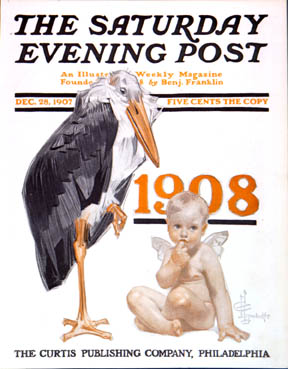
New Year, whether we like it or not


Illustration by J. C. Leyendecker

The Walker Christmas was celebrated this past Saturday, at my palatial home of Blithering Heights. This was timely in meteorological terms, since the earth, though appropriately hard as iron (or at least hard as lead), was bare on Christmas day, but plentiful snow fell on Saturday morning, auguring well for our celebration. Even more than the fortune cookies at the Chinese restaurant where we adjourned for lunch, in traditional Norwegian fashion.

And now the New Year approaches, like the Avenger of Blood in the Pentateuch. I feel more at home with the New Year as I grow older, probably because I come more and more to resemble the New Year’s baby. My festivities are taking the form of a few days off from work, working instead on a translation project while I have a little time off from grad school. My new year’s resolution is to spend less time relaxing. Prospects appear good.

Ah, 2015. God willing, it will be the year I’ll complete all my course credits, leaving only the Comprehensive Tests to be gotten through — some time in early 2016, I suppose. But just finishing class work is enough to give me a future and a hope. All my friends are retiring, it’s true, but everyone knows you retire and you drop dead the next day. At this rate I’ll live forever.

Have a blessed calendar change.

“Hark, the Herald Angels Sing”

A blessed Christmas to you all. Here’s Sissel with what I think is my favorite Christmas hymn. We sang it in church tonight, complete with the old lyrics: “Pleased as man with man to dwell,” “Born to raise the sons of earth,” and all that. I felt like I’d gotten a Christmas present. I punch those lyrics when I sing them.

If anyone needs me, I’ll be in my pod

I understand how you feel. Through all the hectic activity, the parking and the shopping, the glitter and the tinsel, one thought has nagged at you. “This would be a perfect Christmas season,” you think, “if only I could hear Lars Walker’s voice.”

Well, your Christmas wish has come true. Derek Gilbert of View From the Bunker recorded an interview with me, and you can listen to it here.

God bless us, every one.