All posts by Lars Walker

I'd know him anywhere

My favorite Christmas gift this year may have come from a total stranger. Digital artist Jeremiah Humphries produced the above drawing of Erling Skjalgsson, apparently, on a whim.

I like the use of light to suggest the hearth fire in the hall.

These are the moments that suggest to a writer that he hasn’t entirely wasted his time.

For more information on Mr. Humphries’ art, check out his blog.

.

Vitae Lux

Today is St. Lucie’s Day, celebrated every year in Scandinavia (especially in Sweden) with morning processions of young girls, led by one special “Lucia” who wears a crown of candles. The video above is from Sissel’s televised Christmas concert with the Mormon Tabernacle Choir a few years back. Unfortunately for you, this is the Norwegian TV version, so her introduction is dubbed in Norwegian, which you probably can’t understand. But trust me, she’s talking about St. Lucie’s Day. The video’s also a little misleading, because the song she does here isn’t the traditional song for the ceremony, “Santa Lucia” (yes, the Italian one). But it’ll give you some idea of the thing. And it’s always nice to hear Sissel sing, whatever she does.

Happy Luciadagen!

On the other side of 'Jorden'

Every Viking reenactor, unless their given name is something like Ulfljotr Bjørnhjaltrsson, needs to choose a Viking name. My first name was easy to figure out — “Halvdan” means “half Danish,” which is close enough for a Norwegian with one Danish grandfather. But for my last name (or patronymic, properly) I was thinking of using “Jordensson.” Because my father’s name was Jordan. I shall explain the spelling discrepancy.

My grandmother once told me she named my dad after a guy she knew growing up in Iowa. I assume that guy’s name was Jorden, which is a respectable Scandinavian name not related to the biblical river in any way. This guess is reinforced by the fact that, although Dad’s birth certificate (which I have somewhere around here) says “Jordan,” his baptismal certificate (which I’ve also got) spells it “Jorden.”

My problem is I’m not sure if Jorden is a Viking Age name. I did a little web searching, in English and Norwegian, trying to find the history of the name. How far back it goes.

To my surprise, it’s not listed in any of the Norwegian (or Danish; I checked) name lists. There’s one list which claimed to have every name carried by more than three people in Norway, and Jorden didn’t make it.

There are three guys named Jorden in America. A name search that came up told me so. But not in Norway.

So the name has gone out of fashion to an amazing degree in its homeland. This might have to do with embarrassment. “Jorden” means “earth” — in the senses of both the planet and dirt. Also it’s pronounced “urine,” which is awkward for English speakers. Which most Norwegians are nowadays.

Still, it amazed me.

Public service announcement

I figured it all out today. I was talking to a fellow in the library, and I got onto my little speech (which I’ve given in this space before) about the big difference between English and German.

German is famous for long, long words. But those words can be broken down into their constituent parts and analyzed by any moderately educated German speaker. This gives the language tremendous precision.

In English, our long words tend to be borrowed from Latin. And hardly any of us speak Latin anymore. So most of us don’t know what our long words mean.

This has contributed tremendously to the obfuscation of our discourse.

It makes it possible to sound very intelligent in English without making any sense whatever.

In other words, it has given us modernism.

So all we have to do to reclaim the culture is to start teaching Latin again.

There, I’ve figured it out. I leave it to you to work out the details.

An apology, and Baker

First off, I have to apologize and say that you’ll be seeing slow posting from me this week, or none at all. I have a major paper to write for my Library Science class, requiring my undivided attention.

Meanwhile, I direct you to our friend Hunter Baker, who posted a very thoughtful piece today on the minimum wage controversy, and Christian compassion in general.

During a recent visit to twitter, I happened across a post from a noted Christian academic. He had composed the kind of pithy remark which is tailor-made to launch a hundred admiring retweets. Paraphrasing slightly, it was something like this: ”Conservatives, don’t talk to me about family values if you doesn’t endorse a minimum wage increase.” I am sure that he thought it was a pretty high-powered zinger.

The problem is that there is no necessary connection between family values and increasing the minimum wage….

You’d better watch out


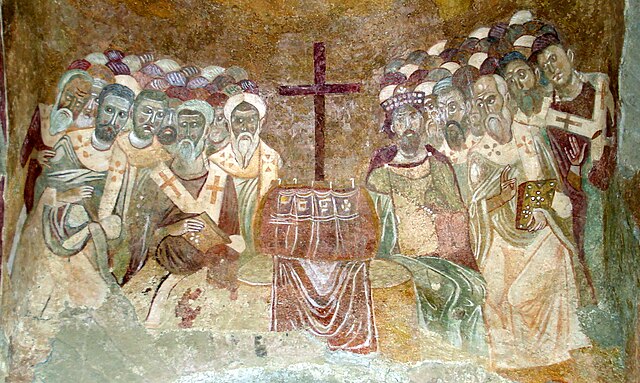
The Council of Nicea. I think St. Nicholas is the bald guy with the book on the right. Photo credit: Hispalois.

Our friend Dr. Paul McCain of Cyberbrethren quotes another friend of ours, Dr. Gene Edward Veith today, reprinting his classic account of Saint Nicholas (whose feast day is today) slapping the heretic Arius.

During the Council of Nicea, jolly old St. Nicholas got so fed up with Arius, who taught that Jesus was just a man, that he walked up and slapped him! That unbishoplike behavior got him in trouble. The council almost stripped him of his office, but Nicholas said he was sorry, so he was forgiven.

Dr. Veith goes on to make some constructive suggestions concerning new Christmas slapping customs we might adopt.

[Update: Due to the ever changing flow of the Internet, Cyberbrethren is no more. Here’s an updated article from Veith at The Lutheran Witness. Here’s an even more recent post referring to this article on Veith’s own blog.]

'The Ambushers' by Donald Hamilton


It made me feel kind of cheap The man was sincerely trying to kill me in a fair fight, and I was just setting him up for a bullet. Well, it’s not a chivalrous age, nor is mine an honorable profession. I wasn’t about to risk turning loose a wild man with an army and a nuclear missile because of some boyish notions of fair play.

For some time a cadre of readers has been clamoring for the re-release of Donald Hamilton’s 1960s Matt Helm novels, which have suffered from neglect, probably due in great part to the memory of those lame old movies with Dean Martin, which are as much like the original books as Paris Hilton resembles Conrad Hilton. Aside from the hero’s name and his cover identity as a photographer, the movies are nothing like the books. Matt Helm was often called an American James Bond in his day, and the comparison is a good one. He’s a tall, blondish fellow, a Scandinavian-American born in Minnesota(!). He works as an assassin for a super-secret American spy agency. My impression, on the basis of reading this one book, The Ambushers, is that the Helm novels are a little grittier than the Bond books (no tuxedos or casinos here), and just a tad more humane.

In this outing, we find Matt in a fictional South American country, setting up a sniper shot to kill a rebel leader, at the invitation of the local government. In the aftermath of his success, the government forces liberate a prisoner of the rebels, a female American agent who has been tortured. Back in the states, he finds himself ordered to go to Mexico to clean up a loose end from the previous job, and through a train of circumstances finds himself teamed up with the same female agent he helped rescue, almost reluctantly helping her to recover from the trauma.

I enjoyed The Ambushers very much, and have already bought The Death of a Citizen, which is the first in the series. Donald Hamilton was a writer of solid prose with a good sense of character and a mordant wit. Some mature content, but due to the age of the book it’s pretty mild by contemporary standards. Recommended.

'Three War Stories' by David Mamet


I do not understand that discipline called “Ethnography,” which seems to me the validation of a prejudice by means of an excursion.

One can no more understand the operation of other cultures from observation than can one so understand the sexual act.

Observation, in the case of each, is missing the point, and Ethnography, or “Anthropology,” rests on a false assumption: that one may be free of prejudice.

Hugh Hewitt interviewed David Mamet, the legendary playwright who has recently “come out” as a conservative, a couple weeks ago. They were discussing this book, Three War Stories. They concentrated on the first story of this collection, The Redwing, which Mamet described as a novella dually inspired by George MacDonald Fraser’s Flashman books and Patrick O’Brien’s seafaring novels. So naturally I had to buy it.

This is one of those profound, densely packed works that probably ought to be read multiple times, and I’ve only read it once. But I enjoyed it, particularly the iconoclastic elements, which are many. I’m just not sure I entirely grasp the themes.

The Redwing is a very complex story, ostensibly narrated by a former sailor, galley slave, and spy who later became the author of popular novels based on his own adventures. He does not tell his story directly, but as a series of commentaries on his books, with which he assumes the reader is already familiar. So we have to piece his real story together, in non-chronological fashion. Thus we’re dealing with a story on numerous levels – “factual” (though fictional) notes on a fictional work, based on supposedly factual events. This allows the author to play with the problems of the veteran who has a need to tell his story, but not all of it. He protects his country, first by risking his life, and then by concealing part of the truth from it.

Notes on Plains Warfare is an examination (which I thought extremely apt) of the dynamics of a war in which one side had a strong moral case, superior tactics, and greater resolve, but was crushed by an opponent simply more numerous, technologically superior, and more pragmatic. It is presented in the form of another memoir, by an American army survivor.

The last story, The Handle and the Hold, is a more matter-of-fact story, a little more linear than the other two, about two Jewish friends, a cop and a gangster, who join together to do a secret mission for Israel shortly after the end of World War II.

Definitely worth reading, but more work than the fiction I usually review. Cautions for language and mature subject matter.

'Mad River' by John Sandford

“He sort of looked mean, but in a hygienic, Minnesota way.”

Just recently I reviewed John Sandford’s more recent Virgil Flowers novel, Storm Front, and noted that that book’s light tone, and the fact that nobody got killed in it, typified the less serious quality of the Flowers books, as compared to Sandford’s hugely successful Prey novels.

After reading Mad River is a story about a killing spree in south central Minnesota towns, perpetrated by a trio of young losers – a couple on their way to nowhere and a slacker friend. Bureau of Criminal Apprehension agent Virgil Flowers is tasked with heading up the effort to stop them, and he’s desperately trying to keep them from getting killed by the local cops, not so much out of professional ethics as because he suspects a murder-for-hire angle, and he needs them to tell him who paid them.

The whole thing is pretty unpleasant. Sandford accomplishes the difficult task of making these stone killers somewhat sympathetic, but I’m not sure whether I’m grateful for that. There’s some humor, but it’s mostly the graveyard variety. The writing’s good, the characters well drawn and complex. But all in all it was pretty depressing.

Recommended on technical grounds, but I can’t say the book was much fun. Cautions for violence, sex, and language.

Addendum, 10:12 p.m.:
I just remembered what irritated me most in this book. At one point Virgil, addressing a group of people, uses the pronoun “Y’all.” This is absurd. Virgil is a native Minnesotan, speaking to other Minnesotans. We do not say “y’all” in these parts. I’m certain Sandford knows this. I can only assume the word was inserted by a New York copy editor.

Thanksgiving 2013


“Home to Thanksgiving” by Currier & Ives, 1867

“He who sits by the fire, thankless for the fire, is just as if he had no fire. Nothing is possessed save in appreciation, of which thankfulness is the indispensable ingredient.” (W.J. Cameron)

I’ve used that quotation for Thanksgiving before, but it was a long time ago. On the old web site, I think. Anyway, I like it.

It occurred to me today how closely thankfulness is connected to faith. One of the most common hindrances to faith—at least in my experience—is worry about the future. “Things are all right just now,” I say to myself, “but what about tomorrow? Being thankful feels too much like complacency. I have to keep my eye out for what’s coming down the road.”

This is one reason, I suppose, why Jesus tells us to cast no thought upon the morrow. Worry kills thankfulness, and lack of thankfulness destroys our spiritual perspective.

So have a blessed Thanksgiving. I hope you spend it with people you love. Or, alternatively, that you love the people you’re spending it with.