All posts by Lars Walker

Stuck on Pogo

Stefan Kanfer has warmed my heart with an affectionate article on the cartoonist Walt Kelly, and his comic strip, Pogo, over at City Journal.

I share Mr. Kanfer’s enthusiasm. Although Kelly was generally known as a lefty (though not an admirer of the Soviet Union, as Kanfer points out), the charm and sheer achievement of Pogo transcended politics. When I was a kid, vaguely hoping to grow up to be a cartoonist, I pored over his daily strips, and despaired of ever achieving anything like that masterful inking and character modeling, to say nothing of the preposterous, nonsensical humor. Imagine Bill Watterson (Calvin and Hobbes) collaborating with Robin Williams—while being possessed by the spirit of Lewis Carroll.

This furry, scaled, quilled, feathered, and shelled quintet was backed by a supporting cast of Dickensian proportions—more than 600 players, all told. They included Beauregard Bugleboy, a doggerel-loving canine; Miz Mam’selle Hepzibah, a flirtatious skunk; and Deacon Mushrat, a hypocritical mammal of the cloth who spoke in elaborately lettered Gothic script. (When an editor complained that such effusions were hard to read, Kelly replied, “Mighty hard to letter, too.”) There were also Molester Mole, a paranoid sneak; Seminole Sam, a fox who specialized in scams; and Bewitched, Bothered, and Bemildred, a trio of scruffy bats. Crowds of lesser players entered and exited, ranging from Sarcophagus MacAbre, a vulture and mortician in search of clients, to Tammananny Tiger, a corrupt politico. But the ursine P. T. Bridgeport outdid them all. Kelly drew his monologues as minuscule vaudeville broadsides, complete with pointing fingers, striped capital letters, and booming exclamation points—making it impossible, in the pages of this magazine, to replicate properly his “Don’t give this away, pal, but DRIVE-IN FUNERAL PARLORS COULD BECOME A LIVIN’ RAGE—quick, easy, curb service!!!”

I’m happy to report that Fantagraphics Publishing has brought out the first volume of a complete collection of daily and Sunday Pogo strips.

I’m eager to get mine. As soon as it comes out in paperback.


“The Professor!”

Today, as Phil has already noted, is the birthday of Prof. J. R. R. Tolkien (shown above as a 2nd Lieutenant in the English army in 1916), author of The Lord of the Rings and subcreator of the world of Middle Earth.

Somebody on Facebook called this his “eleventy-tenth” birthday, in the hobbit fashion. I’m not sure it shouldn’t be “twelftieth,” though.

It’s the custom of the Tolkien Society to promote a rolling, world-wide toast each year on this day, and certainly this year deserves a toast more than most. The instruction are here:

The toast is “The Professor”.

For those unfamiliar with British toast-drinking ceremonies:

To make the Birthday Toast, you stand, raise a glass of your choice of drink (not necessarily alcoholic), and say the words ‘The Professor’ before taking a sip (or swig, if that’s more appropriate for your drink). Sit and enjoy the rest of your drink.

Oddly enough, the notice doesn’t mention the time, but 9:00 p.m., wherever you happen to be, is customary.

Tolkien is often (and correctly) credited with making the fantasy genre respectable. But I think he may have accomplished one more thing. At a time when the whole western tradition was coming under attack, he elevated a part of that tradition so obscure few had even bothered to undermine it (the Anglo-Saxon age), and made it glamorous.

If western civilization survives, Tolkien may deserve much of the honor.

“Rise! Men of the west!”

Talented people

I am temporally at sea today, awash in the tides of chronology. My calendar tells me it’s Monday, January 2, but it doesn’t feel like Monday, January 2. That’s partly because although today is a holiday, it’s not January first (I suppose), and partly because of the energy drain caused by a weekend spent mostly with people. I spent much of this day certain I had a dentist appointment this afternoon, and it was only when my cell phone alarm failed to go off that I realized the appointment is actually for tomorrow. January two and twos-day; you can see how I got confused.

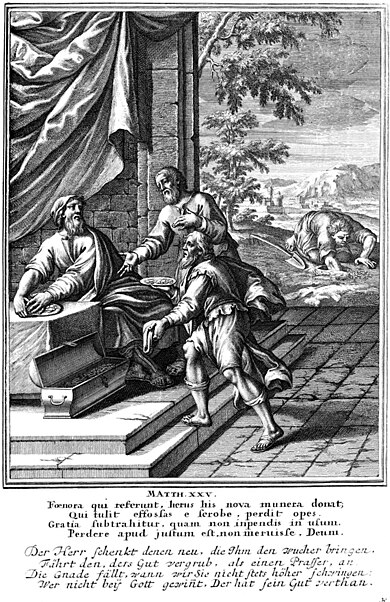
Time is the the great puzzler, God’s subtlest joke, in my opinion. And yet, it’s deadly serious. Take Jesus’ parable of the stewards and the talents (Matthew 25:14-30):

“Again, it will be like a man going on a journey, who called his servants and entrusted his property to them. To one he gave five talents of money, to another two talents, and to another one talent, each according to his ability….”

“Talent” is a Greek term for a sum of money, and our own English use of talent as meaning a special, inborn ability comes from an interpretation of that passage.

But although I wouldn’t go so far as to call that interpretation entirely mistaken, I think there’s a simpler meaning. I suspect the Lord’s intention when He spoke of the talents was simply “time.” Each of us is given some—some of us more, some less. But whatever we’ve got, we’re responsible for. We may complain that we have no great gifts or abilities, but we always have some time, up until the day we die. And we can choose whether to use that time constructively or not, boldly or cautiously. The real targets of the parable are people who are lazy and cowardly.

In other words, it’s directed precisely at me. As for any application to you, you may judge for yourself.

A blessed new year to you.

Film Review: "War Horse"

Stephen Spielberg’s new film War Horse is, as one would expect from a Spielberg production, visually gorgeous. The acting is excellent. The story itself, in my opinion, isn’t strong enough to bear the weight of a pony.

Based on a stage play based on a children’s book by Michael Morpurgo, the film opens in the lovely countryside of Devon, England, where young Albert Narracott (Jeremy Irvine), a farmer’s son, watches a thoroughbred colt being born, and attempts to make friends with it. Later his drunken father (pretty improbably) gets it into his head to buy the animal as a plow horse, and Albert trains it to work. Then setbacks force the father to sell the horse to the army (World War I has just begun), and we follow the horse’s experiences through the entire war, up to Armistice Day and beyond.

Although it was a delight to watch, I did not succeed in suspending my disbelief for one moment in the course of this (too long) movie. It’s a war movie from people who know nothing of war, and a horse movie from people who know nothing of horses (I happened to see it with a couple horse owners, and they got some good laughs out of it). I suppose I was supposed to learn a lesson about the horrors of war, but although there was plenty about that, it all seemed sterile and picture-bookish, and I never really identified with any of the characters. The lesson seemed to be, “Everything will work out for you, if you’re incredibly lucky, which chances are you aren’t.”

War Horse is a beautiful movie, suitable for older children (though there are disturbing scenes). But I brought nothing away from it except some pretty images.

Chicago Lightning, by Max Allan Collins

Max Allan Collins is probably best known for having written the graphic novel on which the movie The Road To Perdition was based. I myself know him as the author of a very fine mystery novel, True Detective, set in Chicago in the 1930s. Turns out he’s written more books about his Jewish-Irish private eye, Nathan Heller, that I didn’t know about. These include Chicago Lightning, a collection of short stories covering a period of about twenty years.

Nathan Heller differs from the standard fictional private eye in that he’s ethical but not technically “clean.” He does occasional, cautious business with organized crime, and those associations are often useful to him in his investigations. His relations with the police are about as equivocal, as some of them bear him a grudge for helping to expose some crooked cops in the past. The assumption throughout is that both groups are about equally corrupt. Continue reading Chicago Lightning, by Max Allan Collins →

Lancelot, by Walker Percy


Do you know what I was? The Knight of the Unholy Grail.

In times like these when everyone is wonderful, what is needed is a quest for evil….

“Evil” is surely the clue to this age, the only quest appropriate to the age. For everything and everyone’s either wonderful or sick and nothing is evil.

Honesty comes first. I’m not at all sure I understand Walker Percy’s novel Lancelot. I think I understand some of it, but it’s one of those books that I come away from pretty sure I’ve encountered something written for people smarter than me.

But it was a fascinating read, and I’ll tell you what I thought. For whatever that’s worth.

The main character and narrator is Lancelot Lamar, formerly the scion of a fine old Louisiana family, owner of a handsome estate, successful lawyer with a record of civil rights advocacy, and loving husband to a beautiful wife.

Now, as he narrates the text of this book, he is a patient in a mental hospital, having been declared insane after blowing up his home, killing his wife and her movie industry friends. His confidante is his friend Percival, a priest (or a former priest; it’s never made clear) who never contributes a word to the narrative. Continue reading Lancelot, by Walker Percy →

The Saga of the Nativity


“Journey to Bethlehem,” by Pieter Bruegel (1566)

[I thought it might be amusing to retell the Christmas story in saga style. The result is below. I’d intended to post this Christmas day, but got distracted.

This version includes some imaginary information not found in Luke’s account. This is because sagas are very different literature from the gospels, and the telling detail is a necessary part of the technique, even if you have to make it up. ljw]

There was a man called Joseph, son of Jacob, son of Matthan, one of the clan of old King David from Bethlehem. Joseph was an honest man, and very clever at building things. But he didn’t get on with his kinfolk, especially his brothers. One day he said, “I’m going to move up to Nazareth in Galilee. They talk strangely up there, but at least they talk sense, and there’s work to be had.” And his brothers said, “Don’t let us stand in your way.”

Now Joseph was promised in marriage to a girl named Mary, daughter of Heli, daughter of Matthat, also of the David clan, though they had kin among the priests. Mary was a beautiful girl, and very devout. Some people said she was too devout for her own good. One day when she was praying in the house all alone, a mighty messenger of God appeared to her, clad in mail that shone like the sun, and he said, “Hail, highly favored one! You are about to conceive a Son, whom you will name Jesus. He will be a hero, and will be known as Gudsson, and the Highest of All will set Him in the high seat of David, and He will reign over the Jacoblings forever.”

“How can this be?” asked Mary. “I am a virgin.” Continue reading The Saga of the Nativity →

In Norwegian we say, "God jul!"

I hope your Christmas was good. Mine was unusual, at least for me. I spent it with the young Norwegian relative I wrote of before, along with his mother, who came to America to be with him for the holiday. I took them to dinner on Friday evening. On Saturday afternoon we joined the family of one of my dad’s cousins, not too far from here, at one of their children’s homes. They have a very large family, so it was a rather different celebration than my less-fecund branch of the Walkers enjoys. But it was very nice, and everyone said they were glad we came. My lefse and pumpkin pie were received with appreciation.

On Sunday we went down to Kenyon, the old family seat, and we showed them the cemetery (where most of the Walkers in Kenyon are now to be found), our church (both the present one and the old stone one in the country), and the farm where my great-grandfather settled in 1915, after moving from Iowa. We also took them to the local nursing home, where they met Aunt Ordella, that great-grandfather’s sole surviving child. She’s 101.

I shouldn’t have been surprised, but meeting Aunt Ordella seemed to be the high point of the visit for the Norwegians. If I understand their comments correctly, they don’t see Ordella as only our oldest relation, but their own oldest relation too. They came to Minnesota in part to touch the lives of their grandparents and great-grandparents.

My branch of the Walkers will meet this weekend. Last weekend was impossible due to scheduling, and this way we can save money by buying presents in after-Christmas sales. At least that’s my strategy.