All posts by Lars Walker

Report from Minot: The fourth

Today is the last day of the festival, the most taxing day of all. Not only do we–for some reason I’ve forgotten–do four combat shows on Saturday, rather than three, but when it’s done tonight we tear down our camp and pack our vehicles for the trip home tomorrow.

One traditional aspect of Viking events for me is wondering (as I leave for the destination) what (not if I have, but what) I’ve forgotten. This year my big mistake was a conscious one. Conscious but stupid.

For years people have told me that I tend to overpack. So as I was leaving the house, I started to pick up my brief case and said to myself, “I don’t need this. I’ve got my laptop case. Don’t need both.”

Wrong, of course. I’d forgotten that the brief case held 1) some information on our next event that I was supposed to give to some people, and 2) the DVD of my book trailer, which I could have run on a continuous loop for advertising, if I’d thought to bring it.

As for my success in fighting, not very good. Didn’t win a single bout yesterday. Despite what Ragnar always says, youth and speed do frequently defeat old age and treachery.

Report from Minot: The third

Crowds are definitely down at Hostfest this year. The main cause, I think, is lack of accommodations for the large tour groups which usually show up. But spirits are high, or at least not low. Everybody seems to be happy that they’re carrying on with the festival at all.

My combat success has not been signal. After I did my first fight on Wednesday, I made the decision to switch to the battle axe as a weapon. It’s kind of ironic that I’ve become the designated axe man in our group, since I’m probably the most attached to the sword, emotionally, of all of us. But I’ve got the most training with the axe, so it’s up to me to figure out how to fight with the thing, and pass the information on. My problem is two-fold–plain unfamiliarity, plus the fact that I tend to lose my grip on the axe haft. I never lose my sword, unless I’m actually injured. But I have a hard time keeping the axe in hand with my protective glove on.

Did win one fight, though. There was also an interesting moment when my mighty axe blow embedded the weapon in my opponent’s shield so firmly that I couldn’t get it out again. Exciting for the spectators, though I got killed.

Ragnar’s hip is hurting him, so I’m mostly fighting with the boys, ages 15 and 19. Not bad for a 61-year-old coal chewer (a saga reference. Look it up).

Report from Minot: The second

The first day went well. Crowds were good (not great, but first day is generally light). My impression is that people in Minot may not have homes, but they tend to have money to spend.

Flood damage is particularly evident in the area around the fairgrounds, where the festival is held. Lots of houses with dirty water lines on the outside walls, ruined household junk piled outside. Some have FEMA trailers parked in the yards, but most are abandoned for the moment.

A restaurant we always used to patronize is boarded up and dead. Some traffic lights are out, and others no longer have left turn signals working, for some reason.

But the festival soldiers on. One thing I appreciate particularly is that a new group has joined the rotation at the Copenhagen Hall stage, around the corner from our Viking World. It’s a very impressive family band (seven kids) that actually does some music I like. I didn’t think such a phenomenon existed in the world anymore.

Report from Minot: The first

Can’t make the WiFi work from the Viking camp at the moment, but I’m making this quick post from a booth sponsored by SRT Communications (credit where credit’s due, and all that).

If you’re looking for work, I might suggest Minot. Jobs are going begging around here. There are three caveats to that statement of fact, however:

1. Once you get here, you’ll find out there are better paying jobs further west, where the oil boom is booming in a booming way. Which is one reason so many jobs are unfilled here.

2. Housing is very limited, due to flood damage.

3. North Dakota winters.

Nevertheless, for those looking for jobs and a decent community to live in, you could do a lot worse than Minot, North Dakota.

It’s about time for Hostfest to begin, so I’ll sign off for now.

Blind Pursuit, by Michael Prescott

I found Blind Pursuit by Michael Prescott a very satisfying thriller. It’s one of those out-of-print novels that has begun to show up cheap in e-book format. I’ve had some good surprises with those.

The main characters are twin sisters, Erin and Annie Reilly, one a psychologist and the other a flower shop owner, who live in Tucson. The action starts fast with Erin’s abduction in the night.

Because the author follows her in the car trunk after she is taken, I was worried I was going to have to watch her murder, and I was ready to drop the book if that happened (I have a low tolerance for the on-stage killing of women). But the kidnapper’s plans for Erin are much more complicated than a simple sex killing. His plot is almost (not quite) beneficent and admirable, and his motives are a complex tangle that gets sorted out strategically for the reader, the enlightenment increasing with the dramatic tension.

The characters intrigue, the suspense is genuine, and there’s even a nice twist at the end. Also there’s romance for the ladies.

I enjoyed Blind Pursuit, and recommend it for adult readers.

This is me, being flexible

A couple nights every week, my renter plonks himself down in front of my desktop computer in the dining room, and dominates it for a few hours around suppertime. Although he has his own computer and is on my network, he claims this old, slow Dell handles certain streaming downloads better than his does. So I have to wait, because I’m passive.

Tonight was one of those nights. It’s also bill-paying night on my schedule. And since I’m going to be gone next Thursday, I had to pay two weeks’ worth of bills. So I overcame my OCD enough to do the bills before I blogged, rather than after, as is my custom.

And this is what I blogged. Just to show you how flexible I am.

Numbering the dead

New estimates, based on U.S. Census data from 1870, strongly suggest that Civil War casualties totaled somewhere from 750-850,000, rather than the 600,000-plus figure used in history books for the last century and a half. According to this New York Times article:

The difference between the two estimates is large enough to change the way we look at the war. The new estimate suggests that more men died as a result of the Civil War than from all other American wars combined. Approximately 1 in 10 white men of military age in 1860 died from the conflict, a substantial increase from the 1 in 13 implied by the traditional estimate. The death toll is also one of our most important measures of the war’s social and economic costs. A higher death toll, for example, implies that more women were widowed and more children were orphaned as a result of the war than has long been suspected.

In other words, the war touched more lives and communities more deeply than we thought, and thus shaped the course of the ensuing decades of American history in ways we have not yet fully grasped. True, the war was terrible in either case. But just how terrible, and just how extensive its consequences, can only be known when we have a better count of the Civil War dead.

It should always be remembered that most of the casualties of the Civil War did not come from death on the battlefield, but from the inherent dangers of army life of the day. Accidents, illness, infections. “Just being in the army in 1861,” Bruce Catton said somewhere, “was more dangerous than almost anything we know about today.”

Tip: Grim’s Hall.


Turning to an entirely different matter,
if you own a Kindle, you might want to check out Free Kindle Books and Tips, a weekday blog that offers books, games, and apps, usually free. I’ve found a few things worth reading there.

For the record, I am not now, nor have I ever been, the Mystery Viking


“Hi! Where are you from?”


I hate the “Mystery Viking.”


The Mystery Viking is an ancient tradition at the annual Norsk Høstfest in Minot, North Dakota.

The idea is that when you’ve got a bunch of Scandinavians all together, there’s likely to be little or no actual social interaction going on, unless money is to be had.

So somebody is designated “the Mystery Viking.” This unidentified volunteer wanders the halls, waiting for someone to walk up to him (or her) and say, “Hi! Where are you from?” Those are the magic words. The Mystery Viking is authorized to award this person 100 dollars.

That’s how it’s supposed to work.

But in fact, of course, since you’re dealing with Scandinavians, comprehension comes slowly, if at all. People hear about the “Mystery Viking” and think, “I need to go up to someone dressed as a Viking, and ask him where he’s from.” So we Vikings get approached by scores of strangers every day, drawn to us solely by their keen love of… money.

This is only one of the soul-searing trials that face me as I venture out to Høstfest again this year. I’ll be gone all next week. I’ll be doing limited posts, if any, depending on how the WiFi’s working in Copenhagen Hall.

We don’t know how the festival will go this year, in the wake of the devastating flooding the city has seen. A friend who lives in Minot told me the people are pretty exhausted, but he also thinks they need some diversion. Accommodations look to be a challenge (though we Vikings are taken care of).

So if you’re in the area, stop in and say hello. Just remember not to ask where I’m from.

I’m generally armed when playing Viking at Høstfest.

Elocution lesson from Mr. Silver

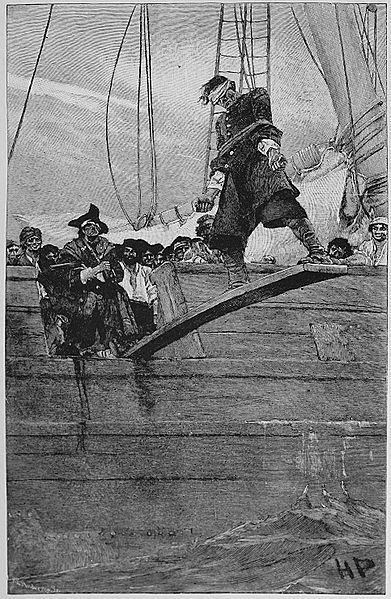
As noted by Phil below, today is Talk Like a Pirate Day.

But if you want to do your yarnin’ ship-shape, you need to go back to the source material. Here’s Long John Silver himself, from Treasure Island, as ever was, in the parley scene, which has always, for some reason, delighted me.

“Now,” resumed Silver, “here it is. You give us the chart to get the treasure by, and drop shooting poor seamen and stoving of their heads in while asleep. You do that, and we’ll offer you a choice. Either you come aboard along of us, once the treasure shipped, and then I’ll give you my affy-davy, upon my word of honour, to clap you somewhere safe ashore. Or if that ain’t to your fancy, some of my hands being rough and having old scores on account of hazing, then you can stay here, you can. We’ll divide stores with you, man for man; and I’ll give my affy-davy, as before to speak the first ship I sight, and send ’em here to pick you up. Now, you’ll own that’s talking. Handsomer you couldn’t look to get, now you. And I hope” — raising his voice — “that all hands in this here block house will overhaul my words, for what is spoke to one is spoke to all.”

When I think back over a lifetime of reading, I can recall very few books that delivered more sheer pleasure of reading to me than Treasure Island. Nearly a perfect adventure story.

A Cry For Justice, by Shelley Hundley

As you’re aware if you’ve been following my posts for a while, I have a personal interest in the subject of child abuse and recovery. I got Shelley’s Hundley’s A Cry For Justice because it was free for Kindle. I won’t say it wasn’t worth the price. It might even have left some ideas behind in my head that someday could be of use to me. But all in all I was disappointed with it.

Shelley Hundley grew up as a missionary kid in Colombia. If it wasn’t bad enough to be exposed to the daily violence of Medellin, where her family lived, she was also the victim of sexual abuse at the hands of a minister, a trusted family friend.

She repressed all memory of the abuse for some years, she tells us, until she was about to go away to college in the U.S. Then everything flooded back, and she angrily rejected God and became a vocal atheist on a Methodist college campus. She suffered from depression and suicidal thoughts, and it was only by what seems like a miracle that she was prevented from throwing herself from the roof of her dormitory one night. After that followed a period of institutionalization, culminating in a dramatic encounter with Jesus which began her process of spiritual and psychological healing.

There are some good insights here. I was particularly impressed when she pointed out that Peter, James, and John, the “inner circle” of Jesus’ disciples, are distinguished by being the ones about whom we know the most embarrassing stories. Apparently Jesus appreciated followers who weren’t afraid to jump in with both feet and make fools of themselves. That’s a tremendous truth, but much as I appreciate it, it doesn’t help someone like me much.

Hundley’s message of healing centers on seeing Christ as both Bridgroom and Judge, as Lover and Avenger. This, I think, is entirely sound and useful.

The bulk of the book, though, is not actually about dealing with the scars of abuse, but with what Hundley (who works with the International House of Prayer in Kansas City) considers her prophetic calling to turn America back to Christ. She lost a great deal of my interest in that part of the story, as I’m very leery of people who claim to have prophetic words for the church. I can believe that God may give someone a word for an individual or a congregation, from time to time, but claiming to have a prophetic message on a par with Scripture is something my church body does not believe in, and I (based on some experiences in my youth) agree wholeheartedly.

So while A Cry For Justice has some value, I can’t really recommend it.