
Category Archives: Reviews

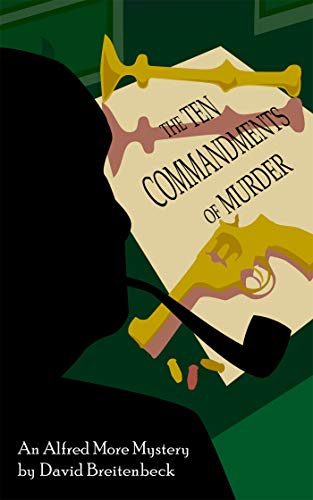
‘The Ten Commandments of Murder,’ by David Breitenbeck

I thanked him and sat down in one of the armchairs, feeling much the same as I had when I’d been called into the headmaster’s office at school. The big clock ticked off the seconds with an unusually heavy tread, as if it were driving a rivet with each tick.

We have under consideration here an attempt at a new cozy mystery franchise, and it’s not a bad one at all. The Ten Commandments of Murder is sort of blend of Sherlock Holmes, Hercule Poirot and Nero Wolfe, with a nice, well-integrated infusion of Christian morality. Utterly unbelievable, but plenty of fun.

Alfred More, our Watson/Hastings/Goodwin here, is at the time of the story (1903) a feckless young idler, the younger son of a Pennsylvania steel magnate. The company is run by his brother Jonathan, with whom Alfred lives. Every April, according to established family tradition, they host a dinner party at their mansion on Long Island for family and family friends. Alfred looks forward to seeing Violet, a young woman he’s been in love with since childhood. But that also means seeing her insufferable husband, Nathan Gale, who is vulgarly rich and delights in offending people. The party also includes the family doctor and a “progressive” clergyman and his family.

Nathan Gale loses no time in making himself odious to everyone. At one point he insults his wife Violet, and Alfred our narrator is incensed enough to say he’d like to kill him. That will come back to bite him when he hears a noise in the nighttime and enters Gale’s room, finding him shot dead. In the honorable tradition of stupid mystery characters since forever, he sees a gun on the floor and picks it up, to be found that way by the others.

What follows passes belief, but is highly suitable for a cozy mystery. The intelligent police detective who comes to investigate does not believe Alfred guilty (I was never sure why), and instead suggests that he engage the services of Mr. Malachi Burke, a former policeman and brilliant consulting detective. Burke turns out to be a huge, unkempt (think W. B. Yeats), aging Irishman who walks with a cane and quickly takes charge. He enlists Alfred to assist him (!) and explains his approach to crime solving, based on his personal list of the “Ten Commandments of Murder” (he also frequently refers to the real biblical commandments, and he’s deadly serious about it).

All the rest goes as expected. Malachi Burke discerns secrets, sees through lies, and ultimately identifies the real murderer.

It was all very satisfactory. The writing was good too (though the author has occasional trouble with homophone confusion).

But all things considered, I greatly enjoyed The Ten Commandments of Murder, and look forward to the next installment in the series.

Netflix recommendation: ‘The Lorenskog Disappearance’

https://youtube.com/watch?v=2g89IxGIFy8

I have yet another opportunity to recommend to you (assuming you have a Netflix subscription) a Norwegian miniseries on which I did translation work. In actual fact, not much of my own work made it into The Lørenskog Disappearance in its final form – our team worked mainly on treatments and scene outlines (as far as I remember), and a lot of our stuff seems to have gotten cut. But I still think it’s an intriguing series, and I recommend it.

Tom Hagen (his having the same name as Robert Duval’s character in “The Godfather” is purely coincidental) was and is one of the richest men in Norway, an energy tycoon. He and his wife Anne-Elisabeth lived in a modest home in a community east of Oslo. Their security was minimal. On October 31, 2018, he came home from work early, having been unable to reach Anne-Elisabeth by phone. He found her missing, but there was a note on a chair, demanding a ransom through an obscure form of cryptocurrency and warning him not to contact the police.

He did contact the police though, and what followed has often been second-guessed. Worried that the kidnappers were watching the house, they did not send in a forensic team immediately, leaving time for evidence to disappear or be removed. They made a mistake in their text communications with the ransomers. Tom paid the ransom, in spite of the fact that he’d gotten no proof of life from the kidnappers.

Anne-Elisabeth was never seen again.

After time passed with no further breakthroughs, suspicion began to turn toward Tom. It was learned that the marriage had been strained. Anne-Elisabeth had contacted a divorce lawyer, who thought the couple’s prenuptial agreement, heavily weighted toward Tom’s interests, could easily be broken. Tom was arrested, but the case against him was weak. Eleven days later the court ordered his release, and the investigation has stalled ever since.

The Lørenskog Disappearance is a docudrama. Many of the characters are fictionalized. We view the story through the viewpoints of four different groups: The police, the reporters (two episodes), the lawyers, and the informers. This produces a Rashomon kind of story, in which the same people and events are viewed from different perspectives. Particularly interesting are two reporters – a man who may be biased against Tom by his experience as the child of an abusive father, and a woman who may be biased toward him by her experience as the child of a Soviet political prisoner.

I don’t think it’s a secret that The Lørenskog Disappearance does not offer any final solutions. What it does offer is a fascinating examination of how we view the stories we see on the news.

Though the trailer above is dubbed, the version I watched on Netflix was subtitled.

‘Media Justice,’ by Dennis Carstens

The print media and national networks ran the same basic theme the next day. It was almost as if they were taking their cue from Melinda’s show. In a way they were. She was becoming a significant source for their stories, so they could start with the lame disclaimer, “It has been reported that…” Of course, this is totally unprofessional and unreliable, but it did provide cover for them. They could point to someone else and truthfully say whatever they reported had been reported elsewhere first.

Dennis Carstens is a poor writer, but an excellent storyteller. He badly needs a good editor to fix his prose and punctuation, but he has spun a riveting tale in Media Justice that had me changing my evening plans in order to see how it all came out.

Unfortunately, he also lost me as a reader. More on that below.

22-year-old Brittany Riley is a widowed, single mom. She has a strained relationship with her domineering mother, but depends on her for child care when she’s working out her frustrations by partying with friends. Being a mother can be tough, but Becky, her two-year-old daughter, is her pride and joy, and she dotes on her. And lately she’s met a man, Bob Olson, whom she thinks might just be Mr. Right…

Then one morning she wakes up to find Becky missing from her room. Bob has also vanished. Brittany panics, terrified of her mother’s anger, so for ten days she (stupidly) pretends nothing’s wrong. She searches for Bob and Becky in the daytime and parties with her friends at night to ease the strain.

When the truth comes out, the county sheriff’s office is helpful at first. But gradually they grow suspicious. This mysterious Bob Olson seems to have left no trace. Nobody ever saw him; nobody seems to know him. It’s looking more and more as if Brittany herself is a baby killer and a liar. When hunters find Becky’s body in a river, Brittany is soon in jail, charged with murder.

So Becky’s mother goes to defense lawyer Marc Kadella. It’s clear that the state’s case against Brittany is in fact circumstantial and fairly thin. But public sentiment is another matter. A local legal reporter has turned the case into her personal crusade, and her point of view becomes everyone’s point of view. And there are crazies out there… It all works up to a shattering climax.

The great strength of the Marc Kadella books is their realistic portrayal of the less glamorous side of the legal profession. There’s a real sense of authenticity in these stories. And the picture Media Justice offers of how “journalism” (especially TV “journalism”) filters facts and manipulates public opinion is genuinely horrifying.

I can always put a book down if I need to, but this one was harder than most.

And yet, I’m done with the Marc Kadella series. The author shows considerable laziness, in my opinion, in falling back – not once but twice – on a hoary entertainment trope, a phenomenon quite rare in the real world – the “murderous pro-lifer.” Using it once in a book I could perhaps forgive as a labor-saving shortcut. But doing it twice strongly suggests malice (as Marc Kadella might say in court), in spite of conservative moments in the story. This guy hates us. I’m confident he doesn’t want someone like me as a reader.

Too bad. I’ll miss him.

‘Key Lime Blues,’ by Mike Jastrzebski

First, a quibble. Although the cover blurb says Key Lime Blues is a “Wes Darling sailing mystery thriller,” the story really has little to do with sailing, though there is a little boat business along the way. The hero lives on a sailboat called the Rough Draft, which is the name, we’re informed on the Amazon page, of the author’s boat. But that’s a name that’s really only appropriate for a writer’s boat, not a private eye’s.

Wes Darling is a bartender in Key West, Florida. He fled to the Keys after quitting his job with the successful detective agency run by his mother. A bad case which ended in the death of a young girl left him traumatized, and he wants nothing more to do with investigations.

But then one of his mother’s operatives, an older man who was her boyfriend and Wes’ father figure, shows up shot to death on a nearby beach. Wes can’t refuse his mother’s request that he look into it, but he’s adamant he’s not coming back to the firm.

He discovers that the victim was in town looking for a client’s girlfriend, with whom he says he wants to reconcile. Only that’s a lie. The girlfriend is a six-foot, drop-dead gorgeous stripper called Destiny, and the client is a gangster who wants the diamonds Destiny stole from him. He’s also got a couple low-intelligence, twin-brother thugs in town searching for her, and Wes will divide his time between trying to protect Destiny from them, and trying to get the truth from Destiny. Much blood will be spilled – some of it Wes’ – before he solves the case.

In the wake of the last book I reviewed, also set in the Keys, I appreciated the lighter tone of Key Lime Blues. I think the intention was to write a humorous mystery (lots of yuks are gotten out of Wes Darling’s last name), but I didn’t find it all that funny.

And the plot didn’t make a lot of sense to me. This is one of those stories where most of the trouble could have been avoided if the hero had just leveled with the police in the first place. It’s explained that Wes doesn’t trust cops because of bad memories from his tragic case, but it’s still stupid behavior, and that diminishes my empathy.

The main villain is supposed to be a super-genius, but doesn’t seem that brilliant, just repeating unsuccessful tactics over and over, hoping they’ll work better this time.

Also, Wes suffers multiple head traumas, and in the honored (and unrealistic) tradition of hard-boiled private eyes, is back in action an hour later. In addition, the fight scenes weren’t very well written.

There was also a psychic who appeared legitimate, which I consider cheating in a mystery.

And finally, the ultimate resolution was morally unsatisfying to me.

So I didn’t really like Key Lime Blues very much. I don’t think I’ll continue with the series.

‘Tropical Freeze,’ by James W. Hall

It was only after I’d purchased James W. Hall’s Tropical Freeze (got a deal on it) that I realized I’d already read the first book in this series (originally published in the late ‘80s), and didn’t much care for it. But having it at hand, I figured I’d give the series a second shot. Results: ambivalent.

Thorn (his only name) is a beach bum in Key Largo, Florida. He occupies his time making fishing lures and rebuilding his house, which got blown up in the last book. He gets a job offer from his friend Gaeton, who used to be an FBI agent. Now he works for Benny Cousins, another ex-FBI agent who runs a private security form. There’s a place there for Thorn, Gaeton says, if he wants it. Good money.

Thorn doesn’t want it. In fact, he takes an instant, intense dislike to Benny.

Then Gaeton disappears off the face of the earth. And Thorn falls for Darcy, Gaeton’s sister, who’s a weather girl in Miami. Darcy, in turn, is being stalked by a dim-bulb local bartender with delusions of Nashville stardom. Meanwhile, Benny Cousins is doing his best to make himself the most important man in Key Largo. And people who cross him have a way of vanishing mysteriously.

I wanted to like Tropical Freeze better than I did. The prose is really good – lines like “He was feeling sorry for Key Largo, for Florida, for North America. For men and women everywhere. For the race of lonely creatures that walked upright.” James W. Hall can turn a phrase (though he does have a problem with logical logistics, as when he has a guy carry three pistols in one hand).

But I found it impossible to like the characters in this book. The narrative forced us to spend considerable periods of time with sociopathic low-lifes, which always annoys me. But I didn’t even like the hero. I never had a sense of Thorn as a character. We’re told things about his background, but I never grasped him as a person.

And there’s was a pervading sense of gloom all through the story. I found it depressing.

Maybe you’ll like it better. Cautions for language and fairly explicit sexual situations.

‘Weird Tales from the Northern Seas,’ by Jonas Lie

In the days of our forefathers, when there was nothing but wretched boats up in Nordland, and folks must needs buy fair winds by the sackful from the Gan-Finn, it was not safe to tack about in the open sea in wintry weather. In those days a fisherman never grew old. It was mostly womenfolk and children, and lame and halt, who were buried ashore.

I thought I was buying a collection of north Norwegian folk stories when I purchased (OK, it was free) Weird Tales of the Northern Seas, by Jonas Lie (considered one of the “four greats” of Norwegian literature in the National Romantic period, along with Ibsen, Bjørnstjerne Bjørnsson, and Alexander Kielland [whose writing retreat near Stavanger I visited this summer]). What I got was something somewhat different, and in some ways better. It certainly left its impression on this reader.

Jonas Lie wrote novels in the “realistic” style (I’ve never read any of them), but he didn’t mind incorporating a folk tale or two into them, as sort of psychological local color. He also assembled some collections of genuine folklore stories. It from both of these categories that the editor (and translator? I’m not sure) R. Nisbet Bain collected this volume in 1893.

These stories are grim. They mirror the attitudes of a culture that learned to eke a marginal existence from the cruel sea at the cost of perpetual danger and human tragedy. The monster that shows up most often here is the draug. The name refers to a kind of revenant in other parts of Norway, but in the north he was a sea-troll who had a head like a seal’s (or a lump of seaweed), who took ruthless, often long-delayed revenge on those who offended him. Most often the lesson of the story is that you will pay for your sins, and nothing can be done about it.

Probably the most famous of the stories is the first, “The Fisherman and the Draug,” which is exactly the sort of thing I just described. The one that impressed me most was the next, “Jack of Sjöholm and the Gan-Finn,” probably the weirdest of the collection. It shows the most obvious marks of literary craftsmanship, especially in its poetic, dream-like quality, and ends in an obscure manner that you never find in real folk tales.

But all in all, these stories are genuinely atmospheric and haunting. If you like this sort of thing, I recommend it. The translation isn’t bad – a little stilted, but that very likely echoes the original text. This was the 1890s, after all. The worst problem is that the footnotes at the end of each story aren’t linked, which creates a difficulty for non-Norwegian readers.

‘Desperate Justice,’ by Dennis Carstens

Dennis Carstens is not a very good prose stylist. His diction can be awkward, even confusing, and his punctuation is best described as whimsical. But I like his characters, he poses very challenging moral problems to the reader, and he’s not politically doctrinaire.

At the beginning of Desperate Justice, Minneapolis attorney Marc Kadella is enjoying an upswing in his business fortunes. His success in his last big case has brought in needed clients. But when a prominent local defense attorney asks him to come on to defend his client’s co-defendant in a linked case, Marc is suspicious. Still, he takes the job, and soon regrets it. He and his client have been set up to take a fall, and Judge Gordon Prentiss – whom we remember with distaste from the last book – does not hesitate to take his personal rancor out on Marc’s client, who goes to prison.

So Marc is astonished when Judge Prentiss is himself charged with murder, and asks for Marc to defend him. Marc has no objection to representing a guilty man (and Prentiss looks guilty as sin), but he considers him a complete sleazeball. Which, the reader soon learns, is entirely correct. Perhaps the man ought to go to prison on general principles.

Desperate Justice is a kind of a diffuse story, which heads off in several directions before bringing it all together in the end. But I very much enjoyed the ethical dilemmas raised. What does “presumption of innocence” really mean? How do you defend a man you despise? How do you respond when even the good guys lie to you?

Stories of moral ambivalence can be corrosive and depressing, if they’re done nihilistically. But the Marc Kadella books never fall into nihilism. They ask honest questions, leaving the reader to draw judgments.

The politics seem pretty moderate to me, but the very fact that Democrats in Minnesota get criticized at all (Republicans come in for it too) is a breath of fresh air.

Cautions for language, sexual situations, and themes of extreme perversion.

‘Ranching in Colorado,’ by J. L. Curtis

I enjoyed the first book in my friend J. L. Curtis’ The Bell Chronicles, Showdown on the River, so I picked up book number two, Ranching in Colorado. The title’s a little generic, but the story was excellent.

Rio Bell, gunslinging Texas rancher’s son, survived the dangers of a trail drive and a range war, and now he has his reward. He’s married and owner of a large spread in Colorado. He wasn’t entirely prepared for mountain life or for northern winters, and when his wife gets pregnant he really feels out of his depth.

But he has some his hands with him, along with the crew of old mountain men who helped so much in his earlier adventures. He’ll learn the business, survive a stampede, and face back-shooting rustlers before he’s done.

I don’t know why I don’t read more westerns. I have an infinite taste for cowboy stories. This book was a little less bombastic than the first one; not much gunplay until the last third of the book or so.

I have quibbles, of course. Wedding dresses were not, as a rule, white in the 1870s. A woman we’re told is Scandinavian uses German words like “mit” (with) and “danke,” rather than “med” and “takk.” Some of the English diction is distractingly modern, like, “this baby is an affirmation of our commitment.”

But those are small things. Enjoy the story. Recommended.

‘The Untold Story of the New Testament Church,’ by Frank Viola

In our degenerate times, claiming that you’ve read the Bible multiple times through sounds like bragging (it wouldn’t have been as much of a big deal when I was starting out). That said, I’ll make so bold as to say that I’ve read the Bible, Old and New Testaments, multiple times. I’m pretty familiar with the narrative.

But I was intrigued by the premise of Frank Viola’s The Untold Story of the New Testament Church. The idea is to straighten out the chronological problems. The Old Testament isn’t laid out in order of events, but the historical books are generally chronological, which is helpful to the reader. But the New Testament is arranged by genre and book length. I won’t say that causes confusion, but it makes the message less coherent than it might be.

What author Viola has done here is to tell the story on a timeline, explaining the historical context (this is very valuable) and then inserting the various books (or rather, descriptions plus reading prompts) in their proper order, based on critical opinion and (sometimes) the author’s personal choices.

It’s a little humbling to admit that the book helped me understand New Testament history better, but it did. Some of the author’s choices are subjective and could be disputed, but all in all I thought the thing as a whole very helpful.

And I learned stuff. I was not aware that Titus was (arguably) Luke’s brother. Or that Gallio, the governor of Corinth, was brother to the philosopher Seneca.

The prose was occasionally a little awkward, and there’s a lamentable tendency to employ exclamation marks. But still, I recommend The Untold Story of the New Testament Church. I think it would be a great project for a Bible study group to work through this book, reading the scriptural books as they come up.

‘Bowmen of England,’ by Donald Featherstone

These commanders who made such good use of archery as a national tactic had no real conception of the fact that in terminating the ascendency in war of the mailed horseman they were putting an end to the feudal regime and all that it entailed.

When you and I think of the medieval English bowman, we (unless you’re very weird) always think first of Robin Hood, in whatever cinematic or literary incarnation we know him. And there’s good reason for that. Robin Hood became an English national legend because he symbolized an important – and uniquely English – historical phenomenon. The English yeomanry enjoyed a very special status in Europe because they provided the manpower for English military archery, which made their country almost invincible on the battlefield for several centuries. Donald Featherstone’s Bowmen of England probably qualifies as a “classic” treatment of the subject, as it was first published 1968. No doubt some of the facts he cites represent scholarship that has since been revised or debunked. But as far as I can tell, the book remains a valuable introduction to the subject.

It opens with a fictional, dramatized scene of classic longbow tactics in battle. This part, I must admit, is rather badly written, and made me wonder what I was getting into as a reader. However, the author hits his stride when he moves on to plain exposition.

The longbow (traditionally, but not always, made of yew, usually imported) was first developed by the Welsh. But King Edward I (one can’t help thinking of Braveheart, but Edward is an admired figure here) recognized its value and adopted it for his own armies. He instituted universal archery practice for all common men, legislation that continued in force in various forms up into the Renaissance period.

Most of the book consists of a historical survey, especially of the Hundred Years’ War, in which the author describes the chief battles in which the longbow was decisive. The pattern is repetitive, and almost comic in a dark way. Again and again the English bowmen slaughtered massed French cavalry, at tremendous cost in lives, equipment and fighting expertise. And yet the French never learned. Every time they were certain that, given enough chivalry and valor, they’d whip the English this time.

Along the way we learn a fair amount about the construction of bows and the training of bowmen. We learn only a little about the military tactics of the time, but that’s only because they barely existed. There are also a lot of casualty figures, which are kind of depressing. It’s saddening to think how many lives were wasted in war in those days. (Sadder still to know that the situation hasn’t improved with time.)

There’s been a fashion in recent decades for publishing books about “The [fill in the blank] that changed the world.” If it had been written later, that title could have been applied to Bowmen of England. The longbow killed chivalry, altered the social order, and laid the groundwork for tactics in the Age of Gunpowder.

The book shows its age through its unabashed patriotism, but that’s just refreshing nowadays.

Recommended.