In spite of the unwelcome appearance of pot-smoking in the previous volume of this collection, I enjoyed the first book in Jack Lynch’s Pete Bragg series enough to continue with the second book, The Missing and the Dead.
Here we find our San Francisco private eye retained by a local celebrity, an over-expressive female TV personality, to look for her brother, Jimmy Lind. Jimmy is an insurance investigator, and he’d been sure he was on the trail of a much-sought, missing artist when he vanished. Oddly, a cop disappeared around the same time in the same area, a sort of artist’s colony.
As is characteristic of the series (so far as I can tell so far), our hero works at solving the puzzles he encounters, but the malevolent genius in the background is such as he could never have imagined. Once again, he’ll survive by luck as much as by strategy, and he won’t really know what he’s facing until the Big Reveal, when it’s almost too late.
But one doesn’t read Hard-boiled for the puzzle solving. The Missing and the Dead was fun to read, a page-turner with lots of fighting and (implied) sex. Plus some surprisingly sensitive characterization. And most satisfactorily, it’s pre-Woke. When a drunk persists in harassing the woman Pete is romancing, he decks the guy, and she doesn’t lecture him on how she doesn’t a man’s protection, but rather appreciates his gallantry.
And the pot-smoking, though mentioned, is restricted to off-stage.
I recommend The Missing and the Dead as popcorn reading.
“Considering the obliging care we take in criminal prosecutions to inform the public at large that two or three grains of arsenic will successfully account for an unpopular individual, however tough, it’s surprising how wasteful people are with their drugs. You can’t teach ‘em. An office-boy who was as incompetent as the average murderer would be sacked with a kick in the bottom….”
Old General Fentiman, a veteran of the Crimean War, was pretty much a fixture at the Bellona Club, a stodgy gentlemen’s club for veterans in London. On Veterans’ Day, he becomes more a fixture than ever, being found dead in his accustomed wing-chair. Certain peculiarities about the condition of the body make it difficult to determine the exact time of his death.
And that becomes an issue, since, as it turns out, the old man had reconciled with his long-estranged sister that same day, and she had also died, after changing her will. The division of her large estate will now depend on which of them passed away first. Lord Peter Wimsey, himself a member of the club, is asked to investigate – as discreetly as possible. Lord Peter grows increasingly interested as he asks questions, and then (as he so often does) begins to dread what he’ll learn. He hopes very much the murderer wasn’t his friend George Fentiman, the old man’s grandson, who is very poor and suffers from shell-shock and the occasional fit of uncontrolled rage.
That’s the premise of The Unpleasantness at the Bellona Club, fourth novel in the Lord Peter Wimsey series. At this point (in my opinion), author Dorothy L. Sayers is coming into her full powers as a detective novelist. Her writing is sharp and amusing, her characters vivid, and the puzzle is a neat one. Also on display are acid social commentary (especially concerning attitudes toward women) and problems of morality.
I like The Unpleasantness at the Bellona Club very much, and recommend it highly.
Notions of personal honor aside, a clash between the Cowboys and lawmen was inevitable. Since November 1878, the Cowboys—from Bob Martin to Curly Bill to the Clantons and McLaurys—had been largely unopposed. On the border the Cowboys had bullied and raided and smuggled and robbed. They had killed anyone who dared oppose them. They had, prior to that fateful October day, murdered at least thirty-two men in New Mexico, Arizona, and Mexico.
Over the years, I’ve read a number of books on the Earp brothers and the OK Corral gunfight. To be fair, plain “debunkings” of the “Earp myth” have grown rare of late. Writers tend to concentrate on the ambivalence in the historical record. The Clantons and their Cowboy allies look bad, but the Earp brothers look pretty bad themselves. Writers find it hard to take sides.
John Boessenecker, author of Ride the Devil’s’ Herd, has no such problem. He reports on the Earps’ corporate and individual transgressions with perfect candor (as far as I could tell), but makes a valuable contribution by doing a job most historians have skipped – he clearly documents the long and bloody history of the Cowboys who were the Earps’ enemies. And balanced in that scale, he has no problem siding with the Earps.
I’d always assumed that the horrific first scene of the movie, “Tombstone,” was an example of cinematic hyperbole – like the entirely fictional opening to “Braveheart,” designed to get us to hate King Edward I from the git-go. But although the specific incident of the wedding massacre never happened, it’s entirely consistent with their habitual behavior. The Cowboys’ history as a criminal organization went back to the 1877 Salt War in Texas. The Salt War, a fight over mineral rights to salt in dry lakes, was a vicious racial conflict between Anglos and Mexicans, and the Cowboys took the opportunity to give full vent to their cravings for theft, rape, and murder. Afterward they mainly specialized in cattle rustling, primarily stealing cattle in Mexico and selling them in the US, though they were perfectly willing to do it the other way around when convenient. They also stole horses, robbed stagecoaches, and walked off with anything not nailed down. They could be charming when they wished to, but made sure to beat or kill anyone they thought might not fear them sufficiently. These were not the “rustlers” of the northern range wars, small ranchers resisting being bulldozed by the big cattle interests. They were, in fact, a terroristic organization. They scared off capital investment, and more than once they precipitated diplomatic crises between the US and Mexico.
The Earps, when they arrived in Tombstone, Arizona, were not a respectable family. They were gamblers (not above cheating), and had been confidence men, horse thieves, arsonists and pimps. A couple of them still were wanted in other states.
But (at least as author Boessenecker portrays it), they came to town intending to turn over a new leaf. Gambling was considered a respectable occupation on the frontier, and as a group they’d built a reputation as formidable police officers. Their record for courage is remarkable, and they were men with “no back-up in them,” as they used to say. They couldn’t be intimidated. They were exactly the men to take the Cowboys down. And that, they came to hope (especially Wyatt), would make them respectable at last.
The rest is history. The proximate reason for the gunfight at the corral was trivial, but the conflict was essential to the time and place. The Earps (as the author sees it) were the necessary implements of civilization to remove a deadly social cancer.
Boessenecker sees Wyatt Earp’s Vendetta Ride in much the same way, but more extreme. By now Wyatt had acquired a Deputy US Marshal’s appointment, and he possessed legal authority to arrest the men who killed his brother Morgan. Instead he chose to murder them. He didn’t trust the Cochise County sheriff, his enemy John Behan, to keep them locked up for trial (Boessenecker defends Behan’s record, however, saying he was never complicit with the Cowboys, only friendly with some of them). Wyatt’s means were illegal, immoral and “in the worst tradition of American law enforcement.’ But they were effective. When he was done, the Cowboys were broken, never to rise again.
Just like in the movies.
I enjoyed Ride the Devil’s Herd very much. The writing wasn’t of the top rank, but it did the job of communicating the narrative. There were lots of interesting anecdotes along the way, and good photographs, well placed in the text. Sources are well-cited. If you’re a Western buff, Ride the Devil’s Herd is well worth your time and money.
Besides, a flurry of that kind was practically an obligatory incident at a certain stage of any good pirate-treasure story, and the Saint was rather a traditionalist about his stories. He liked to feel that all the time-honored trimmings were in their proper place. It encouraged a kind of light-hearted certainty that virtue, which of course he represented, would be triumphant in the end.
I think I’m going to have to re-think my opinion of Simon Templar, the Saint, Leslie Charteris’ famous thriller (I won’t say detective) hero. When I was a boy, Roger Moore represented the Saint, and I’ve never much cared for Roger Moore. Always found him unaccountably lightweight. Still not sure why. But a Kindle edition of the story collection, The Saint on the Spanish Main, came up at a cheap price, and I read it and quite enjoyed it.
The Saint on the Spanish Main is a collection of six short stories, all set in the Caribbean. Most of them were written in the period 1952-1953, when author Leslie Charteris had recently married his fourth wife. He was aging by then and had largely given up on writing, but the relationship seemed to invigorate him. The couple traveled much in the Islands, inspiring these stories. By and large they are well-written, efficient, and tight, with plausible characters and a strong sense of justice motivating the hero. The Saint was originally conceived as a kind of puckish trickster, but gradually developed into something smoother and darker. He’s often described as a Robin Hood character – he seems to have plenty of money that enables him to travel, so he mostly waits for Fate to throw some evil in his path. Then he does something about it. Very often, these are “sting” stories. Unlike your average police detective or private eye, the Saint does not hesitate to take justice – even capital punishment – into his own hands.
It seems that whenever you review old books, you have to provide warnings about treatment of race. There are cringe moments in this book, as you’d expect considering the time and locale, but I think it’s educational to understand how people talked in those days. Also, it should be noted that author Charteris was himself Chinese-English, and had grown up ostracized due to racial prejudice, a circumstance that turned him into a reader. (He had a brother, by the way, Roy Henry Bowyer-Yin, who was an Anglican priest and hymn writer.) Simon Templar has a habit of referring to villains as “the ungodly,” but religion is generally avoided, except in the final story, which deals with voodoo. A notable moment of implausibility in another tale involves a giant octopus, which doesn’t stand up in light of what we’ve since learned about those shy cephalopods.
I need to read some more books in the Saint series. This was fun.
I had never heard of the author Jack Lynch, or his private eye character Pete Bragg, who flourished in the ‘60s and ‘70s, roughly contemporary with John D. MacDonald and the Travis McGee books. But The Complete Bragg compendium (final collection in a series reprint) became available at a low price, and I downloaded it to my Kindle. I was pleasantly surprised. The first book in this volume is The Dead Never Forget.
Pete Bragg was once a newspaper man in Seattle, but now he’s a private eye in San Francisco. When a large, dangerous-looking man comes to invite him to talk to Armando Barker, a retired mobster now gone legit (or so he claims), he can’t afford to turn down profitable work.
Barker explains that he’s been getting cards threatening him and his employees. He wouldn’t worry about that, but now they’ve threatened his 11-year-old stepdaughter, whom he’s maintaining in an expensive private school. Bragg takes the job, and then one of Barker’s employees is murdered, raising the stakes considerably. Bragg is certain the background of the threats must be hidden in the casino town of Sand Valley, Nevada, where Barker used to operate. Barker doubts that, but Bragg follows his instincts and visits the town.
Homages to Akira Kurosawa’s film “Yojimbo” are almost a subgenre in several different storytelling genres. Most famous of the homages is probably the film, “A Fistful of Dollars.” But (or so I’ve read) the original inspiration for that movie was Dashiell Hammet’s novel, Red Harvest. So mystery homages are a kind of closing of the circle. I saw a lot of “Yojimbo” in this book, where the criminals who run The Truck Stop whorehouse at one end of town go to war with the criminals who run the Sky Lodge casino at the other end, and the bullets fly fast and thick enough to call down government intervention. And in the middle is Bragg, trying to make sense of who’s actually profiting from all the chaos. Deduction is not Bragg’s strong point – he’ll only figure it all out when it’s pretty much laid out for him by the last person he suspected.
The Dead Never Forget was a lot of fun to read, for this reader. Uncomplicated by political correctness, with an engaging narrator and lots of action (and sex, though it’s not explicit), it was pretty much exactly what the doctor ordered. Reminiscent of MacDonald, but a little shallower, I think. My only grumble is that I learned at the end that Bragg’s a casual pot smoker. I always dislike that in my heroes. But I paid for the whole collection, so I expect I’ll read the rest, and even have a good time.
Miss Climpson was one of those people who say: “I am not the kind of person who reads other people’s postcards.” This is clear notice to all and sundry that they are, precisely, that kind of person. They are not untruthful; the delusion is real to them. It is merely that Providence has provided them with a warning rattle, like that of the rattle-snake. After that, if you are so foolish as to leave your correspondence in their way, it is your own affair.
In the third volume of Dorothy Sayer’s Lord Peter Wimsey series, Unnatural Death, the mystery comes along by accident. Lord Peter is having lunch with his friend and future brother-in-law, Inspector Parker, when the man at the next table interrupts their conversation, prompted by an overheard comment. He says he’s a doctor, and he knows of a situation that might have been murder, but he can’t prove it. An old woman under his care, who was living with her grandniece and heir, died suddenly, and something about the circumstances just strikes him as wrong. The old woman was dying of cancer, and had shown great reluctance to making a will. But he considers her death suspicious, though he can’t prove foul play. And he can’t imagine a motive, since the intended heir inherited as planned.
Insp. Parker isn’t much impressed, but Lord Peter is intrigued by the whole thing. He dispatches his faithful agent, the admirable spinster Miss Climpson, to ensconce herself in the town and learn what she can by way of gossip. Very gradually, a ruthless plot will be revealed. (Also, this may possibly be the first appearance in literature of a manner of secret murder that’s since become a cliché. But I’m not sure.)
Having read all these books before, I find Unnatural Death the one that left the least impression on me. I believe the problem was that the book is so slow-moving and talky. Everything gets talked over thoroughly in between actual events in the story, which are brutal but rare. It was, frankly, surprisingly dull work from a writer of Dorothy Sayers’ skill. Though the “moral” of the exercise was a good done.
Also, a warning needs to be added that 1920s attitudes toward race are on display here. By the standards of the time, I think Miss Sayers handled the black character in the story pretty well, making him a decent and sympathetic man. But her descriptions and language don’t fly well with the modern reader. There’s also a passing Jewish slur, unnecessary to the plot.
I recommend all the Lord Peter Wimsey books, but I suspect you’ll love Unnatural Death less than the others.
After trauma the world is experienced with a different nervous system that has an altered perception of risk and safety.
Some years back I read about a new psychiatric diagnosis called Complex PTSD. The idea is that symptoms displayed by children who’ve been subject to abuse over long periods of time are very similar to symptoms common to adults who suffer from PTSD due to trauma, as in combat. The difference is that the Complex kind is harder to treat. This is of considerable personal interest to me, for reasons I won’t detail here.
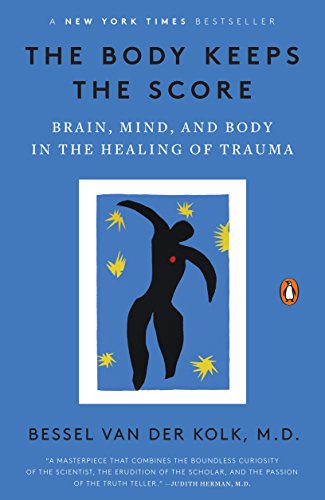
Somebody on Facebook mentioned this book, The Body Keeps the Score, by Bessel van der Kolk, and I was intrigued enough to buy the Kindle version. Turns out Dr. van der Kolk is one of the researchers who came up with the idea of Complex PTSD (which has not to date been accepted for the APA’s book of recognized diagnoses).
The major argument made in this book is that many of our psychological disorders rise from trauma, and that trauma actually makes physical changes in the brain. Current treatment tends to lean toward drug therapy, which (the author argues) only masks the problem. What we need to do is help people to retrain their brains, to reorganize the various areas of the brain to work again in a normal fashion, instead of the abnormal ways they’ve adopted in order to cope with shocks they’ve suffered.
A number of treatments are suggested and evaluated, based on Dr. van der Kolk’s extensive personal experience as a clinician and researcher. These include yoga, biofeedback, and participation in drama.
I found the book largely persuasive (as if I were qualified to judge). I absolutely agree about Complex PTSD. I’m not so sure of the author’s strong defense of Suppressed Memory – he defends it strongly, but completely ignores the numerous cases where it has been used to persecute innocent people, such as day care workers. As a Christian, I’m dubious about yoga.
And the author spoiled it to some degree, for this reader, by his political conclusions. He sees it as self-evident that what will really solve our social problems is national health care and government preschools. I am personally doubtful that bureaucracies are ever going to fill our lives with empathy and caring.
The author is also prone to fall into the refrain of, “The medical establish has never appreciated my genius.” That does raise skepticism in this reader.
But most of the book is convincing, and all of it is worth reading. Recommended, with cautions for disturbing subject matter.
I know you probably regard me as a man of iron, inured to all pain, physical and emotional. But in fact, there are limits to my endurance. It’s possible to write books that drive me away just by being too good, in terms of action and dramatic tension.
I think that’s the situation with Alex Smith’s Whip Crack, fourth in his DCI Robert Kett series. (SPOILER ALERT: If you are reading this series and have not yet finished the third book, Three Little Pigs, you should stop reading here. Parts of my synopsis must necessarily give away some of the ending of that book.)
Robbie Kett has been suspended from the force, due to the extremes he went to, to rescue his children and his wife Billie (who had been kidnapped and held prisoner 5 months). Now they’re back together, but they’re all damaged. Especially in his relationship with Billie, he’s walking on eggshells, never sure what to do to help her readjust to freedom and love.
When four young teenagers disappear in a lonely town on the Norfolk coast, his superior doesn’t order Robbie to go investigate, but pointedly lends him his holiday “caravan” (trailer) near the crime scene. He knows Robbie can’t resist this kind of case.
The four teenagers, all close friends, have been lured away from their homes by recordings on cassette players. Similar players have been left behind with messages for the investigators. With difficulty, the police are able to trace the man who bought the players, a local drug dealer. The only problem is that he’s killed himself. If they’re going to locate the missing kids, they’re going to have to solve the recorded riddles he left behind.
But there’s more to the mystery than even that. Robbie can sense something more is going on – and he’s right. I thought I had figured it out, but it was even weirder than I imagined.
Whip Crack is taut, harrowing, and exciting. The prose is good, too. I can’t fault author Smith on his craftsmanship. Also, he employs some tricks to avoid too much profanity.
But give me a break, guy. Poor Robbie has been through four thrillers now, and in each book he gets injured more – physically and emotionally – and he hasn’t been given time yet to heal up from the first book. My empathy needle is spiking here. I don’t think I can handle the next installment.
Recommended, if you’re made of sterner stuff than I am.
David J. Gatward’s Harry Grimm books are not great literature, but they’re entertaining “English rural” police stories. Harry, you may recall, is a former English paratrooper who joined the police in Bristol after surviving an IUD explosion in Afghanistan. His wounds left him with rather severe facial scarring, which he cheerfully exploits in intimidating suspects. Transferred to a town in the Yorkshire Dales, he’s finding himself – to his own surprise – settling in comfortably with the laid-back, eccentric local force.
In Blood Sport, one of Harry’s colleagues is still smarting from the death, in a previous book, of a close friend who turned out to be a criminal involved in sheep rustling. When a dog is found dead, torn to pieces, in an abandoned barn, the ensuing investigation into illegal dog fighting leads to links with that sheep rustling operation. It’s all part of a large, organized conspiracy run by greedy and cruel people, something no one had looked for out here in the country. The worst part is that no one can be sure whom to trust.
As the mystery gets resolved, we also get to see Harry Grimm make some surprising new connections in his own life.
Blood Sport is plagued by a few misspellings and typos, but is nevertheless quite enjoyable to read. Only mild cautions.
“It is possible, my lord, if your lordship will excuse my saying so, that the liveliness of your lordship’s manner may be misleading to persons of limited—”
“Be careful, Bunter!”
“Limited imagination, my lord.”
“Well-bred English people never have imagination, Bunter.”
“Certainly not, my lord. I meant nothing disparaging.”
I was first introduced to Lord Peter Wimsey through the BBC production of Clouds of Witness (the subject, in its book form, of this review) broadcast on Masterpiece Theatre back in 1973, with the irresistible Ian Carmichael starring. (He didn’t actually resemble the character described in the books, but once seen, he’s impossible to get rid of.)
Clouds of Witness is one of those stories where coincidence and withheld information combine to confuse a fairly simple problem. Lord Peter Wimsey is in Paris, on his way home from a holiday in Corsica, when he learns that his brother Gerald, Duke of Denver, has been arrested for murder.
The fatal events occurred at a hunting lodge in Yorkshire, where the duke and his family and friends were staying. Denis Cathcart, a slightly-too-smooth young gentleman to whom Peter’s sister Mary is engaged, is discovered in the early hours of the morning, shot to death outside the conservatory. Sir Gerald is standing over him.
Mary claims she was awakened by a gunshot, which is a lie, since the shot had been fired more than an hour earlier. Gerald refuses to explain what he was doing outside at that hour.
Sir Gerald’s lawyer, at his client’s wishes, plans to base his defense on reasonable doubt; the gunshot wound could reasonably have been self-inflicted. But Lord Peter, when he shows up, is determined to get past the intersecting lies and discover what really happened. The true murderer must not be allowed to escape. The investigation will lead him to be shot at, to nearly drown in a Yorkshire bog, and to risk his life on a trans-Atlantic airplane flight in a storm (this story is set in 1920, you must remember).
Clouds of Witness is not Dorothy Sayers at the height of her powers, but it’s a fascinating and original detective problem, enjoyable and well worth reading. I particularly enjoyed the tongue-in-cheek descriptions of the English nobility and their quaint customs.
Websites store cookies to enhance functionality and personalise your experience. You can manage your preferences, but blocking some cookies may impact site performance and services.
Essential cookies enable basic functions and are necessary for the proper function of the website.
Name
Description
Duration
Cookie Preferences
This cookie is used to store the user's cookie consent preferences.
30 days
These cookies are needed for adding comments on this website.
Name
Description
Duration
comment_author
Used to track the user across multiple sessions.
Session
comment_author_email
Used to track the user across multiple sessions.
Session
comment_author_url
Used to track the user across multiple sessions.
Session
These cookies are used for managing login functionality on this website.
Name
Description
Duration
wordpress_logged_in
Used to store logged-in users.
Persistent
wordpress_sec
Used to track the user across multiple sessions.
15 days
wordpress_test_cookie
Used to determine if cookies are enabled.
Session
Statistics cookies collect information anonymously. This information helps us understand how visitors use our website.
Google Analytics is a powerful tool that tracks and analyzes website traffic for informed marketing decisions.
Used to monitor number of Google Analytics server requests
10 minutes
__utmb
Used to distinguish new sessions and visits. This cookie is set when the GA.js javascript library is loaded and there is no existing __utmb cookie. The cookie is updated every time data is sent to the Google Analytics server.
30 minutes after last activity
__utmc
Used only with old Urchin versions of Google Analytics and not with GA.js. Was used to distinguish between new sessions and visits at the end of a session.
End of session (browser)
__utmz
Contains information about the traffic source or campaign that directed user to the website. The cookie is set when the GA.js javascript is loaded and updated when data is sent to the Google Anaytics server
6 months after last activity
__utmv
Contains custom information set by the web developer via the _setCustomVar method in Google Analytics. This cookie is updated every time new data is sent to the Google Analytics server.
2 years after last activity
__utmx
Used to determine whether a user is included in an A / B or Multivariate test.
18 months
_ga
ID used to identify users
2 years
_gali
Used by Google Analytics to determine which links on a page are being clicked
30 seconds
_ga_
ID used to identify users
2 years
_gid
ID used to identify users for 24 hours after last activity
24 hours
_gat
Used to monitor number of Google Analytics server requests when using Google Tag Manager
1 minute
_gac_
Contains information related to marketing campaigns of the user. These are shared with Google AdWords / Google Ads when the Google Ads and Google Analytics accounts are linked together.
90 days
Marketing cookies are used to follow visitors to websites. The intention is to show ads that are relevant and engaging to the individual user.
A video-sharing platform for users to upload, view, and share videos across various genres and topics.
Registers a unique ID on mobile devices to enable tracking based on geographical GPS location.
1 day
VISITOR_INFO1_LIVE
Tries to estimate the users' bandwidth on pages with integrated YouTube videos. Also used for marketing
179 days
PREF
This cookie stores your preferences and other information, in particular preferred language, how many search results you wish to be shown on your page, and whether or not you wish to have Google’s SafeSearch filter turned on.
10 years from set/ update
YSC
Registers a unique ID to keep statistics of what videos from YouTube the user has seen.
Session
DEVICE_INFO
Used to detect if the visitor has accepted the marketing category in the cookie banner. This cookie is necessary for GDPR-compliance of the website.
179 days
LOGIN_INFO
This cookie is used to play YouTube videos embedded on the website.