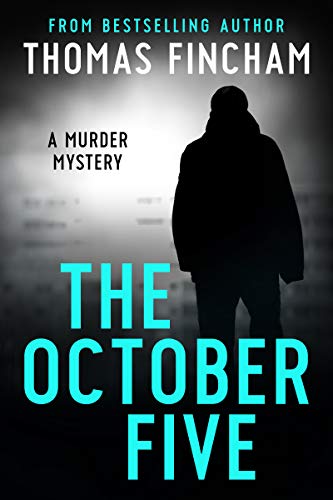
There’s an upstairs apartment in Chicago where a small group of middle-aged men maintain a secret club, The October Five. They are all Marine Vietnam War veterans, survivors of one horrific operation that went very bad. They tell no one about their club, even their families and closest friends. That’s because they work on secret projects together, projects that are highly illegal.
Detective Karl Whaler has a mystery on his hands. A young man has been murdered in his apartment, and no forensic evidence can be found. It’s hard to think why anyone would kill a person as universally beloved as this fellow was – until Karl learns that this man had been systematically defrauding many people, most of whom (such was his charm) still think of him fondly.
A chance discovery puts Karl on a surprising track – is this one in a series of murders, very neat murders in which the victims are people who very much deserved death, but whom the law could not touch?
Soon Karl will be pursuing the October Five. But he’s not their worst danger. Their worst danger will come from a quarter they could never have imagined.
For this reader, The October Five started out in an unpromising way. The beginning of the story meandered, and I got kind of bored with the Five themselves, going about their everyday lives. I had some trouble telling them apart. And Karl Whaler was not a terribly interesting detective.
But the book grabbed me as I moved on. I was particularly pleased with the story’s positive portrayal of Vietnam veterans.
Recommended, with cautions for language, violence, and ambiguous morality.
I put aside my reading of the New Avengers series to look at this collection of five issues called The New Avengers: Illuminati. I thought it was a prequel to the other series and it does begin that way, but somehow I got mixed up on publication dates. My library site has 2019, but these issues start in 2008 and may stretch to 2010-11, putting this book well before my current series.
But it begins as I expected. Reed Richards of the Fantastic Four, Tony Stark, Namor the Sub-Mariner, Charles Xavier, Stephen Strange, and Black Bolt have pulled together to tackle select work of a specialized nature in light of war between the Kree and Skrulls that spilled onto the Earth. Richards has called the meeting and tells them he has one (no, three) of the infinity gems. Oh, and a gauntlet. Understanding it would be super-dangerous for anyone to have all six gems, Richards suggests they are just the super-dangerous men to collect all six in order to keep them out of everyone else’s hands.
Of course, they collect the other three gems, and The Watcher shows up to say, “My job is to watch and record the universe’s defining events.” (I think he’s contractually obligated to say that.) “And, Reed, I am so disappointed in you.” He says no one should have all six gems, especially a human, so Reed distributes them to the team.
What could go wrong?
In the next issue, they deal with an entirely overpowered young man who just wants to have fun. Then they handle another young man who’s really, really mad at mankind. Finally, they talk over the implications of someone they’ve found and realized their efforts to end a future Skrull invasion have kicked open a remodeled level of Hell.
When I said that reading comic books usually involves hopping into the middle of some kind of story arc, this book has more open ends than a farmhouse in summertime. While it does set up the Secret Invasion series (which might have been nice to learn from the preface), as a whole this book is like watching five disconnected episodes in an evening marathon, the last of which is barely more than a cliffhanger scene.
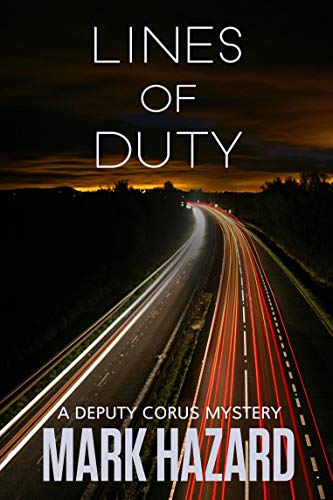
I kind of enjoyedLines of Duty, the first book in Mark Hazard’s Deputy Corus series, set in King County, Washington. So I went on to Book Two, Thin Gray Lines.
Corus, who was a police trainee in the first book, is now a rookie with the department. His boss decides his particular skills, honed in Special Operations, will be useful in investigating a drug operation that seems to be operating on a very large onion farm downstate, near Walla Walla. He sends Corus off with his superior, Danny Jamison, to babysit him, but Danny has other plans. He wants to spend the weekend with his wife, working on their marriage problems. So Corus ends up going on his own.
He decides to go in undercover, as an illegal Hispanic laborer. He will encounter the strange, dysfunctional family that runs the place, along with their innocent daughter and her lover, a South African struggling with his conscience. Also various bad guys, not so bad guys, and plain victims, including an illegal laborer trying to actualize the teachings of Tony Robbins. The final showdown will be – literally – explosive.
Thin Gray Lines was entertaining and engaging, with the same positive energy I noticed in the first book. What I didn’t like about it was, first of all, that the amusing cast of characters we got to know in the last book get very little time on stage in this one. Also, there was some New Age stuff, and a negative depiction of strict Christian groups.
So I guess I won’t go on with this series. But it’s not bad.
Earlier I said I was missing parts of the story being framed up in Jonathan Hickman’s New Avengers series, volume two, called Infinity. That missing part was something like the whole backside of a house. I feel as if I’ve read three Longest-Day-style war stories back to back, and I’m glad I didn’t borrow this collection of issues before reading Everything Dies. While that collection begins with a page telling part of a previously told story, those details introduced the opening scene neatly. Whenever you pick up a comic book that is not issue one, you should assume you’re stepping into the middle of a story at some point.
Infinity by Hickman, Spencer, Latour, and many illustrators begins at issue seven in the series I’ve been reading and issue fourteen in a separate series, so yeah, if I was inclined to be lost by characters I’ve never even heard scant rumor of, then I’d be lost like the shed key I thought I put in the drawer back in October and, I assume, has since been borrowed by the little people of the house.
There’s no way to summarize this book, but I can say its plot is instigated by the loss of the infinity gems I alluded to in the other post. When the gems were used, it appears at least three powerful beings, Thanos among them, noticed immediately. War is raging through the universe, and Thanos looks over Earth and sees an opportunity to accomplish one of his life ambitions–to kill his son.
The battles are legitimately marvelous, and Captain America shines as the man who sees the winning strategy when brute force has been beaten against the wall. But sometimes the more powerful characters appear to be holding back.
One young man, maybe fifteen years old, is known by many others as having great, cosmic power, but he doesn’t know it himself. So when he has to be coached into using his strength, there’s a sense to it; when other characters use their fists until they are almost struck down before ka-booom! they let loose their unique power, I’m left wondering why they didn’t do that to begin with.
I assume this book reflects Marvel’s mythological metanarrative accurately, but that narrative may not be neatly defined. There are plenty of cosmic beings, one of whom is a beautiful woman who apparently created everything. The great enemy that brings so many disparate empires and heroes together to oppose it claims to be agents of evolution, destroyers and creators as they deem appropriate. They note they were created by the universal mother and have since rejected her. At another time, as she lay unconscious, the heroes repeat the main refrain of these books, that everything dies–men, worlds, gods, and galaxies. We’re all just dust in the wind, I suppose.
So what’s the point of it all? asks a younger team member, an Australian named Eden. “How do you make sense of it? Fate? Faith?”
Sometimes a novel can be fairly ordinary in itself, but will reveal intriguing possibilities. That was my reaction to Lines of Duty, by Mark Hazard, first installment in the Deputy Corus series.
“Corus” is the only name of the main character; he has no first name (This is the second book I’ve read recently with a one-name character. Can you even do that in the modern world?). His personal background is mysterious, but the book begins with his last day on Special Forces duty in Afghanistan. He is a brave and decorated soldier. Shortly after his return to the States, he and his wife establish themselves in Seattle, where he has enrolled in a special, elite police training program.
Corus is the best shot in his class. Another classmate, Albert Chu, is the best academically. They fall into an odd, symbiotic friendship as they deal with the considerable pressures of the program. One day, while they are doing grunt work with unclaimed evidence, Corus discovers some diamonds that were never reclaimed by their owner. That, along with other strange points about the evidence, leads him and Chu to poke into the old case. This will have them investigating rodeo people, drug dealers, and an eccentric old lady with an amazing heart.
The author, Mark Hazard, is – judging by this book – good at characterization, but middling on dialogue. His characters sometimes talk like books. But I still liked the characters, and there’s an attitude of positivity here that I can’t help liking. I’m reading the second book now.
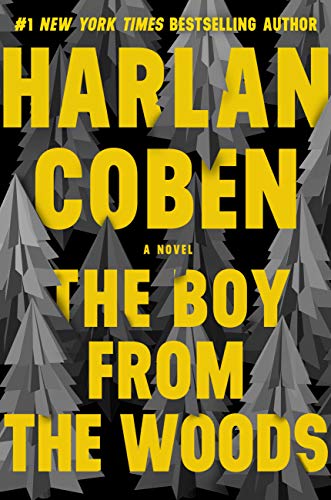
I’ve become a fan of Harlan Coben’s novels, especially since he moved out of sports-based mysteries to more domestic stories, in which responsible husbands and fathers go to extraordinary lengths to rescue family members.
The hero of The Boy from the Woods is a man known only as Wilde. Wilde comes equipped with a fairly implausible back story. As a boy, he was found living in the New Jersey woods, apparently a feral child – although he could speak and read English. No family ever stepped forward to claim him. He entered the military, and then briefly became a private investigator. He still lives in the woods.
The closest thing he has to a family is that of Hester Crimstein (a continuing character who often shows up in Corben’s novels), a tiny but relentless celebrity criminal lawyer. He was particularly close to her youngest son, who died in an auto accident. Now he’s kind of a mentor to her grandson Matthew, who’s in high school.
One day Matthew contacts Wilde and asks for his help. A girl in his class, Naomi Pine, has disappeared. Naomi had been the victim of universal bullying in their school. Matthew is concerned she may have done herself harm.
Wilde’s investigation will lead to unexpected connections with the campaign of a popular presidential candidate, one whom Hester dislikes and fears. This man (a sort of cross between Donald Trump and Rush Limbaugh, by way of Nietzsche and Mussolini) has secrets he will go to any length to cover up. However, even when the truth comes out at great cost, it will prove to be not quite the truth.
The Boy from the Woods kept my interest all the way through. However, some aspects of the story never worked for me. The “feral child” thing struck me as unlikely. (From what I’ve read, such children have been found from time to time in the real world, but they were pitiful physical specimens, nothing like the hunk Wilde has grown into). The mystery of his origins is clearly meant to be an ongoing thread in future books (this is obviously the beginning of a series), but it didn’t convince me.
Also – for no reason I can think of, except to score points with feminists – a group of security people consisting entirely of women (except for one transgender) is introduced. And when Wilde merely hints that their boss (a friend of his) might want to find a less dangerous job, since she’s the mother of four small kids, he gets shot down hard for sexism.
Also, the resolution of the story is unsatisfying in multiple ways.
So my final verdict is that The Boy from the Woods is an interesting, engaging (though ultimately frustrating) story, I don’t think I’ll follow the series any further.
He asked whether language was returning, and I said yes but slowly. Seeing my frustration, he said if a person were to lose any grammar then let it be adjectives. You could get by minus adjectives. In fact you appeared more decisive without them. He asked politely after my nouns, which were mostly intact, then declared with sudden intensity it was verbs you must truly not lose. Without verbs nothing gets done.
With the great novelists, like Leif Enger and me, you sometimes have to wait a while between books. In the case of Enger’s latest, Virgil Wander, it’s been ten years. It’s tempting to compare it to his previous novels, Peace Like a River and So Brave, Young and Handsome, but this one’s so eccentric that seems kind of pointless. It’s pretty wonderful, though.
Virgil Wander, the titular narrator, owns a crumbling movie theater in the moribund town of Greenstone, Minnesota. Once it was a mining town, but that ended long ago and nothing has replaced it.
Virgil is recovering from injuries sustained when he went over a cliff and into Lake Superior in his car. He was rescued by a chance passerby, and is now dealing with minor, probably temporary, brain damage. This damage has changed some of his behavior, not always negatively.
Realizing he needs someone to prevent him absentmindedly burning down his home, he looks around for a roommate (he’s a bachelor). He invites a new acquaintance, Rune Eliassen, a visitor from Norway, to move in with him. Rune came to town to learn about his son, a local sports hero, whose existence he had never guessed until recently. Unfortunately, the son disappeared a few years back, lost flying a plane over the lake or absconded – no one knows for sure.
Rune has a remarkable gift – he makes amazing kites, which he likes to fly over the lake. The kites don’t even look like kites – shapes of dogs and houses and cars and bicycles – but they are wonderful to fly, and Virgil feels strangely alive whenever he gets the chance to fly one.
Rune’s lost son has left behind a beautiful wife (whom Virgil loves from afar) and a troubled son. Other characters include the hard-luck Pea family, whose little boy is obsessed with catching a legendary big fish. And an alcoholic handyman trying to win his wife back. The wife, however, has gotten involved with a celebrity son of the community, a one-hit auteur who shocked the world with his single movie, and now has moved back, claiming he wants to settle down and help the community. He even agrees to appear at the upcoming local festival – “Hard Luck Days” – which might just live up to its name all too well.
Meanwhile, Virgil has recurring visions of a man walking on the lake – and it’s not Jesus.
Most novels (and there’s nothing wrong with this) are experiences where you read along to find out what happens next. This book (it’s a little like Wodehouse in that way) is one where you savor each line and paragraph for its own sake, because the writing itself is a pleasure.
If we hadn’t been looking we’d never have seen it. I wondered then and still wonder what giants we miss by not looking.
Virgil Wander is a delightful book. I luxuriated in it. I recommend it highly. There’s Christian content here, by the way – but it’s parabolic, for those who have eyes to see and ears to hear.
I mentioned a few days ago that I was reading a series called New Avengers, and when I began considering what I could say that would be worth reading (a barrier to entry that you might say hasn’t stopped me before) I remembered some gaping plot points. A war is started and then shrugged off. A major cosmic villain appears and is suddenly neutralized behind the scenes. What am I missing?
I am missing another entire series that fills in the story. Why isn’t there a note at the end of one issue that the story continues in another series’, because when you finish issue 6 and pick up issue 7, you tend to expect the story to pick up with you.
I’m reading the 2014 New Avengers series by Jonathan Hickman, a four volume set. This is the first cover, showing Steve Epting’s excellent artwork. Each volume has a different lead illustrator; all of them impressive. In Everything Dies, seven heroes who aren’t necessarily Avengers, if that term means something, gather as the secret rulers of the known universe, the Illuminati (which is the only name that can be given to that sort of group, even if no one ever uses it).
They meet because Black Panther witnesses a woman, calling herself a black swan, jump to our planet from another one that hung perilously above. She then detonates the first one, and swoosh, all returns to normal. She claims there’s a natural order to the multiverse (infinite parallel universes, infinite parallel realities), and while everything will eventually die, something happened on an Earth in a universe somewhere that caused it to come to an untimely end. That weakened the walls between universes apparently, because it led to two universes touching each other at their point of Earth. As you’ve likely seen in the news, when two universes reject social distancing guidelines, they eliminate each other.
When universes are eliminated, it bothers people, particularly those who wear the same form-fitting suit to work everyday.
The other Earth that the black swan dropped from was an Earth in its own universe. Soon another one will appear in the sky, and if one of the two planets is not destroyed quickly, both universes will perish. The heroes begin work on an early warning system, hoping to give themselves eight hours to save one or both universes. And then someone remembers he has an old infinity gauntlet in his car trunk, and since they have all the infinity gems already, why not try using it?
I’ve been reading Pete Brassett’s Inspector Munro mysteries for a while. I’m not sure I’m entirely on board with the new turn the series has taken, though. Our former hero, heretofore a paragon of physical fitness (mountain running was one of his favorite sports) has suddenly grown old. He’s had a heart attack and is retired – though he’s happy to assist his former subordinates on his own time.
So now the central character is Inspector “Charlie” West, a woman from London who overcame alcoholism after moving north to Scotland. She’s not a bad character, but it seems like everybody’s doing female detectives these days, and it annoys me.
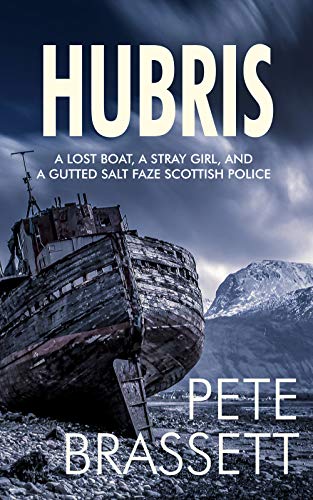
Anyway, the latest book in the series, Hubris, involves a beached fishing boat which a farmer discovers on the shoreline of his property. Looking inside, he finds a man in the hold, gutted like a fish. Forensic evidence indicates the presence of drugs.
Meanwhile, that same farmer’s daughter has gone missing. Why did the family wait to alert the police?
Unsuspected connections will tie the two cases together, and old secrets will resurface to devastate lives. But the detectives are on it, and Inspector Munro will be on hand to provide guidance as well.
Hubris is a good, workmanlike police procedural, with only minimal objectionable content. The series is worth following.
Host: Would the real Robin Hood, outlaw of Sherwood Forest, Duke of Lockesley, please stand up? Psst, one of you should stand. Who’s the original?
(All three subjects stand.)
Host: Ha, ha! They’re still playing with us, folks. Okay, that’s swell. Now, two of you sit down and the genuine Robin Hood remain standing. Come on, now. We’re running out of air time.
Shout from audience: Let ’em shoot it out with arrows!
Blackthorn and Stone has written about the changing character of Robin Hood and how the original stories aren’t the most important thing about him. Was Robin an actual person who lived over 650 years ago? No, he appears to be have been a commonly beloved folk hero.
Interesting to note about the early Robin Hood-esque character is that Hereford’s noble status and inheritance problems don’t feature in the country pageant version of Robin Hood—however, they do turn up again in the Tudor period and have stuck with us ever since.
Did the Tudor era reinvent a Robin Hood for their purposes, or were they actually harkening back to the original conception of the rogue? Evidence for the interpretation of Robin Hood as an archetype, rather than a person, is found when looking at where the vast majority of Robin Hood pre-1600 source material comes from: plays and festivals.
Websites store cookies to enhance functionality and personalise your experience. You can manage your preferences, but blocking some cookies may impact site performance and services.
Essential cookies enable basic functions and are necessary for the proper function of the website.
Name
Description
Duration
Cookie Preferences
This cookie is used to store the user's cookie consent preferences.
30 days
These cookies are needed for adding comments on this website.
Name
Description
Duration
comment_author
Used to track the user across multiple sessions.
Session
comment_author_email
Used to track the user across multiple sessions.
Session
comment_author_url
Used to track the user across multiple sessions.
Session
These cookies are used for managing login functionality on this website.
Name
Description
Duration
wordpress_logged_in
Used to store logged-in users.
Persistent
wordpress_sec
Used to track the user across multiple sessions.
15 days
wordpress_test_cookie
Used to determine if cookies are enabled.
Session
Statistics cookies collect information anonymously. This information helps us understand how visitors use our website.
Google Analytics is a powerful tool that tracks and analyzes website traffic for informed marketing decisions.
Used to monitor number of Google Analytics server requests
10 minutes
__utmb
Used to distinguish new sessions and visits. This cookie is set when the GA.js javascript library is loaded and there is no existing __utmb cookie. The cookie is updated every time data is sent to the Google Analytics server.
30 minutes after last activity
__utmc
Used only with old Urchin versions of Google Analytics and not with GA.js. Was used to distinguish between new sessions and visits at the end of a session.
End of session (browser)
__utmz
Contains information about the traffic source or campaign that directed user to the website. The cookie is set when the GA.js javascript is loaded and updated when data is sent to the Google Anaytics server
6 months after last activity
__utmv
Contains custom information set by the web developer via the _setCustomVar method in Google Analytics. This cookie is updated every time new data is sent to the Google Analytics server.
2 years after last activity
__utmx
Used to determine whether a user is included in an A / B or Multivariate test.
18 months
_ga
ID used to identify users
2 years
_gali
Used by Google Analytics to determine which links on a page are being clicked
30 seconds
_ga_
ID used to identify users
2 years
_gid
ID used to identify users for 24 hours after last activity
24 hours
_gat
Used to monitor number of Google Analytics server requests when using Google Tag Manager
1 minute
_gac_
Contains information related to marketing campaigns of the user. These are shared with Google AdWords / Google Ads when the Google Ads and Google Analytics accounts are linked together.
90 days
Marketing cookies are used to follow visitors to websites. The intention is to show ads that are relevant and engaging to the individual user.
A video-sharing platform for users to upload, view, and share videos across various genres and topics.
Registers a unique ID on mobile devices to enable tracking based on geographical GPS location.
1 day
VISITOR_INFO1_LIVE
Tries to estimate the users' bandwidth on pages with integrated YouTube videos. Also used for marketing
179 days
PREF
This cookie stores your preferences and other information, in particular preferred language, how many search results you wish to be shown on your page, and whether or not you wish to have Google’s SafeSearch filter turned on.
10 years from set/ update
YSC
Registers a unique ID to keep statistics of what videos from YouTube the user has seen.
Session
DEVICE_INFO
Used to detect if the visitor has accepted the marketing category in the cookie banner. This cookie is necessary for GDPR-compliance of the website.
179 days
LOGIN_INFO
This cookie is used to play YouTube videos embedded on the website.