
Jason Duesing talks about taking the time to stare at a painting, Caravaggio’s “Saint John the Baptist in the Wilderness” and what slowing down could mean for anyone.
All posts by Phil
The Traveling Bookstore of France
Jean-Jacques Megel-Nuber’s first drawing of his imagined bookstore on wheels had little in common with its final design. “It looked like the cabins in a Christmas market,” says Megel-Nuber, who is from the Alsace region of eastern France, known for its festive seasonal markets. He had originally thought about opening a brick-and-mortar bookshop but decided he wanted one that could travel to French country towns whose bookstores have often closed. He also wanted a space where he could live during his travels.
So he commissioned a young design firm to construct a cute, little store on a trailer that travels through rural France with 3,000 books, typically stopping at festivals. He’s dubbed his shop Au Vrai Chic Littérère (The Truly Elegant Literary).
‘Being judged by our children as morally corrupt’
British author Sofka Zinovieff, 58, has written a book set in the 70s about a relationship between a child and an adult who is twenty-five years older. It has been called “a Lolita for the era of #MeToo.” In The Guardian this month, she writes about how her daughter’s generation think they have this morality thing all figured out.
When I asked my 23-year-old daughter whether there was sometimes too much emphasis on consent, she retorted: “You can’t debate the importance of consent when rape is still such a big issue. It’s confusing priorities.”
I tried again with my 26-year-old daughter. “It must sometimes be hard these days for sensitive, intelligent, young men,” I said. “They have to be so careful about what they can say and do.”
“It’s only about not being an ****##$*,” she replied curtly. “That’s not so difficult. It’s just speaking and behaving with respect.”
Zinovieff doesn’t spell out exactly what she’s defending. Perhaps we’d have to read her book to get a better idea. But I wonder if both she and her daughters are saying the same thing: whatever happens in a physical relationship, if everyone continues to say he or she approves of it, then it’s good or at least difficult to oppose; only when someone says he or she has been hurt does the relationship become a problem.
Continue reading ‘Being judged by our children as morally corrupt’How Landing on the Moon Changed Us
We once thought nothing was in the heavens, at least nothing like what we saw around us. We didn’t see the moon as a destination of any kind. Joseph Bottum says that began to change after the Renaissance. Authors used the moon as a metaphor for their own commentary for a while; later sci-fi authors explored how we could get there and who might meet us. Before the moon landing, authors told new stories of an uninhabited moon.
But after the 1969 moon landing, the expectation shifted again—to the notion that now we would see a rapid expansion of human settlement out into the solar system. The moon would be a pawn in interplanetary politics, a hostage in the fight between such dominant powers as Mars and the moons of Saturn. . . . That space mission 50 years ago—Neil Armstrong and Buzz Aldrin moonwalking on July 20, 1969—felt to science-fiction writers mostly a precursor, a first step, to the planets beyond.
Research into Writer’s Block
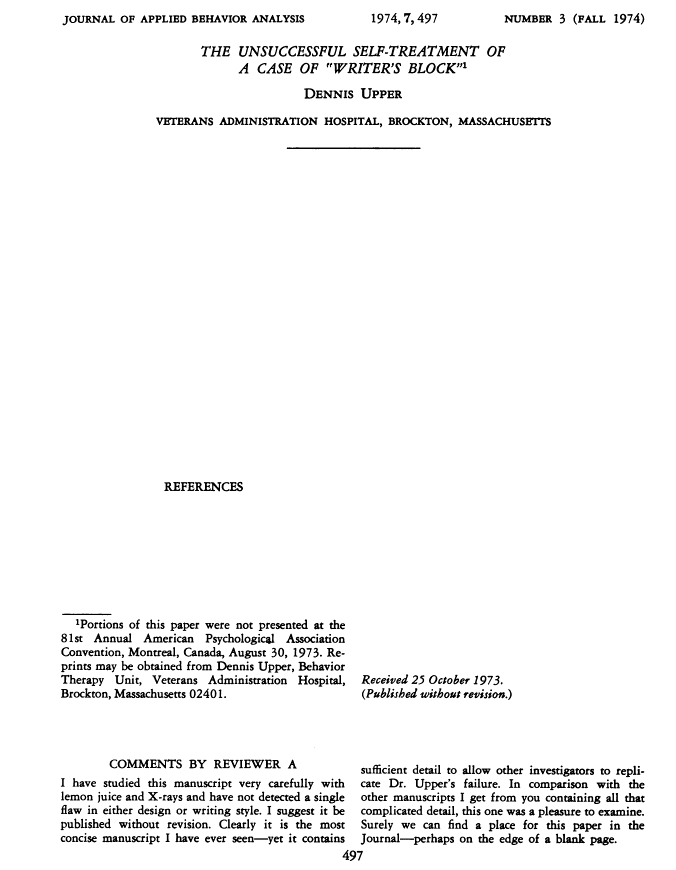
[Seen on Twitter, also found here.
Brutal Opposition (Sometimes Fictitious)
Journalist Andy Ngo has spent a good bit time looking at hate crimes and hoaxes of them. He said, “If you constantly tell the public that bigotry is everywhere, some will do anything to seek it out or even create it when they can’t find it.” This piece backs up that assertion, in which Ngo starts with the lawsuit Oberlin College lost to a local bakery and notes the numerous hoaxes its student body has generated. He reports,
In 2013, students at the elite liberal arts college panicked after someone reported seeing a person in a Ku Klux Klan robe on campus. The administration cancelled all classes for the day. The phantom klansman was never found, though police did find someone wrapped in a blanket. This overreaction was preceded by a month-long spate of racist, anti-Semitic, and anti-gay posters around campus. These, too, were found to be hoaxes.
Twitter is good at these misdirections. Today people are noticing a trending hashtag #NotMyAriel, supposedly in response to the adorable Halle Bailey being cast in a live action remake of The Little Mermaid. However of all the comments pushing back on her casting, none of them use that hashtag. You’re yawning; I can tell. Am I boring you?
Ngo’s reporting is far more serious than unused hashtags. He has worked to expose Antifa for the dangerous group it is. In Portland, Oregon, last Saturday, he was attacked by protesters and consequently hospitalized. Quillette magazine states, “Like schoolboy characters out of Lord of the Flies, these cosplay revolutionaries stomp around, imagining themselves to be heroes stalking the great beast of fascism. But when the beast proves elusive, they gladly settle for beating up journalists, harassing the elderly or engaging in random physical destruction.”
Ngo has written more on the attack in this piece for the Wall Street Journal, going so far as to say Portland is growing into a sanctuary city for “domestic terrorists.”
Joy Harjo Named Poet Laureate
We were running out of breath, as we ran out to meet ourselves. We were surfacing the edge of our ancestors’ fights, and ready to strike.
from “An American Sunrise” by Joy Harjo
Joy Harjo has appointed the next U.S. poet laureate. She is of the Muscogee Creek nation, born in Tulsa, Oklahoma, and the first Oklahoman to be named poet laureate.
She told Tulsa World, “I know a lot of young people were turned off from poetry when the teacher would ask us to ‘tell what the poem means.’ But sometimes, it’s better just to listen. I mean, we all listen to something like ‘Hotel California,’ but could we really explain what it means? What is so amazing about poetry is that it’s a way to speak beyond words.”
Many outlets are reporting that Harjo is the first Native American to be appointed to this position, but poet William Jay Smith, who was part Choctaw, held the position in 1968-70. (This detail was pointed out by A.M. Juster, which I learned through Prufrock)
Eating Seasonally, Feasting Locally
We don’t plant a backyard garden every year and have grown a good crop only two or three times. You may have had more zucchini than you could eat time and again, but we’ve only begun to approach that level once. Usually our squash grows leaves and flowers but no fruit. Once I grew some nice turnip greens; at least the first batch was nice. The second was to bitter. I put only tomatoes and basil out this year, because I didn’t get around to clearing the other bed and trying beans.
Gracy Olmstead has a good piece on feasting, the church calendar, and seasonal eating, noting the self-control and humility it takes to live closer to the land around you.
Don’t get me wrong: we’re incredibly fortunate to get avocados and bananas year-round, and to have refrigerators and freezers in our houses. But I think we’ve also lost some of the joy of food, the ability to treasure the flavors of the seasons, because we no longer understand these patterns of waiting and feasting.
This concern became especially real for me two summers ago, after my husband and I moved to the Virginia countryside. As we were unpacking our books and clothes, I transplanted our fledgling tomato plants into a garden plot the previous homeowners had left behind. Those plants seemed to shoot upward overnight, spreading with fervent glee. . . .
Soon we were picking giant bowls full of tomatoes every day, and the toddler and dog would sit next to each other in the garden and eat them to their hearts’ content.
Death Levels Us All
Matthew McCullough’s recent book on death was featured last week in World Magazine’s Saturday series. It’s not a subject I like to think about, perhaps because I like to imagine I’m above it just as he says here:
The reality of death is profoundly humbling. It tells me that I’m not indispensable. It assures me I will be forgotten. And so death boots me from my self-appointed place at the center of the universe. But learning to recognize death’s challenge to my subconscious narcissism also raises haunting questions about who I am. It isn’t just that death is humbling. It can also be profoundly disorienting.
Most of us would probably agree that a reality check is a generally a good thing. No one likes a narcissist. Wouldn’t it be better for all of us if none of us saw himself as more important than everyone else? If death puts us in our place, that’s ultimately healthy, right?
Yes … but. Death’s challenge actually pushes even deeper. Death’s statement does more than put us in our place. It also raises questions about where our place actually is.
PTSD in Greek Tragedy
Scott Beauchamp reviews a Barnard Columbia Ancient Drama production of Euripides’s Herakles. It’s being performed in ancient Greek with English projections, so — dang! And the music is no afterthought, evoking a unique, ancient feel.
Beauchamp says the story of the god-like Herakles, who returns home to save his family but is deceived by malicious gods, draws him in.
As a former soldier myself who spent years away from his family, it’s difficult for me not to read PTSD into the story of Herakles. Trauma never finds you where you expect it to. It’s never in the moment of combat itself, or triggered by toy guns or cars backfiring (at least not in my experience). PTSD sneaks in through the attic window when you least expect it. You might be driving along on a beautiful day, listening to the radio. Or grocery shopping. Or mowing the lawn. It’s never when you’re ready for it, when it’s obvious. Lyssa [the goddess of rage] comes in at the most anodyne times, or the most exalted ones. She comes right at the moment when your labors are done, you’ve returned home, and put your house back in order. She destroys your clichés from the inside out.