Periodically we note great outcries in the media about “book banning.” The banning of books is indeed a serious issue, when it actually happens, but what these scares are about is almost never real banning. Banning means a book is declared illegal, and its publication and possession are forbidden by law. The closest thing to that that’s going on these days is when conservative books get cancelled by publishers. Which isn’t real banning, either.
Let me divulge (once again, because people keep forgetting) a secret from the forbidden world of librarians – librarians are not actually against banning (in their own sense of the term) books. They call it banning when parents want books kept out of libraries, or at least out of their children’s hands. But the fact is, librarians keep books off the shelves all the time. Deciding what books to acquisition, and what books to reject, is part of a librarian’s job.
The librarians aren’t against books being “banned” in that (erroneous) sense.
They’re against the peasants doing it.
Librarians believe that they themselves, as the anointed priesthood, have the sole right to “ban” books. They go into a snit when mere parents and concerned citizens violate their turf.
I used to be a librarian, but I’m out of the racket now. If I mysteriously disappear, you can be sure the Enforcers of the ALA have abducted me, and I probably sleep with the discards, for violating the Unwritten Code.
Occasionally I run across a book that reminds me what non-Christians must experience when they attempt to read a conventional Christian Booksellers’ Association novel. That was my response, at least, to The Detective Wakes, by Jim McGhee. It’s the start of a series, but I’m not taking it further. I did, however, finish it. I wanted to know whether it would surprise me. No such luck.
Barney Mains is an Edinburgh police detective with a moribund career. He isn’t sure why he’s never gotten on with the department. Then (for some reason) he’s assigned to nursemaid a young female detective, Ffiona (two f’s) McLusky, whose star is rising in the department. Their assignment is assumed to be routine – go to the French Riviera to check on an expatriate Scot – Dot-com billionaire Shona Gladstone, who has been reported missing by her assistant. Everyone assumes the woman has just taken an impromptu holiday. But soon they know it’s kidnapping, and the race begins to figure out why she was taken, and to get her back.
The plot sketch above is in fact misleading. This is actually a political drama, about a plan by young international billionaires to change the world through getting all the governments to adopt social democracy – guaranteed minimum income, wealth tax, green policies – to save civilization in the wake of the Covid epidemic. There are few nuances here – the good guys wear white hats, the bad guys are either corrupt or fascists. No real consideration is given to the possibility that the plan might be counterproductive, as so many socialist schemes have proven in the past. The good guys don’t always use legal means, but hey, everything’s cool when you’re fighting fascism, right?
There were moments of comedy, but they were mostly unintentional – as when the author assures us that the media are almost totally controlled by the right wing.
Have there already been 18 Inspector Skelgill books, set in English Cumbria? I must be enjoying them, because I keep coming back. Inspector Daniel Skelgill is definitely an example of the “curmudgeonly detective” trope, but he manages to remain a sympathetic character. In some ways he seems barely human – especially in relation to women, he seems entirely impassive. Some fun is had with that character trait in this book, Murder Unsolved.
Skelgill’s parents came from rather different families. He seems to favor his father’s side, hard-working, disciplined, stoic. But he’s a Graham on his mother’s side, and they are a different matter. The Grahams are a marginal clan in Cumbria (I remember them being mentioned in accounts of the days of the Border Reivers). They party hard and are inclined to cut corners with the law. But Skelgill has recently had some positive contact with some of his Graham cousins, and one of them, a young woman, asks for his help.
She has a friend, Jade, a beautiful young woman whose old boyfriend, Dale Spooner, a petty criminal, is serving time for a murder three years ago. Two local gangsters were found dead in a burned-out car, and forensic evidence put Dale at the scene. But Jade says Dale has an alibi, which he won’t talk about.
Skeptical at first, Skelgill and his team, DS Jones (female) and DS Leyton (male) look into the evidence (off the record) and find that the case was very shoddily investigated. The case was covered by a team led by Inspector Smart, a smarmy and sly detective none of them respect. They soon realize that a lot of criminal activity has been going on in this apparently quiet country area, and there are people with much greater motives for the murders than Dale Spooner had. And those people will not hesitate to eliminate nosey coppers.
Murder Unsolved was as enjoyable as the previous books in the series. One of the great strengths of author Bruce Beckham’s writing is his wonderful descriptions of the fell country. My only disappointment was that he confused “flout” with “flaunt” on two occasions.
The Skelgill books contain no profanity; sometimes the author openly explains that he’s employed a circumlocution.
Photo credit: New York Public Library. Via Unsplash.
Here’s what came up in my personal devotions this morning. I was reading in Romans 13:
For because of this you also pay taxes, for the authorities are ministers of God, attending to this very thing. Pay to all what is owed to them: taxes to whom taxes are owed, revenue to whom revenue is owed, respect to whom respect is owed, honor to whom honor is owed. (v. 6-7, ESV)
This may offend some of my friends, but there’s zero biblical grounds for saying taxation is theft. The passage above clearly states that we have an obligation before God to pay our taxes (note, Paul’s talking about the Romans here. Nero is the emperor). Government, Paul says, is ordained by God and He expects us to bear our share of the costs.
A particular tax may be unjust. It may be disproportionately levied. It may be too high. We have every right to dispute wrong taxes, and to minimize our own payments the best we can within the law. Tax reform is great. Particular taxes should in many cases be abolished.
But a Christian has no business saying “Taxation is theft” as a general principle. I overlook it when my agnostic or atheist Ayn Rand-following friends say that. But Christians should not.
After all the fights we’ve had about abortion and homosexual marriage, it bothers me to see conservative Christians spouting plainly unbiblical slogans.
Wyatt Earp and friends in Dodge City in 1883. Wyatt is 2nd from left in the front row. Bat Masterson is 2nd from the right in the back row. The rest of these guys you’ve probably never heard of. But there are several pristine Boss of the Plains Stetsons here.
Today I got more translation work, so that’s what I’ve been doing, pretty much. This puts us all at the mercy of my wandering brain, which alights on random topics in idle moments.
I don’t think I’ve ever talked about cowboy hats on this blog. I mean, what could be more appropriate for a book blog? (Hey, there are lots of books about cowboys. Some of them are even good. A few are excellent. As with every other subject.)
Most of us are well acquainted with cowboy hats – we think. But in fact, the cowboy hat as we think of it today is not one the old-time cowboys would have recognized.
The original cowboy hat, of course, was designed by John B. Stetson (1830-1906), a hat maker from New Jersey. He went west for his health (consumption), and used the skills he’d learned in his father’s hattery to make a wide-brimmed hat to wear under the western sun. Originally it was a joke, but he found it useful and comfortable, and later a cowboy bought it off him for five bucks. Eventually Stetson went to Philadelphia (the western climate had cleared up his tuberculosis) and started making hats for the cowboy trade. The rest is history.
Here’s an interesting detail – John B. Stetson was a devout Baptist. The profits that came from selling hats to all those wild and wooly western characters – cowboys and rustlers and gamblers and saloonkeepers – went largely toward his charitable interests, to build the Kingdom of God.
That original cowboy hat style was called “The Boss of the Plains.” It had a relatively tall, rounded crown and a relatively wide brim (though not as tall or wide as the one Kurt Russell wears so well in “Tombstone”). There was no idea, originally, of curling the brim or denting the crown. Those things happened, of course, when a fellow was working a ranch, but were considered slightly disreputable. A respectable man, like the Earps aspired to be, took pride in keeping theirs nice and flat and uniform.
I realized recently that I’ve carried quite a stupid idée fixe in my head all my life, about Wyatt Earp’s hat. I watched the old Wyatt Earp show starring Hugh O’Brien back when I was a kid. One of his trademarks was a flat-brimmed hat, sort of a Spanish hat really, which stood in for a Boss of the Plains on the show. When I first saw the photo above, where Wyatt (second from the left, front) wears a genuine BOTP, I associated that hat (often reproduced in images cropped to make the crown look higher than it is) with him. And whenever I’ve seen a Wyatt Earp movie since, I’ve compared the actor’s hat to that one. (There’s another picture of Wyatt in the same, or a similar, hat – a group photo in front of the fire department in Tombstone. Wyatt is pretty small in that one, but it’s recognizably the same style.)
What I realized recently, though, is that almost everybody wore a BOTP in those days. If I’m going to obsess about Wyatt’s hat, I should obsess about all the others. Wyatt’s hat was in no way unique. Relax, I tell myself. It’s just a movie.
By the way, you know where those turned-up sides on cowboy hats came from (“four in a pickup hats,” I’ve heard them called)? Not from the cowboys themselves, but from movies. In the early days of movie making, lighting was primitive. Scenes were shot out of doors or in open-roofed studios, in natural light. Nobody had figured out you could illuminate a person’s face from below, with reflectors. So when they shot Westerns, the hats were a problem. They shaded the actors’ faces – a real obstacle in a silent film where facial expressions are everything.
So the lighting people went around and turned the hats up on the sides, to let some light in. Then, in a weird twist, the real cowboys saw hats shaped like that in movies, and turned their own up on the sides to look cool.
Most of what’s below can be skipped without any loss to the diverse richness of your life. It’s just the account of my day, offered here for your perusal because I can’t think of anything actually interesting.
No, wait, I do have one interesting fact. Norway has opened its borders again. The requirement that people traveling from countries outside a certain short list must go through a quarantine period before entering has been lifted. You still need to show proof of vaccination, but this is a big relaxation. A step back toward normal life, one fervently hopes.
“Following a recommendation from the National Institute of Public Health, the government is abolishing the requirement for entry quarantine because it is no longer considered necessary for infection control,” the Norwegian Ministry of Health stated.
You may recall that I predicted something like this just a few days ago, based on the amount of translation work I’ve been getting – which would seem to indicate a belief inside the film industry that freer association and travel are coming. I didn’t expect it to happen this fast, though. No doubt the movie moguls I serve in my small way have friends in high places, who tipped them the high sign.
Today was my first day without translation work since… I don’t recall. Probably less time than I think. But it’s been a string of days. I’d marked today out, whatever my work situation, for shopping and errands. (Note: it’s in times like these that I contemplate finding a wife. Only I know she’d retaliate with a Honeydo list.) The coldest day of the week isn’t prime time for such activity, but there are moments when you just need to go to the store, or else you’ll run out of some staple, like chocolate or beef jerky or pigs’ feet.
As I planned my day, I realized a lot of stuff had piled up on my list. It called for careful trip planning and logistics. Aside from the gym in the morning, which was a separate excursion, I must:
Go to the post office. Take my suit to the cleaners. Run my car through the car wash (not optimal on a day with a high around zero, but on the other hand there wasn’t much of a waiting line). Go to Wal Mart for a new computer monitor (because I knocked the old one over and broke the screen. Nothing to do with old age and clumsiness, of course – I was just as clumsy at twenty. And the piece of junk was always unstable. Which should teach me to buy computer components at Wal Mart). Get groceries. Stop at the drug store for immune system supplement. Then get the new monitor working, which is always more complicated than you expect, if you’re over ten years old.
I’m planning to work on the novel tonight. If God gives me strength. And the monitor doesn’t fall over again.
Inspector John Shadow of York, hero of H. L. Marsay’s police procedural series, is annoyed by many things. Crowds for one, which is unfortunate for a man living in a tourist city. Festivals. Geese. Modern music. Social interactions. At the beginning of A Ghostly Shadow, he’s annoyed, as Guy Fawke’s Day approaches, by the costumed tour guides leading “ghost walks” through the city. York is renowned for several ghosts, most prominently Guy Fawkes of the Gunpowder Plot and Dick Turpin the highwayman. Currently, a couple new guides from Oxford have established themselves in the city and are dressing as Fawkes and Turpin, taking business away from local ghost impersonators. Also, somebody has been stealing tour brochures from kiosks.
Then the new Dick Turpin is found hanging from a tree, near the very spot where the original Dick swung for his crimes. Shadow’s team must investigate the murder, under pressure from the city, as usual, to wrap things up before it affects business. Inspector Shadow’s attitude is not improved when he sprains his ankle and has to depend on other people’s help.
I suspect my affection for this series springs from my identification with Shadow himself, as a fellow misanthrope (though I think he’s ruder than I am, yet people seem to like him for some reason I can’t divine). But the writing isn’t top drawer (author Marsay is prone to clichés like “pale and drawn”). Nevertheless, the book was fun to read, and there wasn’t much to offend me. Recommended for light reading.
Being somewhat busy tonight, and having no useful ideas of my own, I turn this space over to G. K. Chesterton as my guest blogger. This film is from his appearance at Holy Cross College, Worcester, Massachusetts, in 1931. His remarks will be brief, and a couple splices in the film have been patched with still photos.
Have a good weekend, my friends, and don’t go outside barefoot.
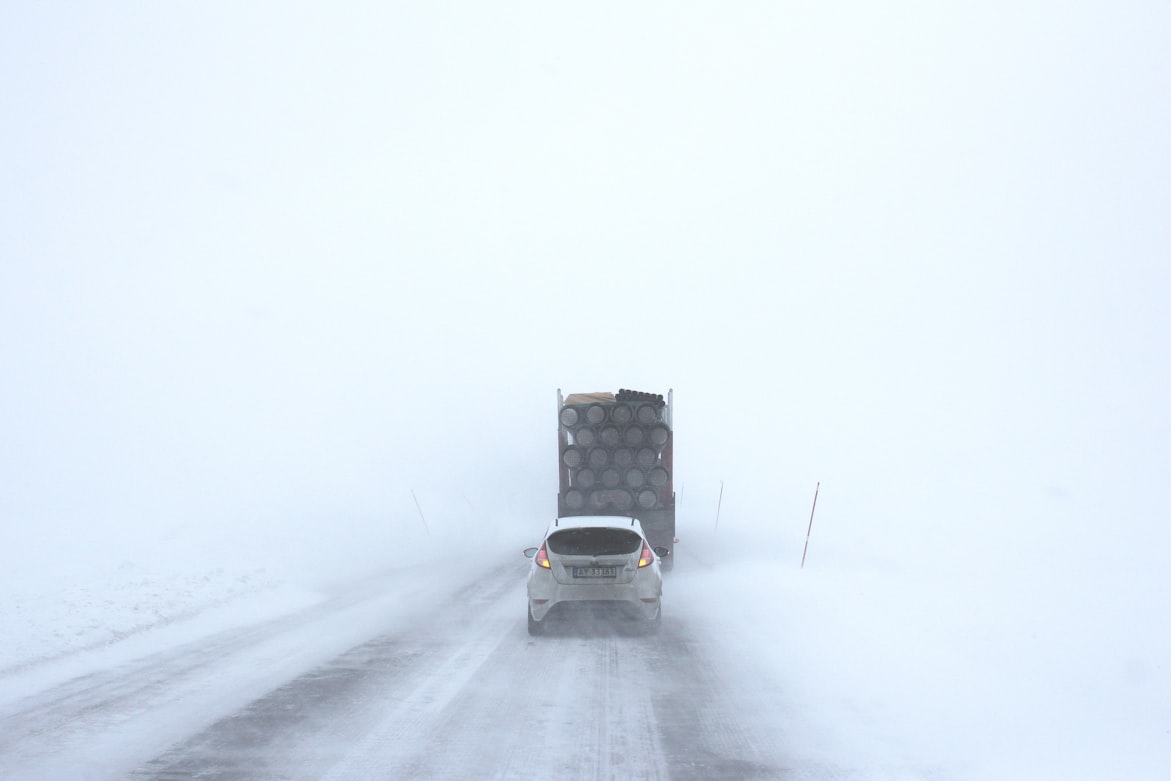
Winter driving in Tromso, Norway. Driving yesterday looked nothing like this, but it’s Norway. Photo credit: Remi Jacquaint @jack_1. Unsplash license.
Back to translating today. I’ve been pretty busy for… well, for the last couple months. My subjective conclusion is that, although Norway remains locked down fairly severely, its film and TV industry is planning on working pretty hard, pretty soon. I think it’s agreed by all the smartest people that entertainment folks are infallible harbingers of future events, like groundhogs in little sunglasses.
Yesterday’s drive to Montevideo (yes, we have a town called Montevideo in Minnesota. I take no responsibility for this. The culprits are long dead) was a cold one. I said the other day that this winter has been an old-fashioned one. By that I meant old-fashioned in terms of frequent snow and thick snow cover. It’s been atypical, however, in terms of yo-yo temperatures. On Tuesday it got up to over 40⁰ Fahrenheit. Stuff melted all over the place. On Wednesday I got into my car at 7:00 am with the temp around 4 below. It rose to about 2 below as I drove, and soared to 8 above by the time I got back to the Cities.
This wasn’t winter like the picture above (chosen mostly because it was taken in Norway). This was one of those clear, cloudless days where the heat is raptured into what I once saw described as “the tremendous heat-sink of a clear winter sky.” This is the cold of space. Alien. Merciless. Frigid as a Minneapolis Star & Tribune critic when sent one of my books to review.
These cold-weather drives put one in mind of Fridtjof Nansen – if you’re a self-dramatizer like me. The cold permeates the car’s frame overnight, and it lingers, even with the heater on full blast. It was an hour before I could take my gloves off, and longer before I could take off my Homburg (it was a funeral. Had to wear my black Homburg).
I wore my black suit with waistcoat, and a Thinsulate scarf and my lined trench coat. Thinsulate gloves too. I was still bloody cold.
I returned to Minnesota from Florida, years back, because I missed spring.
Photo by Mayron Oliveira @m4yron. Unsplash license.
Today I once again drove several hours to attend a funeral in a distant part of the state. It was for my aunt Ada. I wasn’t terribly close to her, but I was fond of her. She may have been the happiest of my mother’s sisters (though I wouldn’t be dogmatic on the point). She worked for years as a school lunch worker, and sang with the Sweet Adelines. She was in her 80s, and her death was quick and easy, as such things go.
She was the last person living to have borne my maternal grandfather’s last name. (I’m not telling you what it is, because as you know it’s a common security question.) Though Grandpa has many descendants, they all come through the female line.
Turnout for the service was very good, and about half the crowd was her descendants and their spouses. It occurs to me that a very good (though not infallible) indicator of a persons’ happiness may be the number of children, grandchildren, etc. who show up at their funerals. I know conventional wisdom today says you’re happiest concentrating on career and self-actualization, but I think there’s a lot to be said for big families. My funeral, unless my plan for world domination succeeds, will probably be a fairly dismal affair.
Think how many people you know who have only one child, and are miserable because that child is unhappy or making bad life choices or on drugs or something. When you have one kid, you’re putting all your legacy eggs in one basket.
Have a “quiver full” (as the Bible puts it) of offspring, and you spread out the risk. One of those kids is likely to be happy and successful, and give you some satisfaction.
And let’s face it, “only” kids face challenges. When I was in school, and only kids were rare, it was commonly understood by the rest of us that only children had socialization problems. They came to school with expectations about how they’d be treated that were doomed to be disappointed. They’d missed out on the friction with siblings that prepares one for playing with others.
Advice on family planning, from a childless man. Take it for what it’s worth.
Websites store cookies to enhance functionality and personalise your experience. You can manage your preferences, but blocking some cookies may impact site performance and services.
Essential cookies enable basic functions and are necessary for the proper function of the website.
Name
Description
Duration
Cookie Preferences
This cookie is used to store the user's cookie consent preferences.
30 days
These cookies are needed for adding comments on this website.
Name
Description
Duration
comment_author
Used to track the user across multiple sessions.
Session
comment_author_email
Used to track the user across multiple sessions.
Session
comment_author_url
Used to track the user across multiple sessions.
Session
These cookies are used for managing login functionality on this website.
Name
Description
Duration
wordpress_logged_in
Used to store logged-in users.
Persistent
wordpress_sec
Used to track the user across multiple sessions.
15 days
wordpress_test_cookie
Used to determine if cookies are enabled.
Session
Statistics cookies collect information anonymously. This information helps us understand how visitors use our website.
Google Analytics is a powerful tool that tracks and analyzes website traffic for informed marketing decisions.
Used to monitor number of Google Analytics server requests
10 minutes
__utmb
Used to distinguish new sessions and visits. This cookie is set when the GA.js javascript library is loaded and there is no existing __utmb cookie. The cookie is updated every time data is sent to the Google Analytics server.
30 minutes after last activity
__utmc
Used only with old Urchin versions of Google Analytics and not with GA.js. Was used to distinguish between new sessions and visits at the end of a session.
End of session (browser)
__utmz
Contains information about the traffic source or campaign that directed user to the website. The cookie is set when the GA.js javascript is loaded and updated when data is sent to the Google Anaytics server
6 months after last activity
__utmv
Contains custom information set by the web developer via the _setCustomVar method in Google Analytics. This cookie is updated every time new data is sent to the Google Analytics server.
2 years after last activity
__utmx
Used to determine whether a user is included in an A / B or Multivariate test.
18 months
_ga
ID used to identify users
2 years
_gali
Used by Google Analytics to determine which links on a page are being clicked
30 seconds
_ga_
ID used to identify users
2 years
_gid
ID used to identify users for 24 hours after last activity
24 hours
_gat
Used to monitor number of Google Analytics server requests when using Google Tag Manager
1 minute
_gac_
Contains information related to marketing campaigns of the user. These are shared with Google AdWords / Google Ads when the Google Ads and Google Analytics accounts are linked together.
90 days
Marketing cookies are used to follow visitors to websites. The intention is to show ads that are relevant and engaging to the individual user.
A video-sharing platform for users to upload, view, and share videos across various genres and topics.
Registers a unique ID on mobile devices to enable tracking based on geographical GPS location.
1 day
VISITOR_INFO1_LIVE
Tries to estimate the users' bandwidth on pages with integrated YouTube videos. Also used for marketing
179 days
PREF
This cookie stores your preferences and other information, in particular preferred language, how many search results you wish to be shown on your page, and whether or not you wish to have Google’s SafeSearch filter turned on.
10 years from set/ update
YSC
Registers a unique ID to keep statistics of what videos from YouTube the user has seen.
Session
DEVICE_INFO
Used to detect if the visitor has accepted the marketing category in the cookie banner. This cookie is necessary for GDPR-compliance of the website.
179 days
LOGIN_INFO
This cookie is used to play YouTube videos embedded on the website.