All posts by Lars Walker

Translator’s notes

Today, of course, I worked at translation. Made good progress, too, and I’ll put some more time in tonight. I’ve got personal business to handle as well, but everything’s in hand.

Started reading a book by an unfamiliar author the other day. A bargain book for Kindle. According to the description it’s a Christian book, and it has a lot of good reviews.

Alas, so often the descriptor “Christian” indicates poor craftsmanship. So it was here.

I won’t tell you the author’s name or the book’s title. They might be favorites of yours. Many people better than me in almost every respect enjoy – or even write – books that don’t please me. It’s not for me to look down my nose at them. I know I’m turning into a literary snob in my dotage.

The author just hadn’t mastered the craft. The story may have been good – I tried to hang with it, to see if the plot grabbed me when the prose didn’t – but in the end I couldn’t hack it. I was opening it out of duty rather than anticipation.

So much in writing depends (as in jazz) on the notes you don’t play. There are lots of things you don’t need to tell the reader, if you can suggest them – through word choice, rhythm, juxtaposition. When the reader expects you to say something and you don’t, that makes him guess at your reasons. Such things make the reading experience a collaborative one, a kind of dance. It draws the reader in.

This author knew nothing of these things. He may learn the craft in time. You’ve got to start somewhere. I wish him well.

Above, a video of The Dragon Harald Fairhair, the largest Viking ship replica ever built. She was constructed in Haugesund, Norway, and I hoped to see her back in 2016, when she was supposed to come to Duluth. But that was prevented by maritime regulations. She’s been sitting in Mystic Harbor, CT for a couple years now, and I wonder what her future will be.

Anyway, this is a cool video, mixing comments by crew members with epic sailing footage. I believe I haven’t seen it before, which means somebody probably sent me the link once, and I was too busy to look at it.

Have a good weekend.

Lars lectures

A good day. Did stuff. Earned some money.

Got up, dim and early, to be in place to deliver my PowerPoint lectures on the 793 AD Viking raid on Lindisfarne, and on the conversion of Norway. I spoke to a small class of seminary students. They did not break into uproarious laughter at my jokes, nor did they weep at the profundity of my wisdom. But they didn’t laugh me out of the room, either. Which is something, in the greater scheme of things.

A nice thing that happened was that, as I was lecturing, I suddenly discovered connections between the two lectures I’d never noticed before. These talks were conceived separately, but I found previously unnoticed ways they fit together.

I love it when ideas fit together.

Of course, that’s also to be expected when you’re a monomaniac.

Just before I left for the seminary, I got an email telling me I’d gotten the translation job from the filmmaker to whom I’d been referred recently. The referral came from someone to whom I’d previously been referred. So now I’ve got referrals at two removes. I think that qualifies as word of mouth. Some measure of business success.

The job isn’t huge, but it has a more imminent deadline than I’d expected. I’ve still got plenty of time to finish it, but this adds an element of dramatic tension to my days. And I suppose that’s not a bad thing, for a phlegmatic guy.

‘Strong Poison,’ by Dorothy L. Sayers

“Give me good food and a little air to breathe and I will caper, goat-like, to a dishonourable old age. People will point me out, as I creep, bald and yellow and supported by discreet corsetry, into the night-clubs of my great-grandchildren, and they’ll say, ‘Look darling! That’s the wicked Lord Peter, celebrated for never having said a reasonable word for the last ninety-six years. He was the only aristocrat who escaped the guillotine in the revolution of 1960. We keep him as a pet for the children.’ And I shall wag my head and display my up-to-date dentures and say, ‘Ah ha! They don’t have the fun we used to have in my young days, the poor, well-regulated creatures!’”

I’m pretty old myself, and I realize it’s been nearly 50 years since I first read the Lord Peter Wimsey mysteries. I’d forgotten enough of Strong Poison to be mystified by the mystery, which made it extra fun. On top of that, I think author Dorothy L. Sayers was at the apex of her powers in this one.

Mystery novelist Harriet Vane is in the dock, on trial for her life. She had entered into an “irregular” domestic relationship with the writer Philip Boyes. When he finally suggested getting married, she took it as an insult and broke up with him. Soon after, he was dead, poisoned with arsenic. Miss Vane was discovered to have purchased arsenic in the recent past (as part of research for a novel), and no one else can be found who could possibly have administered the poison to him.

Up leaps Lord Peter Wimsey, who has fallen deeply in love with this woman, whom most people don’t find very attractive. He has somehow inserted his employee Miss Climpson into the jury, and she deadlocks them, making a second trial necessary. In the time thus gained, Lord Peter will deploy Miss Climpson to cultivate the acquaintance of a rich, dying old lady’s nurse (impersonating a medium to do so) and send another female agent to infiltrate a suspect’s office staff. In his spare time, he’ll light a fire under his friend Chief Inspector Parker, to get him to propose to his sister, Lady Mary Wimsey.

In terms of word count, I’d say the reader spends more time in this book with the female “covert agents” than with Lord Peter himself. But when he’s on stage, Wimsey’s at his best. What author Sayers is actually doing here, it seems to me, is pioneering (not by herself, of course) the female-centered mysteries that have since become such a huge industry. But I enjoyed the book anyway, because it was just such fun. And the solution is very clever.

A classic.  Highly recommended.

the godly safecracker

No translation work today. But no book review either. Maybe tomorrow. Today I’ve been preparing a couple lectures I’ll be delivering to a class at our seminary on Thursday. I’ll talk about the Viking raid at Lindisfarne and the conversion of Norway. I have Things to Say on both subjects, springing from my ever-ready stock of opinions, based on life-long study and my association with a certain independent-minded scholar.

I always try to make it clear that the theories I talk about are theories only. “Don’t look at me! I’m just the errand boy!”

The book I’m reading right now is Dorothy Sayers’ Strong Poison. It’s a landmark volume in the series, because it’s here that Lord Peter Wimsey first meets the novelist Harriet Vane. She’s on trial for murder, and he makes up his mind to save her, largely because he’s fallen in love with her and can’t conceive of the woman he loves being a murderess.

It was adapted for TV back in 1987, with Harriet Walter as Harriet Vane, and Edward Petherbridge as Lord Peter. I quite liked Miss Walter in her role. Petherbridge I found less successful. He looked more like the character than Ian Carmichael in his classic performance (though too tall), but I didn’t like his portrayal. It had a strong basis – the author’s own statements that Lord Peter was basically depressed due to being shell-shocked in the Great War and disappointed in love. His Wodehouseian persona was an act. But Petherbridge played him as a sort of mope who cracked jokes. I think Lord Peter carried the thing off rather more elegantly than that.

Anyway, Strong Poison includes one of my favorite Sayers characters – “Blindfold Bill” Rumm, the reformed safecracker. Bill is a man of no great intelligence or sophistication, but is an absolute master at the art of lock-picking. He turned from that life after Lord Peter caught him breaking into his own safe one night, and pumped him for knowledge rather than turning him in. Soon after he was converted to Evangelicalism (there’s a suggestion that it might have been through Chief Inspector Parker, who’s an evangelical), and now he pastors a house church. However, when Lord Peter needs his help in training someone to crack a lock, Blindfold Bill happily assists. He believes (erroneously) that Lord Peter is also a believer, and (correctly) that all he does is in the service of good.

Dorothy Sayers was a well-known Church of England believer (not an evangelical), who wrote brilliant apologetics. Yet she wrote her mystery stories for the publisher Victor Gollancz, who was an influential Communist. The idea of writing a story in the C.S. Lewis vein, with an evangelical lesson, would have repelled her. And by her own account, she took offense when people suggested she’d make Lord Peter a believer eventually (“Keep your hands off my character!”). I find that perfectly understandable as a novelist, and rather sad as a Christian.

But Blindfold Bill shows how she did include Christian themes in her work, consistent with her views of art. Bill is no Christian Mary Sue, no fantasy-fulfillment character for the Christian reader. He’s remarkable only for two things – his skill (however illicit) as a craftsman, and his unashamed (even awkward) gospel witness. His testimony isn’t intellectually compelling or very appealing. But it’s sincere, and one feels his heart is good.

In short, Blindfold Bill is a realistic Christian character. We’re allowed to laugh at him a little, but he leaves a strong positive impression. I think that’s a subtle kind of apologetics.

‘Captain Jack,’ by Christopher Greyson

I’ve been following Christopher Greyson’s Jack Stratton series for some time, with considerable pleasure. They’re not great literature, but they’ve been fun mysteries with appealing characters, friendly to Christianity.

Sadly, I didn’t much care for the latest, Captain Jack.

This book would seem to initiate a new stage in the series. Jack has at last married his sweetheart Alice, and they’re honeymooning in the Bahamas, which were devastated by a recent hurricane, but are all the more welcoming to tourists for that. They book a diving trip with a guide, and while they’re underwater, another boat approaches. By the time they’ve surfaced, the guide is dead, stabbed to death. They alert the police, who immediately tag them as the most likely suspects in the murder.

Before long they’re running (and swimming, and flying) all around the islands, closely pursued not only by the (mostly corrupt) police, but by Bahamian drug smugglers and mysterious Russians, all after the location of a lost Russian nuclear sub.

If it sounds far-fetched, it is. What’s worse, author Greyson seems to have succumbed to Hollywood Action Flick Disease. It’s all action and chases and gunfights, all the time, each chase more improbable than the last. And our hero shakes off all injuries and carries on with minimal first aid assistance and no apparent need for sleep. And let’s not forget the obligatory female sidekick (Alice) who don’t need no steenking protecting.

I didn’t believe a paragraph of Captain Jack. I only finished it because of my residual fondness for the series.

Your mileage may vary.

Overview of Sola

I have to attend a Sons of Norway meeting tonight, and I was asked to do a lecture. So I’m in haste. And I haven’t finished a book to review.

Hence, the video above. I was looking for one thing, but found it didn’t exist. Instead I accidentally found this video, which I think is kind of nice. This is Sola, Norway, where Erling Skjalgsson lived, in case you’d like my fictional descriptions improved on.

The circular stone array is some kind of ancient ceremonial spot. I think I used it in one of my books.

The stone church you see, with stones numbered and parts of the walls made of glass, is the “Sola Ruin Church.” It was mostly demolished during World War II, but someone thought to number the stones so they could be reassembled, which was done. I’ve been there. Picked up a small stone from the yard and took it home with me. I keep it at my elbow when I write.

This is a very old church – probably 12th Century – but not old enough to be Erling’s. In my novels, I assume Father Ailill’s church stood on the same spot.

‘When Johnny Comes Marching Home’

For Veterans’ Day (as it closes; late to the party is how I roll), I looked for an arrangement of the American song, “When Johnny Comes Marching Home.” I wanted a live performance, but settled for the video above, a popular World War II version by the famous Andrews Sisters (Greek-Norwegian in ancestry, Lutheran in religion, all born in Minneapolis).

The song has an Irish tune, as so many great Civil War songs did. It was written by an Irish-American bandleader named Patrick Gilmore, who copyrighted it under the pseudonym “Louis Lambert” in 1863.

There’s a song called “Johnny We Hardly Knew Ye,” with the same tune, that’s far darker, about a soldier coming home from war maimed – “Ye haven’t an arm, and ye haven’t a leg. All ye can do is sit and beg….” I always assumed it was the original and that Americans altered it to make it suitable for recruiting rallies. However, according to Wikipedia, Gilmore’s song actually was published first, and “Johnny, We Hardly Knew Ye” had a different tune at first.

Most of the videos of this song I found on YouTube featured visuals that seemed to me somewhat ironic, as if to fulfill a moral obligation to remind everyone that war is terrible. Because, I suppose, we’re likely to forget about that.

I wanted to find an upbeat version. What this holiday is for, I think, is to affirm the soldier and the value of his sacrifices. We have another day for those who fell in war. Veteran’s Day is meant to be a day when the warriors in the hall can hear the skalds singing their courage and great deeds. That’s a necessary exercise, I think, and possibly more therapeutic than treating veterans like fragile, broken flowers.

‘When Christmas Comes,’ by Andrew Klavan

“I have,” he told her mildly, “a strange habit of mind.”

“Oh?”

“I hear about things. Things people tell me. Stories in the news. Or I read about things online somewhere. And sometimes, I can think my way into them. Imagine my way into them, as if I’m there. And because of that, I begin to discern the causes of events when other people can’t.”

“You’re talking about…”

“Crimes mostly,” he said….

A new Andrew Klavan book is always cause for celebration. In this case, it’s a Christmas celebration. If Graham Greene had written A Christmas Carol, it might have turned out something like When Christmas Comes.

Cameron Winter claims to be, and actually is, an English professor at a midwestern University (apparently it’s in Indiana). But close examination, especially of his hands, indicates he’s something more. He used to be (and probably still is) some kind of a covert government operative. Yet he seems to have freedom to operate on his own.

The story of When Christmas Comes starts with three different narratives, their connections not initially apparent. A young military veteran in the idyllic town of Sweet Haven has confessed to murdering his wife, a school librarian who was universally loved and whom he adored. Cameron Winter, in a session with a psychologist, tells a long, poignant story about his first love, a girl with whom he spent many Christmases in the past. But her family had a dark history, devastating when revealed. And Cameron gets an appeal from a former lover, now married and a lawyer. She’s defending the accused veteran; she knows she can’t get an acquittal, but can Winter discover anything that might give the judge grounds for showing mercy?

As Winter pokes into the lives of the veteran and his victim, he uncovers more secrets. Dangerous ones. If he makes the wrong decisions, he may ruin lives and get people killed.

I loved this book. Wished it were twice as long. Nobody is better than Klavan at delivering, not only a riveting story, but living, breathing characters with palpable inner lives, all packed up in a bed of crystalline prose.

You should read this book. Can’t recommend it highly enough. I pray Cameron Winter will return for another story.

‘Pieces of Death,’ by Jack Lynch

I continue reading through the late Jack Lynch’s Peter Bragg novels. Enjoyable, if not top rank. With the added charm of being written before the world went all PC.

In Pieces of Death, San Francisco PI Pete Bragg is hired by a friend in the newspaper business who wants him to bodyguard a friend of his own, coming in on a plane from the east. The guy doesn’t seem like someone who needs much protection, but they get along pretty well – until a couple gunmen show up and kill the protectee.

In spite of this failure, Pete’s client wants him to help him out with related work. The guy was coming in to participate in the assembly and sale of a fabulous historical treasure several people hadn’t even known they shared until recently. But will they manage to close the deal before a mysterious killer wipes them all out, one by one?

The whole thing’s kind of a riff on the classic Maltese Falcon scenario, and it was competently handled. I found the basic “Maguffin” somewhat far-fetched, though, and the story sort of meandered. Also, it still kind of annoys me that Pete never figures stuff out until it’s too late to avoid the shoot-out. Though I suppose the shoot-out’s the real point of the story.

But Bragg’s a likeable character, with a sense of honor that seems a little old-fashioned in this century. So I recommend it.

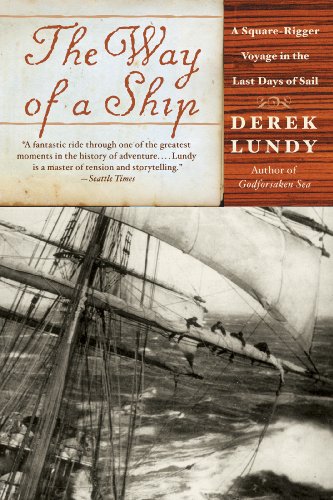
‘The Way of a Ship,’ by Derek Lundy

Benjamin had found the work on a square-rigger hard and testing beyond anything he had imagined. Nevertheless, as the barque turned away from the gale to run fast to the south, not slogging into the eye of the wind or hove to, but for the first time truly sailing, he became aware of something else: fascination, and the rapture of a young man in glamorous jeopardy.

Among the many things I didn’t know before I read Derek Lundy’s The Way of a Ship was that, at the very end of the Age of Sail, during the late 19th Century, there was a time when the square-riggers served their own nemesis. It was apparent to all that the steamship was on its way to replacing wind-sailing ships. But those steamships needed coal to run on, and (for technical reasons having to do with engine efficiency and payload) at the time the cheapest way to transport coal was in sailing ships. So the sailors carried the fuel for their usurpers. These last sailing ships were not wooden, but iron, their rigging made of steel. The profit margin in this commerce was narrow, so the companies economized by keeping the crew sizes at a minimum. The food stores were minimal as well. Men died because of it, but that’s one of the costs of doing business.

Author Derek Lundy conceived an interest in a collateral ancestor of his, a young Irishman named Benjamin Lundy who sailed in a coal ship around the Horn in 1885. He hunted for information, and found it sparse. The old logs, and most of the old letters, had disappeared. The best he could do was learn what he could about the commerce in general, and then imagine a voyage for his ancestor, on a fictional ship, The Beara Head, with an imaginary captain and a (mostly) imaginary crew, and send them through a fairly typical voyage from Liverpool to Valparaiso, and then on to San Francisco.

It’s a harrowing journey. The book it most recalled to me was Richard Henry Dana’s Two Years Before the Mast. But Dana dwelt less on the horrors of the voyage (fewer sailors die in his book). Author Lundy did some sailing as part of his research, including time on a genuine square-rigger. Also he’s a superior wordsmith. Thus he’s able to convey some inkling of the kind of dangers and sufferings these sailors experienced. The oddest thing about it, when you think of it, was that all this was routine. People took it for granted. If you went through an adventure like this today, you’d be on television and get book deals. It’s as if we’re a whole different species from these men.

I found The Way of a Ship utterly engrossing and educational. I recommend it highly. The rare political asides seem pretty even-handed. Some profanity, which kind of goes with the territory.