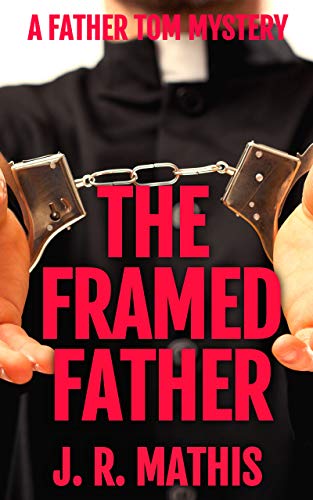
In the second book of the J. R. Mathis’s Father Tom mysteries, The Framed Father, our hero is called back to the town of Myerton, Pennsylvania, where he recently solved the cold case murder of the woman he was married to before he became a priest. He left the parish in the hands of Father McCoy, a callow young priest who seemed the most innocent and inoffensive of men. But accusations have reached the archbishop that Father McCoy has been carrying on with his attractive administrative assistant. So Father McCoy is sent off into retreat, and Father Tom must take over at St. Clare’s once again. But when scandal turns to murder, Father Tom will again team up with Helen, his ex-fiancee, now a police detective (who is improbably open to amateur help) to try to save the young priest’s name and liberty.
I reviewed the previous book in the series, The Penitent Priest, as morally upright and well-composed, but weakly and improbably plotted. I thought The Framed Father somewhat better. There are still too many coincidences, but I didn’t guess the solution this time.
No bad language, heavy violence, or sex scenes to caution you about. Matters of the Catholic faith are treated seriously, and there are good depictions of crises of faith. Father Tom is a little too much the intuitive detective for my personal taste, but the book wasn’t bad.
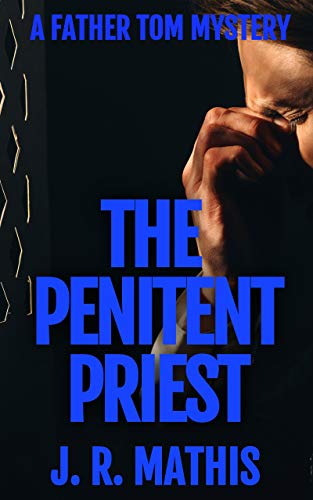
I probably wouldn’t have purchased J. R. Mathis’s mystery novel The Penitent Priest if I’d noticed that its tagline said “A Clean Murder Mystery.” (Puts me in mind of the old joke about “a nice old-fashioned murder with no immorality in it.”) When the first recommendation a book offers is its lack of dirty words and sex scenes, it’s not usually a guarantee of literary quality. But The Penitent Priest turned out better than I would have expected.
Father Tom Greer came to the priesthood late in life, after the murder of his beloved wife. So he’s somewhat nervous when the archbishop assigns him to temporarily replace the parish priest at St. Clare’s in Myerton, Pennsylvania. Myerton is where he lived as a married man and buried his wife, and where he abruptly left a number of old friends when he dropped out of sight afterwards. So he has some personal fences to mend.
But when an unseen stranger tells him secrets no innocent person should know in the confessional, Father Tom knows he has the opportunity to finally identify his wife’s killer. But he’ll also have to face his own fears and guilt.
I was impressed with the writing in The Penitent Priest. You rarely run into a novelist these days who can parse a decent English sentence and spell words right. The plotting, unfortunately, was less wonderful. As is not uncommon among starting authors, author Mathis has laid on too many coincidences. Why should the archbishop assign Father Tom to precisely this parish, considering his personal history and the fact that he’s still a person of interest in his wife’ murder? And is it really likely that the woman to whom Tom was engaged before he met his wife should show up as a police detective here?
Also, the big surprise at the end of the story might as well have been printed on the title page in big red letters.
But because I liked the writing, and because Father Tom is a good character, I bought the sequel.
Having at last finished Neal Price’s very long – and enjoyable – survey, Children of Ash and Elm: A History of the Viking Age, I find my feelings definitely mixed. There is much in this book that I admire and value. I learned from it. But I found what seem to me certain debilitating flaws in it.
I might mention, first of all, that (although he does not cite Viking Legacy, the great book to which I am immortally linked as translator) author Price takes the same line on the historical validity of the sagas – that they are not straight history and cannot be treated as such, but that they do contain useful information for the historian who employs them with care:
Even the most sceptical of literary researchers, those who generally reject the Old Norse texts as viable sources (however remote) for the actual Viking Age, do not always go on to confront the question this viewpoint requires: why, in that case, would medieval Icelanders have created—over several centuries—the most remarkably detailed, comprehensive, and consistent corpus of historical fiction in the world?
Author Price is an accomplished archaeologist, who has spent decades studying the Viking Age. His research is extensive, and he writes with the authority of long familiarity. His purpose in this book is more than to tell the story of the Viking Age. It is to draw on his learning and experience to try to convey to the modern reader the essence of the Vikings – how they saw the world, how they felt. I think he succeeds to a commendable degree.
Most big books on any subject try to offer a new theory or insight, and Children of Ash and Elm does this through a couple (relatively) new ideas – that the Viking Age began earlier and lingered longer than is generally assumed, and that the two Viking enterprises, the “west Viking” and “east Viking” currents, were in fact one and the same, with no real separation.
Hidebound non-specialist that I am, I must admit I’m not convinced by these arguments. Inception and terminus dates are notoriously hard to nail down, but Price points especially to a mass ship grave containing Swedish skeletons, found in Estonia and dated around 750 AD (he always uses CE dating, of course). I don’t entirely buy this argument. It’s hard to identify a “Viking raid” on the basis of a single burial, however impressive.
As for the unity of east and west, I have long held, and continue to hold, that the location and power of Denmark is a central issue in understanding the Viking Age. The simple fact that passing into or out of the Baltic required paying tolls to the king of Denmark tended to send Norwegians west and Swedes east, just to avoid his domains. The compartments weren’t watertight, but I think they existed.
I noted what seemed to me a telling omission in the book’s account of Viking slaving activities. Price makes no secret (quite rightly) of the fact that the Vikings routinely took and trafficked in slaves, and profited greatly from the trade. He speaks movingly of the suffering of those in bondage. But he seems to minimize the role of the Muslim world in it. He does mention the Arab markets, but only more or less in passing. Reading this book, you’d think most Viking slaves ended up toiling on Scandinavian farms. In fact, the great majority were headed into the insatiable maw of the Islamic slave markets.
The book was also marred, for me, also by occasional genuflections toward political correctness. Here and there, author Price finds it necessary to apply concepts like “privilege,” “intersectionality,” and “gendering” to the Vikings. I don’t think this is useful or illuminating in historical context.
Nevertheless, I found Children of Ash and Elm fascinating and informational. It’s written (and well-written) with a clear passion for the subject and a practiced critical eye. I recommend it, with cautions.
Once, in the Russian urban centre of Novgorod, where the waterlogged soil preserves such things well, I breathed in the scent of fresh pine a thousand years old, the whole site just saturated in the fragrance from all the woodworking waste lying where the Viking-Age carpenters had left it.
What we have above is a genuine treasure of Sherlock Holmes lore. The original popular image of Sherlock Holmes came from Sidney Paget’s illustrations for the Strand Magazine in London (bald, long nose). But in American magazines, the foremost illustrator was Frederick Dorr Steele, who based his image on the handsome actor William Gillette, who played Holmes more than 1,300 times on stage in a play he wrote himself. Steele’s Holmes largely superseded Paget’s as the popular image of the great detective.
In 1916, Essanay Studios of Chicago filmed the play (with additions), and Gillette played the role yet again. This historic film was long believed lost, but in 2014 a print was discovered in France. This version had been released as a serial for the French audience, and included extra material not found in the American version. This French version has been splendidly restored, and the dialogue cards have been recreated using Gillette’s script. The orange and blue tinting is original.
Artist Paget bestowed Sherlock Holmes’ deerstalker cap on him, but it was Gillette who gave him the curved calabash pipe, which did not wiggle so much when the actor talked. I hadn’t heard about the re-discovery of this film, and am still astonished I can see Gillette himself in the role.
Like many an aging actor before and since, he’s playing younger than his actual age, with a love interest about old enough to be his daughter.
Ever see one of those old comedy movies, set in the Middle Ages or sometime, in which the orchestra suddenly breaks into swing music and everybody starts jitterbugging? (I recently watched “A Knight’s Tale” for the first time, and they did the same sort of thing , with different pop music. I fear this will not age well.)
I had much the same feeling today as I was reading Neil Price’s generally excellent book, Children of Ash and Elm. In a chapter called “Border Crossings,” he takes a break from a mostly well-informed and insightful study of Viking Age history to impose 21st Century concepts on an alien culture.
There are clear suggestions of queer identities in the Viking Age (with a caveat for the retrospective application of contemporary vocabularies).
Give him points for self-awareness, anyway. Retrospective application is precisely what’s going on here. I speak from a position of prejudice, of course, but it saddened me to see a good study like this marred by what I consider (I could be wrong, of course) a transient intellectual fad.
In fact (except for the admittedly problematic Grave Bj. 581 in Birka, which I can’t explain, but neither can anyone else), he is able to demonstrate nothing about the Vikings themselves other than that they had an extremely “gendered” (his word), male-dominated culture, in which there is evidence of a certain amount of deviance. You could say the same about the Victorians. He admits it plainly at one point, saying, “There are no positive depictions of same-sex relationships in the textual sources.”
To put it in terms comprehensible to current academics, Price is “appropriating” Viking culture, forcing his own paradigm on them in a way that they would have found offensive.
After a couple weeks with Rodney Riesel’s light – and short – Dan Coast books, I have plunged (with some relief, actually) into a little more challenging material. I’m reading Children of Ash and Elm: A History of the Vikings, by Neil Price. It’s a long book, and it will take me a while to get to the point where I can review it. I’m finding it a good object to wrestle with – I like parts very much, and I disagree now and then. Here’s a nice passage from near the beginning:
When properly recited in appropriate surroundings, Viking-Age poetry can taste like cold iron on the tongue, its complex rhyme schemes building upon one another like layers of frost—treacherous but beautiful. We gain something old and true in this language, even if only understood in translation, and for that reason I have included a selection here.
Tolkien would have liked bit that very much. Even if you disagree with a historian, prose like this can make reading his book worth your time.
The saga of Dan Coast, Rodney Riesel’s self-destructive, alcoholic lottery winner living in Key West, continues with Most Likely To Die, in which Dan tries to clear a man unjustly accused of murder. Unless Dan is wrong. Which he often is.
Dan Coast doesn’t like the nurse Reatha Davis. She spoke condescendingly to him once, and corrected his grammar. But she works with Dan’s girlfriend Maxine, and Maxine likes her. So when Reatha asks Dan to find evidence to clear her husband, who’s been arrested for murder, Dan reluctantly agrees. Her husband, Reatha says, is a good man and had no enemies. And neither did his old friend, a schoolmate, who was murdered. Dan figures nobody gets murdered if they have no enemies, so he’s pretty sure somebody’s lying.
With the help of his ever-expanding posse, his big friend Rick, his surfer dude friend Skip, and now his childhood hero, astronaut Kip Larson, Dan runs around annoying people and interfering in the police investigation. Eventually they’ll figure it out, but only by crossing some legal lines.
I think I’m beginning to weary of Dan Coast’s act. The books are fast, and they have some laughs, but they’re not well-written (this one brings in a character from a previous book at one point, then forgets about him completely). They’ve never quite found their balance between comedy and tragedy, but this one was pretty much farce from the git-go. And not very believable.
Still, I won’t pretend it wasn’t fun. I’ve got something more serious to read now, but I may go back to Dan Coast when I need to rest my brain. Cautions for language and juvenile humor.
Book 5 in the Dan Coast series by Rodney Riesel is Double Trouble. Dan starts out doing a divorce case with the help of his friend Red (who still has to drive him around until he gets his license back after a DUI). They are discovered snooping, and have to make tracks.
Then Dan’s dog finds a body buried in the sand in front of his Key West house. Dan calls the police, but leaves the scene, and when the cops get there the body has vanished.
That mystery is explained (partly) when a man shows up looking for his missing sister. He had come to the Keys with his twin brother, who has also disappeared. Dan recognizes him as the spitting image of the guy in the sand. The surviving brother hires Dan to help him find the sister.
I keep complaining about the writing in the Dan Coast series, but then I keep buying the books. So they can’t be that bad. I still have some trouble with the tone – it alternates between buffoonery and deep tragedy. Often the characters don’t seem to be realistically affected by death, even deaths of people close to them. Author Riesel seems to have trouble hitting any notes in between Bottom and Othello. It can be disorienting for the reader.
Also, the big surprise in the book was kind of a chestnut. I saw it coming a mile off.
But I’m continuing reading the series. Cautions for language, inappropriate jokes, and misspelling.
Dan yanked his pistol from his waistband, ejected the magazine from the grip, and looked at the bullets. Then he jammed the magazine back into place with the palm of his hand.
“What was that for?” Red asked.
“I have no idea, but they always do it on TV.”
(Coasts of Christmas Past)
I’m just tooling along through Rodney Riesel’s Dan Coast novels, because they’re short, mostly likeable, and not too demanding. I’ll do two books tonight – Coasts of Christmas Past and Ship of Fools.
Dan Coast, Key West lottery winner and dilettante private investigator, aims for a life of quiet self-destruction on the beach, drinking heavily to suppress memories of his great personal loss. However, in Coasts of Christmas Past, his friend Red and his parents have different plans. His parents show up unexpectedly, organizing a big Christmas for him, whether he wants one or not. Christmas was once his favorite time of the year. But that was before…
The preparations get interrupted when a close friend gets injured. The police believe he was hurt in a botched drug deal, but Dan and Red know better than that. So they ride to the rescue in Red’s borrowed pink Volkswagen. There’s also a touching subplot in this book that will break your heart.
Ship of Fools finds Dan where he’s been headed for some time – confined in a mental hospital, drying out at a judge’s orders. That’s how he gets to know “Officer Mel,” a fellow patient who wears a cardboard badge and thinks he’s a policeman. Nobody believes Mel when he says that somebody has kidnapped his sister, but Dan starts to think there’s something there. So, ruthlessly using his money and snooping skills, he orchestrates his own release and takes Mel with him. Thus begins a madcap adventure with some interesting twists.
I liked the serious aspects of these stories better than the humor. Humor is hard to do, especially the wisecracking kind. One expects drunks to be inappropriate, but even when he’s sober, Dan can be a real jerk. On the other hand, when he gets his priorities straight, he can be a pretty good guy.
The author still needs a proofreader.
Mild cautions for language and adult themes. Good light entertainment, if you can get through the annoying parts.
Rodney Riesel is in no danger of soon winning any major prizes for his prose. But so far I’m enjoying his somewhat uneven Dan Coast mysteries, set in Key West. Ocean Floors is the second.
Dan Coast is an unusual hero in that he’s a lottery winner, but his greatest distinction would seem to be that he’s a degenerating alcoholic. Many chapters begin with him waking in a chair – or even on the ground – after a night-long bender. He has reasons for drinking. This might well alienate readers, though Dan can be admirable when he’s on his game.
Ocean Floors begins with Dan driving north to Miami. He stops for lunch at a roadside bar and grill, where he observes the thuggish bartender bullying a waitress. It’s none of his business, but when he gets back to his decrepit Porsche he finds the waitress huddled in it, pleading with him to take her away. His chivalry kicks in, so they zoom off together.
He soon discovers that this is no mousy little waitress. Also, the bartender was no bartender, but somebody Dan has heard of, somebody very dangerous to cross. As the seductive girl worms her way into his affections, a series of crimes begin, including murder and kidnapping. Dan and his big buddy Red will get in very nearly over their heads.
Author Riesel would profit from a good copy editor, or at least a subscription to Grammarly. He is prone to homophone confusions. I thought he handled the humorous banter slightly better this time out than in the last book, but he’s still learning on the job.
One very intriguing addition here is his neighbor across the street, an old lady named Edna McGee. We are told that Edna is the widow of a “marine salvage expert” in Fort Lauderdale who died in the 1980s. Obviously, we are intended to believe this is the wife of the late Travis McGee. I never knew Travis ever got married, but I kind of like having Edna in the stories, though she’s only a tertiary character so far.
Not great literature, the Dan Coast books are fun to read, so far. I think I’ll keep on with them until I get my mind changed. Cautions for language and mature themes.
Websites store cookies to enhance functionality and personalise your experience. You can manage your preferences, but blocking some cookies may impact site performance and services.
Essential cookies enable basic functions and are necessary for the proper function of the website.
Name
Description
Duration
Cookie Preferences
This cookie is used to store the user's cookie consent preferences.
30 days
These cookies are needed for adding comments on this website.
Name
Description
Duration
comment_author
Used to track the user across multiple sessions.
Session
comment_author_email
Used to track the user across multiple sessions.
Session
comment_author_url
Used to track the user across multiple sessions.
Session
These cookies are used for managing login functionality on this website.
Name
Description
Duration
wordpress_logged_in
Used to store logged-in users.
Persistent
wordpress_sec
Used to track the user across multiple sessions.
15 days
wordpress_test_cookie
Used to determine if cookies are enabled.
Session
Statistics cookies collect information anonymously. This information helps us understand how visitors use our website.
Google Analytics is a powerful tool that tracks and analyzes website traffic for informed marketing decisions.
Used to monitor number of Google Analytics server requests
10 minutes
__utmb
Used to distinguish new sessions and visits. This cookie is set when the GA.js javascript library is loaded and there is no existing __utmb cookie. The cookie is updated every time data is sent to the Google Analytics server.
30 minutes after last activity
__utmc
Used only with old Urchin versions of Google Analytics and not with GA.js. Was used to distinguish between new sessions and visits at the end of a session.
End of session (browser)
__utmz
Contains information about the traffic source or campaign that directed user to the website. The cookie is set when the GA.js javascript is loaded and updated when data is sent to the Google Anaytics server
6 months after last activity
__utmv
Contains custom information set by the web developer via the _setCustomVar method in Google Analytics. This cookie is updated every time new data is sent to the Google Analytics server.
2 years after last activity
__utmx
Used to determine whether a user is included in an A / B or Multivariate test.
18 months
_ga
ID used to identify users
2 years
_gali
Used by Google Analytics to determine which links on a page are being clicked
30 seconds
_ga_
ID used to identify users
2 years
_gid
ID used to identify users for 24 hours after last activity
24 hours
_gat
Used to monitor number of Google Analytics server requests when using Google Tag Manager
1 minute
_gac_
Contains information related to marketing campaigns of the user. These are shared with Google AdWords / Google Ads when the Google Ads and Google Analytics accounts are linked together.
90 days
Marketing cookies are used to follow visitors to websites. The intention is to show ads that are relevant and engaging to the individual user.
A video-sharing platform for users to upload, view, and share videos across various genres and topics.
Registers a unique ID on mobile devices to enable tracking based on geographical GPS location.
1 day
VISITOR_INFO1_LIVE
Tries to estimate the users' bandwidth on pages with integrated YouTube videos. Also used for marketing
179 days
PREF
This cookie stores your preferences and other information, in particular preferred language, how many search results you wish to be shown on your page, and whether or not you wish to have Google’s SafeSearch filter turned on.
10 years from set/ update
YSC
Registers a unique ID to keep statistics of what videos from YouTube the user has seen.
Session
DEVICE_INFO
Used to detect if the visitor has accepted the marketing category in the cookie banner. This cookie is necessary for GDPR-compliance of the website.
179 days
LOGIN_INFO
This cookie is used to play YouTube videos embedded on the website.