All posts by Lars Walker

‘Serenity Engulfed,’ by Craig A. Hart

I’ve been going through Craig A. Hart’s Serenity series, reviewing as I went. I’ve enjoyed them and told you so. What I didn’t mention so much was the books’ weaknesses, which (sadly) are very apparent in the fifth installment of the series, Serenity Engulfed.

Shelby Alexander, former Detroit boxer and semi-legal “fixer,” has moved back to his home town of Serenity in northern Michigan (lower peninsula). His hopes for a peaceful life have been disrupted by appeals from various neighbors to help out with problems requiring a tough pair of fists.

In Serenity Engulfed, Shelby’s daughter Leslie, with whom he has recently reconciled, is kidnapped. The kidnapper is an old enemy, recently released from prison. Meanwhile, a local prostitute asks for his protection from a man who’s been brutalizing her.

Serenity Engulfed, sadly, seems to testify to a failure of creativity on the author’s part. His prose has always been adequate at best, but it looks as if he’s now run out of plot ideas too. This book is all about dealing once again with enemies Shelby has fought before, and replaying plot situations we’ve been through before. And the ending was – in my view – entirely implausible.

I was disappointed with Serenity Engulfed, but I’m a forgiving type. I’ll probably read the next book, to see if the author gets his bearings again.
‘Masked Prey,’ by John Sandford

“Then I’m like that Mission: Impossible thing, where the secretary will disavow any knowledge of me?”

“So fast your head will spin off—although it’d probably be a deputy assistant undersecretary in charge of cover-ups,” Henderson said. “You’re not nearly important enough to be disavowed by an actual secretary.”

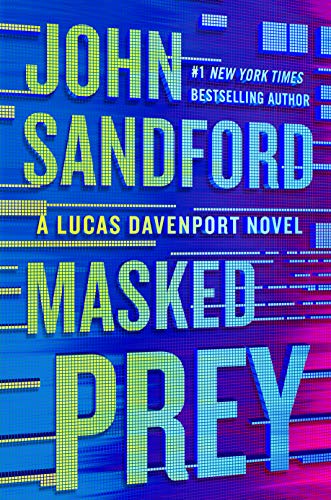
John Sandford’s Lucas Davenport “Prey” series rolls along, dispensing dependable entertainment for the thriller fan. I’m kind of sad Davenport has taken his show on the road, operating as a US Marshal now, rather than sticking to Minnesota, my stomping grounds. But the stories remain good.

In Masked Prey, the teenaged daughter of a female senator, who has made herself a minor celebrity through podcasting, discovers a site on the Dark Web. This site posts excerpts from extreme Alt-Right sites, along with candid photos of the children of a number of legislators. No explicit threat is made, but it seems to be an invitation to target the kids for political purposes. The girl – and her mother – both freak out. The FBI makes a political decision to turn it over to Marshal Lucas Davenport, who’s good with bizarre problems and lateral thinking. What’s implicit, but not stated, is that they want Davenport to hunt the (expletive deleted) down and kill him with minimum fuss.

As Davenport pokes into the world of the Alt-Right, a “lone psycho” begins his journey of what he considers self-actualization. It’s his destiny, he believes, to change history by killing a lawmaker’s kid. He has to learn how to kill – which he does, and it’s harder than he expected – but he’s determined, and intelligent enough to make it work.

This story moves further into politics than most of Sandford’s books, but I think he squares the circle pretty well, generally. He establishes early on that Davenport himself tends to the conservative side. And his right-wing activists are deeper and more faceted than you might expect.

I did find what I believe to be a factual error in this book. I have no personal experience here, but I’m given to understand that the way the villain acquires a couple firearms in this book is not correct. You can’t (or so I’m told) simply walk into a gun show and walk out with a couple of guns, without a background check. Maybe I missed a technical point.

I’ve seen John Sandford criticized for having only one character, and there’s some justice in that. At least in terms of the jokes they make, all his characters talk pretty much the same. But the jokes work, and they’re often politically incorrect, so I’m not complaining.

Recommended, with cautions for language, adult themes, and disturbing scenes.

‘The Museum of Desire,’ by Jonathan Kellerman

During the ensuing decades, no shortage of talk about renewal from politicians. But L.A.’s not a movie town for nothing; people get paid well to act.

Don’t even think about how many Alex Delaware mysteries have been written to date; in the great tradition of literary series, disbelief must be suspended. If you didn’t want to suspend disbelief, why did you shell out for the book?

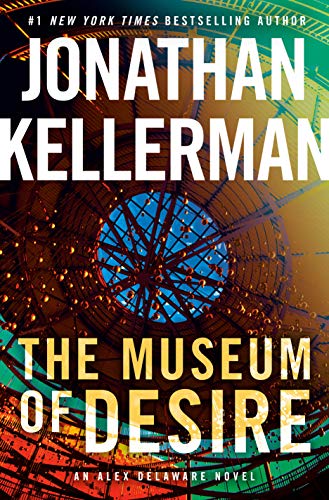
I’m in a position to shell out for some of my pricier favorite authors now, so at last I’ve read The Museum of Desire by Jonathan Kellerman. It’s as good as I hoped.

L.A. Det. Lt. Milo Sturgis calls out his friend, psychologist Alex Delaware, whenever a murder appears to have a weird psychological angle. This one certainly qualifies. Behind an ugly, vacant mansion in Beverly Hills, a stretch limousine has been found. Inside are four bodies, posed in an obscene tableau. Does Alex have any idea what kind of mind is at work here? Alex has never seen anything like it, but the whole thing has an… artistic feel. In a creepy way.

They start talking to people who attended a recent party at the mansion. And that leads to artists, and (as you’d expect) all kinds of weirdness.

The Museum of Desire delivered all I looked for in an Alex Delaware book – twisted psychology, a challenging puzzle, good character interchanges, a pretty satisfying resolution. I had a good time with it. Serious cautions for language and disturbing scenes.

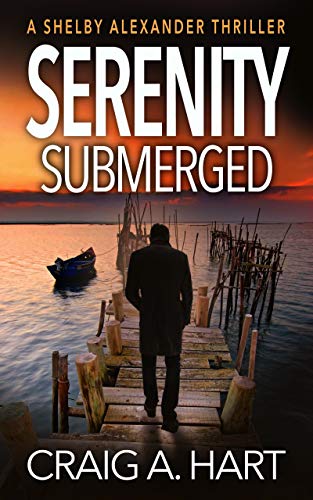
‘Serenity Submerged,’ by Craig A. Hart

I’m enjoying Craig A. Hart’s Shelby Alexander series, set in the Michigan lakeside town of Serenity. Serenity Submerged is Number Four in sequence.

Shelby is a retired boxer who moved home to Serenity for a quieter life. So far his success in that regard has been negligible. This time out, a woman comes to see him, identifying herself as an FBI agent. She shows him a man’s picture and asks if he recognizes him. Shelby doesn’t admit it, but he’s shocked to see that it’s his friend Fritz, a resort owner. When he goes to ask Fritz about it, he learns that Fritz has a dark past. He’s holding some money that some bad people want very much. And now, apparently, he’s been located.

Meanwhile, a group of three criminals come into town, on the hunt for Fritz. Two are merely tough guys, but the third is a monster – a tall, ugly brute who looks like Frankenstein’s monster with a messed-up face.

Anyone who’s been following this series will know that Shelby and the monster are destined for a fistfight.

Serenity Submerged is a well-done “small” thriller – I like stories where the stakes are kept personal, instead of end-of-the-world stuff. The characters are fun – I especially enjoy the interplay between Shelby and his ex-cop friend Mac. And there were surprises. Plus some interpersonal relationship stuff for the ladies.

Recommended, with cautions for the usual suspects.

‘Power In the Blood,’ by Michael Lister

John Jordan is a former policeman, recovering alcoholic, divorced husband and current chaplain at Potter Correctional Institution in Florida. One day he witnesses the killing of a prisoner. The man had been hiding (or had been concealed) in a garbage bag in a truck, and a guard checking for escapees stabs him with a pole.

The warden calls Jordan in along with the prison inspector, a man who hates Jordan. The warden is aware of Jordan’s experience as an investigator (he worked on the Atlanta Child Murders, among other cases) and wants them both to look into this death, along with other suspicious occurrences at the prison.

Meanwhile a pair of neighbor kids at the trailer park where Jordan lives visit him and ask for his help. Their mother, a waitress, has disappeared. They’ll work for him to pay for his time. He promises to try his best.

That’s what Power In the Blood by Michael Lister is about. The prison is a small community, and a corrupt one. The community outside is larger, but equally corrupt. Jordan will face suspicion, threats, actual violence, and false accusations before he can solve both the mysteries confronting him. In the course of the investigation he will learn things about himself as well.

Michael Lister is not a writer I recall hearing about before, but he has a large following, and with good reason. The writing is sharp, the characters vivid, the suspense compelling. (This edition is actually a revision of the first John Jordan book, written back in the ‘90s. Lister polished it up for the re-issue.)

However, this is not a series for me. My main objection is theological. Although John Jordan describes himself as a minister, and works as a chaplain, when he speaks about his faith he misses the mark by my standards (and those of historical Christianity, I might add). He never once mentions Jesus Christ or His cross, except to say how much he dislikes the hymn from which the book’s title is taken). When he preaches, he preaches a comforting message of universal love and acceptance. In other words, he’s a Universalist, though the story suggests he’s operating as a Baptist. If he’s a Universalist, he should be honest about it.

I liked this book, and enjoyed reading it. But it’s not for me. Your mileage may differ. Cautions for language, adult themes, and sexual situations, some of them disturbing.

‘Devoted,’ by Dean Koontz

Progress was real progress only when it evolved naturally and thoughtfully from the history of human experience and accumulated wisdom. When it was imposed in contempt for that experience and wisdom, then progress was in fact radical destruction.

Woodrow “Woody” Bookman, an eleven-year-old genius, is the central character of Dean Koontz’s latest novel, Devoted. He is also autistic; he has never spoken a word. His beautiful mother Megan, an artist and a widow, adores him and lives for him. She does not know that her boy has been doing research on the Dark Web, trying to uncover the truth behind the death of his father. Jason Bookman did not die by accident; he was murdered by his employers.

Kipp is a Golden Labrador who possesses the full intelligence of a human being. There are a number of such dogs living around the west coast. They communicate telepathically with one another on what they call “the Wire.” Most of them keep their intelligence a secret from their owners, but Kipp has revealed himself to his elderly owner Dorothy, who has invented a device that allows him to “type” messages to her. But Dorothy is dying, and Kipp isn’t sure what his future will be.

Lee Shackett is an executive for the company that killed Jason Bookman. They’re a multinational high-tech business, doing secret research on life extension and transhumanism. When the facility where he works is destroyed in an accident, Lee manages to escape. He’s not concerned; he has money squirreled away to finance a new life in Costa Rica. But Lee was contaminated in the accident; his body and his brain are beginning to change. He becomes convinced that he has one piece of business he needs to clear up before making his escape. He has to find the one girl who rejected him, the one he never got over, and make her his slave. That girl is now Megan Bookman, mother of Woody.

Dean Koontz knows his business as a thriller writer. He knows exactly how to push the reader’s buttons. He serves up good characters you fall in love with, and then (like Hitchkock) puts them in deadly peril from his evil characters, detailing the horrors the villain plans for them. The tension can be nearly unbearable.

I wouldn’t say Devoted is the best of Koontz’s works. There were a lot of familiar tropes here, and I found the story a little manipulative. But it also made me laugh and cry, so it was effective in its manipulation. There are some genuine great moments here. The conclusion of the story was a little problematic for the theological thinker, but can (I think) be taken as a parable.

Recommended for older teens and up. Cautions for intense scenes and adult themes.

‘Fiction No More,’ by Ted Clifton

There are three books to date in the Vincent Malone mystery series by Ted Clifton. Fiction No More is the third. It’s worth your time.

Vincent Malone, just to jog your memory, is a former legal investigator from Denver, now living in Santa Fe, New Mexico. For a while he worked as a van driver for a local bed and breakfast, but with improving health and a new attitude and live-in girlfriend, he’s moving back into his old work. He still drives the van now and then, but he’s got new challenges.

Still, his latest case comes out of the Inn. A famous mystery novelist is visiting, and she asks Vincent to check out a man whom she believes is following her. He has contacted her in the past, she says, asking why an incident in her first novel so closely mirrored the murder of his own father.

When the man is arrested for another murder by the police, the author surprises Vince by offering to pay for his defense. Vince’s lawyer boss takes the case on, and the trail leads to that older case from the novel. Turns out the author hasn’t been entirely honest with Vincent – her grandfather had firsthand knowledge of the crime, and had described it to her. It all has to do with the theft of Native American artifacts long ago – and some of the people involved are still alive and dangerous. One of them is even powerful.

Fiction No More was a pretty good read. As I’ve said before, these stories combine hard-boiled and cozy elements, and the fusion works pretty well. An unnecessary anticlimax provides a bittersweet coda that I’m not sure I’m grateful for or not.

Cautions for language and adult themes. Modern attitudes toward marriage and cohabitation bothered me a little, but that’s the world we live in.

Sigrid Undset, the I.S.I., and I

I wrote an essay on Sigrid Undset for the Intercollegiate Studies Institute’s web site:

Like one of her own characters, Sigrid Undset followed her heart, confronted the consequences, and learned. Enabled by a government grant to live abroad, she began an affair in Rome with a married Norwegian painter, Anders Castus Svarstad. They married in 1912, after his divorce, and divorced in turn in 1919. By that time, they’d moved back to Norway, where their third child was born. Their second child, a daughter, was mentally handicapped. When Sigrid learned to her horror that Svarstad’s ex-wife had placed her children by him in an orphanage, Sigrid adopted them. One of these was also mentally handicapped. (Years later, when she received her Nobel Prize, she would donate the entire sum to children’s charities.)

Read the whole thing here.

‘Blood Lies,’ by Andrew Cunningham

A free book deal persuaded me to download Blood Lies, by Andrew Cunningham. It’s the fifth in his “Lies” series.

The main characters are Del Honeycutt, the narrator, and his girlfriend, bestselling mystery writer Samantha Spencer. As the story starts, Samantha is shot on the street, and rushed to the hospital. The main concern is not with the gunshot wound, which is minor, but with possible brain damage from hitting her head on the sidewalk. In a suspicious twist, someone claiming to be a policeman comes to claim the bullet that shot her. Only he’s not from the police.

Del’s investigation of the crime soon leads him to suspect that the bullet was not intended for Samantha, but for him. Which makes no sense, because he’s not the famous one in their relationship. However, he begins learning new things about his own family secrets. He always knew his father was a scoundrel, but he never guessed that he was a spy. For the Chinese.

The story is convoluted, and not particularly plausible. It reminded me a lot of television writing from a bygone era – especially in the main characters’ ability to recover quickly from injuries. Also, deadly perils are averted through improbable lucky breaks – in one memorable scene (and I don’t remember a lot of scenes from this book after a few days), the hero manages to kill an attacker with a cell phone. By accident.

Blood Lies was an entertaining book, but doesn’t bear the weight of much thought. Not highly recommended. Cautions for language and adult themes.

‘Blue Flower, Red Thorns,’ by Ted Clifton

Vincent Malone is the continuing hero in Ted Clinton’s series set in Santa Fe, New Mexico, of which Blue Flower, Red Thorns is the second. Vince went from being a high-flying Dallas lawyer to a successful Denver legal investigator before quitting that work due to his health. He drifted into Santa Fe, where he took a job driving a van for a bed and breakfast. But he found use for his detective skills in the first book, Santa Fe Mojo, and is easing back into that career.

Nevertheless, he’s still driving the van when Blue Flower, Red Thorns begins. He makes a run to Durango, Colorado to get some friends’ son out of a legal problem, and returns to help his pleasant employers deal with a group of important guests. They’re hosting a rising young woman artist and her entourage, while a big auction is held at a local gallery. But these guests act pretty much as you’d expect artists and dealers to act – they’re temperamental, and the artist’s drunken mother makes a scene physically fighting the gallery owner. Which makes her the chief suspect when the owner is found murdered – but if you’re looking for people with motive, there is no shortage. Vincent will have to plunge into the world of art forgery to untangle the mystery.

This is very good entertainment reading, perfect for the beach (or your living room while you’re quarantined). Vince is tough and cynical enough for the hard-boiled fan (though he’s mellowing with a new girlfriend), and the recurring cast of characters is sympathetic enough for cozy readers.

Cautions for language and adult themes. There’s one more book in the series so far.