
All posts by Lars Walker

Concerning Norway and World War II

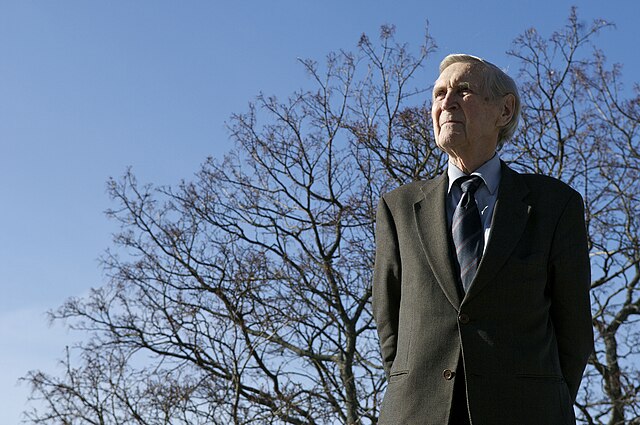
Gunnar Sønsteby. Photo credit: Arnephoto.

I was planning to post something about Occupied Norway today anyway (you’ll find it below), but it happens that one of Norway’s last living Resistance heroes died today. He was named Gunnar Sønsteby, and he was the most decorated man in Norwegian history. If you followed my advice and watched the movie, “Max Manus,” Sønsteby was one of the characters portrayed in it. But he could have carried a movie all on his own.

OK, here’s a strange story.

A while back, I posted a piece I called Survival Story. It concerned a strange character I discovered in a Norwegian-language book I read about my ancestral community, Kvalavåg, in Norway. During World War II, one of the German occupation officers who served there was a Jew named Konrad Grünbaum, who ended up in the Wehrmacht due to a clerical error.

One of the commenters on that post was an actual descendent of Grünbaum’s. He contacted me through Facebook and asked if I had any further information. I didn’t, but promised to check with my relatives over there.

And they came through, past all hope. As it happened, an article on Grünbaum had been published in the Haugesunds Avis newspaper back in 1986. The article was illustrated by a photo of part of Kvalavåg which Grünbaum took during the war. Because of that, my relatives kept a couple copies, and they were happy to send one to me. I have forwarded it to my correspondent, and it’s on its way to him by mail.

My translation of the article can be read below:

THE GERMAN IN KVALAVÅG

By Ida Nydstrøm (July 23, 1986)

Konrad Grünbaum, a Jew by birth, is now 70 years old and a retired city council member in Fürth. He lived in that city before the war as well. He was a metal worker in a factory, and an active member of the SAJ: The Socialist Labor Youth. Continue reading Concerning Norway and World War II →

Killer Swell, by Jeff Shelby

First of all, I’ll just start by saying thumbs up on this one. Killer Swell isn’t the greatest private eye story I’ve ever read, but it drew me in and kept my interest. The characters were well-drawn and realistically layered, for the most part.

In this first novel of an ongoing series, Noah Braddock, San Diego surfer/private eye, is approached by the mother of his former girlfriend. The girlfriend, whom he had deeply loved, broke up with him years ago under pressure from her parents, when she went off to college. But now she’s gone missing, and they’re desperate enough to come to Noah for help.

And he, of course, can’t resist the appeal, even coming from them. But things get messy very quickly, and soon he’s forced to delve deeply into his lost love’s personal life, discovering things he’d much rather have never learned.

I’ve often written about the archetype of the American private eye. Particularly the fact that he’s often a figure of male fantasy. What guy, in his heart, doesn’t sometimes dream of living unfettered, setting his own hours, having uncommitted sex with a series of dangerous dames, and being the Spillaneian Jury?

Noah Braddock seems like a prime example of this paradigm. He combines two occupations that appeal to every guy’s inner Peter Pan—the P.I. and the surf bum.

And yet, Noah is an oddly responsible man. I thought his strength of character, oddly, a weakness in his character, if “character” is understood in its purely literary sense. It seemed odd to me that a guy this mature would choose a lifestyle that might as well have a sign reading “Perpetual Adolescent” taped to it. He seemed to me more suited to conventional police work (though he tells the reader he tried that and got bored) and a traditional marriage.

But that’s just my quibble. Others may disagree. I enjoyed Killer Swell, and will probably return to the Noah Braddock series.

The usual cautions for language and adult themes apply.

Bad Percy

At The Smart Set, Paula Marantz Cohen ponders what is laughingly known as the “character” of the poet Percy Bysshe Shelley:

The exhibition “Shelley’s Ghost: The Afterlife of a Poet,” now at the New York Public Library, is the sort of exhibit that doesn’t necessarily tell you anything you didn’t already know about this poet’s short and messy life. What it does do, by virtue of placing the manuscripts and artifacts into a relatively confined space (the smallish gallery to the left of the main exhibition room on the ground floor of the Library), is give us the facts in a more concentrated and vivid way than we might otherwise receive them. The exhibit demonstrates, with dramatic succinctness, that Percy Bysshe Shelley and some of those he hung out with were pretty [expletive deleted] people.

I’ve always had it in for Shelley, Byron, and that whole set. There’s something about them that, for me, encapsulates the most obvious hypocrisy within (I won’t say of) liberalism—the kind of persons who justify lives of complete selfishness through the loud proclamation of principles which [they insist] promote the improvement of society as a whole. It’s the moral equivalent of “I gave at the office.”

I’m not saying that all, or even most, liberals are like this. I know there are many liberals who deny themselves in order to live consistently with their principles. It’s just that when conservatives get caught in this kind of behavior (and heaven knows they do) they tend to be discredited and to lose their jobs. Liberals get a slap on the wrist at most, and go on to write bestselling books, star in movies, or have long, powerful political careers.

Or [and] they get memorialized, like Shelley, as secular saints.

Tip: The American Culture

The Viking Highlands: The Norse Age in the Highlands, by D. Rognvald Kelday

“This then is the speculative political history of the Viking Highlands,” says author Kelday in his Introduction.

The story of the Vikings in Scotland—and in the Celtic areas of Britain and Ireland in general—has intrigued me for a long time. If D. Rognvald Kelday’s formidable book The Viking Highlands – The Norse Age in the Highlands raises awareness of that story, it will have done us a service, in spite of some flaws.

It’s true enough, as most of us know, that the Norse dispossessed many native people, robbed churches and strongholds, and took many slaves. But it’s also true (as Kelday stresses) that the places where Celtic culture and traditions survived, after the Celtic kingdom of Alba was transformed into the Anglicized kingdom of Scotland, were those parts that remained longest under Norse rule. The clans Gunn (Gunnar), McAuliffe (Olaf), McManus (Magnus), McLeod (Ljot) and McDonald (descended from Somerled, a Celto-Norse lord with a Viking name, Somerlidi) all look back to the days of the Norse jarls who ruled under something like the Scandinavian republican system.

But it’s not only Scots who’ll find material of interest here. Continue reading The Viking Highlands: The Norse Age in the Highlands, by D. Rognvald Kelday →

Survivor’s report

I don’t know exactly why it is that the Festival of Nations—four days in nearby St. Paul—somehow manages to be perceptually more exhausting than Høstfest, five days all the way off in Minot. But so it does. I have my theories.

Mostly I blame the venue. Our Viking group is always situated in basement space in the River Centre, all concrete and low of ceiling. It echoes, not only the clamor of voices, but the bellow of the vuvuzela and the shrill chirp of the warble whistle.

(Although I must concede that they moved us to a new spot, far nicer than the one we’ve had for the last few years. Close to the Men’s room, the water fountain, and the food court. Better traffic. I sold a satisfying number of books, except for on Sunday, which always seems to be slow. Perhaps the visitors are observing the Sabbath.)

I have also discovered, since getting home last night, that part of my exhaustion was due to the fact that I was coming down with something nasty. I dragged myself through work today, but I’m not sure about tomorrow.

There were pleasant happenings, however, for me to report. There was one of the most beautiful women I’ve ever met, who brought her two little boys to my table and eagerly asked all kinds of questions, clearly delighting in opening the world to her sons.

There was the man who introduced himself as a native of Jämteland in Sweden, a region that was part of Norway for many centuries. He said his family traced their genealogy back to the kings of Man, which gave me the opportunity to talk about the book about the Vikings in Scotland I was reading.

And the tall, red-haired high school girl who wanted to know about the kings of Denmark, giving me an opportunity to discuss my theories about the centrality of Denmark to all Viking history. Turned out she was an exchange student from Denmark (couldn’t tell from her accent), and descended from the Danish kings.

So I won’t say I didn’t have some fun.

I’ll just say I feel about a decade older.

And now I shall go boil a mustard plaster for my chest.

Troll Valley reviewed at Land of Caleb

Caleb Land at Land of Caleb reviews Troll Valley.

Simply put, we need many, many more e-books like this one. Walker writes from a distinctly Christian worldview, but is able to avoid so much of the sentimentalist and moralistic errors of the majority of Christian fiction. This is a novel about the law and about grace. This is a novel about forgiveness and justification by faith, and about unmerited favor. That Walker is able to accomplish these things without being preachy and actually telling a compelling story is a testament to his growth as a writer and storyteller.

Festival of Nations, Day One: Report from the front

Made it through the first day of Minnesota’s annual diversity binge, The Festival of Nations in St. Paul. Today was the easiest day—only 9:30 a.m. to 3:00 p.m. The next three days will be 9:30 to 10:00. If there’s such a thing as Death by Crowd, I may be in danger of it.

Today was the first of the student days, reserved for elementary through high school kids. Tomorrow is also a student day till 4:00, at which point the doors will be thrown open to taxpayers. As in past years, the students exhibited an undiminished enthusiasm for buying vuvuzelas and those little bird-shaped whistles that make warbling sounds. If you suspect that this noise might be irritating, you are correct. Sombreros are also popular souvenirs, though the felt pizza hat seems to be declining in public favor.

The best thing about the festival, so far, is that they moved our exhibit to a spot right next to the Men’s Room and the water fountain. I find that that’s about all I really need in life, at this age.

The great disappointment was a technical problem with our photo printer, which prevented us from taking people’s pictures in Viking garb and selling them the prints. This has been a major earner for us in the past, and I hope we get that straightened out tomorrow.

Ah yes, I sold a few books, too. So I came out ahead for the day, even considering the cost of food in the International Food Court.

Tomorrow I’ll drag home sometime around 11:00 p.m., so I expect I won’t be posting anything.

Post-depressed post

Thank you, I’m a little better tonight. Not well, but capable of functioning at a minimal level.

The most insidious thing about depression (I know I’ve written about this before) is the false sense of clarity it gives you. “Now, at last,” you feel, “I’ve cast aside the self-delusion and the rose-colored glasses. Now I see the world plainly, as it is, and I understand that it’s all death and corruption and doom.”

Naturalism in art, as generally practiced, I think, is almost a cultural form of depression. The Naturalist artist prides himself on painting (or writing about) decaying corpses and deformed children, congratulating himself that he has pierced the veil of illusion to portray the world as it actually is.

This same artist, however, very likely has a spouse or lover on whom he dotes, and children who delight him. But he will not include those things in his art, except in order to set the the viewer or reader up for some shock. He’s not a hypocrite, but he’s as delusional as the Pollyannas of this world, only from the other side. His view of reality is one-dimensional and consciously selective.

That’s one of the reasons I appreciate the Bible.

You’ll often run into people (especially on the Net, particularly on Facebook) who will delightedly point out all kinds of awful things somebody (usually not they themselves) found in the Bible—atrocities and rapes and injustices—and natter about how the Bible is really pornography and anybody who takes it seriously must be some kind of deviant.

These people are as superficial as the Christian Triumphalists, whose understanding of Scripture is frequently shaped, not by actually reading the Book, but by books of Biblical Principles written by religious celebrities. Or just some celebrity preacher’s TV sermons.

I wrestle with many things I find in the Bible, and I cannot claim to have solved its mysteries (I’ve written about how I deal with those things elsewhere, and won’t address that subject tonight). But when I go to the Bible I come away with the sense that I’ve encountered something entirely true to life. It is not a happy book about bunnies, nor is it a “realistic” novel by Zola. It contains real pain, real tragedy, and real hope.

Some Christians may be glib. The Bible, whatever else you may say about it, is not that.

I may or may not post tomorrow. I plan to be at The Festival of Nations at the River Centre in St. Paul, as has been my wont in recent years. It closes early tomorrow afternoon, so I may get time to post something, if only a scream from the heart of an overtaxed introvert. Or not.

If you’ll pardon me…

I’m deeply, profoundly depressed tonight, and not up to thinking up a post.

Instead, a picture of a dragonfly. Because I like them. I thought of doing a butterfly, but I’m in more of a dragonfly mood.


Photo credit: André Karwath

Marxists are always wrong

I’m not sure when I’ll do my next book review, as I recently downloaded a huge book on the Vikings in Scotland, The Viking Highlands: The Norse Age in the Highlands, by D. Rognvald Kelday, and it’ll take me a while to plow through it. But I’ll comment on something the author says right now.

Almost at the very beginning the author, who seems to have otherwise done commendable research, makes the following statement:

Norway, the land of the ‘north way’, had witnessed a rapid rise in population in the early part of the seventh century, leading eventually to a lack of land for some and a lack of opportunities for others.

This is certainly a view which may be found, prominently, in many books on the Viking Age. Most authors, though, are content to list overpopulation as one of several possible causes for the increase in Norse raiding. Kelday chooses to state flatly that overpopulation was the sole cause.

The problem with this statement is that it’s entirely false, and known to be false.

As my friend Prof. Torgrim Titlestad of the University of Stavanger writes in his book, Viking Norway (sadly out of print for now), archaeology has discovered no—that is zero—evidence for the overpopulation theory. Norwegian archaeologists report that iron ore extraction declined significantly in the Viking Age, and that moose and reindeer trapping also declined. These are the opposite of what would be expected in a situation where population was increasing and new sources of foodstuffs required. In fact, it was during the Viking Age that the Medieval Warming Period was getting under way, and there was plenty of food pretty much everywhere in Europe.

So why do historians cling to the overpopulation theory, in the teeth of actual archaeological evidence? Titlestad identifies the reason in Viking Norway:

It is also not insignificant that the overpopulation theory was tailor-made for a materialist/Marxist historical outlook…. (p. 359)

Titlestad reports, reassuringly, that the Marxist view is diminishing in influence in historical circles (something that’s news to me) and that other explanations are beginning to get more serious consideration at last.