All posts by Lars Walker

Snippet Four, Troll Valley


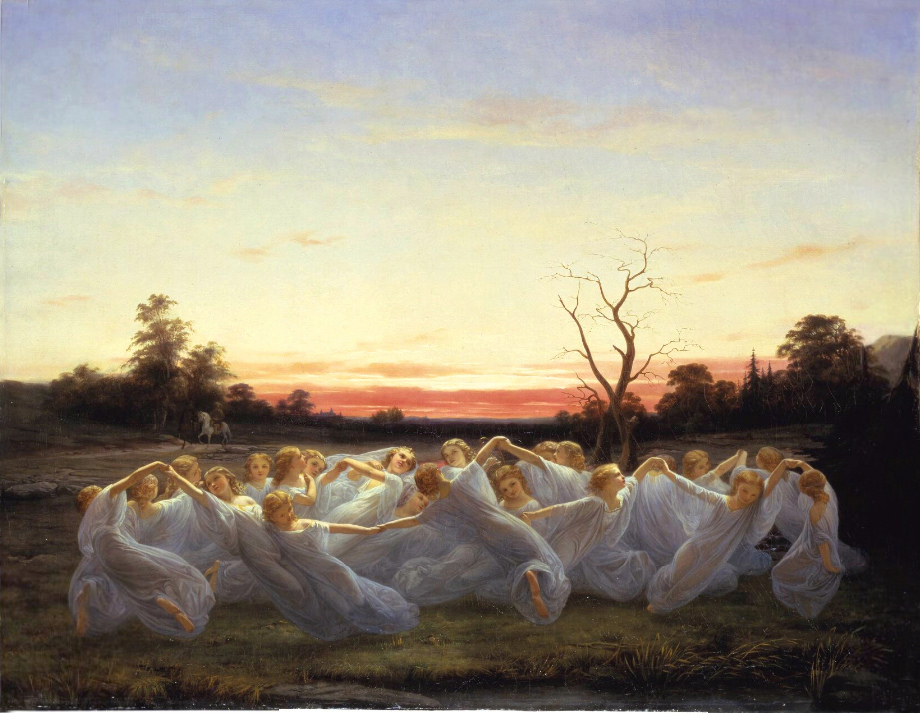
“Meadow Elves,” by Nils Blommer (1850)

I felt a hand on my shoulder. I looked up to see Miss Margit’s face, faceted in my tears. That face, longish and stern, with the gold blaze in the black hair above her right eye, could be gentle when she chose, and her gray eyes would soften with a sweetness that had nothing of sentimentality in it.

“What’s the matter, Kjære?”

I told her, between sobs.

She sat, elegantly careless of her black dress, in the straw beside me. She took my left elbow and fingers in her hands. I shuddered as I always did when someone examined my deformity. There is no nakedness like it.

My arm was permanently bent. More than anything else it resembled a plucked chicken’s wing. The useless fingers curled back toward the elbow, and the flesh hung loose and flaccid on the forearm. I never willingly rolled up my sleeves where anyone could see, which hid the worst of it, but I was an obvious cripple. I had learned early to expect the quick-glance-and-look-away that people use for politeness, or pity.

“You think you are to blame that your papa is unhappy?” Miss Margit asked, stroking the arm, making me shudder.

“If it weren’t for me—ʺ

“If it weren’t for you your family and Mr. Lafferty would find another way to persuade him. Your papa hasn’t the strength to withstand them. If he must be overborne, it’s just as well he do it for love. It’s a kindness you do him, Christian.”

“It doesn’t feel like a kindness.” Continue reading Snippet Four, Troll Valley →

The best of Norwegian Christmas tradition

The devastatingly handsome figure you see above is a piece of lefse. I’m also in the picture, in the maroon sweatshirt. Last night I joined my friend in St. Paul, making lefse at his house for the second year in a row. I know how excited you already are about this, but this year it’s better because we have pictures!

This is what lefse looks like when it’s finished. My friend says it’s the best batch of lefse he’s ever made in his life (and he’s made a lot). On the basis of my own on-site research, I can’t dispute that.

Below, after the fold, a Christmas song from Sissel Kyrkjebø: Continue reading The best of Norwegian Christmas tradition →

Flight out of Egypt, recommended

Sorry to post about bad news so close to Christmas. Tomorrow I promise a Sissel video.

Via my Facebook friend Josh Griffing, this report from a sympathetic Jew at Big Peace, on the plight of Christians in Egypt:

Gordon College is a Christian school between Salem and Rockport. A few weeks ago I spoke there at a commemoration of Kristallnacht, Germany’s night of broken glass, the first mass assault on Europe’s Jews and the harbinger of the Shoah. I told the Christian audience how good it was to feel Christian support for Jews in these times, and that even some of the most stubborn of my people were now appreciating Evangelical support for Israel. I also said that we felt this blessed support came from a spirit of Christian altruism. But given the news from the Middle East, concern for others is surely not the only reason Christians need to support Israel.

I asked how many in the audience of 250 knew of Anne Frank. Almost every hand shot up. Then I asked how many had heard of Ayman Labib. I got a mass blank stare. Ayman was a 17-year-old Egyptian Christian who just weeks ago was beaten to death by his Muslim classmates as teachers watched because he refused their demand to remove his cross necklace.

I asked how many knew about the Maspero massacre, which had left at least 24 Copts dead and 270 injured. And whether they knew that since January, there had been more than 70 attacks on Christian churches or institutions in Egypt.

While tonight you commemorate a Jewish pogrom, I told them, Christianity has just suffered its own “Kristallnacht” … and I have yet to see much of a Christian response.

If I were a utilitarian, I’d recommend that the Christians of the Middle East start demanding their own “homeland.” Unfortunately, the approved method of promoting such a policy, in our time, is suicide bombing, which is forbidden to Christians.

The blood of martyrs is the seed of the church, it’s true. But it would be pretty cold-blooded to look on complacently while our brethren are slaughtered, insulated by a conviction that “it can’t happen here.”

It’s also happening in Africa. Europe is next. Eventually, America will be in the cross-hairs, if nothing is done.

Deadly Stillwater, by Roger Stelljes

It’s generally a pleasure for me to read novels set on my home turf. Not only do I enjoy being able to visualize known locations as I follow the story, but for some reason I have a childish conviction that places are somehow validated, made more interesting, because they’ve been laminated between the covers of a book.

There was lots of that for me in Deadly Stillwater, by Roger Stelljes. The action ranges around eastern Minnesota and western Wisconsin, but most of it happens in the Twin Cities, and the climax is set near Stillwater, just to the east.

The hero is Mac McRyan, a St. Paul police detective. As one of the police chief’s “boys,” a decorated group of smart and effective cops, he’s called in from a vacation day (this all takes place over the Fourth of July holiday) when Shannon Hisle, daughter of one of the city’s most prominent—and wealthy—attorneys, is kidnapped. There’s added urgency because Shannon is a Type 1 diabetic. The police are already going all out when the criminals up the ante—they kidnap the police chief’s daughter as well. These are smart and organized villains who plan with military precision. It will take hard work, some luck, and a lot of ruthlessness to save the girls and bring a very motivated gang to justice. Continue reading Deadly Stillwater, by Roger Stelljes →

Apologia

[If you’ve been following the discussion in the Comments on my “The dance of the straw men” post below, you’ll have noticed that I (and some others) have been carrying on a debate with a visitor named Brendan, a very intelligent, thoughtful and courteous Unitarian. I have just posted a comment in response to his question as to why one should believe the Bible, more than the scriptures of other religions.

My response is below. I think it’s worth giving it a blog post of its own. This is not my personal Christian testimony, and it does not delve into the mysteries of grace. It’s just an account of the line of reasoning that leads me to contemplate the Christian faith in the first place.]

As for believing in biblical Christianity, here’s my rationale.

It’s true that faith begins where reason leaves off. But the decision to take that step is itself a reasoned one. It’s as if I were to take a course in mountain climbing. When I decide to do that, I implicitly accept the idea that I will soon step outside my range of knowledge into territory where I’ve never been before, and do things that make no sense to me. I am prepared to follow my instructor’s commands, even though he tells me to do things that seem counterproductive or even suicidal.

As a Christian, I am obligated (and I’m happy about this) to accept the validity of reason. But I also understand that it takes more than reason to describe the universe I actually live in. Every person alive (unless they have a serious personality disorder) understands this. We accept, at some level, that men who live for possessions alone are living an impoverished life. We accept that beauty matters. We admire people who give up their lives (the only lives they’ll ever get, in the materialist view) for a principle or a loyalty. Continue reading Apologia →

Snippet Three, Troll Valley

They were still discussing it around the wash table outside the mud porch when we got to the house. Bestefar was dipping water from a pail into the washbasin, and as he rolled up his sleeves, loosened his shirt and started to scrub the dirt off he said, “Peter, I think Otto’s got a point. The problem with you is you ain’t got brains enough to know when you’re smart.”

Papa folded his arms and twisted his mouth. “You know how many men try that sort of thing every year and lose their shirts?”

“Ja, some of them fail. But none of the ones who don’t try, succeed,” said Bestefar, lathering his arms with a cake of soap. His hands were red-brown as an Indian’s to the wrist, the arms paint-white from there on up. “Look at me. If I hadn’t been willing to take a chance, I’d still be fishing sild in Norway.”

“You tell him, Ole,” said Otto. Continue reading Snippet Three, Troll Valley →

The dance of the straw men

If you’re a social conservative, chances are you’ve had a conversation something like this:

Conservative: “But if we accept homosexual behavior as normal, how do we retain other traditional taboos, like the one against incest?”

Liberal: “That’s just a straw man. Nobody’s going to advocate incest.”

Now, read this, from Tauriq Moosa, tutor in ethics, bioethics and critical thinking at the University of Cape Town, South Africa (courtesy of Dale Nelson):

Thirdly, and oddly, people exclaim [incest is] “just” repugnant. We will examine this more closer later. Nonetheless, why should the sexual activities of two consenting adults concern us? This is the same question we can ask those who are ‘against’ homosexuality (which is like being against having blue eyes). It is none of our business what two consenting adults wish to do (as long as no one else is harmed/involved without consent).

Repugnance helped many things we now consider wrong to continue in the past, such racial and sexual inequality. We can’t rely on repugnance to justify our social policies, since our repugnance is simply that: our own. Besides which, people are repulsed by different things – and we cannot leave it up to the whims of our emotions to implement policies and laws which could, unnecessarily, cause suffering to other people, as is the case with gay people, women, and indeed the current brother-and-sister couple.

Pretty lively for a straw man, isn’t it?

Liberals—I want to share a serious word with you, in honesty and without malice. If you have any principles—any at all—I promise you that, if you continue on the Left, you will eventually either have to give them up or move to the Right. Because liberalism is not a position. It is a process. That process evolves continually. Nothing is out of bounds for it, given enough time. That’s why so many ‘60s radicals are Reagan Republicans now.

For years, people have been telling me (to take another example) that there’s nothing wrong with homosexual behavior because homosexuals are born that way (I’m still not convinced of that, but it’s beside the point for this discussion). The argument is, “If it’s inborn, it’s natural and right.” Christian liberals say it must be God’s will.

“Why would anyone choose to be gay?” the liberal says. “It’s penalized in our culture. So it must be inborn, and the gays have no choice in the matter.”

Bear that argument in mind when you read this, from Italy’s La Stampa.

A study conducted by neuroscientists at Turin University and researchers at the department of neurological science of the University of Milan asserts that pedophilia is caused by a defective growth factor called pleiotropic protein Progranulin (PGRN). The results were published in the journal Biological Psychiatry and presented during a recent convention of the Neurological Italian Society in Turin.

Now, if this theory is true, explain to me how the previously stated arguments for homosexuality don’t apply just as well to pedophilia.

And no, “You’re a Nazi,” does not count as a valid argument.

Missed it by THAT much.

Well, once again Time Magazine has passed me over for Person of the Year. Instead they chose somebody called “The Protester.”

I protest.

In other news, I was floored by this article from Psychology Today (tip: Conservative Grapevine). In it, psychologists Allan S. Miller and Satoshi Kanazawa come right out and say a number of things we’ve all known all the time, but nobody in the public eye has had the nerve to say out loud. Like, gentlemen prefer blondes. And most suicide bombers are Muslims. And it isn’t sexism that leads to sexual harrassment in the workplace.

Human behavior is a product both of our innate human nature and of our individual experience and environment. In this article, however, we emphasize biological influences on human behavior, because most social scientists explain human behavior as if evolution stops at the neck and as if our behavior is a product almost entirely of environment and socialization. In contrast, evolutionary psychologists see human nature as a collection of psychological adaptations that often operate beneath conscious thinking to solve problems of survival and reproduction by predisposing us to think or feel in certain ways. Our preference for sweets and fats is an evolved psychological mechanism. We do not consciously choose to like sweets and fats; they just taste good to us.

The authors operate from an evolutionary point of view, but in general a Christian can accept all these statements, it seems to me, on the basis of our belief in original sin.

"And suddenly that name will never be the same to me"


“The Annunciation,” by Fra Angelico

My recent Norwegian visitor gifted me with a book called Hva Er et Navn? (What’s In a Name? more or less), about customs and fashions of name-giving through Norwegian history.

In the section on biblical names, the author (Ivar Utne) discusses the origins of the name “Mary” (Maria in Norwegian). I hadn’t been aware there’s so much uncertainty about its meaning. Here’s the relevant section, as translated by me.

No one knows for certain where the name Maria originated. For that reason, several interpretations exist. We know for certain that the name had different forms in Palestine around the time of Jesus’ birth. It was Mariam in Aramaic and Miriam in Hebrew, which were the two languages the Jews used. The New Testament was written in Greek. There the name became Maria, because the Greeks thought “m” an ending that did not go with Mariam.

The trail leads further back. In the Old Testament, written in Hebrew, we find many women named Miriam. The first was the sister of Moses and Aaron, of whom we read in the story of the Hebrews’ exodus from Egypt to Palestine. The names of all three may be Egyptian, as they came from Egypt. The Egyptian meaning of Miriam is “beloved.”

Other scholars contend that Miriam comes from Hebrew and means either “rebel” or “a drop in the sea.” This is because there are Hebrew words with those meanings which sound like Miriam. The “drop” explanation has more recently become “star of the sea” in some naming books, but that explanation is accepted by few scholars.

There are numerous other explanations. In comprehensive naming lists, Maria, for example, is translated “sturdy and strong,” which might be rendered “big and strong.” “Visionary” and “wife” are also to be found among the interpretations.

Jonathan Strange and Mr Norrell, by Susanna Clarke


To young men of a studious turn of mind, who did not desire to go into the Church or the Law, magic was very appealing, particularly since Strange had triumphed on the battlefields of Europe. It is, after all, many centuries since clergymen distinguished themselves on the field of war, and lawyers never have.

It is my settled custom to delay discovering great novels until everybody else has already praised the life out of them. And so it is with Susanna Clarke’s Jonathan Strange and Mr Norrell. A marvelous, original conception carried off with what looks like effortless grace, Jonathan Strange and Mr Norrell is a sprawling, lengthy epic in the heroic fantasy vein, but set in early 19th Century England and narrated in a style reminiscent of Charles Dickens and Jane Austen (and probably other Victorian authors of whom I’m ignorant. I was always a little weak on my 19th Century English fiction). If you’re looking for headlong, fast-paced adventure, this is not the book for you. This is a leisurely book, whose pleasures are subtle ones. I found it totally delightful.

(I might also add that I forgot the author’s name, and could not recall throughout my reading whether the author was a man or a woman. Coming from me, that’s high praise.) Continue reading Jonathan Strange and Mr Norrell, by Susanna Clarke →