All posts by Lars Walker

Men should not act like boys, unless they're playing Viking

Another Viking from my group posted this video of us on Facebook. It’s not one he made; he found it somewhere. I’m not entirely sure who made it, but it’s very well done.

You’ll note that I “kill” Ragnar in the first fight. A phenomenon that rare deserves to be memorialized on film.

Watched the movie, The Hangover last night. I’d heard a lot about how hilarious it is.

Well, it’s funny. I laughed (snorted, actually) in a couple places. But mostly I found it distasteful.

It purports to be an affirmation of manhood and male bonding, in the face of a feminizing culture.

But that affirmation of manhood is actually an affirmation of boyhood. These men aren’t asserting their right to their status as men. They’re asserting their right to be irresponsible and make idiots of themselves. As if that’s what being a man is about.

I was particularly troubled by the attitude of the father of the bride (played by the great Jeffrey Tambor), who sends the bridegroom off to his Vegas bachelor party with a serious, fatherly speech that says, “Remember, what happens in Vegas, stays in Vegas.”

What kind of father is that? What kind of father will his son-in-law be?

Yeah, I’ve achieved fuddy-duddy status at last.

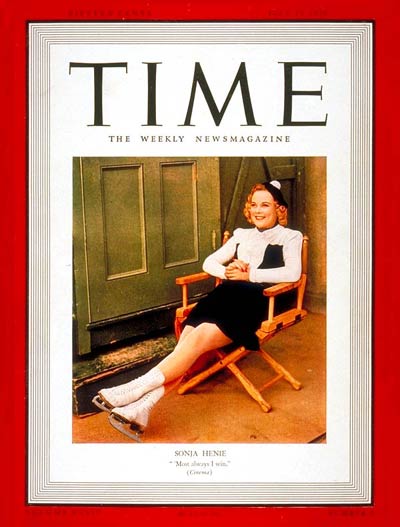
Sonja? I hardly known ya!

My recent lack of book reviews is not because I haven’t been reading books. I’ve been reading a very long book for a while (one I enjoy, but which is taking forever). However, I’ve interrupted that to read a shorter book that someone has asked me to review (more on that anon). I also read a technical manual for a piece of equipment I’m in the way of acquiring. There will be reviews, in time (not of the technical manual, of course). Until then, I vamp.

Tonight’s vamp is Sonja Henie, who was born April 8, 1912.

Norwegians are ambivalent about her, even after all these years. On one hand, she was perhaps the greatest Norwegian celebrity of all time, and a world-beating winter sports athlete. Norwegians will forgive a lot in a world-beating winter sports athlete.

On the other hand, she knew Hitler personally (her husband did business with him), and got along with him quite well. She even gave him the straight arm salute once. Although as a Hollywood celebrity she supported the American war effort, she never lifted a finger to support the Norwegian resistance, something that left a very bitter taste.

Also she was by all accounts alcoholic, narcissistic, and promiscuous. You’ve heard the expression that starts with a vulgar “b” word, and ends with “on ice?” She could have been the inspiration for it, if she wasn’t the inspiration in fact.

Personally, I generally don’t go for the round-faced look, so she never did much for me in the movies.

In other news, Anthony Sacramone posted a new item at Strange Herring, apparently in response to my legendary powers of persuasion.

It’s not a funny piece, but we take what we can get.

Meanwhile, our people have him under surveillance.

Boys and girls together

My creative juices are a little clotted tonight, so I’ll fall back on an old standby—a family photo from my scan collection, one which apparently sat in the sun too long at some point in its history, getting badly faded out.

Country school

Analysis:

This one isn’t strictly a family picture. It’s a photograph (dated around 1930, I’d guess) of the class at a country school, containing at least one of my family members. The second girl from the right on the bottom row is my aunt Corene, I think. Though it could be Aunt Jeannie. But I think it’s Corene.

The thing is, I had the idea my dad was in this picture. But it’s hard to pick him out. The little boy second from the left in that same bottom row might be him, but the hair looks a little dark (Dad was extremely blond). The story I recall is that the picture also includes, among other people, the girl who someday would be the mother of a guy who was my college roommate for a while, years later. But I don’t recall which girl it is.

I also recognize the two boys on the right in the middle row. Not as individuals, but by their family. They were neighbors of ours, and the face genes ran strong among them.

Actually, saying they were neighbors is redundant. This was a country school, built on the old Northwest Ordinance principle by which one section of land in each township was sold to pay for a school, which the kids in the township would attend. As you probably know, it was a one-room operation, in which the older kids and the younger kids all sat in class together. There are those who argue to this day that that setup was actually a benefit to all concerned. The younger kids had the older kids to help them, and the older kids got to help teaching, which is one of the best ways to learn.

You’ll note that almost all the boys are wearing bib overalls. A very practical garment for boys, those were. They cover the most vulnerable parts of the shirt (except, of course, for the elbows), preventing stains and wear. Oddly, although I grew up on a farm, and my dad wore them all the time, I don’t recall ever wearing one myself. There is, however, an old picture of me as a toddler in a small pair.

If I’d been born only a few years earlier, I’d have gone to this school. It was only about a half a mile from our farm, and was still standing, abandoned, when I was a kid. A friend of mine lived on that farm, and we sometimes went inside and goofed around.

Our township schools around Kenyon consolidated just a couple years before I started, so I went to the “new” school in town while it was still pretty new. It was a light-colored, one-story brick affair built in a U shape,with two wings branching off a central administrative section. I suspect somebody thought we kids would play in the space between the wings, but we almost never did, and the teachers didn’t encourage it. Too many windows there. The building was state of the art, equipped with the green chalkboards that, all the best minds agreed, would streamline the learning process and put us years ahead of the Russians. Each room was equipped with an asbestos fire blanket, I recall.

I don’t remember any of my classmates ever wearing bib overalls to school. That age had passed.

Herring shortage. Women, minorities suffer most.

The redoubtable Anthony Sacramone, most amusing of the Lutheran bloggers (OK, it’s a low bar) has done it again. And I don’t mean that in a good way.

His recently resurrected Strange Herring blog hasn’t been updated since March 27. And we all know what that means. Mr. Sacramone has lost interest again. He’s only been back at it since February, and already the Herring languishes like a dead… well, like a dead herring.

I suppose I ought to be grateful for what I can get. I try to be clever on this blog, but I’m seldom hilarious. I’m not capable of the consistent high level of mirth that Sacramone generates when he’s on. No doubt it takes something out of a fellow. Perhaps it causes an amusement deficiency in him, forcing him to retreat to a basement hideaway and read Sylvia Plath while depilitating himself with salad tongs, until his system regenerates itself.

At least Doktor Luther In the 21st Century is still tweeting. I don’t tweet myself, or follow tweets, but I read Doktor Luther’s here.

I shall note that today was the actual beginning of spring, for me. It was the first night I have taken my walk by the lake since last fall. The temperature was almost sixty, which is a little cold for me, but a real man would probably call it perfect. I returned home without any injuries that I’m aware of, so let the revels begin!

I shall wear the ends of my trousers rolled, I think.

The road has two shoulders

Two stories tonight, whose common thread is authors who do non-admirable things.

First of all, First Thoughts directs us to a Salon.com article by a woman who tells “How Ayn Rand Ruined My Childhood.”

My parents split up when I was 4. My father, a lawyer, wrote the divorce papers himself and included one specific rule: My mother was forbidden to raise my brother and me religiously. She agreed, dissolving Sunday church and Bible study with one swift signature. Mom didn’t mind; she was agnostic and knew we didn’t need religion to be good people. But a disdain for faith wasn’t the only reason he wrote God out of my childhood. There was simply no room in our household for both Jesus Christ and my father’s one true love: Ayn Rand.

I was hoping for a story about how the author found her way back to faith, but she says nothing more about that. Mostly it’s the story of how her father used Objectivist principles as an excuse to neglect his children.

Then, from Instapundit, a link to a Reason article by a fellow who set about re-tracing John Steinbeck’s route in his book, Travels With Charlie (which was very big back when I was in high school). His conclusion is that most of what Steinbeck reports is impossible, or is contradicted by the record.

It’s possible Steinbeck and Charley stopped to have lunch by the Maple River on October 12 as they raced across North Dakota. But unless the author was able to be at both ends of the state at the same time—or able to push his pickup truck/camper shell “Rocinante” to supersonic speeds—Steinbeck didn’t camp overnight anywhere near Alice 50 years ago. In the real world, the nonfiction world, Steinbeck spent that night 326 miles farther west, in the Badlands, staying in a motel in the town of Beach, taking a hot bath. We know this is true because Steinbeck wrote about the motel in a letter dated October 12 that he sent from Beach to his wife, Elaine, in New York.

Two writers, one from the far right, the other from the left. Both weighed and found wanting, by at least one reader, but for very different reasons. These are the besetting sins of liberals and conservatives.

I, of course, occupy the exact Middle. I look on both sides with condescension. The extent to which some people see me as partisan is precisely the extent to which the values of our society are warped. (Ahem.)

I expect most people feel that way, wherever they sit on the political/philosophical spectrum. Do the real extremists do the same? Did Stalin ever look at anyone and say, “Boy, he’s taking this Marxist dialectic a little too far”? Did Torquemada ever look at somebody else and say, “Hey, brother, you need to apply a little grace!”?

The wit of Stillman


On Sunday I watched my weekly Netflix rental, this one a movie I’d only seen once before—Whit Stillman’s Metropolitan.
I’m going to have to buy the whole Whitman trilogy, delightful films that yield increasing rewards with each viewing. Stillman is apparently a Christian of some kind (for years he’s been trying unsuccessfully to do a movie about believers in the Caribbean. Metropolitan opens with the chords of “A Mighty Fortress Is Our God”).
Stillman delights in turning cultural expectations on their heads. In Metropolitan, his first film, he portrays Manhattan “Yuppies” (one character insists they ought to be called “Urban Haute Bourgeouise”) as sympathetic and even mildly disadvantaged. In Barcelona, two American cousins, a businessman and a naval officer, deal with the European narrowmindedness and prejudice. And The Last Days Of Disco, set in Manhattan in a strangely ambivalent time period, celebrates the discotheque as a place of joy and a strange kind of innocence.
At one point in Metropolitan, Tom Townsend (Edward Clements) quotes a Lionel Trilling review of Mansfield Park to debutante Audrey (Carolyn Farina), in order to explain his dislike for Jane Austen. Audrey asks him what books of Austen’s he’s read. He says, “None. I don’t read novels. I prefer good literary criticism. That way you get both the novelists’ ideas as well as the critics’ thinking. With fiction I can never forget that none of it really happened, that it’s all just made up by the author.” The great joke is that the film itself is pure Jane Austen, though the comedy of manners has been transported to a small fortress of civility in a barbarian land. Continue reading The wit of Stillman →

Harsh reality

DATELINE HOLLYWOOD: A spokesperson for the Me Too Channel announced today the addition of an exciting new reality to show to their fall lineup.

The program is to be entitled, “Reality Show Reality Show,” and will feature four teams of contestants who will be transported around the nation by livestock truck, following a route determined by a GPS device set on “Random.” The object of the competition will be to find some area of life that has not yet been covered in a reality show. Participants will have points deducted from their scores for any sign of taste, modesty, or empathy for others. Weekly losers will be forced to remain on the program.

In related news, attorneys in Los Angeles announced a class action suit on behalf of every person in America who has not yet been a reality show contestant. “We are suing because it’s obvious to the meanest intelligence that absolutely no talent, brains, or skill of any kind is necessary to be a reality show contestant,” said chief litigator E. Cleveland Weckmeyer. “Therefore all Americans, however feckless, ignorant, or maladroit have the same right to be on such a program as the people who’ve already made money off such appearances. Let me add that if anything ought to be a basic right in a great country like America, it’s reality. Our plaintiffs have been denied their right to reality, and we intend to redress that wrong. Additionally, they’ll get a full dose of reality once they see our legal fees.”

Old school

Every Thursday I get a copy of my home town newspaper, The Kenyon Leader, in the mail. It doesn’t take me long to read it. It wouldn’t in fact take long if I read it all through, but generally I just go to the back page and look at the obituaries, to see if any more of my classmates have died. It doesn’t seem that long ago that I was reading about the deaths of my friends’ parents, but now it’s mostly us. Not that we didn’t lose some surprisingly early—a statistically significant number, it seems to me. There was the girl with juvenile diabetes who excelled at playing the piano (she was the first to go), and the most popular guy in class with the girls (whom I envied intensely); he died in Vietnam. And the foreign-born boy who was only with us the last couple years, and never quite fit in. I forget what he died of. The big, tall guy with the Czechoslovakian name we used to tease about being a “bohonk” (but admitted to our circle of friends, a group I personally consider the elite). I don’t recall how he died either. Another guy dropped dead of a heart attack in California, apparently without warning. All within the first decade. I may have forgotten some. Our original strength was only 68 people, mind you.

Come to think of it, I think the rate of death has actually slowed down in the last decade or so. Those of us who’ve made it this far seem likely to last a little longer.

No classmates died in time for this issue, but there was a death of sorts. Our old high school building suffered a major fire. Arson is suspected. Continue reading Old school →

Mostly old things, like Beowulf, lead books, and me


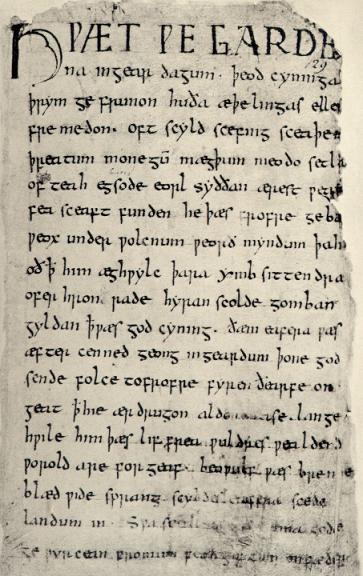
First page of the Beowulf manuscript.

Andrew Klavan has read Beowulf, and he wrote an essay on it for an anthology called Thrillers: 100 Must Reads. As would be expected from a writer of Klavan’s sensibilities, he gets the point entirely:

We in the modern West have been so powerful, so dominant, so safe in our homes for so long that we slip too easily into the illusion that we live at peace. We are never at peace, not really. When we go to the ballet or walk in the park or stop to smell a rose or read a book, we only do so by the good graces of the fighters who stand ready to kill and die to defend us. Soldiers on our borders, police officers on our streets—only the threat of their physical force keeps those who would murder, rob, or enslave us at bay. Every moment of tranquility and freedom implies the warrior who protects it. The world of Beowulf is the real world.

Read it all.

There’s big archaeological news today. A collection of about 70 ancient books, written on lead sheets bound with lead rings, has appeared in Israel (Jordan claims that they came originally from its territory, and is trying to get them back). Written in coded Hebrew, they appear to be the oldest extant Christian documents, and scholars are eager to examine them (if they ever get out of court.)

The director of the Jordan’s Department of Antiquities, Ziad al-Saad, says the books might have been made by followers of Jesus in the few decades immediately following his crucifixion.

“They will really match, and perhaps be more significant than, the Dead Sea Scrolls,” says Mr Saad.

“Maybe it will lead to further interpretation and authenticity checks of the material, but the initial information is very encouraging, and it seems that we are looking at a very important and significant discovery, maybe the most important discovery in the history of archaeology.”

This will be cool.

Of course it’s always fun until Opus Dei sends in its paid assassins.

Kidding! Kidding!

(Tip: Cronaca.)

Abbie Riddle of Abbie Reviews gives my West Oversea a glowing review here.

And I got an invitation to lecture on another Norway cruise today. Of course this kind of lecturing is only for the financially flush, which I no longer am, so I politely declined. But it’s nice to know I don’t have a black spot next to my name in the Great Ledger. (Or, alternatively, they may just be very, very desperate for lecturers. Maybe the armadillo juggler got sick.)

A Viking's Story, by John Andrews

A Viking’s Story is a privately published novel by a Wisconsin resident (under a pseudonym), available inexpensively in electronic formats only. I bought it in the first flush of Kindle enthusiasm (order a book, have it ready to read in about five seconds!), and I’m not sorry I bought it.

It’s the story of Harald Fairhair (also known as Harald Finehair), traditionally the first king of a united Norway. Andrews combines the traditional story of Harald, as recorded in the sagas, and weaves into it the findings of modern historical scholarship and archeology. The result is a generally coherent fictional memoir, as Harald himself dictates his life story to an English priest never mentioned in the actual historical record.

The result hangs together pretty well. I think this book would be a good introduction to the Viking Age for a general reader looking to learn more about that period. In my opinion, the author underestimates the superstition of a real Viking. Also, he falls into the rookie error of trying to convey emotion with exclamation points! But these are minor errors, and all in all the book was enjoyable.

The issue of Christianity does come up, and I have to give Andrews credit for evenhandedness in that department. The priest/amanuensis, to the extent that we come to know him, is relatively tolerant and reasonable. Harald himself, of course, scorns the religion (though he does admire its bureaucracy), which is entirely consistent with what we know of him.

A Viking’s Story is not a great Viking novel, but it’s pretty good, and has the special advantage of copious and up-to-date research (mostly. I found some things to quibble about, but I could be wrong about some of them myself).

Suitable for teens and up.