I have a new piece up at The American Spectator Online today. I was worried it was a little too personal for the venue, but the editor told me it was “the best piece I’ve read in a long time.” Which is always nice to hear.
Anyway, it’s about the Lockdown and living in fear. Because fear is a subject I know all about.
I hope I’m open-minded enough to listen to experts. However, when an “expert” starts telling me the only way to prevent Gotterdammerung is to increase the size and power of government, I start reaching for my skeptic’s hat. I wear that hat a lot nowadays.
I’m not an epidemiologist, as you’ve probably guessed.
But I do know about fear.
And what troubles me most about our current predicament is that we’re being governed on the basis of fear.
Here’s a little Latin you may find useful when you’re working from home, recovering at home, taking refuge at home, or being confined at home.
Domi manere convenit felicibus. — It befits those who are happy at home to remain there.
I hope that’s true for you; it’s not true for too many, because as Ovid says, “Dos est uxoria lites,” that is, strife is a wife’s dowry. May that not be your home, for domus sua cuique tutissimum refugium (every man’s home is his safest place of refuge).
Remember that a friendly house is the best of houses (domus amica domus optima), but remember also that pain compels all things (dolor omnia cogit).
You may find it useful to say to yourself and others:
Dominus vobiscum (The Lord be with you)
Dominus providebit (The Lord will provide)
Dominus illuminatio mea (The Lord is my light)
Deus det [nobis pacem] (May God give [us peace])
Deus propitius esto mihi peccatori (God be merciful to me a sinner)
Here are a few others words you may wish to repeat, echoing the wisdom of the ages.
Honesty is the poor man’s pork and the rich man’s pudding.
Hope is grief’s best music, but help which is long on the road is no help.
Keep a thing seven years, and you’ll find a use for it.
Today is the 75th anniversary of VE Day, “Victory in Europe Day,” in 1945. It was a bigger commemoration when I was a boy, when those events were still recent history to all the grownups I knew.
In Norway it’s known as Frigjøringsdag, “Liberation Day.” The bit of newsreel footage I’ve posted above provides one of the more amusing moments of that event. A German commander, Oberst Karsch, marches up to British Air Commander Darrell, a big smile on his face, as if hoping to convince him it’s all been a big misunderstanding and to let bygones be bygones. Darrell is not amused, and appears to defer to his Norwegian colleagues.
It’s an important date. Too bad the Norwegians can’t celebrate it properly under current conditions.
I have a fondness for old ballads. Mostly I’ve read the British kind (you may have read “Barbara Allen” or “Sir Patrick Spens” in school). They’re voices of the past; sometimes heard indistinctly, sometimes garbled in the hearing, sometimes in the retelling. Often they’re like assemblies of interchangeable parts – you can mix and match them. Or change the hero’s name and you’ve got a ready-made new story. The ballad is often a marvel of narrative simplicity – you may learn what’s happening solely through dialogue (even monologue); you may even have to guess a bit what’s going on.
I’ve had some exposure to Scandinavian ballads in the past; generally they follow the same forms the British ones. The chief difference is that when a hero in a British ballad meets a supernatural being, it’s likely to be some kind of Faery. In the Scandinavian kind, you get trolls most often, then sometimes it’s the Huldre (the Underground Folk, the Scandinavian equivalent of Faery; I mention them in my novels).
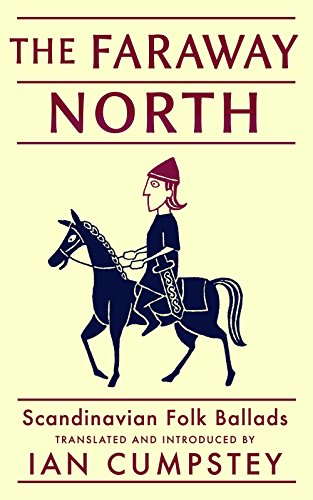
Ian Cumpstey is a Swedish-to-English translator, but in his collection, The Faraway North, he has collected examples from Norwegian, Danish, and Swedish ballads, all done over into English. They sound very much like the ones we’re familiar with. They don’t always rhyme, but ours don’t either – I wondered as I read whether the translator’s creativity had failed, but he says in his notes that the originals often don’t rhyme either.
We encounter some famous characters in these verses – St. Olaf and King Harald Hardrada, for instance, or Sigurd (the one in the verses quoted above), better known to us as Siegfried the Dragon-slayer. But many of them are mysteries – if their characters ever lived at all, their stories are preserved only in these songs.
I enjoyed read The Faraway North very much. You might like it too, if you’re fond of antiquities.
I have a new column up at The American Spectator Online today. This one (written before the Plague descended) considers the old TV show, “The Adventures of Jim Bowie” in light of the New York Times’ “1619 Project.”
In fact, America has a long history of self-criticism when it comes to Native American issues. Sticking to popular culture, I can cite a few examples out of my own limited viewing and reading.
Today is Maundy Thursday in the church calendar. The word “maundy” is related to the Latin root of the word “mandate,” meaning command. It’s a reference to Christ’s words at the Last Supper: “A new commandment I give you, to love one another as I have loved you.”
This is a day for Holy Communion in many churches. Most traditional Lutherans aren’t doing the sacrament until the quarantine is over, though. Because we believe actual physical presence is necessary. (My own church is doing virtual communion online, but we’re kind of outlaws.)
April 9 is a sad day in Norwegian history. 80 years ago today, German troops marched into Oslo. They actually expected to be greeted as saviors, protecting the Norwegians from the British, who’d been violating Norwegian neutrality in various ways. The Norwegian government wasn’t quite sure what to do with them at first — after all, Hitler was (for the moment) allied with Stalin, who was a friend and benefactor to Norway’s ruling Labor Party. When the troops marched in, they got a police escort.
However, on that same day, Norwegian troops at Oscarsborg Fortress on the Oslofjord, under the command of Col. Birger Eriksen, fired on a German battleship. The Blucher was a brand-new ship; many of its crew were raw recruits on their first voyage. But among the personnel on board were Gestapo officers and other personnel whose assignment was to capture the Norwegian royal family and government. Because the ship had refused to respond to warning shots, Col. Eriksen determined that whoever they were (he didn’t know at that point), they were hostile and it was his duty to fire on them. His words were, “Either I will be decorated or I will be court-martialled. Fire!” His guns and ammunition were old, but they performed admirably. Both his battery’s shots hit, and the Blucher began burning. Further shots from secondary batteries caused further damage, and the Blucher sank with the loss of 650-800 soldiers and sailors (1,400 survived). The delay caused by the sinking gave the royal family and the government time to escape the city, and ultimately to flee to exile in England.
Aside from Atlantic Crossing, which I’ve told you about, I’ve done some other work having to do with Norway in World War II, which I still can’t tell you about. I hope they’re released eventually. I’m quite proud of them.
Years ago, for some reason (perhaps a college assignment I’ve forgotten), I picked up a copy of Boccaccio’s Decameron.
This is not a review of that book.
I started reading the Decameron, for some reason, years later in Florida, when I was sick in bed and looking for reading material. Back before I could summon books magically through the ether with my Amazon Fire.
I didn’t finish it. It’s one of those books I just couldn’t get into.
Anyway, it’s a collection of 100 stories, supposedly told by a group of ladies and gentlemen who’ve fled Florence during the Black Death in the 14th Century.
I tell you all of that just to ease into my real subject – I have a very brief Plague Story of my own today.
Buoyed by the prospect of money coming in from my recent translation job, I decided to throw some patronage at a restaurant I like, but haven’t been to for a while. I called in an order for pick-up.
When I got there, rocking my stylish Black Bart Stagecoach Robber bandana mask, the cashier told me it would be just a minute. I said sure.
There was another guy there, sitting on a bench. A middle-aged guy (which makes him younger than me, I shudder to think) who seemed to be waiting for a large order.
“Sure never thought I’d see times like this in America,” he said to me, keeping his distance as the law prescribes.
I agreed, pretty much echoing the same sentiment back to him. “I feel bad for the small business owners,” I added. “A lot of those people don’t have a lot of margin to fall back on.”
He told me he was a small businessman himself. He owned two neighborhood bars. “I’m doing OK,” he said. “But I feel bad for my employees. Some of them are in real bad shape.”
We went on to talk about various theories about the Coronavirus thing. He’d heard that people get immunity from sunlight exposure in summer. I said I’d heard it was temperatures over 80 degrees and humidity.
“If it’s heat and humidity,” he asked, “how come it doesn’t die on your body? What’s warmer and humider than your body?”
I admitted he had a point.
Then the cashier came out with my food. As I stepped toward the counter, the guy said, “Hey, Mister, forget it. It’s on me. It was a pleasure to talk to somebody new after all these days at home.”
I’ll share a little-known personal secret with you – I almost never turn down free stuff. I thanked him and gave the cashier a big tip. We were all happy for a moment.
As I left he asked my name, and gave me his. Which, of course, I’ve forgotten already.
I should have asked the names of his bars, so I could recommend them to any locals who may read this – after they re-open on VC day. But I didn’t think of that. And I don’t drink myself.
Well, fortunately he’ll never be able reproach me for my ingratitude. He never saw my face without a mask.
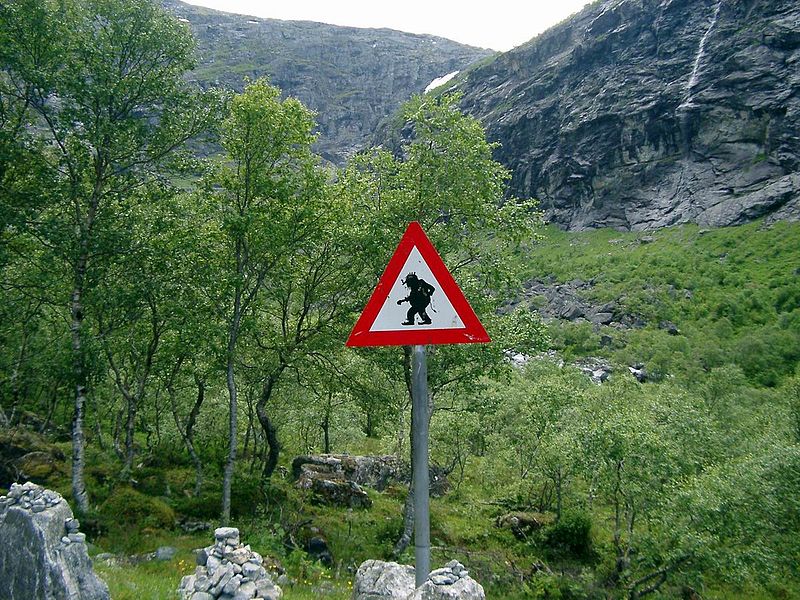
By Hesse1309 – Own work, CC BY-SA 3.0, https://commons.wikimedia.org/w/index.php?curid=487491
The picture above isn’t one of mine. It’s in Norway, though. I think I may have seen this sign on one of my journeys; I know I saw one like it. We take our trolls seriously, we Norwegians. If they kidnap a princess or two, well, that’s the price of living in the most beautiful place in the world.
It was quite a weekend, friends. I was intensely engaged with the Norwegian language. I will not tell you what translation project I was working on, and I’ll not tell you whom it was for. It was a script. You can guess the medium for yourself.
But I had a lot of work to do, and a deadline to meet. I was a little insecure about meeting it, but it turned out I’d underestimated myself. The work went faster than I’d looked for. The thing didn’t get delivered as soon as I hoped, due to a glitch that appeared and wiped away a whole lot of work that had to be done all over again. But I got up early and worked late, and delivered everything well before I’d estimated.
It’s a little disconcerting that I haven’t heard anything back from the client (checking again to see that my email with the files actually went out; yes, it did). But if my product had been awful, I suspect somebody would have said something. I take comfort in that thought.
After all these months, it was sweet to open up the First Draft app and do that voodoo that I do so adequately. It was fun, in the same sense that being a rodeo rider or a cage fighter is fun. It takes its toll, but you come out stimulated. While all around me people were going batty with cabin fever, I was in my element, growing as a craftsman. It was, frankly, the best weekend I’ve had in quite a long time.
I’ve become a little cautious about discussing translation work. So suffice it to say that I snagged a nice one, and there’s a deadline coming on, and I can’t really spend much time on a blog post.
But rejoice with me that I’ve found work, when better men are filing for unemployment. Whatever my project is, it’s interesting. Have a good weekend. Don’t do anything I wouldn’t do (that ought to keep you pretty safe).
“Smithsonian Channel has also begun to roll out entire episodes on YouTube, and weekly online “watch parties” are planned to make the “Aerial America” viewing experience interactive despite social distancing. Every Tuesday and Thursday from 4 to 5 p.m. EST, Smithsonian Channel’s Facebook page will host state-specific trivia while showing an episode. Each episode will simultaneously drop on YouTube.”
It may not be Epcot’s Soarin’ ride, but it’s close and much longer. There are currently four episodes: Alabama, Alaska, Arizona, and Arkansas.
Websites store cookies to enhance functionality and personalise your experience. You can manage your preferences, but blocking some cookies may impact site performance and services.
Essential cookies enable basic functions and are necessary for the proper function of the website.
Name
Description
Duration
Cookie Preferences
This cookie is used to store the user's cookie consent preferences.
30 days
These cookies are needed for adding comments on this website.
Name
Description
Duration
comment_author
Used to track the user across multiple sessions.
Session
comment_author_email
Used to track the user across multiple sessions.
Session
comment_author_url
Used to track the user across multiple sessions.
Session
These cookies are used for managing login functionality on this website.
Name
Description
Duration
wordpress_logged_in
Used to store logged-in users.
Persistent
wordpress_sec
Used to track the user across multiple sessions.
15 days
wordpress_test_cookie
Used to determine if cookies are enabled.
Session
Statistics cookies collect information anonymously. This information helps us understand how visitors use our website.
Google Analytics is a powerful tool that tracks and analyzes website traffic for informed marketing decisions.
Used to monitor number of Google Analytics server requests
10 minutes
__utmb
Used to distinguish new sessions and visits. This cookie is set when the GA.js javascript library is loaded and there is no existing __utmb cookie. The cookie is updated every time data is sent to the Google Analytics server.
30 minutes after last activity
__utmc
Used only with old Urchin versions of Google Analytics and not with GA.js. Was used to distinguish between new sessions and visits at the end of a session.
End of session (browser)
__utmz
Contains information about the traffic source or campaign that directed user to the website. The cookie is set when the GA.js javascript is loaded and updated when data is sent to the Google Anaytics server
6 months after last activity
__utmv
Contains custom information set by the web developer via the _setCustomVar method in Google Analytics. This cookie is updated every time new data is sent to the Google Analytics server.
2 years after last activity
__utmx
Used to determine whether a user is included in an A / B or Multivariate test.
18 months
_ga
ID used to identify users
2 years
_gali
Used by Google Analytics to determine which links on a page are being clicked
30 seconds
_ga_
ID used to identify users
2 years
_gid
ID used to identify users for 24 hours after last activity
24 hours
_gat
Used to monitor number of Google Analytics server requests when using Google Tag Manager
1 minute
_gac_
Contains information related to marketing campaigns of the user. These are shared with Google AdWords / Google Ads when the Google Ads and Google Analytics accounts are linked together.
90 days
Marketing cookies are used to follow visitors to websites. The intention is to show ads that are relevant and engaging to the individual user.
A video-sharing platform for users to upload, view, and share videos across various genres and topics.
Registers a unique ID on mobile devices to enable tracking based on geographical GPS location.
1 day
VISITOR_INFO1_LIVE
Tries to estimate the users' bandwidth on pages with integrated YouTube videos. Also used for marketing
179 days
PREF
This cookie stores your preferences and other information, in particular preferred language, how many search results you wish to be shown on your page, and whether or not you wish to have Google’s SafeSearch filter turned on.
10 years from set/ update
YSC
Registers a unique ID to keep statistics of what videos from YouTube the user has seen.
Session
DEVICE_INFO
Used to detect if the visitor has accepted the marketing category in the cookie banner. This cookie is necessary for GDPR-compliance of the website.
179 days
LOGIN_INFO
This cookie is used to play YouTube videos embedded on the website.