
Tomorrow, Saturday, Sept. 14, I’ll be playing Viking in Granite Falls, MN at the Elvidal Viking Fest. Information here.
Category Archives: Uncategorized
The Tale of Tormod, KolBrun’s Skald

In Trapped, the Icelandic miniseries I reviewed last night, both in the first season (which I reviewed) and the second (which I’m watching now), there’s a female character named Kolbrun. It was a familiar name to me, and by coincidence I came to the Tale of Tormod Kolbrunarskald in my reading of the Norwegian translation of Flatøy Book. Obviously this was a sign from heaven that I should share Tormod’s story with you.
Tormod Kolbrunarskald is an important character in the Saga of St. Olaf. He doesn’t appear in my novel, The Elder King, but I expect he’ll show up in a later book, because he’s an important character and has one of the most memorable deaths in saga literature. But that’s not my topic tonight. My topic is his backstory.
I’d always assumed that he got his nickname, which means “dark-brow poet,” because he had dark eyebrows. Turns out that’s not true. His nickname actually means, “Dark-Brow’s Poet”
This is the tale (in highly condensed form).
Tormod Bersesson was living at his father’s farm in Laugabol, Iceland. Nearby, at a farm called Ogr, there lived a widow named Grima who had a beautiful daughter named Tordis. Tormod got in the habit of visiting Ogr, and spending time in private with the girl.
Eventually Grima, the mother, took Tormod aside and suggested that he should either ask for the girl’s hand honestly, or leave her alone for the sake of her reputation. Tormod hemmed and hawed, so to show she was serious, Grima sent a thrall to kill Tormod, but the poet escaped with a wounded hand.
After that, Tormod relocated to a fishing station his father had at Bolungarvik. Nearby lived another widow, named Katla, who had a daughter named Torbjorg, who was nicknamed Kolbrun because of her dark eyebrows.
Tormod thought Kolbrun not quite as pretty as Tordis, but nevertheless he started spending time with her. To gain her favor he wrote a series of poems, the “Kolbrun Poems.”
Later, when winter came, Tormod moved back to Laugabol, and renewed his visits with Tordis. At first she was distant. “I heard that you wrote a series of poems for a girl at Bolungarvik named Kolbrun,” she said.
“Oh, no!” Tormod lied. “That story is completely wrong. I didn’t write those poems for Kolbrun. I wrote them for you.” He immediately recited them for her, but changed the words so they now praised Tordis. Tordis was pleased with this.
But that night, Tormod had a terrible dream. He saw Kolbrun floating in the darkness in front of his bed. She said, “You have broken your word to me. It’s dangerous to break your word to a witch. I will now lay this curse on you – your eyes will swell up and grow terribly painful. They will swell so that if it isn’t stopped they’ll pop right out of your head. The only way you can prevent this from happening is by announcing in public that the poems are mine, not Tordis’s, and that you lied.”
Tormod woke in terrible pain, and slept no more that night. As soon as he could he assembled family and friends and confessed his lie. Immediately his eyes improved, and soon he was well again.
But forever after he was known as Tormod, Kolbrun’s Poet.
Nordic Music Fest
Tomorrow I and the Vikings will be at the Nordic Music Festival at Lions Park in Victoria, Minnesota. 10:00 a.m. to 5:00 p.m. More information here. I will have books to sell.
Blessed aches and pains

It’s one of the most delightful and inspirational stories of American history. John Adams and Thomas Jefferson, who started as political allies in the Continental Congress – where they worked together on drafting the Declaration of Independence – became the bitterest of political enemies after independence had been won. Their approaches to government were very different, and their perceptions of dangers to the republic widely separated. The lies and vitriol both men (and especially their spokesmen) employed against each other in election campaigns make the ugliness of today’s politics look courtly and tame.
And yet, in their old age, the two men began corresponding, and became friends again. Amazingly, they died on the very same day – and that day was the 50th anniversary of the signing of the Declaration. (Seriously. It’s true. Look it up.)
I’m recalling that story today, not for political purposes, but just to talk about old age – a subject of increasing interest to me.
I haven’t read the Adams-Jefferson letters (I know, I should). But I wonder if part of their reconciliation, beyond the fact that they were nearly the sole survivors of their generation, was the reconciling power of shared aches and pains.
I had opportunities recently to spend time with a couple of people from my youth. One of the particular tribulations to which a just Providence has subjected me in my dotage has been that pretty much every one of the friends of my youth, the people I was closest to, have walked away from the beliefs we shared. I have not changed (much). They have changed their views in almost every way.
And yet we spent time together in amity. Thinking it over afterward, I realized that we spent a lot of the time discussing our health complaints.
This is a topic that never fails among the old.
I remember being young (my memory is still that good), and I recall that one of the things we laughed about when talking about old people was how they couldn’t shut up about their aches and pains, their digestions and their prescriptions.
And I understand. I have no wish to impose tales of my dry skin and digestive habits on the healthy young, who should have their minds set on higher things.
But when we oldsters are together, ailment talk is great. It bridges divisions, awakens sympathy, and arouses our helpful instincts.
All part of God’s plan, no doubt. He has a wry sense of humor.
2 Spellings of Gray. Or Grey.

It must be because I’ve been plowing through Mark Greaney’s Gray Man novels – I got to thinking about the spelling of the word “gray,” which seems to be in a “dynamic” state just now.
As a child I learned the basic rule – Americans spell it “gray;” the English spell it “grey.” The first warning of change swam into my ken when I read an interview with Colleen McCullough, author of the besteller, The Thorn Birds. I think it was in the 1980s. She said, as I recall, that she always spelled it “gray,” except when describing eye color. “Grey” just seemed right for eyes, she said.
And it did seem right in that case. Maybe it’s the mirroring of the two vowels, “e” and “y.” There seems to be a suggestion of something kind of blue-grey in the English spelling. At least for me.
Then, years later, along comes the novel, Fifty Shades of Grey (Sorry, I will not link to it). It became a huge phenomenon and Americans began to see that “ey” spelling in front of their faces all day long. It seems to have imprinted itself on a lot of them.
Maybe it has to do with the fact that sexual excitement increases memorability.
In any case, it seems to be catching on. I’ve noticed that James Lileks consistently spells it “grey” over at the Daily Bleat. I expect that has more to do with the time he’s spent in England than with Fifty Shades.
But it looks (to me) as if we’re in the midst of a spelling shift in this country. The English are winning this one. Gradually.
Me, I’m going to stick with “gray,” even though I’ll admit I kind of like “grey.” I’m an anglophile, after all, and there is a certain nuance with the “ey.”
But I stick with the old rules, unless there’s good reason to drop them. And “gray” has committed no crime deserving of termination.
For your Spectation
I have a new column up at The American Spectator Online today: Slaves to Intellectual Fashion: 1619. A little more fiery and dismissive than my usual stuff, I think. This particular initiative gets my goat in a personal way. I consider it slander against a country I love and am grateful for.
The weekend was good, thanks for asking. We had a couple Viking groups at Nisswa, Minnesota for a one-day Viking event on Saturday. I took a few pictures, but they weren’t very good. Having 2 groups together made it possible to have some relatively impressive battles, with (I guess) 15 to 20 guys all together. I did not participate in those. I sat in my pavilion in Viking splendor, dispensing wisdom and information to all comers. Also selling books.
It was nice, the weather was beatiful, and I stayed with some very gracious hosts in Brainerd. All in all, pretty rewarding. The scuttlebutt is that the event will happen again next year.
Next stop, Nisswa

If you’re in the Bemidji Minnesota area tomorrow, a lot of bloodthirsty Vikings will be gathered there for a brand new festival. I shall be among them, spreading sunshine on my way, as is my wont. Books shall be bought and sold.
Read more about it here.
Watch for ‘Wisting’

I have approval now to tell you about another Norwegian TV miniseries I helped translate. You may recall the name Wisting, because I reviewed several of the books on which this series is based, written by Jørn Lier Horst. I couldn’t say it at the time, but I got interested in the books when I worked on the TV scripts (though I admit I only helped with a couple). The books seem to be out of print in English right now, but I suspect they’re preparing a new edition to tie in with the miniseries.
Should be interesting. It’s been broadcast in Norway already, so I would look for it to show up on Netflix or something before very long. Recommended, with cautions for the sort of things you’d expect.
The Donald and the Erik
Sorry about the lack of a post last night. I actually posted one, and WordPress disappeared it. It vanished into the ether, like a childhood friend of Stalin. I don’t know what my sin was.
Let’s see if this one stays up.
Last night’s post wasn’t anything you’ll miss much, just a reminiscence from my childhood. Not even very dramatic. Maybe I’ll write about it again someday.
One of today’s big news stories is that President Trump, apparently, would like the US to purchase Greenland.
It ain’t gonna happen, according to the Danes. They have no need, or wish, to part with one of the very few remnants of their once-extensive empire.
And after all, people live in Greenland. I would hope they’d have a say in the matter.
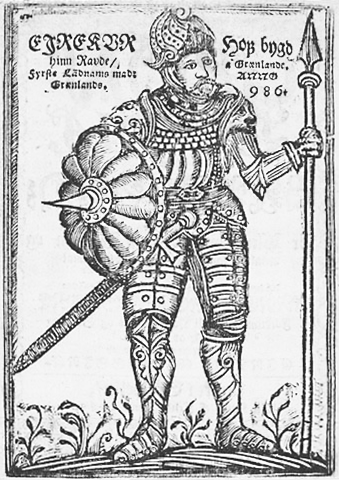
Still, it’s an intriguing thought. It occurs to me that Donald Trump and Erik the Red, settler of Greenland, are kindred souls.
Both are larger-than-life characters, combative, practiced in self-promotion. The saga famously says that Erik called his country Greenland “because people would be more inclined to move there if it had a pleasant name.”
Thus he’s been called the first real estate developer.
I like to think that if Erik and Donald could meet, they’d take to one another right off. Sit down over some mead (though I understand Pres. Trump doesn’t drink) and talk deals.
I suspect Erik could have been talked out of Greenland, for a sweet enough offer.
Alexandria the Great

For a few days I was a rock star. Granted, I was a rock star with “selective appeal,” but a couple hundred people in Alexandria, Minnesota treated me like a celebrity.
The event was the Tre Lag Stevne. The Bygdelags (as I explained last week) are organizations composed of descendants of immigrants from various Norwegian regions. The three “lags” who met for the stevne (gathering) were groups from Gudbrandsdal, Hedemark, and Trondelag. They invited me to lecture twice on Thursday – once on the Lindisfarne raid in 793 AD, and again on the book Viking Legacy (which I translated; might not have mentioned that to you before).
The audience was attentive, smart (they laughed at my jokes) and appreciative. They descended on my book table like a flock of seagulls and snatched up every copy of Viking Legacy I brought. On top of the sales, I got an honorarium which was generous by my standards.
I have no complaints.
The next day I had to be in a meeting in Fergus Falls, just a little up the road, so I stayed a second night. I had some free time – and when Walker has free time in Alexandria, he can’t resist visiting the Kensington Rune Stone Museum. I’ve been there before, but I heard they’d made some changes.

This is the stone itself. I have grave reservations about its authenticity, but you can’t deny it’s become a part of history in its own right.

This display is the main thing I came to see. They did an upgrade to the museum a few years back, and decided to include a tableau about the real Vikings (even if the stone is genuine, it’s not a Viking artifact. Its date is 14th Century, long after the Viking Age ended). The person the museum hired to make costumes for the Viking family was my friend Kelsey Patton – who also made the Viking trousers and summer tunic I’m wearing in the top picture.

Here’s a surprise – the museum has a Viking ship, in a barn outside. It’s a ¾ scale replica of a Viking knarr (a cargo ship), which was built as a project some years ago by the American Museum of Natural History. Somehow it ended up here.
An interesting and profitable few days. Thanks to everyone who made it possible.