Category Archives: Publishing

Finn Now, Hemingway Next

D.G. Myers picked up on the story Lars linked to yesterday, saying the word slave doesn’t have the humanity needed to communicate the story in Huckleberry Finn. If this scrubbing of the text flies, Hemingway’s Sun Also Rises may be next. We can’t have a character described as “superior and Jewish.” What would the Greeks say? (via Books, Inq)

"Huckleberry Fi" (n's removed)

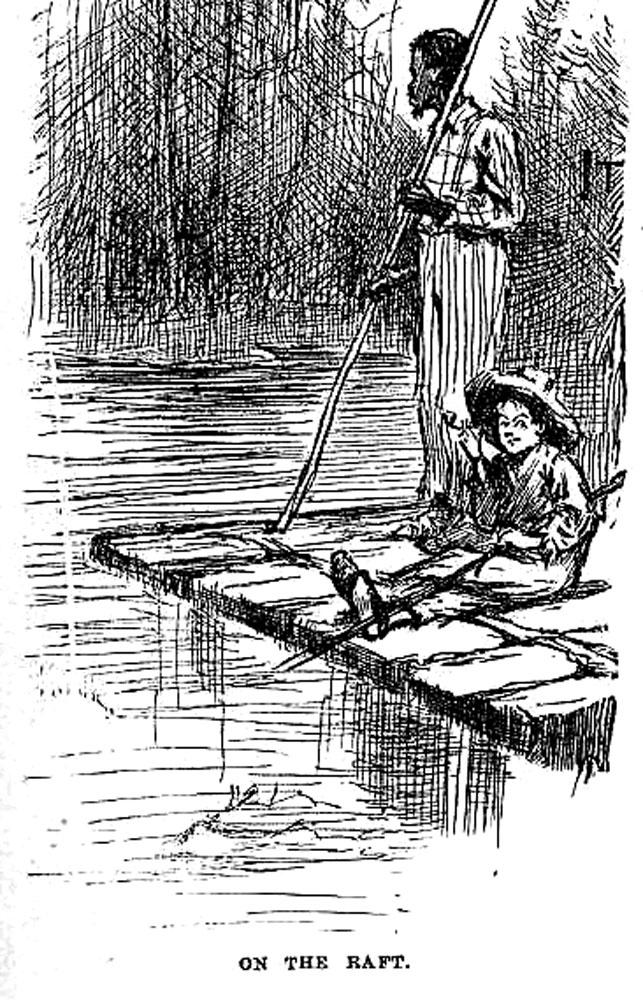
Huck and Jim

This Is Just Too Weird Dept.: Tonight when I came home from work, precisely as I pulled Mrs. Hermanson into the garage to leave her for the night, her odometer turned over 100,000 miles.

I think there can be no question that this is a Sign and a Portent.

But of what, I wonder?

According to this article from Entertainment Weekly (Tip: Big Hollywood), NewSouth Books is bringing out a new edition of Huckleberry Finn, aimed at students. Every instance of the “n” word (you know the word I mean) has been changed to “slave.” And every instance of “Injun” has been changed to… something. They don’t say what.

“Is this really a big deal?” the columnist asks.

Yeah, I kind of think it is.

On the other hand, if this puts the book into the hands of kids who would not otherwise be allowed to read it due to forces beyond their control (overprotective parents and the school boards they frighten), then maybe we shouldn’t be so quick to judge. It’s unfortunate, but is it really any more catastrophic than a TBS-friendly re-edit of The Godfather, you down-and-dirty melon farmer? The original product is changed for the benefit of those who, for one reason or another, are not mature enough to handle it, but as long as it doesn’t affect the original, is there a problem?

My opinion (I could, of course, be wrong), is that if a student is old enough to understand the extremely sophisticated themes of Huckleberry Finn, he or she is old enough to understand that the “n” word, while always offensive, was in very common use in Mark Twain’s time, even by black people themselves. I think that’s a fact worth knowing. Educational, even.

“Ah ha!” says someone. “But you’re saying ‘n word’ yourself! You’re a hypocrite!”

“Silence, Imaginary Interlocutor!” say I (I might as well. Anthony Sacramone isn’t using the phrase much these days [I just tried to link to his dormant blog, but now it won’t let you in without a Google account]). The truth of the age I live in is that the “n” word is no longer in common use, except as an insult (and in rap lyrics). If I tried to use it in Mark Twain’s way, I’d be as false to my own world as it’s false to his to clean it up in Huckleberry Finn.

I hold (again, I could be wrong) that when it comes to speech, the Victorians were able to express themselves with far greater freedom than we enjoy today.

Five E-book Trends

Philip Ruppel, president of McGraw-Hill Professional, notes five trends he says will change the publishing industry.

    1. Enhanced E-Books Are Coming and Will Only Get Better
      The Device War Is Nearly Over
      The $9.99 E-Book Won’t Last Forever
      The Contextual Upsell Will be a Business Model to Watch
      Publisher Editing and Design Will Be More Important Than Ever
  • Iranian Filmmaker Jailed, Banned from Filming

    The Guardian (UK) reports:

    The acclaimed Iranian film-maker Jafar Panahi was sentenced to six years in prison today, and banned from directing and producing films for the next 20 years, his lawyer said.

    Hamid Dabashi, a professor of Iranian studies at Columbia University, said: “What Iran is doing with the artists, is exactly similar to what Taliban did in Afghanistan. This is exactly like bombing Buddha statues by the Taliban, Iran is doing the same with its artists.”

    John Thompson of Merchants of Culture


    Cambridge University professor John Thompson talks about the problems with the publishing industry in this interview with The Brooklyn Rail. He is the author of the book

    “The real trouble for the publishing industry, in my view,” Thompson says, “has more to do with the gradual unfolding of this economic transformation that led to this structure of publishing, where we now have five large corporate groups and a small number of retail chains dominating the industry.” He says the large corporations must maintain profitability, and 95% of their revenue is still from printed book sales. When profit margins stretch thin, they must eliminate people or other overhead costs to keep the large companies in the black. Everyone in the process must demonstrate growth for the corporation or risk being let go, and if they understand that to mean selling more books, despite the thousands they currently sell, then they try to crank out more books. Naturally, an environment like this produced the desire for the bestseller, those few great selling books which bring in the dough and relieve the pressure to sell other books, making one’s sales load more manageable.

    Other factors putting publishing in its current bind include the rise of agents and the changes in book retailing. Will the whole thing collapse soon? Thompson doesn’t think so. Despite all of the industry changes likely to come, he states, “books are a deeply embedded part of Western culture, indeed of other cultures, too, and I don’t think that is likely to change quickly.”

    Thanks, But This Isn't for Us

    The post intended for this space was thoughtful, well-written though a little long-winded, and it would have made beautiful reading for thousands of BwB readers, however it simply was not the tenor of post we wish to distribute here. We wish the writer all the best success with other blogs for that post. Instead for this space, the self-congratulatory editors of BwB offer our readers a link to this article in the Independent of Ireland on famous statements made when rejecting manuscripts which later made bestselling books, e.g. J.K. Rowling’s first Harry Potter novel, which was rejected by nine publishers before one man’s eight-year-old daughter said it was so much better than anything else.

    A commenter on Twitter pointed to this article, saying it was the reason agents send out bland, boilerplate rejection letters. They fear saying “guitar groups are on the way out” to a band like The Beatles.

    On the subject of rejections, Molly-Ann Leikin has a short list of them here.

    William Faulkner’s novel, Sanctuary, was tossed back in his face with the editor’s horrified remark, “Good God, I can’t publish this. We’d both be in jail.” It was eventually published, of course, and nobody ended up behind bars.

    Free Chapters of New Books

    Jonathan Acuff, author of Stuff Christians Like, is in the middle of 12 Days of Fantasticalness to promote his new book, Gazelles, Baby Steps And 37 Other Things Dave Ramsey Taught Me About Debt. He’s allowing us to download the first chapter for free. Such generosity is rarely seen, wouldn’t you agree?

    Maybe not.

    Matthew Spalding of The Heritage Foundation offers a free chapter of his book, We Still Hold These Truths, which is filled with great quotes from our nation’s founding leaders. There’s a 20 minute video to promote the ideas of the book.

    Let me promote a book you may not see many places. Shared Hope International has published the story of their founder, Linda Smith. From Congress to the Brothel describes Linda’s paradigm-shifting journey to a Mumbai brothel district.

    Hat tips to Veith

    Gene Edward Veith, of the Cranach blog, provides today’s subject matter.

    First of all, he links to this article, which tells how the Beatles, John Lennon especially, tried to make a deal to film The Lord of the Rings back in the 1960s.

    According to Peter Jackson, who knows a little something about making Lord of the Rings movies, John Lennon was the Beatle most keen on LOTR back in the ’60s—and he wanted to play Gollum, while Paul McCartney would play Frodo, Ringo Starr would take on Sam and George Harrison would beard it up for Gandalf. And he approached a pre-2001 Stanley Kubrick to direct.

    Fortunately, Prof. Tolkien was still alive at the time, and he put his brogan down firmly on the idea.

    Prof. Veith also writes about the new NIV Bible, which (most of us weren’t aware, I’m sure) is now going to supersede both previous versions of the NIV.

    …But still there remains lots of interpretations for the sake of modern readers in place of simply rendering what these non-modern texts literally say, this being part of the translating philosophy of the NIV. Here too is that tendency in American evangelicalism to cut itself off from the church of the past (eliminating “saints”?). Not to mention the presumption of correcting the Bible’s “sexist” language.

    This seems like an excellent opportunity to publicly thank Dale Nelson, for his generous gift of a copy of the new The Lutheran Study Bible: English Standard Version from Concordia Publishing. Thus am I delivered from the quagmire that is the NIV Study Bible.