Category Archives: Reading

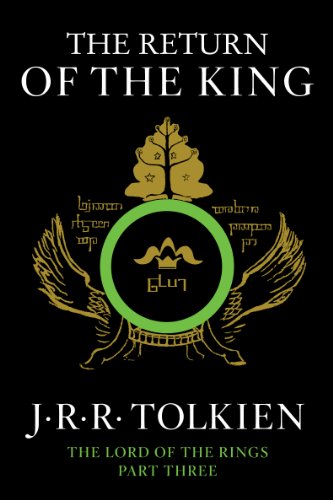
Reader’s report: ‘the Return of the King’: Happy endings

And he sang to them, now in the elven-tongue, now in the speech of the West, until their hearts, wounded with sweet words, overflowed, and their joy was like swords, and they passed in thought out to regions where pain and delight flow together and tears are the very wine of blessedness.

Blogging my way through The Lord of the Rings, now reading The Return of the King.

I’ve gotten through the hardest part. The ring is destroyed, Sauron is fallen; his followers are scattered and defeated. The great evil has passed, and the world begins to heal under the wise power of the King and the White Wizard.

Tolkien’s essay on Fairy Stories emphasizes the importance of the Eucatastrophe – the surprising happy ending. The eucatastrophe doesn’t work unless the dramatic tension is intense. All must seem lost. Any hope that remains must be no hope at all. “We must do without hope,” as one of the characters says. Only after the good side has lost hope and continues fighting merely out of a stubborn determination to die on the right side, if the right must fall – only then can you have a real eucatastrophe.

It seems to me that most writers – and I am certainly one of them – are a little shy about happy endings. We know how to pile up the obstacles; we know how to frustrate our heroes and test them past the point of despair. But when – beyond all expectation – they triumph in the end, we’re not sure what to do with the victory. Mustn’t do an end zone dance, after all.

Tolkien does an end zone dance. He knows that the drama doesn’t exist for its own sake. It exists for the sake of the happy ending, just as the saga of humanity itself exists only for the sake of Christ’s Kingdom. The Return of the King should be read side by side with the Book of Revelation.

He describes in loving detail how friends are reunited, the wounded are healed, the land is cleansed, the pollution is washed away, and justice is restored. He understands that after the sufferings his characters (and the reader, vicariously) have endured, they well deserve a reward.

I need to bear this in mind as I work on my latest Erling book. My current story actually involves a happy ending with historical warrant. I need to be less shy about rejoicing and vindication.

Like most modern people, I know more about depression than rejoicing. More about ambivalence than victory. I need to look to the Word of God to guide me in subcreation.

Reader’s report: ‘The Return of the King’: Healing hands

Blogging my way through The Lord of the Rings. Now reading The Return of the King.

It’s a moving scene in the book, and moving in the movie too – the scene with the “healing hands of the king.”

“For it is said in old lore: The hands of the king are the hands of a healer. And so the rightful king could ever be known.’

Then Aragorn exercises his healing arts on Eowyn and Merry and Faramir. It’s beautiful in itself, and an evocative image of Christ as King and Healer. Lovely.

I don’t know where Tolkien first came across the idea of the king having healing hands, but I’m pretty sure I know one place where he read about it – Snorri Sturlusson’s Heimskringla. But in Snorri it’s a far darker story. Snorri generally shows conventional reverence for Olaf Haraldsson as the patron saint of Norway. But his treatment can be ambivalent, and it’s at this point in Olaf’s saga, not long before his exile to Russia, that Olaf loses the sympathy of a lot of readers. Historically, it certain lost him some allies.

The situation is this: Thorir Olvesson, a young man with important family connections, is getting married, and King Olaf and his entourage are invited. The hospitality is splendid. Food and drink are plentiful, and everyone is having a good time. But one of Olaf’s men whispers to him that Thorir, the bridegroom, has been bribed by King Canute of England/Denmark to murder the king.

From Lee Hollander’s translation:

When the king sat at table and the men had drunk for a while and were very merry, while Thorir went about, serving the people, the king had Thorir called before him. He came up to the king’s table and rested his elbows on it.

“How old a man are you, Thorir?” asked the king.

“I am eighteen years old,” he replied.

The king said, “A big man you are for your age, Thorir, and a fine fellow.” Then the king put his hand around Thorir’s right arm and stroked it above the elbow.

Thorir, said, “Gently, sire! I have a boil on my arm.” The king held on to his arm and felt something hard underneath.

The king said, “Haven’t you heard that I am a healer? Let me see that boil.” Then Thorir saw that it would not do to conceal it any longer and took off the ring and showed it to the king. The king asked whether it was a gift from King Knut. Thorir said he would not deny it.

The king had Thorir seized and put in chains.  Then Kalf [Arnesson] came forward and asked for mercy, offering money for him. Many supported him and offered compensation. The king was so furious that no one dared to address him. He declared that Thorir was to have the same sentence [of death] which Thorir had intended for him, and had him killed afterwards. But that deed created the greatest ill-will….

Reader’s report: ‘The Return of the King’: Concerning tombs

Blogging my way through The Lord of the Rings. I’m on The Return of the King now.

Reading impressions: I was struck, as most readers will forever be now, I suppose, by the differences between the movies and the books. I know this, and yet it always sort of surprises me. The impression I always get from the movies (and of course it’s much easier to watch the movies than read the trilogy) is that the movies are pretty faithful, except for a few obvious changes. The role of Arwen is the most famous. The omission of Tom Bombadil is another. And we could go on and on, in orders of relative importance.

But in fact, the movies are very different from the books. The general plot lines are largely the same, though the order of presentation has often been shuffled. But there are actually few scenes in the films that are presented substantially as Tolkien described them. Compression and economy have had their effects everywhere. Most of the dialogue is new, too. We notice the direct quotations when they come, and quote them in Facebook memes. But they’re actually relatively rare. Most of the dialogue is new – streamlined paraphrases of Tolkien’s general sense.

Every fan of the movies should read the books at least once.

Of course, they won’t.

Looking at the story through the eyes of a Viking buff, one thing struck me in my recent reading. When Denethor commands that Faramir be carried into the kings’ tombs, the entrance is described like this:

Turning westward they came at length to a door in the rearward wall of the sixth circle. Fen Hollen it was called, for it was kept ever shut save at times of funeral, and only the Lord of the City might use that way, or those who bore the token of the tombs and tended the houses of the dead.

In other words, bodies were not carried in through the main entrance, but through a separate, smaller, door. I’m probably reaching, but this reminded me of a Norse custom known from the sagas. We’re told that when someone died in a house, the corpse was not carried out through the main door. Instead a hole was broken into a side wall, and the corpse carried out that way. Then the hole would be repaired. The idea was that if the dead person were to “walk again,” they would try to get back in the way they left, and be unable to find that door. This would protect the residents.

The two things are different, in that one involves carrying corpses in, and the other involved carrying them out. Still, I thought it might have been in the back of the Professor’s mind.

Reading report: ‘The Lord of the Rings’: Incompatibility

Blogging my way through The Two Towers:

To some extent Ronald and Edith [Tolkien] lived separate lives at Northmoor Road [Oxford], sleeping in separate bedrooms and keeping different hours…. She and Ronald did not always talk about the same things to the same people, and as they grew older each went his and her own way in this respect, Ronald discoursing on an English place-name apparently oblivious that the same visitor was simultaneously being addressed by Edith on the subject of a grandchild’s measles. But this was something that regular guests learnt to cope with. (J. R. R. Tolkien: A Biography, Humphrey Carpenter.)

‘But our hearts did not go on growing in the same way: the Ents gave their love to things that they met in the world, and the Entwives gave their thought to other things, for the Ents loved the great trees, and the wild woods, and the slopes of the high hills…. But the Entwives gave their minds to the lesser trees, and to the meads in the sunshine beyond the feet of the forests…. ‘ (Treebeard, in The Two Towers)

Just a parallel that struck me, from Tolkien’s life and his books. It’s not for me to say much about the Professor’s domestic life (which was full of love by all accounts, though a little eccentric). Just to point out a similarity.

Reading report: ‘The Lord of the Rings’: Diversity

Blogging my way through The Two Towers:

Another theme in these books that strikes me is the vision of what – at the risk of political correctness – I might call “diversity.”

The Fellowship of the Ring is, self-consciously, a diverse group. It includes members of several of the more-or-less human “races” not dominated by Sauron – Men, and Elves, and Hobbits. No doubt this mirrors Tolkien’s experience with classes and Imperial ethnicities (not to mention Allies) during the Great War. The feeling (it must have seemed very strange in those times) of thinking, “Here I am, crouched in a trench with men I might have despised or even fought against in the past. But we’re all at war for a single cause now, and I find much to love and admire in them.”

No doubt it would have occurred to a thoughtful mind that one could conceivably come to feel the same way about the enemy, under different circumstances.

But it wouldn’t only have been the war. The fabled Inklings group was itself (to an extent) a disparate gathering. Not radically disparate, but to Tolkien, as a member of a religious minority, the chasm between Catholic and Protestant was always significant. I don’t recall that any of the Inklings was an atheist or agnostic, but Owen Barfield was a Theosophist (though he eventually became a communicant Anglican).

Which reminds me of the issue of “Jack” Lewis’s Anglicanism, always a sore point with Tolkien. After the famous night in 1931 when he and Hugo Dyson convinced Lewis that mythology might be a kind of inchoate prophecy from Heaven (leading to his Christian conversion), Tolkien hoped Jack would join him in his Roman faith. But Jack remained at bottom a Belfast Protestant, though he learned to appreciate certain beauties in his friend’s church.

And when I read of Gimli and Legolas, tentatively finding common ground in which an Elf might go so far as to visit caverns, in order (perhaps) to discover the beauties a Dwarf sees there, and the Dwarf condescends to travel in a forest with the Elf for the same reason, we may be peering into the heart of Tolkien’s and Lewis’s friendship.

Reading report: The Two Towers, by J.R.R. Tolkien: The name of Erling

Blogging my way through The Lord of the Rings.

I’m well into The Two Towers now. An anxious nation will be gratified to know that I Have Thoughts.

I noticed – for the first time, I think – the name of the ancient warrior who – we are told – founded the Kingdom of Rohan. His name was Eorl the Young.

This is where I did a little linguistic analysis, based on my fair knowledge of Norwegian and my sketchy grasp of Old Norse.

I figured Eorl must be etymologically related to the Norse word, Jarl, which means a ruler. I was pretty sure that the Norse cognate when used in personal names was “Erl.” I had looked up the meaning of Erling (for obvious reasons) and learned that the name means “young ruler.”

That makes sense, because the “ing” suffix is common in sagas to indicate “the younger,” as in “junior.” Thus the sons of Arne Arnmodsson (whom I mentioned a few days ago in my post on my novel writing) were known as the Arnmodings.

My guesses were verified by the author of this web site, assuming he knows what he’s talking about.

Therefore, when you encounter the name Eorl the Young in TLOTR, think “Erling.”

Did Tolkien have Erling Skjalgsson in mind when he named the character? I have no evidence for that. But I like to think so. Because what I like is extremely important.

‘Reading report: The Fellowship of the Ring, by J.R.R. Tolkien: The Rainbow Wizard

I finished reading The Fellowship of the Ring over the weekend. One can’t really review a work of this eminence. I can only write appreciations. One thing I noted was a detail I’d forgotten, one that was left out of the movies, and it’s  no mystery why. It’s when Gandalf meets with Saruman at Orthanc, and learns his former master’s perfidy:

‘”For I am Saruman the Wise, Saruman Ring-maker, Saruman of Many Colours!”

‘I looked then and saw that his robes, which had seemed white, were not so, but were woven of all colours, and if he moved they shimmered and changed hue so that the eye was bewildered.

‘”I liked white better,” I said.

‘”White!” he sneered. “It serves as a beginning. White cloth may be dyed. The white page can be overwritten; and the white light can be broken.”

‘”In which case it is no longer white,” said I. “And he that breaks a thing to find out what it is has left the path of wisdom.”’

This is an amazing passage. Saruman the White, whose white color had symbolized his supreme wisdom, has broken the white color down into its constituent prismatic hues.

He’s made it into a rainbow.

We see rainbows all the time today, in churches that believe they’ve “deconstructed” traditional morality and theology.

Was Tolkien an actual prophet? Did he foretell the future of the church?

Reading report: ‘The Fellowship of the Ring,’ by J.R.R. Tolkien: A veteran’s story

‘Yes sir!’ said Sam. ‘Begging your pardon, sir! But I meant no wrong to you, Mr. Frodo, nor to Mr. Gandalf for that matter. He has some sense, mind you; and when you said go alone, he said no! take someone as you can trust.’

‘But it does not seem that I can trust anyone,’ said Frodo.

Sam looked at him unhappily. ‘It all depends on what you want’ put in Merry. ‘You can trust us to stick to you through thick and thin – to the bitter end. And you can trust us to keep any secret of yours – closer than you keep it yourself. But you cannot trust us to let you face trouble alone, and go off without a word. We are your friends, Frodo. Anyway: there it is. We know most of what Gandalf has told you. We know a good deal about the Ring. We are horribly afraid – but we are coming with you; or following you like hounds.’

No major revelations from my reading of The Fellowship of the Ring tonight. Just a thought on a subject I’ve touched on before – The Lord of the Rings as veteran’s literature.

What struck me in the scene above – which takes place at Frodo’s new house in Crickhollow, before the adventure even properly begins – is how different the tone is from what we see of the hobbits in the films. Merry and Pippin are pure comic relief in the movies – up till the moments when they’re forced to grow up.

And there’s certainly an element of that in the books too. But in this scene we see them in a different light. Here they are Frodo’s comrades – his buddies in the military sense. They’re freemen and equals, under no illusions, and loyal to their officer. There’s a time for games and laughter, but when it comes to the point, we all know what we’re here for, and we’re in to the end. Whatever the cost.

If we were privileged to have access to Tolkien’s memories, I think we’d find that this scene echoes some moment (or moments) in his wartime career. He’s memorializing men he served with – most of whom would probably have never come home. Jack Lewis would have recognized it right off.

Reading report: ‘The Fellowship of the Ring,’ by J.R.R. Tolkien: Bombadil and Goldberry

There on the hill-brow she stood beckoning to them: her hair was flying loose, and as it caught the sun it shone and shimmered. A light like the glint of water on dewy grass flashed from under her feet as she danced.

Blogging through the Lord of the Rings, still on The Fellowship of the Ring:

What are we to make of Tom Bombadil? He’s a riddle inside an enigma inside a mathom, which is probably just what the author intended. The narrative of the epic can endure without him, as the movies demonstrated. But every reader knows he belongs, somehow, in Tolkien’s world. Every reader will think of Tom in his own way. I’ve stated my view before on this blog, but I’ll repeat it here:

Tom seems to me to be a representation of Adam, or at least of unfallen Man. Adam tended the Garden, and he named the animals; whatever he called the beasts, that was their name. Tom Bombadil controls all nature within his domains, and when he names the hobbits’ ponies, those are the names they answer to ever after. Tom says of himself:

“Eldest, that’s what I am. Mark my words, my friends: Tom was here before the river and the trees; Tom remembers the first raindrop and the first acorn.”

Remember how important “subcreation” was in Tolkien’s artistic/religious vision. Man in fellowship with God becomes a kind of little god – he can’t create ex nihilo as God does, but he creates in a smaller way that brings glory to his Master. In the same way, I think, unfallen Tom Bombadil glorifies his Creator by ruling the Garden that’s been set under his stewardship.

Tom Bombadil, incidentally, began as a toy, a Dutch doll owned by Tolkien’s daughter Priscilla. She lost it down a sewer, and was distraught. Her father comforted her with tales of how Tom floated along the river and had numerous adventures, overcoming all kinds of dangers through his magical powers. Eventually he even overcomes the powerful River-woman, and marries her daughter, Goldberry (herself a rather sinister figure until Tom tames her).

Which brings us to Goldberry. Goldberry has a very special place in this reader’s heart.

The year must have been 1973; I was in college, and my roommate was an even bigger Tolkien geek than I was. We agreed that I would read the Hobbit and the Trilogy to him, one chapter a night (I love to read aloud). And we did that – straight through. It took a while.

During that same period I went out on my first date, with a girl who was very Goldberry-esque. I fell hard for that girl, and have never quite gotten over her. She’s a grandmother today, and lives far away, but to me she’ll be forever young and slender and graceful.

Whenever Tolkien tells us of a woman dancing, and how her feet tinkle on the grass (as in the case of Luthien), I’m pretty sure he’s harkening back to Edith Bratt and how she danced for him in the woods the day he fell in love with her. For my own part, I always look forward to seeing Goldberry again.

Reading Report: ‘The Fellowship of the Ring,’ by J.R.R. Tolkien

He thought he had come to the end of his adventure, and a terrible end, but the thought hardened him. He found himself stiffening, as if for a final spring; he no longer felt limp like a helpless prey.

This quotation, concerning Frodo Baggins in the Barrow Downs, from The Fellowship of the Ring, seems to me a good epitome of what I’ve found in my current reading of the Lord of the Rings

Actually, the thought was mainly inspired (to my shame, I suppose) by watching the movies twice through recently. I’ve found them inspirational as I wrestle with my Work in Progress. It’s a remarkable thing, as I see it, that in spite of the movie industry’s well-earned notoriety for messing with original sources, the Peter Jackson movies managed – overall – to preserve the heart of the story. Even though most of the people involved must surely have been a thousand miles away from Tolkien’s beliefs.

Anyway, what struck me as I watched and read was this. It hardly needs saying that we’re in perilous times. I never thought I’d live to see a day when I worried about the breakdown of civil society and the loss of our republic, but such things don’t seem unthinkable now.

I’m not a man known for confidence and courage. I reserve heroism for my books. I know heroism when I see it, and I salute it from a safe distance. I’m pretty sure that if the day comes when I must raise my sword in defense of my rights, I’ll probably trip over the scabbard.

But it occurred to me that maybe this isn’t the end. That’s the thing about stories.

In every good story, there comes a moment when the main character thinks the tale is told – and that he’s lost. A moment when his strongest instinct is to lay his weapon down and surrender.

But that’s not really the end, in a good story. It’s only the Final Crisis. It’s the hero’s test. The climax is yet to come – and at the climax, the hero either triumphs or fails in a way that means something.

So this is my message. Not the message of a prophet, or the son of a prophet, but of a storyteller.

This isn’t the end. It’s the crisis. Hold on. Carry on doing your service, at the station where God has set you. As Sam Gamgee said:

“It’s like in the great stories, Mr. Frodo. The ones that really mattered. Full of darkness and danger, they were. And sometimes you didn’t want to know the end. Because how could the end be happy? How could the world go back to the way it was when so much bad had happened? But in the end, it’s only a passing thing, this shadow. Even darkness must pass. A new day will come. And when the sun shines it will shine out the clearer. Those were the stories that stayed with you. That meant something, even if you were too small to understand why. But I think, Mr. Frodo, I do understand. I know now. Folk in those stories had lots of chances of turning back, only they didn’t. They kept going. Because they were holding on to something.”