
Sometimes good literature can make your life better, in more than the pleasure-giving sense.
Take Mark Helprin’s In Sunlight and in Shadow, which I reviewed the other day.
Harry, the hero, is haunted by his experiences as an airborne ranger in World War II. There’s a particular scene where he tells his fiancée about one incident he can’t get out of his head. “There was nothing I could do,” he says. “But I feel responsible.”
That, friends, is The Song of My People – my people being trauma victims of various sorts. Due to circumstances of a very different kind, I too am haunted – bedeviled – by memories. Memories of bad things that happened – often things I did that I’m ashamed of – that just won’t lie down and die.
It’s comforting to me to tell myself, “Think about Harry, and people like him. Whatever you’ve done, it didn’t involve anybody dying.”’
This doesn’t mean my flashbacks are going to disappear. My Complex PTSD (not actually a disorder currently recognized by the professionals) is, I know very well, capable of infinite adaptation.
But for now it helps. Thank you, Mark Helprin.
Category Archives: Reading
On Creativity
Five books recommended by artist Makoto Fujimura. “Literature that reveals what art and beauty ought to be.”
Skip to the End and Discount eBooks
Roberto Estreitinho writes about reading. “If by page 30 of a book I’m not hooked, I stop reading,” he says, and if it’s a long book he begins to have doubts about, he skips to the end. “If it’s worthy of understanding how the author got there, read it all. If not, congratulations. You just avoided wasting time.” (via 99u)
On that note, The Unofficial #TGC13 Discount E-Book Store is open with many discounted eBooks from the authors at The Gospel Coalition Conference in Orlando this week.
More from Through Norway With a Knapsack

I’m feeling a bit better now, thanks for asking, having seen a doctor last week and gotten antibiotics and a steroid for my lungs. But a day at work still wipes me out, and I’ve got stuff I need to get done tonight. So, in lieu of the hard work of thinking out a blog post, I’ll just post another short excerpt from Williams’ Through Norway With a Knapsack, last night’s subject.
In this episode, our hero has gotten lost and spent a long day on the mountains, finally finding a guest house late at night, exhausted.
On awakening, I found a stout gentleman sitting at my bedside. He was the pastor of Lom. A Norwegian pastor is not merely a preacher; he is clergy-man, physician, magistrate, arbitrator, and general friend and father, to whom all his scattered parishioners appeal. In a country where there are none but peasant farmers – no aristocracy, no gentry, no towns and villages, no shopkeepers, no professional class – a highly educated man must be strangely isolated, and, unless endowed with the true spirit of Christian benevolence, must be one of the most miserable of men; but, if suited to his work, he may be one of the happiest, for his opportunities of doing unmistakable good, and of witnessing the full fruits of his good deeds, are almost unlimited. Most of these Norwegian pastors are, I believe, excellent men, and render great services to the people around.
In the present instance, the paternal relations of the good pastor of Lom were illustrated in my case, for he sat at my bedside, where he had evidently been watching for some time, as though he feared that some fever or other ailment might result from the over-exertion, excitement and fasting….
“Ringing” through the years

Today I was reminded, for some reason, of my first introduction to The Lord of the Rings. The image above is the same edition I got, back around 1966 (the publication page says that was the year of the printing). I would have been about 16 years old at the time. The trilogy was offered by Scholastic Books, a major force in my life in those days. There was no bookstore within practical distance of my home. I had never been in a bookstore in my life – bookstores were distant Rivendell to me. So those periodic (Monthly? Quarterly? I don’t remember) Scholastic catalogs were to me what the wandering peddler was to my ancestors.
I’d never heard of The Lord of the Rings or Tolkien in my life (I knew C. S. Lewis, but had no “inkling” of his friendship with Tolkien). The catalog descriptions were intriguing. But the books cost ninety-five cents apiece – more than three bucks for the trilogy with postage figured in. That was not the kind of money I spent casually in those days. Fortunately I mentioned the books to my brother, and he was interested too. So we went in together. The only drawback was that he demanded first dibs. I had to wait for him to finish The Fellowship of the Ring before I got my chance at it. I chafed as he worked through the long book, saying things like, “This is really good. You’ll like this a lot.”
At last I got my turn and opened the pages onto a whole new world. It was better than I hoped (Lewis himself described it as “good beyond hope”) and gave me satisfactions I’d never known a book could offer.
I still have all three books in those original editions. They’re not actually falling apart (I’ve always been pretty gentle with my books), but they’re so battered that I replaced them with a new set a few years back, for actual reading. These copies are personal relics. When I touch them as I do now (the Fellowship is at my elbow as I write) it brings me back to a moment in my life when new possibilities opened up. And believe me, I needed new possibilities just then.
Reading report: Angrvadil

In Surprised by Joy, C.S. Lewis recalls a turning point in his youthful imaginative life:
…I had become fond of Longfellow’s Saga of King Olaf: fond of it in a casual, shallow way for its story and its vigorous rhythms. But then, and quite different from such pleasures, and like a voice from far more distant regions, there came a moment when I idly turned the pages of the book and found the unrhymed translation of Tegner’s Drapa and read
I heard a voice that cried,
Balder the beautiful
Is dead, is dead —I knew nothing about Balder, but instantly I was uplifted into huge regions of northern sky, I desired with almost sickening intensity something never to be described (except that it is cold, spacious, severe, pale, and remote) ….
This would seem to be the passage that Saga Bok Publishers (the discerning Norwegian firm which has hired me to translate one of its books) references on the back cover notes of Angrvađil when it says (my translation), “Artists, politicians, and others have been inspired by the stories in this book – from C.S. Lewis who was ‘uplifted’ by the magical atmosphere of the stories – to our own Roald Amundson….” I’m not sure that statement is strictly accurate, since Tegner’s Drapa as such doesn’t appear in the book, but there’s some association if only in that the Swedish poet Esaias Tegner’s translation would have been the basis for the English version Lewis read (assuming he read Fridtjof’s Saga and not just Longfellow).
The good people at Saga Bok sent me a copy of their new translation of Fridjtof’s Saga, along with preliminary material, entitled Angrvađil: Sagaene om Torstein Vikingsson & Fridtjov den Frøkne (Angrvađil: The Sagas of Torstein Vikingsson and Fridtjov the Bold).
These sagas are part of what are known as the Fornalder Sagas. The Fornalder Sagas are very old stories, preserved in Iceland not as reports of actual events, but purely for their legendary interest. Prof. Titlestad, whose book I’m translating, makes serious claims for the value of the sagas as historical sources, saying that useful information can be preserved in folk memory for about 300 years. The Fornalder sagas were much more than 300 years old at the time of writing, though. One reads them for the pleasures of the stories in themselves. Continue reading Reading report: Angrvadil
Losing to win, in stories
One change owning a Kindle has made in my reading habits is that I’m now a whole lot more likely than I used to be to dump a book that fails to please me.
When I was younger, it was kind of a point of honor to finish any book I started. (This sprang in part from the fact that books were copied by hand on calfskin in those days.) But as I got older, and especially as I crystallized my political and social views, I became more willing to ashcan a book whose author (as I imagined him/her) obviously wouldn’t want a person like me for a reader.
The Kindle makes this easier because I’ve been getting a lot more free books, especially from the Free Kindle Books and Tips blog. Easy come, easy go. A lot of these books are fully worth their price of nothing, and I feel no guilt (OK, not much guilt) in showing them the virtual door.
I dumped one book yesterday, and another today, which I think is a new record.
One was a mystery/thriller, pretty competently written. The characters were mostly good, and the writing slipped only rarely. But around half way through I discovered that the evil District Attorney, whom we had been schooled to hate (the one-dimensionality of his character was one of the book’s weaknesses from the start) was a political conservative, getting money from those evil conservative political action committees.
I could have finished it. I’ve finished worse. But I wasn’t in the mood. Maybe it’s the election season.
The second book was more congenial in viewpoint, being a sort of contemporary Christian fantasy. And the writing was pretty good for Christian literature. But then the main character, a non-Christian, got into a conversation with his Christian neighbor at one point, and it all went south as far as I was concerned.
I have strong views about how conversations about matters faith in novels ought to go. I like to think I do it pretty well in my books, but maybe other people find my approach as offputting as I find so many that I see.
Here’s how I think such conversations should be handled—generally.
1. Avoid easy victories. Christians love anecdotes about how some Christian silenced an atheist through a single pithy, incisive remark. In my experience this never happens in real life. In real life the atheist has a good laugh, and the Christian trickles away humiliated (this isn’t necessarily bad. I know of instances when such conversations have resulted, eventually, in the conversion of the atheist). You gain realism points if you allow your Christian character to lose at least the initial skirmish.
2. Remember that the point of the exercise is not winning the debate, but winning the person. The action of the story is where the non-believer will have his world-view truly challenged. A story where he gets converted merely by an argument is by nature a weak story. Use the rising tension of the story’s action to make him doubt his preconceptions. This is both good storytelling and true to life.
3. Eschew Triumphalism. This really summarizes the two points above. James Bond is not a Christian. The smooth character who always makes the right choices and is always in control of the situation is not realistic, and would be a poor example in any case, since none of us live that way. The Christian conquers through bowing, through dying, through the way of humility.
And no, I’m not going to tell you the names of the books I dumped. I deleted them from my Kindle, and I don’t think I remember the titles. I’m sure I don’t remember the authors’ names.
Reading Through Deep Depression
A reader of The Paris Review asks for recommendations to him through depression: “books that will show me why to live and how, and books that will allow me to escape my present torture. Both need to be pretty easy to follow.” This post suggests many titles, and blog reader recommend many more. I don’t know if any of the readers recommend the Bible (Oh, I see someone does), but I think the poetry suggestion is very good: old sonnets, Wordsworth (even his silly stuff), Robert Frost, Billy Collins. I also wonder if painting, cooking, or gardening would help this person.
Souring on E-Book Samples
A reader in the United Kingdom talks about problems with Amazon’s Kindle e-book samples, for example, finding books with far stronger writing on the sample pages than throughout the book.
I, for one, welcome our new digital overlords
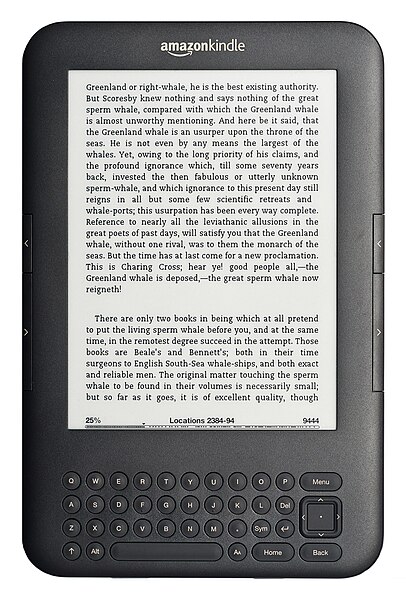
Over at I Saw Lightning Fall, our friend Loren Eaton links to a Wall Street Journal article by Joshua Fruhlinger, in which he explains why he gave up on e-book readers and went back to dead tree tomes.
I BROKE UP WITH E-BOOKS last year after a flight from Los Angeles to New York. My first-generation Kindle and I had been together for five years, but I knew we’d have to go our separate ways when, an hour into the journey, it completely shut me out. Or rather, it shut down. I’d forgotten to charge the device before I left.
Upon arrival in New York, I coolly walked into a bookstore and bought a paperback version of the book my Kindle wouldn’t let me read in the air. It felt good to be back on paper, turning real pages. I realized then: E-readers are needy, but a paperback will always be there for you.
Here I find myself in the awkward and almost existentially self-contradictory position of being on the side of progress as over against tradition. Before I owned a Kindle I had all the standard Luddite objections—I loved the smell and feel of books¹, I did not want to be dependent on an electronic device that might fail or get damaged at any time, and by thunder, paper books were good enough for my grandmother, and they’re good enough for me!
But as you know if you’ve been following this blog, those objections evaporated as soon as Hunter Baker (author of Political Thought: A Student’s Guide) gave me a Kindle 3 in a random act of kindness. I very shortly made some surprising discoveries.
The most surprising was that I don’t love the feel and smell of paper books nearly as much as I thought I did. In fact I’m able now to admit my secret shame for many years—that I’ve always had trouble holding books open (I’m not a breaker of spines), and had found it somewhat tiring, in long reading sessions, to hold a book open at a convenient angle. An e-book doesn’t have a facing page to curl back, and its lightness makes it ideal for reading in comfortable situations, like when I’m stretched out on the couch. For ease of use, the Kindle has paper books beat in almost every situation. Continue reading I, for one, welcome our new digital overlords