
“I believe the novel is a moral form. We turn to novels in pursuit of virtue. Through the tales fashioned by thoughtful writers we discover or reaffirm what we believe to be right and good. Our eternal subject is the nature of the well-lived life. So here’s a theory of what has happened to the middle classes and the novel. A hundred years or so ago the language of idealism changed. As Christianity fractured, the imagination of those who wanted to make a better world was seized by a new idealism: socialism. In this new understanding of society the working class had virtue and was the future; the middle class had power and was the past. Bourgeois values came to be seen as vices. The middle-class consumers of art and literature gradually found themselves cast in negative terms, as exploitative, parasitic and reactionary.
By the last decades of the 20th century, as these perceptions became the orthodoxy of the educated elite, writers and artists found they faced a fork in the road.” Read the rest
Category Archives: Reading
Elocution lesson from Mr. Silver
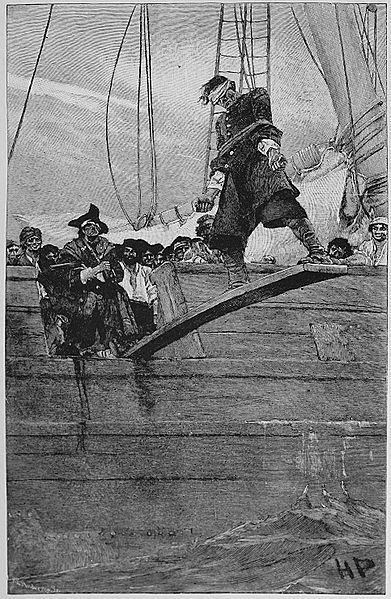
As noted by Phil below, today is Talk Like a Pirate Day.
But if you want to do your yarnin’ ship-shape, you need to go back to the source material. Here’s Long John Silver himself, from Treasure Island, as ever was, in the parley scene, which has always, for some reason, delighted me.
“Now,” resumed Silver, “here it is. You give us the chart to get the treasure by, and drop shooting poor seamen and stoving of their heads in while asleep. You do that, and we’ll offer you a choice. Either you come aboard along of us, once the treasure shipped, and then I’ll give you my affy-davy, upon my word of honour, to clap you somewhere safe ashore. Or if that ain’t to your fancy, some of my hands being rough and having old scores on account of hazing, then you can stay here, you can. We’ll divide stores with you, man for man; and I’ll give my affy-davy, as before to speak the first ship I sight, and send ’em here to pick you up. Now, you’ll own that’s talking. Handsomer you couldn’t look to get, now you. And I hope” — raising his voice — “that all hands in this here block house will overhaul my words, for what is spoke to one is spoke to all.”
When I think back over a lifetime of reading, I can recall very few books that delivered more sheer pleasure of reading to me than Treasure Island. Nearly a perfect adventure story.
But It's For the Children
Sara Zarr, author of How to Save a Life
Sara says she feels that way about adult fiction too and asks why it isn’t frequently criticized for being so dark like YA lit has been for many years. What we need in both book fields, she says, is hope, even if the story is a dark one. “We need context, we need excellence, everywhere. Not just for the young.”
Reading by Familiar Setting
Scientist and author Tali Sharot likes to read books from places she’s familiar with. She likes The Easter Parade by Richard Yates, because it’s placed in New York. In this interview with the Boston Globe, she describes her reading habits. It’s nice to see people dropping books they are no longer interested in.
Vote for Top 100 SF/F Novels
NPR is calling for your five favorite Sci-Fi/Fantasy novels so they can make up a top 100 list. Note the rules before you sign in.
Self-prescribed Tunnel Vision
 If we continue to watch only the titillating shows and avoid the thoughtful ones, if we get out of the house only for novelty, then eventually all of entertainment will be sequels, writes A.G. Harmon in Image Journal. “If to exercise the body we must accept discomfort, pushing beyond pain,” he states, “to exercise the mind requires a related effort, an involvement that rejects the passive, formaldehyde bath of strobing visuals. A human is more than his eyes—certainly more than his ocular reflexes—and to be human means breaking free of this dangerous trap.”
We could easily dismiss this if Harmon was referring only to popular entertainment, meaning that which is nationally distributed in some way. But I’m sure he is urging us to embrace our local culture by attending concerts, plays, art shows, story-tellings, jamborees and town hall meetings (touching on the civic side of public involvement). By seeking only the exciting or shocking stuff, we risk narrowing our vision, withdrawing into our inner space, and closing off most of the world. Harmon warns us against an obsession with personal comfort.
One Page at a Time
Alan Jacobs on the joy of reading: “Don’t turn reading into the intellectual equivalent of eating organic greens.”
Reading As Often As Possible
“I cannot remember a time when I did not want to read as much as possible. Since my family did not have many books, my main sources were school books, gifts from relatives, and books borrowed from neighbors until I was old enough to check them out of the Butte Public Library, which I did as often and as many as possible.”
Patrick Kurp talks about the love for words, saying we have a master poet walking among us today in Helen Pinkerton. He brings her up in reference to an email he got from D.G. Myers, asking whether he thought printed books were positively, absolutely, undeniably, and reliably dead.
Loose Baggy Monsters
 Erin O’Connor writes about reading long novels, those works she says Henry James called “Loose Baggy Monsters.”
The psychology of feeling that one should, of giving it a go, of wanting it to work, of bogging down, of eventually admitting–if only to oneself–failure, and, finally, at a later date, when the frustration has faded, of doing it all again–that’s a psychology that is, I think, pretty specific to long works of fiction. They demand a lot of your time–and a lot of you. They will color your imagination and dominate your inner dream-scape while you are involved with them. Reading really long works of fiction is more than reading–it’s having a relationship. It’s not surprising that they evoke some commitment anxiety.
Maybe Apathy Isn't Closing Public Libraries
 I agree that public libraries should have a line item in every city and state budget. Small towns particularly need libraries or cultural centers to draw their folks out of a small town mindset into the larger world, and even though this may be accomplished with private ownership, I’d think public funding or tax leniency would be needed to run a library suitable for a whole town or area of a city.
I get the impression that Charles Simic, writing in the blog for the New York Review of Books, is not reading off the page to which my book is open. He writes, “‘The greatest nation on earth,’ as we still call ourselves, no longer has the political will to arrest its visible and precipitous decline and save the institutions on which the workings of our democracy depend.”
It’s more correct to say there isn’t the political will to arrest the negligent spending in other areas–areas where new civil rights have been declared–that are squeezing out the funds for good, but unglamorous, services like libraries. Of course, there are competing voices Continue reading Maybe Apathy Isn't Closing Public Libraries