I’ve been reading Pete Brassett’s Inspector Munro mysteries for a while. I’m not sure I’m entirely on board with the new turn the series has taken, though. Our former hero, heretofore a paragon of physical fitness (mountain running was one of his favorite sports) has suddenly grown old. He’s had a heart attack and is retired – though he’s happy to assist his former subordinates on his own time.
So now the central character is Inspector “Charlie” West, a woman from London who overcame alcoholism after moving north to Scotland. She’s not a bad character, but it seems like everybody’s doing female detectives these days, and it annoys me.
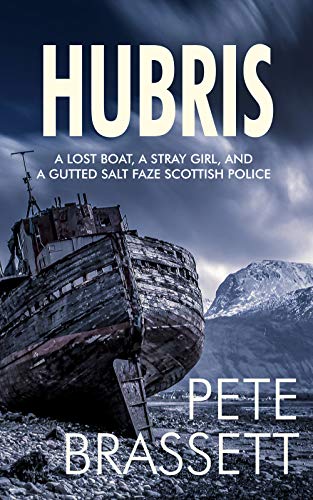
Anyway, the latest book in the series, Hubris, involves a beached fishing boat which a farmer discovers on the shoreline of his property. Looking inside, he finds a man in the hold, gutted like a fish. Forensic evidence indicates the presence of drugs.
Meanwhile, that same farmer’s daughter has gone missing. Why did the family wait to alert the police?
Unsuspected connections will tie the two cases together, and old secrets will resurface to devastate lives. But the detectives are on it, and Inspector Munro will be on hand to provide guidance as well.
Hubris is a good, workmanlike police procedural, with only minimal objectionable content. The series is worth following.
“I understand you think that,” Evan said. “And your track record has given you good reason to believe that you’re scary. You’ve got the look down. The manicured tough-guy beard. The handiwork carved into your skin. But I want you to do something. Look at me. Look at me closely. And ask yourself: Do I look scared?”
First of all: I. Loved. This. Book.
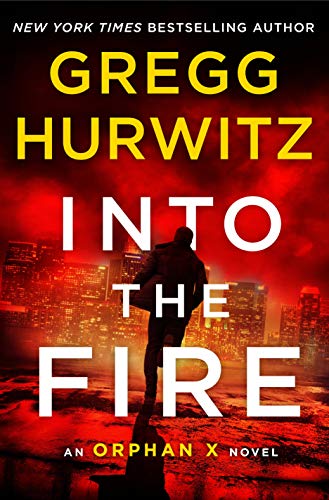
You may have seen my earlier reviews of Gregg Hurwitz’s Orphan X novels. Orphan X is Evan Smoak, formerly part of a top secret, very elite group of special agents for the US government. Recruited from orphanages and given new identities, trained for stealth and secrecy and lethality, they were the ultimate deniable weapons. But Evan managed to get free of the program, and now he lives a secret life. He lives in a secure penthouse in Los Angeles, but officially does not exist. As a kind of personal penance, he rescues people from impossible problems. When a job is done, he gives each rescuee a secret phone number. They are to find one – only one – other person who needs similar help, and give them the number. But now Evan feels he’s ready to start a new chapter. His next rescue will be his last.
It will also be the toughest he’s ever faced.
Max Merriweather, the client in Into the Fire, seems like an unlikely character to be involved in anything important. He’s a broken man, living a marginal life as a manual laborer. Once he had a marriage and hopes for the future, but it all fell apart on him.
Even his own family ignores him, leaves him out of things. So he was surprised when his cousin Grant, the golden boy of the family, entrusted him with an envelope. In the event of his death, Grant said, Max is to deliver that envelope to a certain reporter.
But events have made that impossible now.
So Max slips into a café to think about his problem. And there a young man sits down across from him and says he’s noticed he’s upset. And if he is, if he has an impossible problem, he knows someone who could help. So Max calls The Number, and Evan answers.
Ever have one of those days when you do one job, and it uncovers a bigger job that also needs doing, and that one reveals an even bigger one, and so on? This case is like that, only each problem involves bigger, more powerful criminals and greater dangers. And along the way, Evan somehow suffers a concussion, and so has to operate in such a way as not to hit his head again. Sleep would help, if he had any time for sleep.
Other readers may not respond to Into the Fire the way I did. This book seemed calculated to push all my personal buttons and elicit profoundly personal responses. I was terrified at some points, and my spirit soared at others. This book isn’t just about uncovering crime, it’s about people overcoming trauma, moving out of their comfort zones, and opening their hearts to risk-taking.
I give Into the Fire my highest recommendation. You should be aware of obscene language and intense, violent situations.
I think a moment about my own actions, then say, “I’ve learned something in my years doing what I do. If you don’t feel guilt, then you can’t change. Guilt can be a driving force for good, for doing what’s right. Or it can be a limiting force. Something that causes you to throw away right and wrong, to justify yourself. That’s the weak way to deal with your conscience. The determining factor in whether guilt locks you into evil or spurs you on towards good is your own inner strength. Your own good moral compass.”
The greatest trope of the thriller genre is perhaps its most improbable – the man of violence who somehow keeps his moral center, who is not corrupted by his bloody work.
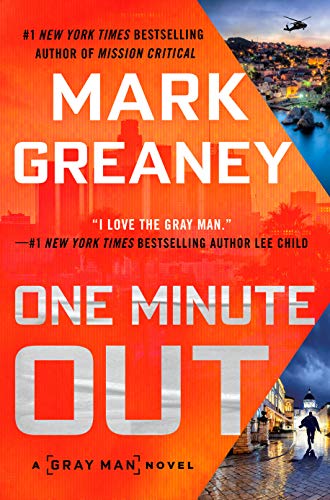
No thriller hero exemplifies this principle more than Court Gentry, hero of Mark Greaney’s “Gray Man” series. Court is a former CIA asset, trained and employed for many years as a dark ops assassin. He managed to escape from that life and now operates on his own. Except that he ended up having to call on his old handlers for assistance, and now he owes them favors. So he works for them occasionally again – off the books.
But he has one supreme rule: he only kills bad guys.
It’s a freelance job he’s on as One Minute Out opens. He’s in Croatia, assassinating a former war criminal. Simple job, easy in, easy out. Only he discovers what his target is doing – he’s guarding a group of young women who are being trafficked as sex slaves. He wants to liberate them all, but they refuse. If they run away, their families will be punished, they tell him. And now they themselves will be punished, just because he was here and caused trouble.
Court ought to just go home and forget it, but he can’t. Once he’s seen this evil, he has to do something about it. Along the way he will meet a remarkable woman, sister of one of the captives, on her own crusade against human traffickers. But they have no idea what kind of power and influence they’re up against.
One Minute Out is a fascinating story, but (like most thrillers, but here more than usual) the story suffered (for me) through its sheer improbability. It’s a smart fictional technique to stack the odds against the hero to seemingly impossible heights. But here the challenges pass the limits of the plausible (for this reader). I have limits in my suspension of disbelief, and this book came pretty close to them. Still, I’ll probably read the next one.
For all my quibbles, One Minute Out was a rousing tale, with lots of optimism built in. Cautions for language and disturbing themes.
Virgil had never seen a purely ideological murder, Republicans being too cautious, Democrats generally being bad shots.
I don’t like John Sandford’s Virgil Flowers character as much as I like his more famous detective, Lucas Davenport. But I quite enjoyed Bloody Genius, the latest in the Flowers series. I notice that it’s gotten a lot of poor Amazon reviews, but I had a good time.
Virgil Flowers is a deceptively laid-back agent for Minnesota’s Bureau of Criminal Apprehension. He dresses like an aging rock musician, and goes fishing on company time, but he closes cases.
This time he’s called to Minneapolis (which he hates; rural Minnesota is his stomping grounds) to investigate the murder of a famous genetic researcher at the university, who was battered to death in his study carrell in the library. No motive is apparent, and the murder weapon is uncertain – though his heavy laptop computer is missing.
Virgil probes the murky waters of academic rivalries, and the victim’s sexual escapades, and his family relationships. But the real culprit and the real motive will be new ones in his experience.
As often happens with these books, they take me to places I’m familiar with, at least to some extent, and I enjoy that. And I like Sandford’s observations of the world, though Flowers’s eyes – quite often they’re politically incorrect.
I was surprised by the observation, at a couple points, that the University of Minnesota’s team colors are red and gold. Even I, the opposite of a sports fan, know they’re maroon and gold.
But I particularly liked Harry, an old guy Virgil meets in a bar. Harry informs Virgil that he can recite “The Cremation of Sam McGee” and “Gunga Din.” As it happens, those were my performance pieces back in the day. Harry might almost be me, except that I don’t hang out in bars.
As always, cautions for lots of foul language and adult themes.
Has it actually been six years we’ve been enjoying Amazon Prime’s outstanding Bosch series? This isn’t exactly the world, or the characters, you’ll find in Michael Connelly’s bestselling crime novels, but it’s true to the spirit of the exercise. And Titus Welliver, as I’ve often said, has the character of Harry Bosch nailed.
This season, like the previous ones, is based on more than one book. So you’ll need to pay attention to keep the multiple story lines straight. Plot lines include the murder of a scientist near the famous Hollywood sign, which at first looks like part of a terrorist act by right-wing extremists. But it’s a lot more complicated than that, and police mistakes lead to serious blowback. There’s also a cold case, one of Harry’s “everybody matters” crusades, in which he tries to find the murderer of a teenaged street prostitute, attempting to give her mother some closure. And Harry’s partner Jerry Edgar is deep in an investigation of Haitian street gangs, which brings up bad memories of his own childhood in Haiti and leads him to contemplate crossing some lines.
It’s all intense, and fascinating, and compelling. A couple of points linger with me. I appreciated the expanded role for the Mutt ‘n Jeff detective team known as “Crate and Barrel,” older guys who started out pretty much as comic relief, but are now being permitted to demonstrate the qualities that earned them their gold shields in the first place.
Also the series took an interesting approach to its Alt-Right extremists. Although they’re clearly in the wrong, they’re given a chance to make their case, and they’re not entirely unsympathetic. Also – very oddly – they’re depicted as a multiracial group. I appreciate that touch, though I don’t find it very plausible (could be wrong).
Anyway, I consider Bosch one of the best series on any entertainment delivery system at the present time. Extreme cautions for language and mature themes.
I’ve been going through Craig A. Hart’s Serenity series, reviewing as I went. I’ve enjoyed them and told you so. What I didn’t mention so much was the books’ weaknesses, which (sadly) are very apparent in the fifth installment of the series, Serenity Engulfed.
Shelby Alexander, former Detroit boxer and semi-legal “fixer,” has moved back to his home town of Serenity in northern Michigan (lower peninsula). His hopes for a peaceful life have been disrupted by appeals from various neighbors to help out with problems requiring a tough pair of fists.
In Serenity Engulfed, Shelby’s daughter Leslie, with whom he has recently reconciled, is kidnapped. The kidnapper is an old enemy, recently released from prison. Meanwhile, a local prostitute asks for his protection from a man who’s been brutalizing her.
Serenity Engulfed, sadly, seems to testify to a failure of creativity on the author’s part. His prose has always been adequate at best, but it looks as if he’s now run out of plot ideas too. This book is all about dealing once again with enemies Shelby has fought before, and replaying plot situations we’ve been through before. And the ending was – in my view – entirely implausible.
I was disappointed with Serenity Engulfed, but I’m a forgiving type. I’ll probably read the next book, to see if the author gets his bearings again.
“Then I’m like that Mission: Impossible thing, where the secretary will disavow any knowledge of me?”
“So fast your head will spin off—although it’d probably be a deputy assistant undersecretary in charge of cover-ups,” Henderson said. “You’re not nearly important enough to be disavowed by an actual secretary.”
John Sandford’s Lucas Davenport “Prey” series rolls along, dispensing dependable entertainment for the thriller fan. I’m kind of sad Davenport has taken his show on the road, operating as a US Marshal now, rather than sticking to Minnesota, my stomping grounds. But the stories remain good.
In Masked Prey, the teenaged daughter of a female senator, who has made herself a minor celebrity through podcasting, discovers a site on the Dark Web. This site posts excerpts from extreme Alt-Right sites, along with candid photos of the children of a number of legislators. No explicit threat is made, but it seems to be an invitation to target the kids for political purposes. The girl – and her mother – both freak out. The FBI makes a political decision to turn it over to Marshal Lucas Davenport, who’s good with bizarre problems and lateral thinking. What’s implicit, but not stated, is that they want Davenport to hunt the (expletive deleted) down and kill him with minimum fuss.
As Davenport pokes into the world of the Alt-Right, a “lone psycho” begins his journey of what he considers self-actualization. It’s his destiny, he believes, to change history by killing a lawmaker’s kid. He has to learn how to kill – which he does, and it’s harder than he expected – but he’s determined, and intelligent enough to make it work.
This story moves further into politics than most of Sandford’s books, but I think he squares the circle pretty well, generally. He establishes early on that Davenport himself tends to the conservative side. And his right-wing activists are deeper and more faceted than you might expect.
I did find what I believe to be a factual error in this book. I have no personal experience here, but I’m given to understand that the way the villain acquires a couple firearms in this book is not correct. You can’t (or so I’m told) simply walk into a gun show and walk out with a couple of guns, without a background check. Maybe I missed a technical point.
I’ve seen John Sandford criticized for having only one character, and there’s some justice in that. At least in terms of the jokes they make, all his characters talk pretty much the same. But the jokes work, and they’re often politically incorrect, so I’m not complaining.
Recommended, with cautions for language, adult themes, and disturbing scenes.
During the ensuing decades, no shortage of talk about renewal from politicians. But L.A.’s not a movie town for nothing; people get paid well to act.
Don’t even think about how many Alex Delaware mysteries have been written to date; in the great tradition of literary series, disbelief must be suspended. If you didn’t want to suspend disbelief, why did you shell out for the book?
I’m in a position to shell out for some of my pricier favorite authors now, so at last I’ve read The Museum of Desire by Jonathan Kellerman. It’s as good as I hoped.
L.A. Det. Lt. Milo Sturgis calls out his friend, psychologist Alex Delaware, whenever a murder appears to have a weird psychological angle. This one certainly qualifies. Behind an ugly, vacant mansion in Beverly Hills, a stretch limousine has been found. Inside are four bodies, posed in an obscene tableau. Does Alex have any idea what kind of mind is at work here? Alex has never seen anything like it, but the whole thing has an… artistic feel. In a creepy way.
They start talking to people who attended a recent party at the mansion. And that leads to artists, and (as you’d expect) all kinds of weirdness.
The Museum of Desire delivered all I looked for in an Alex Delaware book – twisted psychology, a challenging puzzle, good character interchanges, a pretty satisfying resolution. I had a good time with it. Serious cautions for language and disturbing scenes.
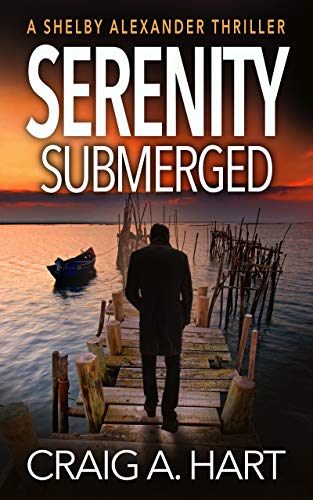
I’m enjoying Craig A. Hart’s Shelby Alexander series, set in the Michigan lakeside town of Serenity. Serenity Submerged is Number Four in sequence.
Shelby is a retired boxer who moved home to Serenity for a quieter life. So far his success in that regard has been negligible. This time out, a woman comes to see him, identifying herself as an FBI agent. She shows him a man’s picture and asks if he recognizes him. Shelby doesn’t admit it, but he’s shocked to see that it’s his friend Fritz, a resort owner. When he goes to ask Fritz about it, he learns that Fritz has a dark past. He’s holding some money that some bad people want very much. And now, apparently, he’s been located.
Meanwhile, a group of three criminals come into town, on the hunt for Fritz. Two are merely tough guys, but the third is a monster – a tall, ugly brute who looks like Frankenstein’s monster with a messed-up face.
Anyone who’s been following this series will know that Shelby and the monster are destined for a fistfight.
Serenity Submerged is a well-done “small” thriller – I like stories where the stakes are kept personal, instead of end-of-the-world stuff. The characters are fun – I especially enjoy the interplay between Shelby and his ex-cop friend Mac. And there were surprises. Plus some interpersonal relationship stuff for the ladies.
Recommended, with cautions for the usual suspects.
It would be natural and unfair to compare Justice by Jim Krueger and Alex Ross to the comic book series I reviewed a couple days ago. The Infinity Gauntlet was published in 1991, Justice in published in 2007. The scope of each project was likely different from the start. Twelve large issues for Thanos’s story may not have been possible had it been proposed.
But the two series offer roughly similar stories. The end of the world is at hand and a wide host of characters jump forward to move the story in their own direction, at least half of them I didn’t know. This set of twelve issues touches good, moving themes that are often left in draft in other series or touched so briefly as to be unnoticeable.
Justice appears to be a story of DC Comics’ Justice League of America moving from a loosely coordinated group of confederates to a band of actual friends. It begins with the world in nuclear holocaust, each hero failing to save a city or region as another destructive wave crashes over them. A few of them say, “I was too late. But I’m never too late.”
This is just a dream, however, that the world’s supervillains all experience together. They come to believe the world will end soon and their nemeses in the Justice League will be powerless to stop it. So they band together to save humanity, while taking measures to profit personally. Captain Cold and Poison Ivy turn a desert into an oasis. Scarecrow offers miracle cures to young people with crippling diseases. When the time is right, Luthor, Black Manta, and others announce to the world their generosity and intent to raise up new, floating cities to welcome the downtrodden and raise up a newly emboldened human race to seek new horizons, to soar to new heights, etc. etc.
The world is amazed at this turn of events, but willing to go along with what appears to be a good thing. The Justice League of America is nowhere to seen, so they don’t appear to have a problem with it or maybe, the cynics say, they can’t profit by it.
Websites store cookies to enhance functionality and personalise your experience. You can manage your preferences, but blocking some cookies may impact site performance and services.
Essential cookies enable basic functions and are necessary for the proper function of the website.
Name
Description
Duration
Cookie Preferences
This cookie is used to store the user's cookie consent preferences.
30 days
These cookies are needed for adding comments on this website.
Name
Description
Duration
comment_author
Used to track the user across multiple sessions.
Session
comment_author_email
Used to track the user across multiple sessions.
Session
comment_author_url
Used to track the user across multiple sessions.
Session
These cookies are used for managing login functionality on this website.
Name
Description
Duration
wordpress_logged_in
Used to store logged-in users.
Persistent
wordpress_sec
Used to track the user across multiple sessions.
15 days
wordpress_test_cookie
Used to determine if cookies are enabled.
Session
Statistics cookies collect information anonymously. This information helps us understand how visitors use our website.
Google Analytics is a powerful tool that tracks and analyzes website traffic for informed marketing decisions.
Used to monitor number of Google Analytics server requests
10 minutes
__utmb
Used to distinguish new sessions and visits. This cookie is set when the GA.js javascript library is loaded and there is no existing __utmb cookie. The cookie is updated every time data is sent to the Google Analytics server.
30 minutes after last activity
__utmc
Used only with old Urchin versions of Google Analytics and not with GA.js. Was used to distinguish between new sessions and visits at the end of a session.
End of session (browser)
__utmz
Contains information about the traffic source or campaign that directed user to the website. The cookie is set when the GA.js javascript is loaded and updated when data is sent to the Google Anaytics server
6 months after last activity
__utmv
Contains custom information set by the web developer via the _setCustomVar method in Google Analytics. This cookie is updated every time new data is sent to the Google Analytics server.
2 years after last activity
__utmx
Used to determine whether a user is included in an A / B or Multivariate test.
18 months
_ga
ID used to identify users
2 years
_gali
Used by Google Analytics to determine which links on a page are being clicked
30 seconds
_ga_
ID used to identify users
2 years
_gid
ID used to identify users for 24 hours after last activity
24 hours
_gat
Used to monitor number of Google Analytics server requests when using Google Tag Manager
1 minute
_gac_
Contains information related to marketing campaigns of the user. These are shared with Google AdWords / Google Ads when the Google Ads and Google Analytics accounts are linked together.
90 days
Marketing cookies are used to follow visitors to websites. The intention is to show ads that are relevant and engaging to the individual user.
A video-sharing platform for users to upload, view, and share videos across various genres and topics.
Registers a unique ID on mobile devices to enable tracking based on geographical GPS location.
1 day
VISITOR_INFO1_LIVE
Tries to estimate the users' bandwidth on pages with integrated YouTube videos. Also used for marketing
179 days
PREF
This cookie stores your preferences and other information, in particular preferred language, how many search results you wish to be shown on your page, and whether or not you wish to have Google’s SafeSearch filter turned on.
10 years from set/ update
YSC
Registers a unique ID to keep statistics of what videos from YouTube the user has seen.
Session
DEVICE_INFO
Used to detect if the visitor has accepted the marketing category in the cookie banner. This cookie is necessary for GDPR-compliance of the website.
179 days
LOGIN_INFO
This cookie is used to play YouTube videos embedded on the website.