Category Archives: Reviews

Blind Pursuit, by Michael Prescott

I found Blind Pursuit by Michael Prescott a very satisfying thriller. It’s one of those out-of-print novels that has begun to show up cheap in e-book format. I’ve had some good surprises with those.

The main characters are twin sisters, Erin and Annie Reilly, one a psychologist and the other a flower shop owner, who live in Tucson. The action starts fast with Erin’s abduction in the night.

Because the author follows her in the car trunk after she is taken, I was worried I was going to have to watch her murder, and I was ready to drop the book if that happened (I have a low tolerance for the on-stage killing of women). But the kidnapper’s plans for Erin are much more complicated than a simple sex killing. His plot is almost (not quite) beneficent and admirable, and his motives are a complex tangle that gets sorted out strategically for the reader, the enlightenment increasing with the dramatic tension.

The characters intrigue, the suspense is genuine, and there’s even a nice twist at the end. Also there’s romance for the ladies.

I enjoyed Blind Pursuit, and recommend it for adult readers.

A Cry For Justice, by Shelley Hundley

As you’re aware if you’ve been following my posts for a while, I have a personal interest in the subject of child abuse and recovery. I got Shelley’s Hundley’s A Cry For Justice because it was free for Kindle. I won’t say it wasn’t worth the price. It might even have left some ideas behind in my head that someday could be of use to me. But all in all I was disappointed with it.

Shelley Hundley grew up as a missionary kid in Colombia. If it wasn’t bad enough to be exposed to the daily violence of Medellin, where her family lived, she was also the victim of sexual abuse at the hands of a minister, a trusted family friend.

She repressed all memory of the abuse for some years, she tells us, until she was about to go away to college in the U.S. Then everything flooded back, and she angrily rejected God and became a vocal atheist on a Methodist college campus. She suffered from depression and suicidal thoughts, and it was only by what seems like a miracle that she was prevented from throwing herself from the roof of her dormitory one night. After that followed a period of institutionalization, culminating in a dramatic encounter with Jesus which began her process of spiritual and psychological healing.

There are some good insights here. I was particularly impressed when she pointed out that Peter, James, and John, the “inner circle” of Jesus’ disciples, are distinguished by being the ones about whom we know the most embarrassing stories. Apparently Jesus appreciated followers who weren’t afraid to jump in with both feet and make fools of themselves. That’s a tremendous truth, but much as I appreciate it, it doesn’t help someone like me much.

Hundley’s message of healing centers on seeing Christ as both Bridgroom and Judge, as Lover and Avenger. This, I think, is entirely sound and useful.

The bulk of the book, though, is not actually about dealing with the scars of abuse, but with what Hundley (who works with the International House of Prayer in Kansas City) considers her prophetic calling to turn America back to Christ. She lost a great deal of my interest in that part of the story, as I’m very leery of people who claim to have prophetic words for the church. I can believe that God may give someone a word for an individual or a congregation, from time to time, but claiming to have a prophetic message on a par with Scripture is something my church body does not believe in, and I (based on some experiences in my youth) agree wholeheartedly.

So while A Cry For Justice has some value, I can’t really recommend it.

Your Average Joe, Unplugged, by Joseph D. Schneller


Believe it or not, God does not want you to win them all. At times, you will swing and miss, you will submit and be rejected, you will try and you won’t succeed. You may miss your mark on a single attempt or for an entire season. And no, it won’t be due to some specific sin.

Today we will discuss the wonderful calamity of failure.

Occasionally a book from which you expected little is a wonderful surprise. Full disclosure: Your Average Joe, Unplugged is published by my own current publisher, and I got a review copy for free. But I’ve passed over other books by that publisher. This book impressed me very much, and was a blessing to me.

Joseph Schneller lost his business, a restaurant franchise, in 2008, about the same time the economy took a nosedive. As he struggled with the challenge of job-hunting, paying the bills, and being a husband and father to his family, he wrote a blog chronicling his spiritual battles. Those blog posts became the book, Your Average Joe, Unplugged.

It’s a one-month devotional, but more than a devotional. Schneller walks us through his own experience, as he applies the Bible and its promises to the day-to-day challenges and fears of an unemployed “average Joe.” There is much insight here, and courage I can only admire. Also humor, very well done.

I can hardly think of a more timely book. Your Average Joe, Unplugged is highly recommended, especially for those seeking jobs, underemployed, or worried about their jobs.

And who isn’t right now?

Pattern of Wounds, by J. Mark Bertrand

One of the keys to a long career in law enforcement is learning how to tell police psychologists what they need to hear without sounding deceptive. The only alternative is good mental health, which to me has always seemed too unrealistic a goal.

That’s Houston Police Detective Roland March, hero of J. Mark Bertrand’s crime novel Pattern of Wounds, a sequel to Back On Murder. I liked the first book very much, and I think I liked this one even more. Bertrand is doing almost exactly the thing I’ve tried to do (with far less success) in my own fantasy novels—to portray the real world through eyes of faith, giving both believers and unbelievers a fair chance to make their cases.
Roland March is a Houston cop, at once admired and disliked in his department because of his erratic career history. Successful enough as a crime solver to have been the subject of two true crime novels, he went through a slump period (following the death of his daughter in a car accident with a drunk driver) during which he seemed to be on the way out. In this book he tells us something we didn’t know before about that period—he was cutting corners because he didn’t trust the justice system. Always staying within the limits of strict legality (or so he believed), he nevertheless bent the law in order to insure “true justice” as he saw it. Continue reading Pattern of Wounds, by J. Mark Bertrand →

E-book: The Donzerly Light, by Ryne Douglas Pearson

I got this book free for my Kindle (it still is free, at least as of this writing), and I have to say it’s one of the better free books I’ve downloaded. Ryne Douglas Pearson is known as an author of techno-thrillers, but, as he explains in an Author’s Note, before he started in that genre he wrote The Donzerly Light, a Dean Koontzian supernatural thriller, which didn’t sell. He remained fond of it though, and the advent of e-publishing made it possible for him to offer it to the public.

The time is the late 1990s. Jay Grady wakes, tied up and blindfolded, in a dark closet, with a cast on a broken leg. Rough hands lift him up and carry him to an interrogation room, where he is questioned by a man who does not seem to be a policeman. Jay was captured after being seen shooting a man to death. He does not deny the act. Once, we learn, he was a Wall Street celebrity, a young man with a gift for picking winning stocks, a mover on the way up. Then he suffered what looked like a psychotic break, and disappeared. For years he survived as a transient. Now here he is.

Jay hides nothing. His life was altered forever, he says, when he stopped one morning and gave money to a panhandler on Wall Street. The panhandler rewarded him with a “gift,” a form of magic that allowed him to identify rising stocks ahead of the market. The gift might almost have seemed a divine one, except that it led Jay into all the stereotypical excesses and acts of selfishness that so frequently go with being young and rich. Then, when his power changed in a terrifying way, he fled his old life. But he could not avoid a final showdown with the supernatural forces in which he’d dabbled.

I found The Donzerly Light (the title refers to a child’s misunderstanding of the line from the national anthem) an utterly fascinating story, worthy of comparison with Dean Koontz in his middle period, before he started adding explicitly Christian elements to his stories. (I might note that this book treats Christians with respect, and Jay, although he shares a motel room with an attractive woman drawn into his adventure, does not share a bed with her).

Fascinating, moving, with a genuine, page-turning mystery at its bottom, The Donzerly Light is a winner. If you have an e-book reader, I recommend it. Mild cautions for language and adult situations.

Uncle Abner, Master of Mysteries, by Melville Davisson Post

“Abner,” replied Dillworth, “how shall we know what justice is unless the law defines it?”

“I think every man knows what it is,” said Abner.

“And shall every man set up a standard of his own,” said Dillworth, “and disregard the standard that the law sets up? That would be the end of justice.”

“It would be the beginning of justice,” said Abner, “if every man followed the standard that God gives him.”

“But, Abner,” replied Dillworth, “is there a court that could administer justice if there were no arbitrary standard and every man followed his own?”

“I think there is such a court,” said Abner.

This passage, from a story entitled, “The Tenth Commandment,” in the book, Uncle Abner, Master of Mysteries, by Melville Davisson Post (published 1918), encapsulates, in its moral libertarianism, much of what I found fascinating, and irritating, in this collection. I would like to recommend it for some readers, but have a hard time saying what kind of readers those might be.

“Uncle Abner” is a Virginian backwoodsman living some time in the early 19th Century (I was never able to work out exactly what period. The clues were all over the map.) Most of his stories are narrated by his hero-worshiping nephew (hence the “Uncle”). Abner is a Christian of unimpeachable (frankly overdrawn) integrity and intelligence, a man without official office who nevertheless acts as an investigator whenever a murder is discovered in the neighborhood. His reading of the human heart is infallible, his observations invariably correct, his judgments infallible.

He has little regard for human institutions of justice. When he discovers a murder he’s as likely to let the guilty party off as to turn him over to the authorities, sometimes on the basis of reasoning that seemed pretty obscure to me. He seems to believe that God’s justice is active and inescapable, not only in eternity but in the present, and regards himself as God’s instrument.

In short, he’s a man many of us would like to be, and is also kind of insufferable. In addition I think his theology weak (at one point he says that the devil “is very nearly equal, the Scriptures tell us, to the King of Kings.” The Scriptures tell us no such thing).

The puzzles are interesting, some of them noteworthy in the history of mystery writing. The stories reminded me of Chesterton’s Father Brown mysteries, but were less didactic in terms of theology, and the characters less rounded.

I’d like to recommend this book to adults, but I suspect most readers (even Christians) will find them a touch naïve in terms of realism. I’d like to recommend them for children, but the depictions of black people (mostly slaves at that point in time in Virginia) are not the kind I’d like to see children exposed to.

So make your own judgment.

No fool he

The redoubtable Anthony Sacramone has been energized once again in his blogging at Strange Herring, which makes the world a sweeter and better place in so many ways. Today he reviewed the new film, “Our Idiot Brother.” He kind of liked it, but was not blind to its conceptual failings. Especially in the area of honesty, as seen through Hollywood eyes:

The moral of our story is that honesty is the best policy. And “openness” to others is the free-est form of expression. It sounds so simple and right. Except, well, this is Hollywood. And even its moralizing needs some desanitizing.

It’s possible to be so “open” to the other that one becomes a mere experiment in someone else’s “life journey.” One can also use “honesty” as a cover for merely being frank. You know the difference between being honest and being frank, right? Abraham Lincoln was honest. Adolf Hitler was frank.

The frank person makes no bones about the fact that he is robbing you, but insists that this “admission” also makes him honest. The frank person admits to cheating you, or cheating on you, and insists that needs must be met, and what about those banks and insurance companies and Wall Streeters?

To be honest means more than calling a spade a spade. It is also means more than mere earnestness. It is a a habit of mind, heart, and soul. It is a form of personal integration — integritas — that emanates from the center and not from attempting to Crazy Glue all the broken pieces back together with hollow apologies and confessions of being merely human.

All Things Considered, by G. K. Chesterton

If you like reading blogs, you’ll probably like reading G. K. Chesterton. Chesterton did the thing bloggers do long before blogging existed, and he did it better than the best of us. If he were alive today his blog would be the most popular one in the world. It would drive liberals crazy much of the time, but conservatives would take offense now and then too, and both sides would likely post indignant comments to tell him how STOOPID he was.

All Things Considered is a collection of columns Chesterton wrote for the London Daily News during the years up to World War I. They’re not his absolute best work. He admits in the preface that many of them were written under tight deadlines, when “there was no time for epigrams.” And what he wrote frequently got snipped down, pretty arbitrarily, by editors.

But even under adverse conditions, Chesterton offers a wealth of opportunities to the happy highlighter. Instead of reviewing All Things Considered (an act of hubris), I’ll just list some snippets to give you a taste.

First of all I want to mention that this book includes what may, very probably, be the first use of the word “groovy” in the English language. Seriously. Chesterton doesn’t use it as the hippies did, and I’m pretty sure they weren’t quoting him when they re-coined the adjective, but it’s right here, in a column called “Humanitarianism and Strength”:

Have you ever noticed that strange line of Tennyson, in which he confesses, half consciously, how very conventional progress is?—

“Let the great world spin for ever down the ringing grooves of change.”

Even in praising change, he takes for a simile the most unchanging thing. He calls our modern change a groove. And it is a groove; perhaps there was never anything so groovy.

*

The real objection to modernism is simply that it is a form of snobbishness. It is an attempt to crush a rational opponent not by reason, but by some mystery of superiority, by hinting that one is specially up to date or particularly “in the know.”

I believe firmly in the value of all vulgar notions, especially of vulgar jokes. When once you have got hold of a vulgar joke, you may be certain that you have got hold of a subtle and spiritual idea. Continue reading All Things Considered, by G. K. Chesterton →

Fair, partly cloudy


The Minnesota State Fair. Artist’s Conception.

It occurs to me that I should have taken pictures at the State Fair on Saturday, like Lileks does. But then I realize, it was hard enough dragging myself around the fairgrounds, let alone taking a camera. I know people have tiny little cameras in their cell phones nowadays, but I’m a straggler on the dragging edge of technology. I only get things after they’re passé (except for my Kindle, which was a gift from… well, I won’t embarrass him again).
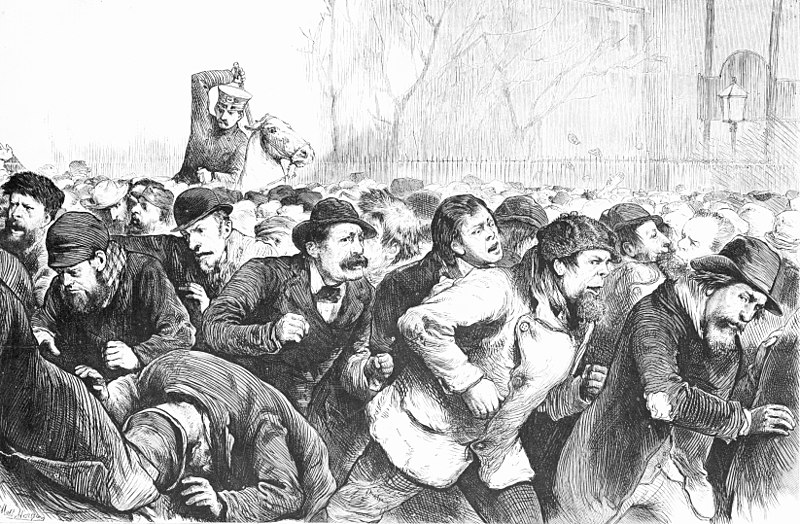
It was possibly the most perfect day for the fair I’ve ever seen, from the perspective of weather. Nice temperature, and it started sunny and then clouded over without actually raining more than the occasional tiny spit. This was great for the concessionaires, not so great for Avoidants and Introverts. You know that place in the gospels where Jesus is pushing through a crowd, and stops and says, “Who touched Me?” because (He says) “I felt power go out of Me”? I didn’t heal anybody (may have injured some) but when we pushed through a crowd of teenagers who suddenly appeared around us, screaming for some pop singers (or something) at a radio station booth, I felt the power go out of me, all right. I was a shell of a man by the time I got free of that.
The conclusion was obvious. I need to lose even more weight, and get some exercise. Which I’m trying to do.
Or else give up the fair.
I need to retract an endorsement.
Hunter Baker (funny, I was just thinking about him) commented on my review of Lee Child’s Killing Floor, writing the words I always dread:

I have read a lot of Lee Child books, but had to stop a couple of years back. He revealed himself in a couple of books to be pretty seriously anti-Christian. And made the Reacher character share those views. That did it for me…
I was a major fan of his. It began small with Reacher refusing to fly Alaska Airlines because they put a small Bible verse on each tray. In a subsequent book, there is an extremely bizarre Christian character who is some kind of caricature of American evangelicals. Once I read that one, I just decided Lee Child didn’t need any more of my money.

Sad, but not really a surprise. No more of my hard-earned will flow to Lee Child either.

Film review: Conan the Barbarian

With this review, I consciously renounce all right to any respect as a film critic. I loved Cowboys and Aliens, which right-thinking people seem to despise, and now I’m going to admit to the world that I enjoyed the new Conan the Barbarian, which everybody except me and a few Facebook friends seems to loathe.

I’m going to start by moving my recommendation, which I usually leave for the end of the review, to the beginning. The good things I’m about to say about Conan the Barbarian should not be taken as an endorsement for most of our readers. This movie earns its “R” rating. There is much violence, and enough graphic, special effects-enhanced gore to please Odin’s ravens. Also considerable female nudity, often in situations involving bondage. I think this was a major error on the part of the filmmakers. They could have made a movie just as good without voluntarily reducing their paying audience through shock techniques and salaciousness.

On the other hand, the “R” rating is not inconsistent with the original material.

I approached Conan the Barbarian with something less than low expectations. I mistrusted the re-boot project from the first, and Michael Medved, whose opinion I respect, hated it. So I was pleasantly surprised when, somewhere along the way, I realized I was enjoying the show. Continue reading Film review: Conan the Barbarian →