Category Archives: Authors

What Is Man But Freedom?

If man is simply good by nature and governed by social or natural laws, then someone somewhere could raise up utopia for the perpetual happiness of all who lived there. Dostoevsky said that if such a place could be constructed, let several years pass and “people would suddenly see that they had no more life left, that they had no freedom of spirit, no will, no personality. . . . they would see that their human image had disappeared . . . that their lives had been taken away for the sake of bread, for ‘stones turned into bread.'”

Gary Saul Morson writes about Dostoevsky’s faith in human independence and that the idea is politically practical.

A passage in Notes from Underground looks forward to modern dystopian novels, works like Yevgeny Zamyatin’s We (1920–21) or Aldous Huxley’s Brave New World (1932), where heroes rebel against guaranteed happiness. They want their lives to be their own. Put man in utopia, the underground man observes, and he will devise “destruction and chaos,” do something perverse, and, if given the chance, return to the world of suffering. In short, “the whole work of man seems really to consist in nothing but proving to himself continually that he is a man and not an organ stop. It may be at the cost of his skin; but he has proved it.”

Any politician who believes the right policies or governing body can right all wrongs does not understand the people he claims to serve nor, perhaps, himself. We must be free, even to our ruin. (via Prufrock News)

The Master Ghost-Storyteller

Lored Eaton is lining up another round of scary ghost stories for the most wonderful time of the year. I plan to contribute one, which you’ll find here on December 19. I hope you enjoy it; feel free to say you don’t.

One of the masters of the ghost story is M.R. James (1862-1936). His tales have been adapted for the BBC many times, though not this year according to The Critic.

Many of his tales originated from being read to favoured students or pupils around his study fire in the winter, or from told as Christmas Eve entertainments for his friends. Although not all of them followed the same formula, there were several ingredients that can be regarded as quintessentially “Jamesian”, and which constitute the archetypal festive ghost story.

The protagonist of his tales is usually a learned man and a bachelor, as James himself was, who is not an especially clubbable or sociable figure, but makes up for his slight misanthropy with a great love of books and manuscripts. He often finds himself in an unusual setting, such as an abbey library or in a quiet seaside town, and stumbles upon some document or artefact that has the unforeseen effect of unleashing supernatural powers upon him.

(via Prufrock News)

The Kindness of Alex Trebek

Jeopardy champion Jackie Fuchs describes the “Uncle Alex” she knew, some of the filler phrases he used, and what TV viewers couldn’t see in the studio.

Him taking my hand and asking me how I felt after I’d had a hypoglycemic scare during my fifth episode. His explaining to one of my competitors who’d gotten off to a blazing start, only to falter in the second half, that it was her buzzer technique and not her knowledge that had been her downfall. How he’d made us feel that it was cool to geek out over “Star Wars” or to collect Barbie dolls or to be interested in whatever we were passionate about.

He reportedly said the game show would carry on without him one day, but who could fill his shoes? In this moment when the contestants tied at $16,000, Alex showed his love the game with a quick laugh.

May he rest in peace.

Lost Letters Between Barrie and Stevenson Found in Library Box

Everyone’s favorite author of pirate stories, Robert Louis Stevenson, once wrote to Henry James that he, J.M. Barrie, and Rudyard Kipling “are now my Muses Three. And with Kipling, as you know, there are reservations to be made. And you and Barrie don’t write enough.”

Stevenson was writing from Samoa during this time. His letters have been published in various collections, but his correspondence with J.M. Barrie has lacked Barrie’s letters until now.

Dr. Michael Shaw of the University of Stirling found the letters in a cardboard box at Beinecke Library in Yale University, not realizing they were unpublished until later when he followed up his research with the published correspondence.

“I just assumed that they had been published and I didn’t know about them,” he said. “I was judging myself, thinking I really should have read these.”

Apparently Stevenson told Barrie how to get to his Pacific island, a little over 4,800 miles southwest from the San Francisco bay, in this way: “You take the boat at San Francisco, and then my place is second to the left.”

Reading report: ‘The Lord of the Rings’: Incompatibility

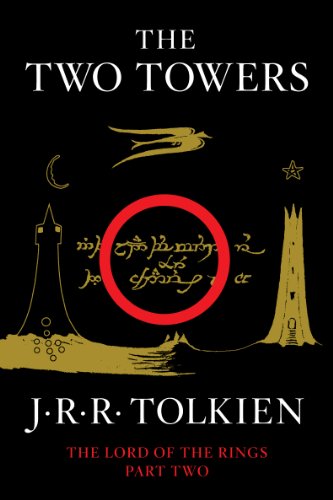
Blogging my way through The Two Towers:

To some extent Ronald and Edith [Tolkien] lived separate lives at Northmoor Road [Oxford], sleeping in separate bedrooms and keeping different hours…. She and Ronald did not always talk about the same things to the same people, and as they grew older each went his and her own way in this respect, Ronald discoursing on an English place-name apparently oblivious that the same visitor was simultaneously being addressed by Edith on the subject of a grandchild’s measles. But this was something that regular guests learnt to cope with. (J. R. R. Tolkien: A Biography, Humphrey Carpenter.)

‘But our hearts did not go on growing in the same way: the Ents gave their love to things that they met in the world, and the Entwives gave their thought to other things, for the Ents loved the great trees, and the wild woods, and the slopes of the high hills…. But the Entwives gave their minds to the lesser trees, and to the meads in the sunshine beyond the feet of the forests…. ‘ (Treebeard, in The Two Towers)

Just a parallel that struck me, from Tolkien’s life and his books. It’s not for me to say much about the Professor’s domestic life (which was full of love by all accounts, though a little eccentric). Just to point out a similarity.

Reading report: ‘The Lord of the Rings’: Diversity

Blogging my way through The Two Towers:

Another theme in these books that strikes me is the vision of what – at the risk of political correctness – I might call “diversity.”

The Fellowship of the Ring is, self-consciously, a diverse group. It includes members of several of the more-or-less human “races” not dominated by Sauron – Men, and Elves, and Hobbits. No doubt this mirrors Tolkien’s experience with classes and Imperial ethnicities (not to mention Allies) during the Great War. The feeling (it must have seemed very strange in those times) of thinking, “Here I am, crouched in a trench with men I might have despised or even fought against in the past. But we’re all at war for a single cause now, and I find much to love and admire in them.”

No doubt it would have occurred to a thoughtful mind that one could conceivably come to feel the same way about the enemy, under different circumstances.

But it wouldn’t only have been the war. The fabled Inklings group was itself (to an extent) a disparate gathering. Not radically disparate, but to Tolkien, as a member of a religious minority, the chasm between Catholic and Protestant was always significant. I don’t recall that any of the Inklings was an atheist or agnostic, but Owen Barfield was a Theosophist (though he eventually became a communicant Anglican).

Which reminds me of the issue of “Jack” Lewis’s Anglicanism, always a sore point with Tolkien. After the famous night in 1931 when he and Hugo Dyson convinced Lewis that mythology might be a kind of inchoate prophecy from Heaven (leading to his Christian conversion), Tolkien hoped Jack would join him in his Roman faith. But Jack remained at bottom a Belfast Protestant, though he learned to appreciate certain beauties in his friend’s church.

And when I read of Gimli and Legolas, tentatively finding common ground in which an Elf might go so far as to visit caverns, in order (perhaps) to discover the beauties a Dwarf sees there, and the Dwarf condescends to travel in a forest with the Elf for the same reason, we may be peering into the heart of Tolkien’s and Lewis’s friendship.

‘New’ C. S. Lewis recordings

“Like cold water to a thirsty soul, so is good news from a far country.” (Proverbs 25:25, ESV)

There is good news, folks, even now, especially if you’re a C. S. Lewis fan.

There are “new” recordings of C. S. Lewis reading his own work and Chaucer, available from the Rabbit Room Store. That’s surprising in itself, but the source of the recordings is even more remarkable.

In August of 1960, C. S. Lewis’s wife Joy Davidman had been dead for about a month. At that time her ex-husband, William Gresham, traveled to England to see his sons, Douglas and David. It must have been an awkward reunion. Bill Gresham tried hard to get custody of his sons, but “Jack” Lewis strenuously opposed him, winning custody for himself. (According to Joy Davidman’s biographer, she may have exaggerated her stories of Bill’s neglect and abuse. However, it is indisputable that he was an alcoholic.)

However he felt, Bill was gracious enough to ask Jack to read some of his work into the new tape recorder he’d brought along. Jack did so, reading excerpts from Perelandra and That Hideous Strength, and then reading (or reciting) part of the Prologue to The Canterbury Tales in flawless Middle English.

I haven’t bought my copy yet, mostly out of laziness, but I’m going to. I can’t complain about the price – three bucks for the whole caboodle.

Proceeds go to benefit the Marion E. Wade Center, which owns the rights.

‘Reading report: The Fellowship of the Ring, by J.R.R. Tolkien: The Rainbow Wizard

I finished reading The Fellowship of the Ring over the weekend. One can’t really review a work of this eminence. I can only write appreciations. One thing I noted was a detail I’d forgotten, one that was left out of the movies, and it’s  no mystery why. It’s when Gandalf meets with Saruman at Orthanc, and learns his former master’s perfidy:

‘”For I am Saruman the Wise, Saruman Ring-maker, Saruman of Many Colours!”

‘I looked then and saw that his robes, which had seemed white, were not so, but were woven of all colours, and if he moved they shimmered and changed hue so that the eye was bewildered.

‘”I liked white better,” I said.

‘”White!” he sneered. “It serves as a beginning. White cloth may be dyed. The white page can be overwritten; and the white light can be broken.”

‘”In which case it is no longer white,” said I. “And he that breaks a thing to find out what it is has left the path of wisdom.”’

This is an amazing passage. Saruman the White, whose white color had symbolized his supreme wisdom, has broken the white color down into its constituent prismatic hues.

He’s made it into a rainbow.

We see rainbows all the time today, in churches that believe they’ve “deconstructed” traditional morality and theology.

Was Tolkien an actual prophet? Did he foretell the future of the church?

Snorri on my mind

An old friend of mine, Brad Day, mentioned on Facebook that today (actually yesterday) was the anniversary of the death of an author I’ve talked about a lot on this blog – Snorri Sturlusson (your spelling may vary), author of Heimskringla, the Prose Edda, and (very likely) the Saga of Egil Skallagrimsson).

Snorri is an author I identify with, not because of his genius, but because he wrote better than he lived. Born to a powerful Icelandic family and well-educated in the home of a learned relation, he grew up to cherish both literary and political ambitions. These sometimes overlapped. His great historical saga, Heimskringla, was clearly composed to gain favor with the Norwegian king. His Prose Edda was an effort to present the myths of the old religion in a way acceptable to the Church, so that the tradition of Norse poetry might carry on.

He sailed to Norway twice, and got to see a lot of the country. That familiarity comes out in Heimskringla. Lacking the gift of prophecy, he made a bad tactical mistake, attaching himself to the powerful Duke Skuli, uncle of the king, Haakon IV Haakonsson. This would prove fatal, as Skuli and Haakon fell out, and Haakon won the war. Snorri’s second visit to Norway turned out badly, and he actually offended the king. This led eventually to his murder at the hands of his enemies, one of whom was his son-in-law. It is thought that the killers were acting on Haakon’s orders.

Snorri did not die like a saga hero. We are told he was speared to death while cowering in his cellar, crying “Don’t strike!”

It is believed that Snorri also connived in Iceland’s loss of independence to Norway.

But he was a literary genius. Every Viking and mythology buff owes Snorri a tremendous debt. Tolkien’s work would have been vastly different without Snorri – perhaps it might not have been written at all.

Few Know About C.S. Lewis’s schizophrenic Stepson

Douglas Gresham has begun talking about his difficulty experiences as a child with his brother, David, and how Lewis and Uncle Warnie did all they could to care for this dangerously schizophrenic boy.

“When I was a small child,” Gresham told Jonathon Van Maren, “he was continually trying to get rid of me. This went on into our teen years.” He said he remembers “running like crazy or defending myself from my rather insane brother. . . I would never have said anything to harm him or upset him while he was alive, because oddly enough I still loved him as a brother. In fact, I wept when he died.”

“Jack went out of his way to do everything he possibly could for that lad, and none of it was accepted.” (via Prufrock News)