
Category Archives: Authors

Milton, Our Contemporary

Milton, as much as Shakespeare, remains our contemporary. As Wordsworth put it in a sonnet from 1802, ‘Milton! thou shouldst be living at this hour:/ England hath need of thee.’ One half of a nation almost as bitterly — if not as bloodily — divided as in his day needs to understand how the blind, scorned radical, ‘though fallen on evil days… In darkness, and with dangers compassed round’, channelled his dismay at the failure of England’s revolution and the restoration of monarchy into a masterpiece that finds salvation through despair. In 1660, Milton was arrested, imprisoned and might have gone to his death as an impenitent regicide without a few well-placed admirers. His epic, with its aim to ‘assert eternal providence/ And justify the ways of God to men’, climbs from his pit of disillusion to find meaning and hope in calamity. A hero for Remainers, then.

Boyd Tonkin urges us to read Milton today, because he will speak to us if we will listen. April is the 350th anniversary of Paradise Lost‘s publication. (via Prufrock News)

Would Southerners Have Killed Spurgeon?

On March 22, a “Vigilance Committee” in Montgomery . . . burned Spurgeon’s sermons in the public square. A week later Mr. B. B. Davis, a bookstore owner, prepared “a good ore of pine sticks” before reducing about 60 volumes of Spurgeon’s sermons “to smoke and ashes.” . . .
Anti-Spurgeon bonfires illuminated jail yards, plantations, bookstores, and courthouses throughout the Southern states. In Virginia, Mr. Humphrey H. Kuber, a Baptist preacher and “highly respectable citizen” of Matthews County, burned seven calf-skinned volumes of Spurgeon’s sermons “on the head of a flour barrel.”

British newspapers quipped that America had given Spurgeon a warm welcome, “a literally brilliant reception.”

Christian George, head of the C. H. Spurgeon Library, has produced the first volume of lost sermons by the great London preacher. The dark history above comes from the preface of this volume.

Linkage

The great Dave Lull sends a link to an interview with Anne Kennedy on The Eric Metaxas Show. Anne is the author of the devotional book Nailed It, which I reviewed here.

And our friend Ori Pomerantz recommends this link to the Federalist, where John Ehrett imagines the “hot takes” (a new term to me, I’ll admit) that might have been published if C.S. Lewis’ Narnia books had been published today.

Reason: “Narnia Doesn’t Need Kings”
In “Prince Caspian,” the Telmarines were on the cusp of transforming Narnia into a successfully modern state that would’ve created job opportunities for everyone. Aslan’s violent return destroyed valuable capital and plunged the regime back into a preindustrial dark age. The GDP losses are incalculable. For shame, Aslan.

Recovered Essay on Extraterrestrial Life

Who comes to mind as a public figure who has written an essay on the possibilities of life on other planets?  Not a high school paper, but a fairly scientific essay that concludes, “With hundreds of thousands of nebulae, each containing thousands of millions of suns, the odds are enormous that there must be immense numbers which possess planets whose circumstances would not render life impossible.”

Would you believe Winston Churchill wrote these words?

The essay written in 1939 reportedly has a strong understanding of contemporary astronomy and how scientists would approach the question of extraterrestrial life. It was found by Timothy Riley, director of the National Churchill Museum at Westminster College in Fulton, Missouri. He recommended the essay to astrophysicist Mario Livio, who was thrilled to examine it.

Churchill did his homework, Livio reports. Though he probably didn’t pore over peer-reviewed scientific literature, the statesman seems to have read enough, and spoke with enough top scientists—including the physicist Frederick Lindemann, his friend and later his official scientific adviser—to have had a strong grasp of the major theories and ideas of his time.

Burned-out Author Forges On, Lands Deal

Nancy Peacock has done well as a novel writer, and her path has been a challenging one. Speaking of her mindset about ten years ago, she writes,

At the time, writing and publishing another book was the last thing on my mind. Although, even as I say it, that feels like a bit of a lie. I think publishing is always on a writer’s mind; I also think we have to forget about it. We have to write without feeding any fear regarding the future of a book, how we’re going to publish, how we’re going to reach an audience, and how the book will be received.

She describes how she soured on traditional publishing, chose to self-publish her third novel with professional help, and the key that turned her back to traditional publishing.

http://www.writersdigest.com/editor-blogs/guide-to-literary-agents/indie-author-landed-traditional-book-deal

Peacock doesn’t talk about her experience with queries, but whatever mistakes she may have made, I’m sure she didn’t make any of the ones agent Steve Laube lists in this post on odd queries he’s received.  Here’s one of them.

An email proposal with a cover note that reads, “I am sure you get a lot of proposals, but this one is worth your time to read.”
But the author claims they looked at what we agents want and then sent us something we specifically say we do not represent. Then says they followed our guidelines for submission but didn’t follow one of them. And then claims the Holy Spirit told them to write it and gave them the words. They must not have read what I wrote a while back “God Gave Me This Blog Post.”

Nevermore to forget…

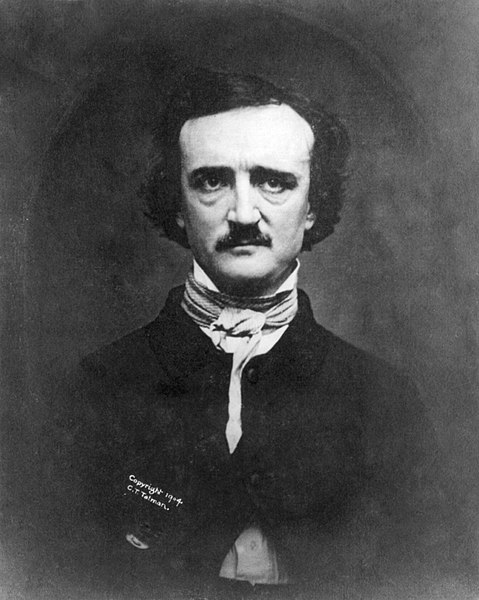
Edgar Allan Poe

A book I’ve had for many years is Louis Untermeyer’s A Concise Treasury of Great Poems, English and American, published in paperback in 1958. In his introduction to Edgar Allan Poe, Untermeyer notes, “The quality of his gift as well as the tragedy of his life is indicated in the words of Sir Francis Bacon which are on the Poe Memorial Gate at West Point: ‘There is no exquisite beauty without some strangeness in the proportion.'”

Oddly enough, that gate is not mentioned in Atlas Obscura’s list of 10 Places That Rejected Poe in Life but Celebrate Him in Death.”

Edgar Allan Poe pioneered a distinctly American brand of gothic horror and romanticism, and introduced the short story to the literary tradition. Yet throughout his career he never received much fame or money. “The Raven” was his best-known work, for which he was paid $9. Poe spent his life traveling up and down the Atlantic coast, working odd jobs and performing parlor readings to make ends meet, going from one failed relationship to the next. He ultimately died with no family, raving mad in the streets of Baltimore.

As if in an attempt to rectify Poe’s lack of success, numerous locations of import during his lifetime have been posthumously dedicated to him, or at least honor his presence there. Here are 10 places in the Atlas that trace the footsteps of America’s master of macabre.

Caimh McDonnell Listens to Audiobooks

Lars’ review of Caimh McDonnell’s first novel yesterday drew the attention of McDonnell’s publisher on Twitter. That lead to my discovery of this interview of McDonnell posted yesterday. Blommin’ Brilliant Books asked the comedian what genres he preferred.

Typically most of the novels I like to read either fall into the crime or sci-fi genres. Having said that, quite a lot of the ‘reading’ I do is actually audiobooks. I can often spend 16 or so hours in a week driving to gigs and I fill that time by devouring audiobooks. I think the influence of that can be seen very clearly in my writing. I write to be read out loud and I believe dialogue is usually the best way of conveying information. I have also read hundreds of TV and film scripts as I’m completely self-taught as a TV writer. People have said that dialogue is my biggest strength as a writer and I guess if you’ve spent as much time as I have forensically examining the work of Aaron Sorkin, that’s no great surprise – not that I’m anywhere close to his level.

He also said he drew one of his characters from an actual, living being. “Phil Nellis is heavily based on my friend and fellow comedian Phil Ellis. In fact, I did it specifically to annoy him.”

Standing In for Thomas Pynchon

Comedian Irwin Corey, who regularly lampooned the educated classes, died this week at age 102. The NY Times tells a story of how he impersonated author Thomas Pynchon to receive the National Book Award for fiction in 1974.

No one in the crowd had any idea what the reclusive Mr. Pynchon looked like, and when Mr. Corey arrived to accept the award for him (the novelist had approved the stunt), many people thought they were getting their first look at Mr. Pynchon.

They soon learned otherwise. Beginning his remarks, as he often did, “However,” Mr. Corey referred to the author as “Richard Python” and said, “Today we must all be aware that protocol takes precedence over procedure.” He continued: “Marx, Groucho Marx, once said that religion is the opiate of the people. I say that when religion outlives its usefulness, then opium will be the opiate. Ah, that’s not a bad idea.”

The Times reported the next morning that Mr. Corey’s “series of bad jokes and mangled syntax” left “some people roaring with laughter and others perplexed.”

See Corey and hear his acceptance speech from the National Book Awards here.

In memory yet Green

Roger Lancelyn Green

My friend Dale Nelson recently sent me a couple old articles on Tolkien he thought might be of interest. One of them was from Amon Hen, the journal of the Tolkien Society, #44, May 1980. It was a piece by Roger Lancelyn Green, in which he reminisced on his friendship with the professor. Green has sometimes been identified as a member of the Inklings, but he does not claim that honor (or honour). His article includes the following delightful paragraph:

I never saw The Lord of the Rings before it was published, but heard a good deal about it from Lewis, who kept saying that if only Tolkien would finish it, it would be one of the great books of the century – “But Tollers just won’t finish it! Every time he gives himself a month’s holiday to do so, he begins by reading over what he has already written, and sees how he can better that, and spends most of his month on revising!”

Landmarks and visions

Landmark Center
The Landmark Center in St. Paul. Photo 2005 by Mulad.

The old US post office, custom house, and court house in St. Paul, built in 1902 and home to much graft and corruption in its time, is now called Landmark Center. They’re a little more tolerant of architectural treasures in that city than in Minneapolis, so it was saved from the wrecking ball and now exists as a cultural center. Once a month they host events for various ethnic groups. This month (yesterday) it was the Danes, and we Vikings were asked to man a table for the event. Three of us showed up. We had a pretty good time.

Lots of visitors, and lots of questions, many from children, which is always nice. I was able to explain how people got the idea that Viking helmets had horns, and how chain mail was made. Sold a couple books and several bits of leather work.

One of the best parts was that we were right next to the aebelskiver stand. Aebelskivers are Danish pancakes, formed by secret and occult methods into spheres. They’re generally served with powdered sugar and strawberry preserves. Delightful.

I also had the pleasure, over the weekend, of receiving another tip from Dave Lull. He remembered that I’m fond of the late D. Keith Mano, and he alerted me to a reprint of one of Mano’s old columns over at the National Review. They’re going to be publishing a series of them over the next few weeks. This one concerns a series of visions of the Virgin Mary in Bayside, Queens, New York back in 1975. Mano describes his “investigation” in bemused and gentle terms.

The church of St. Robert Bellarmine—now half school, half gym—stands two blocks up. There used to be a statue on the corner: large copy of those Virgins in telephone booths that wait outside Catholic houses. Veronica had her first visions here. But, as crowds grew, an unsympathetic Mother Church had the statue sledgehammered away. So much for mariolatry. You can still see the pedestal stump, cordoned off by wooden snow fencing.

It occurred to me to do a web search on Dave Lull. Turns out he’s not merely a reader of this blog, which would be enough to adorn the fame of any man. He’s a librarian (thus one of nature’s noblemen) and a facilitator of blogs. Blogless himself, he sends tips like this to a number of book bloggers.

I am honored to be among that number.