Category Archives: Fiction

‘Fiction No More,’ by Ted Clifton

There are three books to date in the Vincent Malone mystery series by Ted Clifton. Fiction No More is the third. It’s worth your time.

Vincent Malone, just to jog your memory, is a former legal investigator from Denver, now living in Santa Fe, New Mexico. For a while he worked as a van driver for a local bed and breakfast, but with improving health and a new attitude and live-in girlfriend, he’s moving back into his old work. He still drives the van now and then, but he’s got new challenges.

Still, his latest case comes out of the Inn. A famous mystery novelist is visiting, and she asks Vincent to check out a man whom she believes is following her. He has contacted her in the past, she says, asking why an incident in her first novel so closely mirrored the murder of his own father.

When the man is arrested for another murder by the police, the author surprises Vince by offering to pay for his defense. Vince’s lawyer boss takes the case on, and the trail leads to that older case from the novel. Turns out the author hasn’t been entirely honest with Vincent – her grandfather had firsthand knowledge of the crime, and had described it to her. It all has to do with the theft of Native American artifacts long ago – and some of the people involved are still alive and dangerous. One of them is even powerful.

Fiction No More was a pretty good read. As I’ve said before, these stories combine hard-boiled and cozy elements, and the fusion works pretty well. An unnecessary anticlimax provides a bittersweet coda that I’m not sure I’m grateful for or not.

Cautions for language and adult themes. Modern attitudes toward marriage and cohabitation bothered me a little, but that’s the world we live in.

Source Material: Infinity Gauntlet

By the magic of my community library’s digital loaning platform, I was able to borrow a comic book. Crazy wild, I know.

Thanos: The Infinity Gauntlet

When I discovered I possessed this uncanny power, I sought out the source material for the recent Avengers extravaganza, the original telling of Thanos and the Infinity Gauntlet. I didn’t like the movie’s storyline for its heavy reliance on a single argument and felt certain Hollywood had rejected perfectly good source material for its own twisted narrative. Surely the original was better; I mean, it’s the canon, right?

Not even Death realized what limitless might the mad titan was striving for. Through cunning, sheer strength, and murder, Thanos wrested the infinity gems from those that possessed them and with each acquisition he gained mastery over the soul, the mind, power, time, reality, space.

The Infinity Gauntlet by Jim Starlin and artists George Perez and Ron Lim starts on an interesting note. Unlike Avengers: Infinity War, Thanos starts the book with all the infinity gems. The story skips neatly over all the nobodies Thanos had to dispatch in order to obtain the six gems, which is fair. How could they have told engaging stories about unknown aliens guarding unknown powers? The threat to human and all sentient life builds nicely over the first two issues.

If you’re unfamiliar with the story, Thanos has just about infinite power with these gems and eliminates half of the sentient beings in the universe. The Avengers won’t roll over for that and neither will the Avenger-friends. That much is in the movies. In the comic books, The Silver Surfer rushes to Earth to tell Doctor Strange everything he knows, Strange receives word from a metaphysical being who is also in the know, and other heroes hear from their sources as well. In short, everyone soon knows who they oppose but not how they can oppose him.

Fault one with The Infinity Gauntlet: The Hulk doesn’t say, “There’s trouble brewing!”

Fault two comes in the big fight. Sure, someone must devise a clever plan. Sure, many heroes will be overwhelmed by this nigh omnipotent villain. Sure, many words will be spilled by B-string supers who speak of themselves in the third person and are supposed to be super-duper defenders except this time. All of this can be done well enough, but they tried to take it to the next level by bringing in a menagerie of gods to challenge the one with godlike power. And what do you think happens to them?

Continue reading Source Material: Infinity Gauntlet →

‘Blood Lies,’ by Andrew Cunningham

A free book deal persuaded me to download Blood Lies, by Andrew Cunningham. It’s the fifth in his “Lies” series.

The main characters are Del Honeycutt, the narrator, and his girlfriend, bestselling mystery writer Samantha Spencer. As the story starts, Samantha is shot on the street, and rushed to the hospital. The main concern is not with the gunshot wound, which is minor, but with possible brain damage from hitting her head on the sidewalk. In a suspicious twist, someone claiming to be a policeman comes to claim the bullet that shot her. Only he’s not from the police.

Del’s investigation of the crime soon leads him to suspect that the bullet was not intended for Samantha, but for him. Which makes no sense, because he’s not the famous one in their relationship. However, he begins learning new things about his own family secrets. He always knew his father was a scoundrel, but he never guessed that he was a spy. For the Chinese.

The story is convoluted, and not particularly plausible. It reminded me a lot of television writing from a bygone era – especially in the main characters’ ability to recover quickly from injuries. Also, deadly perils are averted through improbable lucky breaks – in one memorable scene (and I don’t remember a lot of scenes from this book after a few days), the hero manages to kill an attacker with a cell phone. By accident.

Blood Lies was an entertaining book, but doesn’t bear the weight of much thought. Not highly recommended. Cautions for language and adult themes.

‘Blue Flower, Red Thorns,’ by Ted Clifton

Vincent Malone is the continuing hero in Ted Clinton’s series set in Santa Fe, New Mexico, of which Blue Flower, Red Thorns is the second. Vince went from being a high-flying Dallas lawyer to a successful Denver legal investigator before quitting that work due to his health. He drifted into Santa Fe, where he took a job driving a van for a bed and breakfast. But he found use for his detective skills in the first book, Santa Fe Mojo, and is easing back into that career.

Nevertheless, he’s still driving the van when Blue Flower, Red Thorns begins. He makes a run to Durango, Colorado to get some friends’ son out of a legal problem, and returns to help his pleasant employers deal with a group of important guests. They’re hosting a rising young woman artist and her entourage, while a big auction is held at a local gallery. But these guests act pretty much as you’d expect artists and dealers to act – they’re temperamental, and the artist’s drunken mother makes a scene physically fighting the gallery owner. Which makes her the chief suspect when the owner is found murdered – but if you’re looking for people with motive, there is no shortage. Vincent will have to plunge into the world of art forgery to untangle the mystery.

This is very good entertainment reading, perfect for the beach (or your living room while you’re quarantined). Vince is tough and cynical enough for the hard-boiled fan (though he’s mellowing with a new girlfriend), and the recurring cast of characters is sympathetic enough for cozy readers.

Cautions for language and adult themes. There’s one more book in the series so far.

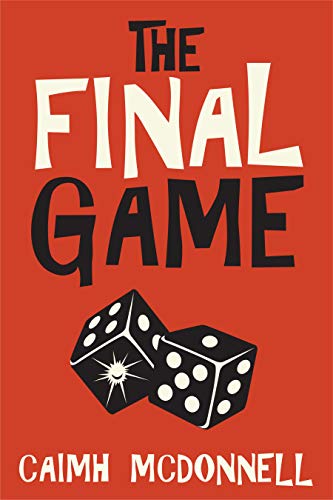
‘The Final Game,’ by Caimh MDonnell

In response to this, Gregory’s mouth flapped open and closed in outrage, like a fish that had been slapped in the face with another fish.

Caimh McDonnell’s comic mystery novels are an ongoing entertainment of a pretty high order. They began with the adventures of Paul Mulchrone and Brigit Conroy (called a trilogy, of which this is something like the fifth), amateur private detectives, who hook up with Bunny McGarry, a Falstaffian old policeman, to solve crime. Bunny has been spun off into his own series of adventures in America, but Paul and Brigit soldier on, acquiring in this book, The Final Game, the assistance of James Stewart, a retired cop who (unlike Bunny) does not drink, but keeps falling over anyway, due to an inner ear problem.

Dorothy Graham is a character we know from earlier books in the series. She was a feisty old woman who became Paul’s surrogate mother when he was doing volunteer work with the elderly. She was a brilliant and aggressive player of board games, and immensely rich.

Sadly, Paul comes out of an undercover job to learn that Dorothy is dead. She fell down her stairway while alone. Paul is devastated by the news. But he’ll soon be flabbergasted by her will.

The old woman had a flair for the dramatic, and utter contempt for the idle and self-indulgent step-grandchildren who are in line to inherit her wealth. So she did one better than the old video will gag, where the deceased gets the chance to get the last word on their assembled relatives.

Dorothy has spared no expense to turn the settlement of her estate into a world-class production – literally. She has arranged to make the inheritance a competition. The heirs are to compete in teams of two, in something like a TV reality show, handling various ridiculous and embarrassing challenges. And it’s all to be podcast over the internet.

To Paul’s astonishment, he and Brigit are designated as one of the teams. Dorothy tells them, on video, that she wants them to win the money, rather than her obnoxious step-family. Paul reluctantly agrees, even though it means wearing pink jump suits and Mexican wrestler masks.

But when he learns that Dorothy might have been murdered, it becomes a game of life and death.

Caimh McDonnell excels at this kind of ridiculous story, and the laughs are frequent. It’s also remarkable that there are actually a few really touching moments in the story. The characters are vivid, and we come to care about them (or hate them, depending on which they are).

McDonnell is as funny in his own way as P. G. Wodehouse, and I had a very good time with The Final Game. My only quibble is that he leans pretty heavily on the “smart, tough girls vs. dumb, feckless men” trope, which has been overdone lately. It’s not as new a trope as one might think (it wasn’t even new for Wodehouse), but these days it’s lost all its power through overuse. It’s become a cliché. It’s predictable.

Still, I highly recommend The Final Game. Cautions for language, gross humor, and adult themes.

‘Santa Fe Mojo,’ by Ted Clifton

Vincent Malone, hero of Ted Clifton’s Santa Fe Mojo, was once a hotshot lawyer in Dallas, until alcohol trashed both his career and his marriage. He drifted to Denver, where he found his niche as a legal investigator. Then he developed gout, and missed too much work. Figuring a warmer climate would help, he headed for Albuquerque, and cheap housing. But in a diner in Santa Fe he saw an ad for a job driving a customer van for a bed and breakfast. On a whim, he applied for the job.

Vincent is a misanthrope, a man who’s seen the worst in people and has distanced himself from them. But the couple who hire him are annoyingly nice. He doesn’t know what to do with them, but he kind of likes working there as he gets used to it.

They’re excited to greet their first guests at the B&B, but something is wrong. The rooms were booked by a major sports agent who lives locally, for a group of his top clients and their spouses. But when they hold a meeting, it ends in shouting and threats.

The next morning the police come. The agent has been murdered. Vincent can tell that the sheriff’s department would like to hang something on him, but they quickly settle one of the clients – a major league baseball player. Security video shows the two men fighting in the agent’s front yard, a few hours before the murder.

Vincent, though, based on his investigative experience, thinks the cops haven’t looked far enough. They found an easy suspect and stopped detecting. The accused’s lawyer shows up, and he’s the accused’s uncle and Vincent’s spiritual twin – a hard man who got rich defending whoever paid him, using any kind of trick he could get away with. But he’s older now, and thinking it might be nice to form some kind of bond with his only surviving relative. At least he forms a bond with Vincent, who shares his bemusement at discovering morality late in life.

Santa Fe Mojo straddles the line between cozy mystery and hard-boiled, and does it pretty well, I think. The gradual softening of Vincent’s hard shell in the warmth of human friendship provides an enjoyable sub-plot. I enjoyed Santa Fe Mojo quite a lot. Cautions for language, mostly.

‘The Musketeer’s Seamstress,’ by Sarah D’Almeida

Sarah Hoyt is a Facebook friend and a fellow Baen author. Aside from her SF work, she has produced, under the nom de plume (a particularly appropriate term in this case) Sarah D’Almeida, a seies of novels about Alexandre Dumas’s Three Musketeers. These are mysteries, and have been inserted directly into the timeline of that classic novel. The Musketeer’s Seamstress, second in the series, occurs shortly after D’Artagnon meets his swashbuckling friends, but (if I understand correctly) before all the bother about the queen’s diamonds.

Aramis, the romantic musketeer destined for the church, is at the palace, dallying with his mistress, a lady of the court whom he refers to with his friends as his “seamstress.” He steps out of the chamber for a moment. When he returns, he finds her dead, a dagger through her heart. Like so many idiots in mysteries, he pulls the dagger out, getting blood all over his hands. When he hears people at the door, he makes a leap from the balcony onto a convenient tree and then manages to get away over a wall – stark naked. He is fortunate enough to find his friends Athos, Porthos, and D’Artagnon at guard at one of the gates, and they help make his escape. Cardinal Richelieu, who seems to cherish a particular dislike for Aramis, sets a hunt going, but Aramis manages to get away to his home estate, while his friends try to uncover how an “impossible” murder was committed.

The author, I think, did an interesting job with the familiar characters. She invents back story material for them that Dumas only hinted at, and as far as I can remember it’s pretty consistent with his portrayals. I particularly like the character of Porthos, who is envisioned as a man not stupid, but simply plain-minded and practical. Which makes it possible for him – sometimes – to see things his subtler friends miss.

I felt a certain tension in the insertion of a whodunnit into what is essentially an action/adventure setting. The action is quite good when it happens, but a lot of the book involves people just thinking and discussing matters, which struck me as a little incongruous. However, as I said, I liked what was done with the characters, so such scenes were not without interest.

I wouldn’t rate The Musketeer’s Seamstress as a top-shelf book, either as an actioner or a mystery, but it was an enjoyable read, and I had a good time reacquainting myself with what is, perhaps, the archetypal male-bonding group in all literature.

‘Desires and Dreams and Powers,’ by Rosamund Hodge

During the later part of the war, the government issued a pamphlet on how to recognize changelings. Violet read it (a green tinge of the features; propensity to cruelty) and laughed. The real signs had been far more pervasive, far less clear. Sometimes she thought she had only realized she wasn’t human when she was fourteen. Sometimes she thought she had always known.

That’s the first paragraph of a story called “More Full of Weeping Than You Can Understand,” possibly my favorite among the stories in Rosamund Hodge’s delightful collection, Desires and Dreams and Powers.

A friend sent me a copy as a gift, and I’m extremely grateful to him. As I’ve often said, I don’t much care for most modern fantasy. But when someone gets it exactly right – as in the cases of Walter Wangerin, and Mark Helprin, and Leif Enger, the result is delight of an exquisite sort.

The stories in Desires and Dreams and Powers are of diverse kinds, within the general fantasy genre. There is urban fantasy, and tales of witches, and tales of monsters. But most of them (at least as I recall them) are faery stories. And that’s like a birthday present to me.

Ever since I read Tolkien’s essay, “On Faery Stories,” I’ve wanted to write faeries properly. I tried it in Troll Valley – which I think is a pretty good book, but I’m not at all sure I got the Faery/Huldre thing right. Susanna Clark got it right, I think, in Jonathan Strange & Mr Norrell. And now I declare, by the powers vested in me, that Rosamund Hodge gets it right too. The strangeness, the danger, the alien unreason of the faeries is as well depicted here as it ever has been. Kudos to the author.

I can’t recommend this book highly enough. On top of the imaginative genius, the prose is first class. Cautions are in order – not for the usual “adult” material, but for the weird and the alien and the disturbing (and the cruel). But read it, if you’re a grown-up and not overly sensitive. There may be a Christian element here too, though it’s not at all explicit.

‘Rollover,’ by James Raven

Thrillers as a genre are different from mysteries, but there tends to be a lot of overlap. Thrillers concentrate on building tension and unease in the reader, but a mystery element adds to that tension. Me, I’m more of a mystery person than a thriller person, and Rollover, by James Raven, kept me reading, but took me far beyond my comfort zone. Which will have been, of course the point.

Danny Cain is a journalist, partner in a struggling independent news agency in Southampton, England, with his friend Vince. One evening he gets a call from Vince – he has to come right over. Vince has won the national lottery! Their troubles are over!

But when he gets there, Danny finds Vince dead, bludgeoned to death on the floor. Before he can telephone the police, he gets a call from his wife’s mobile phone – a strange man’s voice says to get out of there and wait for further instructions. They have kidnapped Danny’s wife and 6-year-old daughter; if he doesn’t follow instructions, they will die.

Then begins Danny’s ordeal – once of those situations where things start impossible and then get worse. He has no resources to call on, and his enemies seem organized, omniscient, and remorseless. Doing what he’s told might be impossible, and even if he can, chances of survival are low.

Meanwhile, Hampshire Detective Jeff Temple is called to the crime scene. Danny Cain looks like the obvious culprit, but Jeff isn’t sure. Things don’t add up, but he has no idea what awful revelations will come to light before it’s all over.

Taunt, tense, and remorseless, Rollover is a masterful thriller. It worked so well that I’m scared to continue on with the sequel.

‘Murder at Flood Tide,’ by Robert McNeill

A woman is strangled in an out-of-the way spot in Edinburgh. Detective Inspector Jack Knox is surprised to learn that the case has been taken over by a “more sophisticated” police team from western Scotland. Their leader, however, turns out to be a decent and sensible fellow. He puts Jack in operational command and makes his people available to reinforce the local cops, who know the territory.

Crime scene investigation, witness reports, and CCTV suggest that the killer drove a delivery van, so the team begins a systematic investigation of delivery companies and their drivers. Slowly the noose tightens, but surprises are in store.

That’s how Robert McNeill’s Murder at Flood Tide goes. It’s not a thriller, but a fairly realistic police procedural, like the previous volume in the series, The Innocent and the Dead, which I’ve already reviewed. The drama is mostly low-key, but along with the threat of the serial killer, there is an insubordinate team member to be dealt with.

I like the realistic approach of this series, but I can’t pretend I find these books compelling. They are entertainment with a moderate level of dramatic tension; nothing to keep you awake at night.