
Category Archives: Fiction

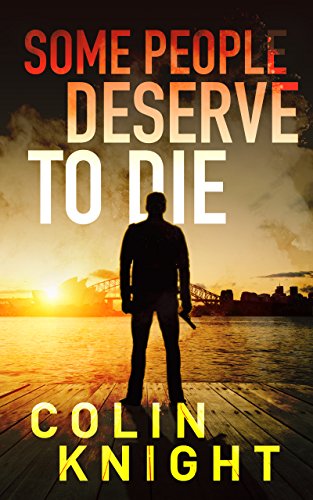
‘Some People Deserve to Die,’ by Colin Knight

I think most readers will find few surprises in Colin Knight’s Some People Deserve to Die. It’s a fairly standard revenge story, but it’s told in a compelling way.

Alan Davies is discovered homeless on the streets of Toronto, strung out on booze, drugs, and guilt. After he dries out in a hospital, he discovers he’s actually fairly wealthy now. What he’ll do next is a no-brainer – he’ll get revenge on the people who ruined his life.

As a boy in a small town, Alan was a nerd, a target of bullies. One day those bullies tricked him into committing an act that left him permanently shamed. It didn’t help that his father had died that same year, and his sister had committed suicide. So he went on the road. His wanderings took him first to the South Pacific paradise of Vanuatu, where he got involved with the local drug trade and learned to be a thug. When that went sour, he fled to the North Atlantic to work on an offshore oil rig. Then he followed his drilling team to Nigeria, where they stepped into a hellish world of crime, corruption and bestial cruelty. That led him to a stint as a mercenary, and finally to a quest for oblivion on the streets of Toronto. Then, at last, to his neat, professional, ruthless revenge project. And a shocking discovery.

The revenge story is a difficult challenge for a Christian reviewer. Forgiveness doesn’t enter into this story, but things don’t work out quite as Alan planned, so forgiveness may be conspicuous by its absence. (Though I wasn’t quite sure how to think about the conclusion.) I knew what was coming pretty much all the way through, but the storytelling kept me fascinated (in spite of some typos).

Moderately recommended, if you have a strong stomach for violence and rough language.

‘The Assistant,’ by Kjell Ola Dahl

It’s not often I finish reading a book with the feeling of, “Glad that’s over.” But that was my response to The Assistant, a stand-alone novel by Kjell Ola Dahl, one of the big guns of Scandinavian Noir.

There are two parallel narrative threads in this book. In 1924, a young man with the non-Norwegian name of Jack Rivers works as a driver for a bootlegger. Though a thrill-seeker and a bit of a rogue, Jack would rather be doing something legal. But there’s a depression on, and he takes what work he can get. Eventually he will be arrested by the incorruptible policeman Ludvig Paaske, who nevertheless takes a liking to him. Jack has a sense of honor and is faithful to his friends, something those friends do not reciprocate.

In 1938, Jack is out of prison, now working as an assistant for Paaske, who has become a private detective. Paaske is approached, in the classic Hard-boiled manner, by a beautiful woman who wants him to follow her husband. She suspects he’s being unfaithful.

Her husband, it turns out, is the bootlegger Jack used to work for, now a successful businessman and politician. And the wife is not being entirely honest. Both Jack and Paaske will have reunions with women they cared about in the past, and each will worry that the other is being manipulated. In addition, Nazi agents are involved.

The Assistant is a moodier and more thoughtful book than the average mystery. I suspect it might be more evocative in the original Norwegian. This translation seemed good to me at first, but seemed to deteriorate as it went along. Sometimes it was ploddingly literal (a vice hard to avoid, as I can say from experience). And sometimes it seemed like a rush job to me, the author having given up on finding the right words. The first time someone made coffee in a “pan,” I thought it was due to their poverty, but eventually I realized the translator must have blanked on the words “pot” and “kettle” all through. And the parliament is referred to as “Stortinget,” which is technically correct but won’t be familiar to many English-language readers.

I need to mention that a Labor Party speech gets fact-checked by Paaske at one point (that’s rare in a Norwegian book), and one character’s Christian piety is  treated with respect.

But I didn’t believe this story. It was operatic – the main characters make great, Quixotic gestures that seem both irrational and out of character. And the two different timelines share so much in location, characters and action that they were hard to keep straight.

Also, the ending just left me floundering.

I can’t really recommend The Assistant.

‘The Woman Who Died a Lot,’ by Jasper Fforde

Happy Labor Day, folks. Hope you had a good one.

It has been my fate in life to be one of those people who often observe their fellow men enjoying things that they don’t understand at all. Parties. All sports. Reality shows. Cheese. I’ve learned perforce the truth that my disinterest in a thing is a vote neither for nor against it.

I’d heard high praise of Jasper Fforde’s Thursday Next series. So when I got a bargain offer on The Woman Who Died a Lot, a recent entry, I figured I’d give it a try.

There were a lot of fun elements in this book. I did laugh fairly often.

And yet, I didn’t fall in love with it.

Perhaps I should have started with an earlier volume.

Thursday Next, as many of you know, I’m sure, lives in an alternate universe which diverged from ours (apparently) some time in the 18th or 19th Centuries. They live under a world government (not a despotism – nice trick, that) and she works as a special agent dealing with literary crimes. She has the ability to “read herself” into another dimension where the books we read, and their characters, are real. The stories abound in literary jokes, absurdities, and paradoxes.

But in this book, Thursday has had her wings clipped. Middle-aged now, she has suffered a leg injury that makes it impossible for her to make the physical moves necessary to change dimensions. Also, her whole department has been abolished since the discovery that time travel is impossible, which entirely undoes all the science they’ve been operating on up to now. This has left her oldest son Friday with the ultimate career frustration – instead of becoming head of the division and a hero, he’s scheduled to commit murder and go to prison. Also, God has announced plans to smite the city of Swindon (which, as far as I can figure out, does London’s job in this universe) for its sins, and Thursday’s genius daughter Tuesday – 16 years old – is obsessively occupied in trying to work out an algorithm to prevent it. And Thursday is finding synthetic clones of herself running around stealing her identity – literally.

These are only a few of the points in the super-complex plot of The Woman Who Died a Lot. To be honest, I found it hard to keep up. I felt insecure as a reader, not sure of the rules (no doubt a consequence of jumping into the series toward the end).

Also, how shall I put it? I have an old guy’s response to religious flippancy. In this universe, Thursday’s brother Joffey has converted the whole world to Theism through logic, establishing one universal church, which everyone joined voluntarily. But God doesn’t seem pleased, and has begun smiting places – His reasons are never entirely explained. Joffey’s church has become something like a collective bargaining organization, with God playing adversary.

Complicating it even more, Joffey is homosexual. I might be tempted to think that that’s what made God mad, but I doubt that’s Fforde’s intention.

Anyway, I did chuckle often reading The Woman Who Died a Lot. But I feel no desire to repeat the experience. Since lots of people like these books, your mileage is likely to vary.

‘Bad Dog,’ by Alex Smith

“Can you describe the two people for me?” Kett asked. “The man and the woman.”

“She was, like, a woman,” he said, concentrating so hard it looked like his head might pop clean off his shoulders. “He was more like, I don’t know, a fella.”

When I reviewed Alex Smith’s first DCI Robert Kett novel, Paper Girls, a few days back, I remarked that while many mystery writers these days go “extreme” with their stories in terms of action and the physical suffering of the protagonists, this book went extreme with the hero’s emotional suffering. Sent to Norfolk for a country break in the wake of the unsolved kidnapping of his wife, Robbie Kett gets involved in a local case. He’s supposed to be decompressing emotionally and spending time with his three little daughters, but he ends up helping to solve the kidnappings of three local girls.

I couldn’t describe the suffering in the second book, Bad Dog, as primarily emotional, though there’s plenty of that. This time out, Kett is still recovering from wounds received in the Paper Girls case, and he goes on to multiple further injuries in this one, enduring with increasingly implausible stoicism (which is not to say that he isn’t suffering inside too, because he definitely is).

A young couple are out walking in the forest when they are attacked by – something. The woman’s body (her husband disappears completely) has been torn up as if by a dog attack – but the teeth marks are human. The locals immediately attribute the killing to “Black Shuck,” a legendary monster said to be a ghostly black hound, kind of like the Hound of the Baskervilles. Kett’s suspicions incline more to some neighbors who seems to be running a dog-fighting ring. But the real solution will be more bizarre than anyone ever dreamed.

Which was kind of my problem with the book. Not only was extreme physical suffering added to Kett’s emotional challenges, but the crime itself kind of pushed the limits of plausibility for me – though maybe I’m just naïve.

However, the author threw in a tantalizing cliffhanger at the end, so I’ll have to get the next book.

I didn’t like Bad Dog as much as Paper Girls. But the characters are still good, and there are very funny moments. And some fair values. Cautions for language and grotesque violence.

‘A False Mirror,’ by Charles Todd

It’s 1920. Inspector Ian Rutledge of Scotland Yard is dispatched to the town of Hampton Regis, to investigate the beating of Matthew Hamilton, a prominent local citizen, a diplomat who has retired to the seaside. Suspicion immediately falls on a young man named Stephen Mallory. Mallory was engaged to Hamilton’s young wife before the war, from which he returned with shell shock. He thinks he’s been discreet about keeping a watch on the Hamilton house, to spy on the woman he still loves, but you can’t keep secrets like that in a small town.

Inspector Rutledge is inclined to suspect Mallory too. He knew him personally in the war, and considered him a coward. But he knows – better than most – that such prejudices can disrupt your judgment. He has battle fatigue himself, manifested in the form of Hamish MacLeod, his best friend, who did not survive the war – due to Rutledge’s own actions – and who constitutes a continuous presence at his shoulder now, commenting on everything that goes on when he’s not accusing Rutledge.

When Mallory barricades himself in the Hamilton house, holding Mrs. Hamilton and her maid hostage, things look black for him. But Rutledge thinks there’s more to this business than is apparent, especially when Hamilton inexplicably disappears from his bed in the doctor’s house.

There was much to like in Charles Todd’s novel, False Mirror, but I have to confess I found it hard going. It seemed to me to move slowly, but what bothered me most was the downbeat atmosphere. The book was depressing. Especially for me, as I know something about accusatory voices from the past (don’t ask).

On the other hand, Christianity comes out looking very good in this book. Remarkably good by the standards of our time.

A look at Amazon reviews told me that this is in fact a flashback book, an origin story, in a very popular series, and other readers say this book’s atmosphere is not representative of the series. So I may try another Ian Rutledge book. I did like the Christian elements.

Missing the Joke or Playing Along?

What’s the thing you saw to make you wonder about people’s grasp on reality? Sure, we seem to run a fair risk of seeing a Karen-type in social media each week, and that’s enough to wonder who those people think they are. But if you haven’t seen one of those people, here’s a story that may make you scratch your head.

In The Princess Bride, William Goldman opens talking about himself, how he was introduced to this “classic” from another era, and throughout the novel he inserts editorial notes of explanation or obfuscation. The fictional classic author Morgenstern, whom Goldman says he is merely editing, does the same. Somewhere in the middle, Morgenstern interrupts the narrative to say his wife had a complaint. Goldman interrupts the interruption to explain that M., not G., is interrupting at this point and that he agrees with M’s wife’s complaint.

I assume you know the story well enough for me to carry on. Yes? All right.

The complaint is over the lack of a reunion scene between Westley and Buttercup after she discovers who he is. Goldman says Morgenstern did not write such a scene, about which his otherwise appreciative wife complained. Goldman claims to have written the scene himself and that his editor would not allow him to insert it, because he’s not writing the book, only editing what Morgenstern wrote. Goldman tells us we can have this scene sent to us by request, giving an address for Urban del Rey at Ballentine Books, and saying his publisher would pay for return postage.

So please, if you have the least interest at all or even if you don’t, write in for my reunion scene. You don’t have to read it–I’m not asking that–but I would love to cost those publishing geniuses a few dollars, because, let’s face it, they’re not spending much on advertising my books.

—William Goldman, The Princess Bride, ch 5

How many letters would you say have arrived in New York with this request? When the book debuted, six or so letters a week found their way to the publisher. It was released in paperback the next year, 1974, and spurred upwards of 100 letters a week. In 1987, the L.A. Times reported that since the movie came out, 400-500 letters a week began coming in.

I don’t know how long that stream kept up that pace, but it seems a bit unhinged, doesn’t it? Combine this with reports of people asking for the original Morgenstern edition, which doesn’t exist because the whole abridgment thing is a joke, and you wonder about their grip on reality. Are they playing along or do they realize Goldman says many things he doesn’t not mean?

‘Paper Girls,’ by Alex Smith

It’s common to find “extreme” thrillers on bookshelves today. Usually that means extreme in terms of action – improbably indestructible heroes taking damage that would permanently cripple lesser men, ripping drip lines out of their arms and escaping hospitals, and dominating climactic showdowns against impossible odds amid large explosions.

Alex Smith’s Paper Girls is extreme in a different way. It’s extreme on the interior level, driving its hero to the limits of his emotional resources (before he nearly gets killed in a fight).

Detective Chief Inspector Robert Kett is a London policeman on compassionate leave; he’s moved temporarily to Norwich to decompress and spend time with his three daughters, one of them a baby. Famed for his skill as a finder off missing persons, he’s tormented by the fact that he couldn’t locate his own wife, who has been kidnapped.

His down time is interrupted, though, when his boss calls and asks him for a favor. The local police in Norwich need help with a pair of kidnappings. Two eleven-year-old girls, who made money delivering newspapers, have been snatched. Everyone knows that after the first few hours, chances of discovering the victims alive sink to almost zero.

Personally, I don’t think I’d have put up with the guff Kett takes when he shows up to help. His temporary boss, rather than being grateful, is openly insulting and uses him as a scapegoat when things go wrong (though he’s a layered character; I like that in a book). And Kett has more than enough on his hands trying to care for his traumatized girls. But he doesn’t quit because he cares deeply; he can’t help himself thinking about what the victims are suffering. He can’t help believing that if he can find these girls, maybe he can find his wife too.

The detective work was pretty plausible. The characters were very good. Paper Girls was almost too intense for me – I have a hard time dealing with kidnapping stories in general. But I stayed with it and was glad I did. There was a cliff-hanger at the end, but the author played fair.

Male readers will enjoy the suspense and the action. Female readers will enjoy seeing a man find out what women have to do all day. I highly recommend Paper Girls. Cautions for language and mature subject matter.

Cuba in ‘1984’

A few weeks ago, I started reading 1984 as a change of pace from the Rubus novels I went through. That was when news from Cuba came out on Twitter, and Cubans had taken to the streets.

Our media, which allows claims of Cuba’s “entirely free” health care to go unchallenged, told us they were upset that COVID vaccines were in short supply. But everything has been in short supply. Farmland that could be cultivated with modern techniques is wasted by political bullies who must control everything even when there’s nothing left. Little abuelas are saying they have lived under communism for 60 years and they’re sick of it. The protests sprang up everywhere. Police have ushered hundreds of people off the streets, beating them for protesting or “disappearing” them. World reports some of the details here.

Communists blocked all or most of the country’s Internet access early on, prompting U.S. advocates to talk about deploying special Internet beacons like we did in Puerto Rico a few years ago. Doctors are now speaking up about the sorry condition of state-run hospitals. Health is not a particular care of the state.

This week, Cuba has made it illegal to complain online, so the video last month of a woman crying hysterically over her son bleeding to death under state-run care, wounds caused by police, would be a crime to record and share. Praising the all-knowing, ever-benevolent state is all that’s allowed.

With this going on, I found it difficult to read 1984. The parallels were too strong, the story too dark. It was akin to enduring my mother’s death in a hospital a couple years ago and later trying to watch a Korean TV drama set in a hospice care facility in which characters regularly pass away.

I made it through about 70-90 pages. I heard a professor (I think) say he thought the book felted dated, pulled out of history’s dustbin. I think it describes Cuba perfectly. A country at war with ideological enemies. History constantly rewritten to agree with present claims. Enthusiastic support of our dear leader is required from all. No one is interested in discussing the truth or exploring possibilities. No one wants personal risk or neighborly respect. The state speaks for the people, because the people have no voice of their own.

I don’t find that kind of fear entertaining or enlightening.

I wonder if Cuba has their own version of Newspeak.

‘The Man by the Sea,’ by Jack Benton

First, an update on my car. The part arrived. They tried to put it in. It turned out to be defective. They’ll order another. Estimated time window: about a month.

You probably won’t be surprised by now to know that I wasn’t surprised at all by this. I was expecting it to be the wrong part, but otherwise this was the scenario I fully anticipated.

Anyway, on to my book review. The Man By the Sea by Jack Benton.

John “Slim” Hardy is a private eye in Lancashire, England. He is a failed soldier and a serious alcoholic. He’s been hired by a woman to follow her husband, whom she suspects of having an affair.

He’s not having an affair. Slim has discovered that the man is going once a week to a secluded cove known for dangerous rip tides, where he stands reading out loud from a book. What he’s reading, Slim discovers (I forget how), is a Latin incantation to the dead.

Instead of reporting the good news to the wife and closing the case, Slim gets obsessed with the husband’s reasons for this behavior, and starts looking into his past, and into local history. Not neglecting to turn the situation fully ironic by having an affair with the wife.

If this summary sounds improbable, the rest of the book is even less plausible.

I don’t think I’ve ever read a novel so detached from genuine human motivations and behavior. At every juncture, the characters fail to do what a normal person would do, but instead act in some hysterical way. They respond operatically, or perhaps more aptly, soap-operatically.

And our hero is not just a maintenance alcoholic, like your run of the mill literary private eye. Slim Hardy is a full-fledged dipsomaniac, subject to black-outs and car accidents and completely out of control. He needs to be locked up for the protection of himself and others.

The story was sad, the narrative frustrating to read. I do not recommend The Man By the Sea.

‘The Off-Islander.’ by Peter Colt

Andy Roark, the hero of Peter Colt’s The Off-Islander, is a Boston private eye with a middling business and a drinking problem. He suffers from the after-effects of combat in Vietnam (this story is set in 1982), and from regrets following a break-up with his girlfriend. He grew up in the depressed Southie section of town, and his best childhood friend is Danny Sullivan, now a lawyer who works for the mob, but who dreams of respectability.

Danny hires Andy to do an investigation for a beautiful, rich woman whose husband has political aspirations. Her father disappeared when she was a girl, she tells them, and she’s worried he might have gotten involved in something since that time that would cause a scandal. They’ve already paid the Pinkerton Agency to run down leads on the West Coast, without any luck. They want Andy to check out the East Coast. Andy visits an address the man used in Hyannis, which leads him to a property on Nantucket Island. There the clues he follows will lead him to layers of lies and a violent challenge that will suddenly transform his greatest handicap – his PTSD – into the strength he needs to survive a threat unlike any he’s faced since the war.

I wasn’t sure at first whether I liked Andy Roark as a hero. His first-person narration is intentionally reminiscent of Philip Marlowe in a Chandler novel, though author Colt isn’t as lyrical a writer (and for some reason he often avoids contractions in dialogue). Often Andy seemed self-sabotaging, which was annoying, and there were a couple instances of casual marijuana use, which always annoys me in a character. However, the pot leads to nothing good, and I really appreciated the power of the final, dramatic denouement. The book ended very strong, leaving an extremely good impression on this reader. I think I’m going to read the next book in the series.

Recommended, for adults.