Category Archives: Fiction

‘The Spy Who Came In From the Bin,’ by Christopher Shevlin

‘He’s a hard man to photograph,’ said Lance.

‘But these are good likenesses, right?’ said Lizzie.

‘Sort of. It sounds weird to say, but there are other people who look more like Jonathon than he does himself.’

I’ve been trying to come up with blog topics all week, and I forgot I’d finished a book last week that I hadn’t reviewed yet.

There’s a third book in  Christopher Shevilin’s weird Jonathon Fairfax series, The Spy Who Came In From the Bin. Jonathan Fairfax, if you recall my earlier reviews, is a well-meaning Englishman who bumbles through life, never quite sure what’s going on as adventure swirls around him.

In this book, Jonathon wakes up in a garbage truck in Berlin, being unloaded from a bin, having completely forgotten who he is. He’s taken to a hospital, but manages to escape after an assassin shows up to murder him. Soon he’s taken in by a friendly American student and her Russian boyfriend. They go on the run, pursued by CIA killers, as Jonathon’s best friend and girlfriend rush to rescue him, assisted by other CIA killers, who may or may not actually be on their side.

It’s all very weird, in the style of these books, where there are very few actual gags to laugh at, but the situations are highly comic in cumulative effect.

What I disliked about this book was a lazy European anti-Americanism, that sees the US as the world’s only real problem. I’m not sure whether I can overlook that attitude enough to read the next book, assuming there is one.

But it’s funny. I can’t deny that.

Culling the Shelves of Bad Books

Sometimes I browse a bookstore as I would other stores I visit while playing the tourist. I look at the many curious spines, letters, and colors, seeing the curiosity of one, the value of another, with little intension of buying either. Sometimes I go to a bookstore in hope of finding a few, specific titles or types of books or maybe anything by that guy who wrote those stories–you know the ones–about that cool thing, remember, and though I enter with hope, I must put it on a table somewhere to pick up something else, because I gradually despair of finding anything I want.

But there are times when I take a chance on a book I know nothing about. That’s when I run the risk of having my wife read it.

I’m a slow reader. If I wasn’t so good-looking, I’d be notably less successful than I am. My wife is fast reader, and I don’t mean by comparison to me. I can buy her a promising title from the used bookstore, and in two days, having read it through, she’ll ask me to take the trashy thing back.

I went to the used bookstore a couple weeks ago, carrying a mug of hope for reasons I don’t recall. Maybe it was our recent collection of trade-ins and having avoided the store for about a year. Inspired by Lars’s recent urban fantasy reviews, I wanted to find something fun and maybe good to try. So I went home with a steampunk novel, first of a series. Saying she needed to screen it for the kids, my wife read it immediately.

I think I read somewhere that nothing in steampunk was worth reading. It was all fan-fiction, heavily derivative. This book has to be step aside from that, because it was traditionally published by an author who has many other published books, but it isn’t good.

Getting all of this from my wife, the dialog is awful, particularly everything the heroine says. The plot is dragged down by her constantly wrestling over marrying someone instead of doing the adventure thing that you’d expect from a novel like this.

The devices and contraptions are interesting, even though they don’t move the story. The pirates are vile, needlessly dark, and disappear after their initial scuffle, which may be realistic but not fun. The zombie disease doesn’t make sense, and I don’t need to go on.

That’s the risk I run plucking a book off the shelf, being too kind to the cover art, and even reading the description or a random page. I’ve done that before to positive effect. More than that, I don’t need to buy books. I have many good ones on my shelves and more on that little Kindle thing that could spy on me if I didn’t put it to sleep with no wi-fi every day.

Starting Inspector Rebus Series in the Middle

I think I picked up of Ian Rankin’s A Question of Blood at a library sale. I remember bringing it home along with a Brad Meltzer book. I didn’t know anything about the series, not even that this is the 14th in a total of 23 (which was released last October). A Question of Blood was published in 2004. It may be the third novel that features Siobhan Clarke as a main character.

Rankin doesn’t punish new readers for starting in the middle. Even with Siobhan’s name (which I looked up as I began reading), Rankin explains the Irish pronunciation (Shi-VAWN) and makes a point of it with character interaction to help us along. All of the characters are introduced appropriately so that new readers will not be lost among many names.

As Siobhan’s name is foreign to the Scottish characters in this series, so are many of native elements foreign to me. I loved various Scottish words and details that cropped up as I read. At least, I attributed them to Scottish culture. Maybe I’m just ignorant. The writing is tight and suspenseful, perhaps even restrained.

In A Question of Blood, Rebus gets called to Queensberry to offer perspective on a murder-suicide at a private school involving a former army special forces soldier, the son of judge, and the son of an MP. It’s clear the soldier snapped and decided to kills some school kids, but why those kids in the common room of Port Edgar Academy and not any of the students he passed on the way? Was there some vendetta? Did they know each other?

At the same time, Siohban has been stalked by a man she tried to put away for assault. She’s started scanning for him out of windows and watching her back more than usual. It’s been going on for three weeks, and suddenly the stalker’s house burns, killing him. A coincidental accident or is someone seeking revenge on her behalf?

I plan to pick up the first Inspector Rebus novel next to see if Rankin started off as strong a writer as he is in this book or grows into it latter on.

Photo by Adam Wilson on Unsplash

‘Straight Shot,’ by Jack LIvely

“You’re using yourself as bait, Keeler. Is that wise?”

“Probably better to think of me as a carnivorous plant with legs. If they’re wise, they’ll just give up now, immediately. At least they’ll have a chance of staying alive.”

I think the idea with Tom Keeler, hero of Jack Lively’s Straight Shot, is to emulate Lee Child’s Jack Reacher. And there’s nothing wrong with that.

Tom is newly retired from US Air Force Search and Rescue. But he belonged to a special unit, one trained for weapons, tactics, and covert operations. He’s a very dangerous man. Right now he’s touring Europe. He stops off at the town of Alencourt, France, because his mother’s family came from there. Maybe he can scare up some relatives.

He’s hardly off the train before somebody tries to murder him. He handles that situation with aplomb, killing his assailant, and the police give him no trouble – in fact one of them, Officer Cecile Nazari, strikes some romantic sparks. When Tom learns that a local citizen who may be his cousin has been crippled by a similar attack, and that various murders are happening around town, he starts investigating. He finds clues relating to human smuggling and official corruption. So he makes up his mind to clean the town up.

What I liked best about Straight Shot was the writing. Jack Lively knows how to put a sentence and paragraph together. The final action seemed to me kind of predictable – the previously invulnerable hero suddenly becomes vulnerable, to increase dramatic tension. And female fighters are brought in for equal opportunity or something.

But all in all I thought Straight Shot a pretty good read. I might go on to the second book.

‘The Maine Events,’ by Rodney Riesel

What a weird reading experience this one was.

Rodney Riesel’s novel The Maine Events begins with our hero, bestselling mystery writer Allen Crane, arriving in York Beach, Maine. Blocked in his creativity since the loss of his wife 3 years ago, he’s hoping a couple weeks at a motel by the beach will help him find his creativity again. With him comes his faithful mutt, Frankie.

On the first day, at a restaurant, he stumbles in on a couple guys fighting in the men’s room. He intervenes, and the bigger guy suddenly collapses with a mild heart attack. However, the next day the guy himself shows up at Allen’s room to assure him there’s no hard feelings.

In fact, everybody seems to be nice in York Beach. There’s the pretty waitress who goes out with Allen, the friendly family staying next door, the elderly couple from Oklahoma, and the gay guy who makes a pass at him (but whom Allen befriends anyway, just to show how openminded he is). For about half the book, nothing much really happens, though the character interactions are pleasant enough. Then a couple young boys disappear, and Allen starts putting clues together.

And at the end of a relatively implausible final action scene, the author comes in out of left field and turns the story in a whole different direction than it had been going up to then.

I did not like the ending. I do not recommend this book.

Also, the author has trouble with his characters. There’s a difference between giving your characters quirks and just throwing in weird behavior that makes no sense. That sin is committed now and then in this book. The writing isn’t actually bad – not great, but passable – but the author is capricious.

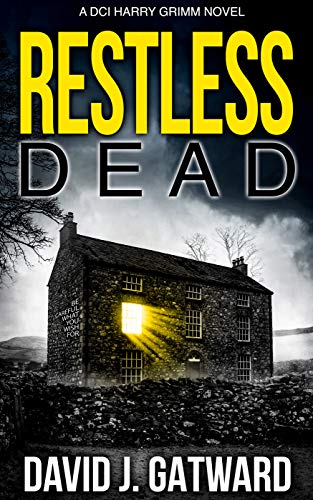
‘Restless Dead,’ by David J. Gatward

David J. Gatward’s Detective Chief Inspector Grimm series continues with Restless Dead. It’s a small mystery, the kind that couldn’t actually happen, in the same way, in an urban setting. But Harry Grimm, facially-scarred war veteran, is settling in in the relatively bucolic Wensleydale region, and in these parts they give the public more personal service than cops did back in Bristol.

Retired Col. James Fletcher is devastated by the death of his wife, killed in an auto accident while driving him home on his birthday, because he’d been drinking. Although his two daughters, his son-in-law, and his grandson have rallied around him, he’s profoundly depressed. Lately he’s started imagining he’s seeing his wife again around the estate (already rumored to be haunted); the family reports it to the police, who find no sign of an intruder. Col. Fletcher is not mollified, and things are about to get deadly.

Also, somebody is rustling sheep in Wensleydale, and the father of one of Grimm’s team members is a victim.

The Grimm series is semi-cozy and character-driven. I like it a lot (in spite of the injection of a “genuine” spiritualist). Restless Dead ends with a cliffhanger, but the major mystery was solved, and I look forward to the next book, coming in June.

“The Past Is Never as Past as We’d Like to Think”

A strength of Erin Bartels’s 2019 debut novel We Hope for Better Things is its main story hook in the race riot in 1967 Detroit. A generational family drama that touches on the American Civil War, obvert and subtle hatred of colored people, and interracial relationships naturally feels like a Southern novel–at least it does to me. Telling a well-researched story from her neck of the woods, the complicated city of Detroit, Michigan, helps balance the typical narrative by showing how Yankees contributed to the slave systems of Southern states.

The story begins in modern day Detroit with an ambitious reporter, Elizabeth Balsam, meeting with a man who wants to ask a favor of her. She might be interested, if there’s a good story in it, but she’s in the middle of a potentially explosive investigation that is taking just about all of her emotional energy and creativity. When her investigation actually explodes in her face, she considers helping the man and maybe saving her career. The favor means looking up Nora Balsam, whom Elizabeth discovers is her great aunt living about 60 miles north in Lapeer, which is about 20 miles outside of Flint.

Before we get too far into Elizabeth’s interaction with Nora, the story turns back to Detroit 1963 and a younger Nora Balsam, who is looking for artwork to but at an exhibition. Instead she meets a good-looking photographer named William Rich and struggles to make sense of one of his photos on display, that of her father angrily reaching for the cameraman. Being as wealthy as she is, Nora hasn’t met many genuine people, that is eligible, young men, so she finds William’s bold interest in her appealing. You might call his interest reckless, because he is black and she’s white.

Once we understand a little more about Nora, we are pulled back to Lapeer 1861, where Mary and Nathaniel Balsam have begun to establish their farm. Nathaniel feels compelled to join the Union army to fight for the abolitionist ideas they have long discussed. That left Mary alone and pregnant with two housekeepers to manage everything. Of course, Nathaniel thought he would be home in several months, but three years later he had only returned once for a few days on furlough. His decisions in the field changed his family far more than his absence–he sent runaway slaves to Lapeer for safe harbor.

These three stories are skillfully woven together, holding the narrative tension well. I remember another novel set in Mississippi that tells three, interrelated stories at once, one of the three being comparatively dull. I was on the verge of skipping a section out of interest for the other story threads. We Hope for Better Things is engaging throughout. Questions raised in one thread begin to carry into the next.

With the publisher being Revell, you may think Bartels had to write in some explicit preaching or Xian exposition, but her faith comes through more subtly than that, in the faithfulness of the story arc.

Photo by Camylla Battani on Unsplash

‘Basil’s War,’ by Stephen Hunter

In fact, in one sense, the Third Reich and its adventure in mass death was a conspiracy against irony. Perhaps that is why Basil hated it so much and fought it so hard.

First of all, I have to take back a criticism of this book that I made last night. I said I was reading a novella I’d read before, which had been simply re-titled. Now that I’ve completed Basil’s War, based on the novella Citadel, I see that it is in fact a full novel (though a short one for author Stephen Hunter). He took Citadel and added some new action (mostly at the end), and made the whole thing a lot more complex.

Basil St. Florian is a British SOE agent in World War II. Like the character in Beau Geste, he possesses almost no virtue save courage. He’s good at lying, stealing, killing, and seducing women. In ordinary civilian life, he’d probably end up in prison. But now, as a top field agent, he’s more likely to end up dead – and he isn’t greatly concerned about it.

In a secret war room under London, he gets briefed (by Alan Turing, among others) on his next mission (should he choose to accept it), which will involve making his way to Paris and into a museum library. There he is to photograph certain pages from a rare manuscript, which has been used as a “book code.” This code will identify a Russian agent in the Bletchley Park cryptography operation. There are reasons for this, but Basil’s job is to get to the book.

We follow Basil as he parachutes into France, steals false identity papers, bluffs his way through security checks, and generally stays one step ahead of the Germans – until he loses a step.

Basil is an interesting character to follow – he’s very good at his job, and more sympathetic than he probably ought to be, mostly because of his wit. The book is full of mordant observations on the nature of war and of warriors, plus the characters of the French and the Germans. (As well as intimate moments with Vivian Leigh.) The riddles within enigmas that unfold at the end are clever and surprising.

Stephen Hunter is a fine thriller writer, and I think most readers will enjoy Basil’s War. Cautions for mature material, but for a war story it’s pretty lighthearted.

A run of lackluster books and movies

My reading of late has been oddly frustrating. After a beautiful Syttende Mai (the Norwegian Constitution Day, on which I had a couple actual human interactions, both of them surprisingly pleasant) I’ve come up against a string of bum books.

First there was a novel from a series I hadn’t revisited in a while. I didn’t get far into it before I remembered why I’d stopped reading the books; I saw some ugly stuff coming and sent the whole thing into the virtual rubbish bin. Then I started a Christian novel that looked intriguing. I have an idea the story might well be worth reading, but the prose was so awful I gave up on that one, too.

Now I’m reading a new book by a favorite author, which turns out on closer inspection to be a novella. A novella I’ve already read. Re-released under a new title. I’m still reading, because it’s pretty good, but I’m a little bitter too.

I’m in the habit of watching old movies on Amazon Prime in the afternoons. Yesterday I saw “High Voltage,” which stars William Boyd (before he was Hopalong Cassidy) and Carole Lombard (in her first major movie role, before she added the “e” to her first name). It was a highly moral melodrama about bus passengers caught in a blizzard in the Sierra Nevadas, and ends with a repentant Boyd on his way to jail in St. Paul.

Today it was “The Naked Hills,” with David Wayne and Denver Pyle. This was a western with aspirations. Instead of the standard shoot-em-up, it’s a story about how greed destroys a man’s life. David Wayne, in a rare starring role, plays a man who grows obsessed with finding a fortune, in the 1849 Gold Rush and after. The message was commendable, but the story was one-dimensional, and the resolution anticlimactic.

What surprised me was the theme song. It’s a number called “The Four Seasons,” by Herschel Burke Gilbert and Bob Russell. I knew this song from before. I have blogged here previously about my fondness for the old “Yancy Derringer” TV series. During the series’ original run, it had its own title song, “The Ballad of Yancy Derringer.” But when it went into syndication, for some reason (probably having to do with copyrights) they changed it to an instrumental theme. And that theme was this same “The Four Seasons” melody. Only without the verses they use in the movie.

There are even lyrics, which somebody sings at the beginning. As best I remember, they go something like this:

We have four seasons, four seasons  
To make our dreams come true.  
God gives a man four seasons, that’s all that he can do.

I don’t know if that last “he” refers to God or the man.

Kind of depressing, actually. But I have an ear worm now.

And if you have to have an ear worm, it might as well be a song you like.

‘Shooting Season,’ by David J. Gatward

I read and reviewed the first three Inspector Harry Grimm novels previously, and liked them. Somehow the series fell off my radar. But I picked up the fourth book, Shooting Season, recently, and found it still worked for me.

Harry Grimm has a face that literally scares people – due to an IUD explosion during his service as a paratrooper. He was a detective in the city of Bristol, but was seconded up to rural Wensleydale in Yorkshire when the local inspector went on leave. That leave has been extended, and Harry is discovering he quite likes the place. He likes the fresh air, the scenery, and the people. His team (they have no actual police station, but operate out of the community center) is low-key but smart and professional, and they’ve taken to him.

Charlie Baker is a bestselling thriller writer, famously arrogant and hard to work with. Because his latest work is set in a shooting lodge in Yorkshire, his agent (and former lover) has set up a “shooting” (clay pigeons) weekend in the area. But at a kick-off bookstore reading, a fan stands up to accuse Charlie of using a ghost writer. What makes this even more awkward is that it happens to be true – Charlie’s “editor,” also visiting at the lodge, does in fact do most of the work. Also present are Charlie’s elderly accountant, his young female assistant, and a couple shabby-nobility hangers-on.

After the fiasco at the reading, Charlie gets more drunk than usual, and clashes with most of his “friends.” In the middle of the night he’s seen driving off, and the next day his body is found in a field near his crashed Porsche, his head literally blown off by a shotgun. At first it looks like suicide, but the mechanics of this shotgun make that impossible.

There’s no lack of plausible suspects, but everybody has an alibi. Inspector Grimm will need to do some heavy thinking on this one. But he’ll also need to think about his own greatest mystery – what to do about his criminal father, who killed his mother.

These books are pretty low-key, almost “cozy,” but with an edge. I like them a lot.