Category Archives: Fiction

‘Mercy,’ by Brett Battles

I’m a fan of Brett Battles’ novels about covert operations “cleaner” Jonathan Quinn, and the spin-off Night Man novels have been fun too. The Night Man is Nate, Quinn’s associate, who has taken up a sideline in his spare time – essentially being Batman. Along with his sort-of girlfriend Jar, an Asian woman on the Autism spectrum who does the computer stuff, he intervenes to help people who need help, but can’t be helped by the law. It’s nice, and his relationship with Jar is quite sweet. Nate is motivated to these actions by the voice of his ex-girlfriend, Lisa, who is dead. Nate doesn’t believe in ghosts, but the voice always seems to be right.

But I was a little disappointed with the latest Night Man book, Mercy. Because this one takes Nate and Jar out of their usual urban environments into American flyover country. And they don’t look good there – in my opinion – though I’m sure they see it differently.

The Cleaner team is on suspension right now, so Nate and Jar have more time for their vigilante activities. Unfortunately, those activities have begun to attract media interest, which they don’t want. So they decide to get a small Winnebago and take a road trip. Jar has never seen much of the US.

At the Grand Canyon, guided by Lisa’s voice, they hike along the edge of the Canyon and rescue a teenaged boy who is stuck on a ledge just below the brink. When the boy returns to his camper, he is cruelly punished by his father. Nate and Jar do not hesitate to make this guy their target, following the family to their home in Mercy, Colorado, planning to document his abuse and turn the evidence over to the authorities.

However, they soon discover that the man is involved in plenty of other shady activities. There’s a criminal conspiracy under way, and Nate and Jar are on it, whatever the danger.

The adventure in Mercy was up to Brett Battles’ usual high standards. What I didn’t like was Nate’s attitude. He looks at these small-town people and has nothing good to say about them. They’re too white, they use the wrong pronouns, they’re not worried enough about Covid masking. As a resident of the Midwest, I found all this condescending. Nobody in the town is depicted positively, except for the abused kids.

I won’t be boycotting Battles’ books, but I hope he sticks in the future to people he understands and can sympathize with.

‘Capital Murder,’ by Dan Willis

Book 7 in Dan Willis’s Arcane Casebook series is Capital Murder. Once again we join private eye/runewright Alex Lockerby as he fights the forces of evil in a magical 1930s America.

Alex has gotten pretty good at traveling by supernatural means, but only in one direction. Wherever he is, he can get home by opening a magical portal to his interdimensional vault, which opens into his home and office. But when his sometime boss Andrew Barton, the Lightning Lord of New York (who provides the city’s electricity through sorcery) wants him to accompany him to Washington DC, they have to take an airship.

Once there, Alex gets an appeal from the widow of a senator, who was recently murdered. She does not believe the man the police are accusing is really guilty. Will Alex investigate? Also a major gang leader wants Alex to locate his nephew, who has disappeared. On top of that, Alex is surprised to find that his sort-of girlfriend, sorceress Sorsha Kincaid, is in town investigating for the FBI, and she’s furious because the newspapers are giving Alex credit for her own successes. And you don’t want to see Sorsha angry…

Not highbrow entertainment, Capital Murder was an enjoyable read, like the other books in the series. We are also learning gradually more about a mysterious group called the Legion (biblical reference) which has some kind of malevolent plan to rule the world.

It was fun.

‘Blood Relation,’ by Dan Willis

As you know, I’ve been working my way through Dan Willis’s enjoyable urban fantasy series about New York Private Detective/Runewright Alex Lockerby in the 1930s. Book 6 is Blood Relation.

In this one, we find our hero definitely rising in the world. Instead of his seedy old office, he is now installed in luxury space in the Empire State Building, thanks to being on retainer to the Lightning Lord, the sorcerer who provides the city with electricity. Which means he keeps getting interrupted by problems at the transmitter, as breakers at the new Brooklyn station keep tripping for no known reason.

Meanwhile a woman mathematician has been found murdered, with clues leading to foreign espionage. And prostitutes are being murdered, their blood used in some kind of ritual Alex has never seen before. Plus, a mysterious wizard is playing a game of wits with Alex.

All in a day’s work. What I like about the series is its interesting characters and cheerful mood (in spite of the occasional horror). Theological objections are neutralized by the fact that Alex is a practicing Catholic. I could criticize the prose, which is pedestrian at best, and full of neologisms. No effort is made to evoke mannerisms from the period. And I’m less than enamored with Alex’s sweetheart, the powerful sorceress Sorsha Kincaid. She’s as strong a female character as any feminist could want, but she ends up being mad at Alex for one reason or another most of the time. I like a little more tenderness in relationships (probably one of the reasons I don’t have one of my own).

But the books are entertaining and undemanding. I’m staying with them.

‘Ocean Prey,’ by John Sandford

Novel title "Ocean Prey" distorted by water

“Is this gonna ruin my career?” Devlin asked.

“No, you’re too obscure to ruin. Get a few more years under your belt and a little more status, get closer to a pension, then you’ll be worth ruining. Ruining you now would be like shooting a squirrel and mounting its head. Nobody would be impressed.”

Lucas Davenport returns for the umpteenth time in yet another Prey novel, Ocean Prey. John Sandford’s hero is a millionaire, a former cop, a former agent with the Minnesota Bureau of Criminal Apprehension, and now a US Marshal. We’re told he’s fifty-two, but I’m pretty sure that means some time compression has happened – as is allowed in the world of fictional serial heroes. I think John D. MacDonald said he aged Travis McGee one year for every three in the real world.

In the ocean off Miami, the crew of a speedboat, interrupted while collecting something unknown from the ocean bottom, gets into a fire fight with the Coast Guard, killing two officers before escaping. They disappear without a trace, and police divers aren’t able to locate whatever it was they were looking for underwater. The case goes to the FBI, and when they can’t find any clues, they go to the US Marshals and their agency gunslinger – Marshal Lucas Davenport.

Lucas starts poking around, along with Bob, one of his regular partners. They begin making some connections, and then things go very bad.

That’s when Lucas calls in the big gun – his Minnesota friend Virgil Flowers (who doesn’t actually use guns much). Virgil is the perfect guy to go in undercover, after a crash course in deep ocean diving.

The Prey books pretty much guarantee a good read, and Ocean Prey did not disappoint. The characters are always intriguing, and nobody writes cop banter better than Sandford. Lots of action and suspense, with both heavy and light moments.

Recommended, with cautions for frank dialogue.

‘The Truth,’ by Peter Grainger

Cover of "The Truth" novel. White man's hand raised to shake hands with someone.

DC Smith is back. This is very good news. The hero of Peter Grainger’s low-key police novels, an inspector in a fictional town in Northumberlandshire, England, Smith was badly wounded a couple books ago. The series focus turned to younger detectives in a reorganized team. The next books were all right, but they weren’t Smith stories. Smith has retired now, but he’s fully recovered and starting to chafe at the inactivity. Even his live-in partner, Jo, thinks he needs to find something to do.

In The Truth, Anthony Hills, real estate broker son of Smith’s old desk sergeant, Charlie Hills, has been arrested. He bought a share in a luxury yacht, which turned out to be used for drug smuggling. Charlie retains a law firm to defend him, and they mention he might want to talk to a local private detective agency. That agency usually does cyber-investigation, but they’ve been thinking of taking on some shoe leather cases. And who better to handle such an investigation – just as a one-time shot – than DC Smith?

Private inquiry is a whole new world for our hero. He misses having police authority backing him up, but on the other hand he’s less tied down by regulations and paperwork. The case will involve a trip to Amsterdam entailing genuine danger of death, but in the end Smith will make the case. With a couple big surprises at the wrap-up.

Smith’s a great character, kind of a less scruffy Columbo. Small in stature and unprepossessing, he is in fact wicked smart and dangerous in a fight. He’s been one of my favorite fictional heroes for some time now, and it was a pure delight to see him back in action.

Recommended.

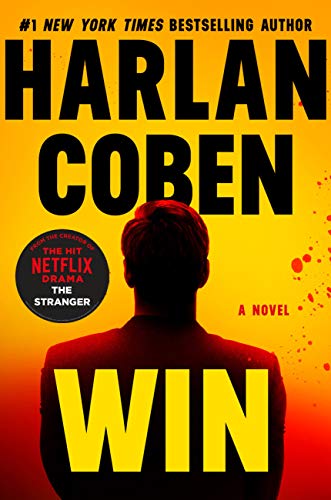
‘Win,’ by Harlan Coben

Cover of "Win" novel with sticker "From the creator of the hit Netflix drama The Stranger"

I realize that impersonating an officer is breaking the law, but here is the thing about being rich: You don’t go to jail for crimes like this. The rich hire a bunch of attorneys who will twist reality in a thousand different ways until reality is made irrelevant.

I like Harlan Coben (generally) as an author, and my perception of his Myron Bolitar novels was that I liked them too – though looking at my old reviews, I see that I cooled toward the later books. Too much political correctness had crept in. It looks like the Bolitar series is finished now (I’d forgotten that Coben married the character off in the last volume), but instead we’ve got a new series about his friend Win Lockhart. I’ve never liked Win much as a character, but for odd reasons I enjoyed the novel, Win quite a lot. And the nature of the main character kept the PC suppressed a bit.

Win Lockhart used to fill the niche in the Bolitar books that I’ve designated the “psycho killer friend.” In many mystery series, your rational, decent hero has a very dangerous friend he can call on when the bad guys threaten and the odds get long. Win was an eccentric example of the PKF. Born to an elite family, exclusively educated, small and effete-appearing, he is nevertheless a master of unarmed and armed combat, the kind of guy who can kill a man twice his size quickly, with his bare hands. I always found Win implausible and affected. But he worked better here, in the first person.

The police call Win to an exclusive Upper West Side apartment building, to a penthouse tower apartment. There, in a room with a murdered man, they have found two items long missing – a Vermeer painting that was stolen from Win’s family years ago, and a custom-made suitcase that once belonged to Win himself. How does Win account for that?

Win knows nothing about how the painting got there, but he had given the suitcase to Patricia, a female cousin of whom he is very fond. He doesn’t believe she murdered this man – whoever he was – but he’s not going to tell the police about it. He’ll investigate the matter himself.

His investigation will take him into a maze of old secrets, secrets related to radical antiwar violence of the days of Vietnam, and dark family secrets that Win thinks he knows about – but does not. Yet.

In the Bolitar books, Win was always presented as a kind of psychopath whose only true relationship was with his friend Myron . Which I found unpersuasive. In Win, presented in the first person, we get further inside him. He proves to be a man of (relatively) normal empathies who was traumatized as a child and whose emotional energy has been diverted into strange channels. This works better for me, though I’m still not sure it’s entirely plausible.

The plot has multiple resolutions, some of them morally problematic. But they satisfied me as a reader.

Also, the author had a chance to trash evangelical Christians, and chose not to. I always appreciate that.

Cautions for the usual stuff.

Stay Safe, Okay? Safer than You Are Now

In First Things, Sohrab Ahmari describes a 1995 movie that looks like a commentary on 2020.

Safe with Julianne Moore and Xander Berkeley tells the story of a woman who has closed herself off from those around her. She comes to believe she is allergic to the modern world and, if not already, at least on the verge of becoming desperately ill. She takes refuge in a kind of spiritual camp in the desert to help keep the world away.

Ahmari describes the message of the camp: “Things are getting better out there in the dangerous outside world, thanks to ‘workplace sensitivity training’ and ‘multiculturalism,’ but meanwhile, the patients must avoid all risk, must remain at the center, and must avoid negative thoughts.”

Because we can control our world, if we only remain aware of it and ourselves. We can survive by receiving positivity and blocking out germs and whatever else the environment has to kill us.

Carol begins the movie in an alienating gated community—and ends it even more alienated, eventually in a literal safety pod. Rather than face the social-structural crises head-on—crises rooted in our modern obsession with individual mastery and autonomy—the safetyist “cure” requires an even more aggressively individualistic vision. As [Director] Haynes himself told an interviewer in 2015, “isolation becomes the problem and the answer to the problem.” 

‘Look Down,’ by Ed Church

Cover of "Look Down" novel saying back of soldier facing empty street and crumbled house

The third entry in Ed Church’s promising Brook Deelman police series is not strictly part of the series, but a novella giving us some background on Brook’s best friend, Welsh-born detective “Jonboy” Davies. Look Down is a flashback to 2004, when Jonboy served as a Royal Military Police investigator in Kosovo. Jonboy is leading a team of four Ghurkas, plus an attractive woman interpreter. Their task is to examine houses destroyed in a massacre, documenting the damage. But as they survey one particular village, people talk about the “red house” down the street, which was hardly damaged. When Jonboy and the team knock on the door and ask to look around, they find it inhabited by a number of soldiers, who tell them they’re not welcome, and this house is none of their business.

Later, Jonboy speaks with a local blind man, who tells him cryptically that if he wants the secret of the red house, he needs to “look down.”

What Jonboy and his team eventually discover is shocking, shameful, and a potential political bomb.

Look Down was a pretty good read. Jonboy is an appealing character, and the mystery is compelling. Also, we’re reunited at one point with an intriguing character from the first book, a mysterious assassin called “The Tourist.” The Tourist is trying to work out his personal karma by killing a few people whose absence will improve the world, and he seems to be the instrument of whatever force of fate is in charge of this particular fictional universe.

Recommended.

‘Probably Dead,’ by Ed Church

Cover of "Probably Dead" with side of woman in leather jacket looking at street protest

There’s a famous curse, known well to authors, that goes with the second novel. Too often, the second novel isn’t quite as good as the first. This shouldn’t be surprising. A first novel is often the product of years of loving rewriting and polishing; the second book is often written under a deadline.

I praised Ed Church’s first Brook Deelman novel, Non-Suspicious, to the skies. The second in the series, Probably Dead, is not (in my opinion) as good. But the first book was unusually good, so Number Two is still worth reading.

Probably Dead finds London police detective Brook Deelman on a “career break,” touring his home continent of Africa. In South Africa he happens on a bar being robbed, and helps the owner stop the criminals. The grateful owner befriends him. He’s an old London cop himself, he says. He left the force after his daughter disappeared – probably dead according to investigators – after participating in a riot in the 1990s. He’s almost apologetic as he shows him his copy of the police file – could Brook look into the case, when he gets back?

The next day the bar owner is dead – likely suicide, like his daughter – and Brook heads back to the big city, feeling some kind of obligation.

His first stop is to visit an old retired cop in a recreational center. The man seems strangely secretive and hostile. As he’s driving away, Brook is stopped by a policeman, who then searches his vehicle and “finds” drugs. This could mean the end of Brook’s career, and even time in prison.

But Brook barely thinks about that. What he’s mostly thinking about is how mad he is, and how no policeman should use his power that way.

There will be consequences.

There was nothing really wrong with Probably Dead, except that it failed to match the tight plotting and surprises of the first book. Also the villain was pretty one-dimensional. There was a possible hint of politics too, but not too heavy for me to bear. I’m staying with the series for the present.

The running theme of these books seems to be some kind of cosmic balance – something like fate, or possibly even God. There’s a palpable frisson for the reader when fate is revealed. That’s fun.

‘Missing Amanda,’ by Duane Lindsay

Cover of "Missing Amanda" novel showing big city traffic at night

Lou Fleener, a private eye in 1950s Chicago, is the hero of Duane Lindsay’s comic novel, Missing Amanda. Lou is not prepossessing in appearance – short, dumpy, and balding. But he’s actually the next thing to a superhero. He’s almost impossible to beat in a fight. It’s something he was born with – lightning reflexes, an uncanny ability to anticipate his opponents’ moves, and a skill for turning any odd object at hand into a deadly weapon. He’s Jackie Chan before there was a Jackie Chan.

He also has ethics. So when he gets a visit from thugs representing Duke Braddock, one of the city’s gang bosses, who wants to hire him, he turns them down flat – then hurts them when they try to get tough.

Braddock responds by doing an end run on him. He goes to Lou’s best friend, Monk. Monk is tall and handsome, but socially inept. He’s also depressed, missing the daughter his ex-wife took away in their divorce. So he’s a sucker for Braddock’s sob story about how his little girl Amanda was kidnapped – certainly by one of his gangster rivals. He needs Monk to persuade Lou to find out who’s got her and rescue her.

And, by the way, he’ll kill Monk if Lou refuses.

So, against his best instincts, Lou starts poking around. Soon he’s got various mobsters mad at him, and he’s figured out that Braddock never had a daughter. It was all a scheme to start a gang war and get his rivals to kill one another off. Rubbing Lou and Monk out along the way will be just a detail.

Lou is angry. He knows how to fight, and Monk knows how to strategize. Together (along with a blonde they pick up along the way) they begin a big operation to bring everybody down.

They may not survive, but they’re gonna have a whole lot of fun.

My nutshell reaction to Missing Amanda was, “It would have been better as a movie.”

I can’t really complain about the story. It kept me reading, and it had many amusing moments. Also some heartwarming ones. But the plot maintained a level of implausibility that struck me as more suitable to the screen than the printed page. I was never able to quite suspend my disbelief.

Also, there were a couple hints of politics – not many, but enough to be annoying. And some anachronisms, especially in language and slang.

Still, I was reminded of Donald E. Westlake. A lot of people like Westlake more than I do. If you’re a Westlake fan, you might enjoy Missing Amanda very much.