The other day somebody on F*cebook shared a fine article on J. R. R. Tolkien from the archives (2002) of Touchstone Magazine. It’s about love and happens to have been written by Dale Nelson, a Tolkien scholar and a close personal friend of mine:
Tolkien told one of his sons about his young love for Edith in a letter, written after her death. “I met the Lúthien Tinúviel of my own personal ‘romance’ with her long dark hair, fair face and starry eyes, and beautiful voice” in 1908, when he was 16 and she was 19. Very soon after they married, he was captivated by his wife’s dancing, for him alone, when he was an army officer on leave from the Great War, in 1917, and they slipped away to “a woodland glade filled with hemlocks” in Yorkshire. And that moment was the origin of the myth of Beren and Lúthien, Tolkien wrote to another of their sons.
I’m not a big fan of modern wizard books (you may have noticed I failed to succumb to the charm of Jim Butcher’s Dresden novels) generally, but someone suggested I check out Dan Willis’s Alex Lockerby novels. I read the first, In Plain Sight, and found a lot to like.
Alex Lockerby is a private eye/rune writer in 1930s New York City, but in an alternate universe. In this universe, magic substitutes for science. Pretty much everything runs on electricity, and the electricity is provided by a small number of great sorcerers, who are the plutocrats of the day (Rockefeller is one of them). Rune writers like Alex are far more common, doing smaller-scale magic at various levels of expertise.
One day a beautiful young woman comes into Alex’s office to ask him to locate her brother, who has disappeared. He was a rune writer too, and she fears he might have gotten into magical trouble he couldn’t handle. Alex takes the job, and falls for the girl.
Meanwhile, a personal tragedy strikes, in the form of the mysterious deaths of a number of people in a church homeless mission, including the priest. That priest was the man who raised Alex, and the police (reluctantly) allow him to consult on the case. He lends his expertise to the hunt for a secret journal belonging to Leonardo Da Vinci, rumored to contain a few complex runes that would give their owner almost unlimited power – power for which certain foreign agents are hunting.
I liked In Plain Sight much more than I expected. It transposed a lot of good old hard-boiled tropes, and there was a pretty neat surprise at the end, involving a major character. The tension with Christian theology that tends to go with books about magic is softened here by the fact that Alex is close to a Catholic priest who has no objections. Apparently the rules are different in this universe. Here magic is like science, and spiritual beings don’t seem to come into it.
If you like urban fantasy and hard-boiled mysteries, In Plain Sight is a pretty fun way to spend your reading time. Recommended.
The second offering in Mark Pryor’s Hugo Marston series, about a US embassy security head in Paris, is The Crypt Thief. I liked it, but not as much as the first book.
On summer night in the famous Pére Lachaise cemetery, near the grave of Jim Morrison, a young couple is shot to death. One of them is an American man from a prominent family; the woman is a dancer who turns out to have connections to a suspected terrorist. It is also discovered that a grave has been robbed – part of the skeleton of a famous Paris dancer has been taken. Where others see a terrorist act, Hugo Marston, whose background is in criminal profiling, sees the grave desecration as the central point. He suspects – and fears – that this may be the beginning of a string of serial killings. Since he’s the hero, we know he’s going to be right.
Once again Hugo is joined by his CIA friend Tom (who is showing troubling signs of a serious drinking problem) and his girlfriend Claudia, a plucky reporter with (as is common in fictional females) no rational sense of danger whatever.
This story didn’t work for me as well as The Bookseller. I thought it fell into a lot of common thriller tropes. The serial killer was certainly an original type, but extreme; I had trouble believing in him. And I’m a little weary of stories where the hero is sure he has to rush into danger personally, because the police don’t understand the truth the way he does.
But it wasn’t bad. I’ll still continue reading the series. Cautions for very disturbing subject matter.
You’ve likely seen other bloggers writing about the first time they read Lord of the Rings. It seems appropriate to treat Dune the same way. With a new movie adaptation coming up (though I usually don’t see movies until months after they release, if then), I wanted to read the book that’s been sitting on my shelf a while.
I didn’t know anything about the world of Arrakis beyond a few images from the 1984 movie. Having reviewed a bit of the trailer from that movie, I don’t think I’ll spend any more time on it. I watched Zardoz as an impressionable youth. I don’t need anymore rank garbage like that.
I’ve just learned there are 19 books in the series and apparently more on the way, but only six of them are by original author Frank Herbert, so I doubt I’ll make it through even that many.
What I’ve read so far is book one of three in the original book. It’s a great part one, ending on a cliffhanger after all the foreshadowed conflict has crashed on the beach, leaving readers to wonder what happens next.
That foreshadowing though. Granny telling Little Red Riding Hood not to stray from the path easily sets up the idea that she will at least be tempted to stray. But Herbert doesn’t foreshadow as much as foretell. The narrative doesn’t stick to a single point of view but flits between characters, sometimes only for a moment, revealing their hidden motives. I thought I would hate it after a while, but I didn’t. Herbert’s style carries the story pretty well, but I have to wonder why he felt the need to quickly reveal this or that betrayal, when half the time it could have remained unsaid or supposed by one of the two especially perceptive characters.
“He nodded. ‘Of course.’ And he thought: If only there were some way not to do this thing that I must do.“
Well, for starters, you could consider avoiding loud whispering that everyone can hear.
That doesn’t touch on the quotations from backstory books that begin each chapter, saying one character is super, super bad or another one is going to die later on. No spoiler alert labels either. The main thing these quotations communicate is that Herbert is working on something of epic length. This won’t wrap up soon, gentle reader; note the gravitas of Princess Irulan’s history.
Despite this, I found book one to be compelling. The gifted, young Paul Atteides, only son of Duke Leto and his mistress Jessica, is remarkably perceptive, asking serious questions an adult should ask. His father works hard to gain and sustain loyal for his royal family, and he has a measure of success, but it becomes plain (that foretelling again) that the deck is stacked against him. A gifted observer or historian may be able to critic the Duke’s decisions and point to critical weaknesses or failures, but the story reveals a man who is trying to do his level best.
While reading, I thought I would see far more similarity to Star Wars, but so far the two stories are not alike. Paul is not some untrained kid hoping to get off his desert planet, and while the Empire is in the background and doesn’t look too good, it isn’t hunting down rebels. The story pits two ruling families against each other with a third, not-entirely-neutral party, a labor union that’s so large it could be an empire of its own. Add to this the free tribes of Arrakis, whom the Empire calls Sand Pirates (not at all like Sand People or Jawas).
I look forward to the rest of it and maybe even a sequel.
Harry Starke is a high-end private eye working in Chattanooga. (No doubt Phil Wade has run into him). Son of a successful personal injury lawyer, he works out of a nice office and owns a beautiful home. He’s dating a woman police detective. As Harry Starke, the first book in this series begins, he watches a beautiful young woman flee a couple of tough guys in a seedy bar, tries to rescue her as she flees over a bridge on the Tennessee River, and watches helplessly as she plunges to her death.
In the tradition of fictional private eyes, he immediately vows to find out who’s responsible for her death. The girl turns out to be the daughter of a prominent surgeon, who immediately hires him to investigate. With the help of his highly competent staff (though he does the dangerous stuff alone, of course), and in cooperation with Kate, his police squeeze, he follows the clues to the offices of a local drug dealer, who appears suddenly more prosperous than he should be, and a corrupt local politician. With occasional stops to investigate a secret sex club.
Harry Starke kept me reading to the end, but I didn’t really like it a lot. It seemed superficial to me, assembled from shiny parts like a TV series pilot, with nothing behind the facades on the set. I especially thought Harry’s relationship with Kate, the cop, was implausible. Would any real-life police department allow a private operator whom a detective was dating to consult on a case and run around with her, chasing suspects?
The language, I should note, was fairly clean for this kind of novel. There were several sexual encounters, but they weren’t described explicitly. However, there was one sexual moment that was just creepy for this reader. It was that creepy moment, though not that moment alone, that decided me that I probably won’t be investing in any more Harry Starke books.
Outside the car’s window Paris flashed by, the sluggish river Seine appearing and disappearing beside them, seeming to slow their progress with her magnetic pull, a seductress winking through the plane trees, teasing them with glimpses of her silvery skirts, and with the threat of more death, more bodies hidden within their deadly folds.
Along the river Seine in Paris, there is a class of booksellers known as bouquinistes, occupants of much-coveted stalls. Hugo Marston, head of security for the US embassy, is fond of browsing their offerings, and has made particular friends with an old man named Max. As The Bookseller opens, Hugo asks Max for something special, out of his private stock – a conciliatory gift for his girlfriend, who recently abandoned him and returned to the US. Max offers two rare books – an Agatha Christie first edition, and a rare copy of the poet Rimbaud. Before he leaves, Hugo witnesses Max being bullied by a thug, who forces him down to the river bank. Max is shoved onto a boat, and Hugo is unable to do anything to prevent it. When he reports the abduction to the police, they seem uninterested – and quickly drop the investigation.
Meanwhile, Hugo discovers that the Rimbaud book is an extremely rare signed copy, worth hundreds of thousands of euros. Why did he sell it to Hugo for less than a thousand? Was he trying to send a message, leave some kind of clue behind? When Hugo learns that Max was once a Nazi hunter, and when other bouquinistes start turning up dead in the river, Hugo begins his own independent investigation. His friend Tom, a CIA operative, comes along to watch his back and help out with the rough stuff. And Hugo meets a charming female journalist with a shocking secret.
The Bookseller was a first novel for author Mark Pryor, and for my money it was a home run. (Our commenter Paul alerted me to it.) The writing was superior, and I liked the characters very much. Hugo and Tom have great rapport, and they’re fun to watch in action. I look forward to reading the next books in the series.
The usual cautions for language are in order. Some time is spent on Hugo’s agnosticism, but he himself is forced to admit occasionally that it’s inconsistent with his actual life experience.
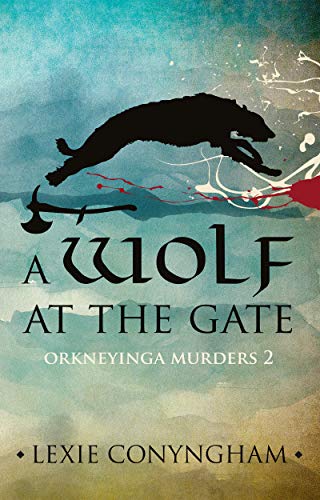
I was pretty happy with this book at the beginning – A Wolf At the Gate, by Lexie Conyngham, offered pretty good prose, along with evidence of some serious research on Viking Age life. But as I read on, I grew less happy with it.
Ketil, the apparent hero of the book, is in the service of Earl Thorfinn of Orkney (which sets the story in time a little later than my Erling books). Ketil generally operates outside of Orkney, and he’s about to sail away, but the earl calls him back to investigate a murder. Ketil solved a previous killing for the earl, so he’s assumed to be good at that sort of thing.
Secret murder is rare among the Norse, and this murder is all the more puzzling because the victim, a man in the earl’s service named Steinar (recently back from Colonia in Saxony, which I take to mean Cologne) seems to have been universally liked. He was a devout Christian, rather strict about church rules, but harsh only with himself. Someone split his skull with an axe in front of his own house.
I said that Ketil was the apparent hero of this book, because he is in fact just the Inspector Lestrade here. The real detective is a woman named Sigrid, a childhood friend of Ketil’s who now lives as a widow in Orkney. She was the one who actually solved the previous murder. Gradually she and Ketil renew their friendship – there’s some suppressed attraction there, but both of them deny it. Together they consider the multiple puzzles that face them – does the murder of a man just back from Colonia have anything to do with the fact that an abbot from Colonia is visiting the island? Does someone covet Steinar’s beautiful wife? Or was the killer Ketil’s follower Lambi, who seems to be a sneak thief?
The further I read in this book, the more disappointed I grew. First of all, the characterizations were fairly flat, especially the male characters. Author Conyngham seems to have a problem I’ve often noticed in books by women – she doesn’t get men at all. There’s a famous line (unjust but funny) in (I think) the movie, As Good As It Gets, where Jack Nicholson, asked how he writes women so well says, “I think of a man. And I take away reason and accountability.” Conyngham writes men by thinking of a woman, and taking away any clue.
Also, the story began to bore me. Although the plot gets sweetened by further murders, I never felt any sense of urgency, any idea that great things were at stake.
Also, the narrative falls into what I believe to be serious factual falsehoods about the Christian church. It’s not an anti-Christian book as such, since most of the serious Christians are depicted sympathetically. But the author states and reiterates – and this is a major plot element – that the Catholic church denied baptism to the children of slaves, and to deformed babies.
I had never heard of this before. It entirely contradicted my own understanding of the matter. Now maybe author Conyngham, whose biography says she’s a historian, knows something I don’t know. But my online searches find documentation directly contradicting these contentions.
On the issue of slaves, this article from Christianity Today, by Rodney Stark, is behind a paywall. But the passage I need is right there above the barrier — “That the Church willingly baptized slaves was claimed as proof that they had souls, and soon both kings and bishops—including William the Conqueror (1027-1087) and Saints Wulfstan (1009-1095) and Anselm (1033-1109)—forbade the enslavement of Christians.”
I also found numerous references online to the historical fact that the early Christians made it a practice to hunt through the dumping sites where the Romans – quite legally – habitually discarded their unwanted babies. The Christians would baptize these infants, adopt them, and raise them in the church. One of the primary excuses the Romans gave for “exposing” babies this way was that they were born deformed.
So in the end I was both bored and irritated by A Wolf At the Gates. Too bad. It showed promise.
Interesting concept. Over the top execution. That’s how I’d describe Stuart Doughty’s The Art of Danger, first book in his John Kite series.
John Kite is a former London policeman, now working as an investigator for an insurance company that writes policies on objects of art. What no one knows is that John Kite is not his real name. He has a secret history, a former life from which he has cut himself off completely.
The theft of an obscure painting by a middling German Renaissance painter wouldn’t appear to offer any major challenges. But when John shows up with the ransom money to buy the painting back for its owner, no one meets him. Instead, someone gets killed, and John is plunged into a convoluted mystery involving Middle Eastern terrorists and an English public relations guru. John doesn’t know how a forgettable, not-at-all-priceless portrait could relate to the World Cup finals in Qatar. But he will learn the truth, even if it takes high-speed car chases and a helicopter pursuit.
John Kite is an interesting character, and art crime is an intriguing field for mystery fiction. John’s gradual revelations of his past, and the surprising things he himself learns, were strong plot elements. I felt the second half of the book lost credibility though, as the author resorted to high-speed chases right out of a Hollywood movie to tie up his story with a bang.
Through the window of his taxi, he watched rain-streaked red sandstone tenements drift past, the colour leeched from them somehow by lack of light, like watching a black-and-white movie of his childhood spool by.
Peter May excels at creating interesting protagonists for his novels. He’s given us another winner (at least for this reader) in John Mackenzie, hero of A Silent Death. Mackenzie is a policeman with issues – highly intelligent but utterly lacking in interpersonal skills. Kind of like Monk, or Cumberbatch’s Sherlock Holmes (in fact, Cumberbatch would be a good casting choice if this book is ever filmed). He made himself unwelcome at the Metropolitan Police, and now works for the National Crime Agency, not a step up career-wise.
It’s as much to get rid of him as anything else that his boss sends him to Spain, to collect a criminal being extradited. Only when he arrives, he finds that the criminal, a murderer and drug dealer named Jack Cleland, has escaped. This fact is of particular, urgent concern to Spanish officer Cristina Sanchez Pradell, who is tasked with meeting and escorting Mackenzie. Jack Cleland blames Cristina for the death of his fiancée, and has vowed to take his revenge on her – by targeting her husband, her son, and her blind-and-deaf-aunt, Ana.
As Mackenzie applies his considerable brain to the problem of where Cleland might be hiding, Cleland kidnaps Ana. Surprisingly, an odd relationship gradually rises between the two outsiders, as Mackenzie also learns a few things about being human from Cristina.
Silent Death was engrossing, poignant and exciting. I rate this book very high. Occasional references to religion are not positive, but are fair from the characters’ point of view.
I recently reviewed a novel that I found a little difficult to read. Blake Banner’s Immortal Hate was not like that at all. It was fast and easy and very quickly finished. Popcorn reading, well done according to its kind.
Harry Bauer, hero of Immortal Hate and the other books in the Cobra series, is an international assassin working for the customary shadowy international organization. His brief is to eliminate the worst of the worst monsters in the world. He’s good at it, and remorseless.
“The worst of the worst” certainly applies to General Kostas Marcovic, fugitive Serbian warlord, who was guilty of one of the greatest atrocities in the recent Balkan troubles. Now he’s been identified as living under a pseudonym on the Caribbean island of St. George. Harry’s orders are simple – go in, kill the man (make it look like an accident if possible) and leave without making a fuss.
That, however, is not Harry’s style. On the ferry to the island he meets Helen, an attractive woman who runs a bar on the island. Helen senses that this is a dangerous man, and sets about enticing him to help her friend Maria extricate herself from the affections of a local drug lord. Harry is in no way reluctant to help out – he has a particular hatred of drug merchants – but Helen is not prepared for the swift and ruthless way Harry will go to work.
But that’s just the beginning. It turns out there are two old Serbians living on the island, and each claims the other is the real Marcovic.
On top of that, there’s a hurricane coming.
Over the top, lightning-paced and morally problematic, Immortal Hate was the equivalent of a Hollywood action movie. I enjoyed it, but I’m not entirely proud of myself for it.
Websites store cookies to enhance functionality and personalise your experience. You can manage your preferences, but blocking some cookies may impact site performance and services.
Essential cookies enable basic functions and are necessary for the proper function of the website.
Name
Description
Duration
Cookie Preferences
This cookie is used to store the user's cookie consent preferences.
30 days
These cookies are needed for adding comments on this website.
Name
Description
Duration
comment_author
Used to track the user across multiple sessions.
Session
comment_author_email
Used to track the user across multiple sessions.
Session
comment_author_url
Used to track the user across multiple sessions.
Session
These cookies are used for managing login functionality on this website.
Name
Description
Duration
wordpress_logged_in
Used to store logged-in users.
Persistent
wordpress_sec
Used to track the user across multiple sessions.
15 days
wordpress_test_cookie
Used to determine if cookies are enabled.
Session
Statistics cookies collect information anonymously. This information helps us understand how visitors use our website.
Google Analytics is a powerful tool that tracks and analyzes website traffic for informed marketing decisions.
Used to monitor number of Google Analytics server requests
10 minutes
__utmb
Used to distinguish new sessions and visits. This cookie is set when the GA.js javascript library is loaded and there is no existing __utmb cookie. The cookie is updated every time data is sent to the Google Analytics server.
30 minutes after last activity
__utmc
Used only with old Urchin versions of Google Analytics and not with GA.js. Was used to distinguish between new sessions and visits at the end of a session.
End of session (browser)
__utmz
Contains information about the traffic source or campaign that directed user to the website. The cookie is set when the GA.js javascript is loaded and updated when data is sent to the Google Anaytics server
6 months after last activity
__utmv
Contains custom information set by the web developer via the _setCustomVar method in Google Analytics. This cookie is updated every time new data is sent to the Google Analytics server.
2 years after last activity
__utmx
Used to determine whether a user is included in an A / B or Multivariate test.
18 months
_ga
ID used to identify users
2 years
_gali
Used by Google Analytics to determine which links on a page are being clicked
30 seconds
_ga_
ID used to identify users
2 years
_gid
ID used to identify users for 24 hours after last activity
24 hours
_gat
Used to monitor number of Google Analytics server requests when using Google Tag Manager
1 minute
_gac_
Contains information related to marketing campaigns of the user. These are shared with Google AdWords / Google Ads when the Google Ads and Google Analytics accounts are linked together.
90 days
Marketing cookies are used to follow visitors to websites. The intention is to show ads that are relevant and engaging to the individual user.
A video-sharing platform for users to upload, view, and share videos across various genres and topics.
Registers a unique ID on mobile devices to enable tracking based on geographical GPS location.
1 day
VISITOR_INFO1_LIVE
Tries to estimate the users' bandwidth on pages with integrated YouTube videos. Also used for marketing
179 days
PREF
This cookie stores your preferences and other information, in particular preferred language, how many search results you wish to be shown on your page, and whether or not you wish to have Google’s SafeSearch filter turned on.
10 years from set/ update
YSC
Registers a unique ID to keep statistics of what videos from YouTube the user has seen.
Session
DEVICE_INFO
Used to detect if the visitor has accepted the marketing category in the cookie banner. This cookie is necessary for GDPR-compliance of the website.
179 days
LOGIN_INFO
This cookie is used to play YouTube videos embedded on the website.