Category Archives: Fiction

Reading Report: ‘The Fellowship of the Ring,’ by J.R.R. Tolkien

He thought he had come to the end of his adventure, and a terrible end, but the thought hardened him. He found himself stiffening, as if for a final spring; he no longer felt limp like a helpless prey.

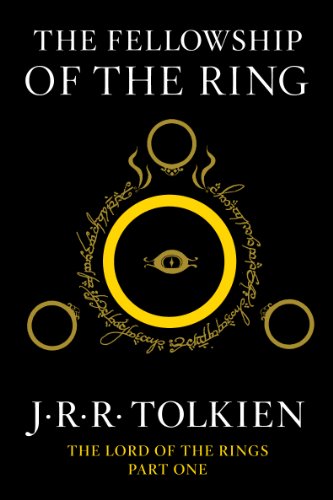
This quotation, concerning Frodo Baggins in the Barrow Downs, from The Fellowship of the Ring, seems to me a good epitome of what I’ve found in my current reading of the Lord of the Rings

Actually, the thought was mainly inspired (to my shame, I suppose) by watching the movies twice through recently. I’ve found them inspirational as I wrestle with my Work in Progress. It’s a remarkable thing, as I see it, that in spite of the movie industry’s well-earned notoriety for messing with original sources, the Peter Jackson movies managed – overall – to preserve the heart of the story. Even though most of the people involved must surely have been a thousand miles away from Tolkien’s beliefs.

Anyway, what struck me as I watched and read was this. It hardly needs saying that we’re in perilous times. I never thought I’d live to see a day when I worried about the breakdown of civil society and the loss of our republic, but such things don’t seem unthinkable now.

I’m not a man known for confidence and courage. I reserve heroism for my books. I know heroism when I see it, and I salute it from a safe distance. I’m pretty sure that if the day comes when I must raise my sword in defense of my rights, I’ll probably trip over the scabbard.

But it occurred to me that maybe this isn’t the end. That’s the thing about stories.

In every good story, there comes a moment when the main character thinks the tale is told – and that he’s lost. A moment when his strongest instinct is to lay his weapon down and surrender.

But that’s not really the end, in a good story. It’s only the Final Crisis. It’s the hero’s test. The climax is yet to come – and at the climax, the hero either triumphs or fails in a way that means something.

So this is my message. Not the message of a prophet, or the son of a prophet, but of a storyteller.

This isn’t the end. It’s the crisis. Hold on. Carry on doing your service, at the station where God has set you. As Sam Gamgee said:

“It’s like in the great stories, Mr. Frodo. The ones that really mattered. Full of darkness and danger, they were. And sometimes you didn’t want to know the end. Because how could the end be happy? How could the world go back to the way it was when so much bad had happened? But in the end, it’s only a passing thing, this shadow. Even darkness must pass. A new day will come. And when the sun shines it will shine out the clearer. Those were the stories that stayed with you. That meant something, even if you were too small to understand why. But I think, Mr. Frodo, I do understand. I know now. Folk in those stories had lots of chances of turning back, only they didn’t. They kept going. Because they were holding on to something.”

‘Beren and Luthien,’ by J. R. R. Tolkien

Tevildo however, himself a great and skilled liar, was so deeply versed in the lies and subtleties of all the beasts and creatures that he seldom knew whether to believe what was said to him or not, and was wont to disbelieve all things save those he wished to believe true, and so was he often deceived by the most honest.

I’ve long cherished a great fondness for Tolkien’s tale of Beren and Luthien, which impressed me long ago when I read the Silmarillion. And of course, it’s referenced often in The Lord of the Rings. So before I moved on from The Hobbit to the Trilogy, I thought I’d read the (fairly) recent book devoted to that story.

It wasn’t entirely what I expected. It’s sort of a scholarly exercise. In it, the late Christopher Tolkien, the author’s son and literary executor, traces the development of the story through various stages in the collected manuscripts, where it is altered in numerous ways. There are surprises. For instance, an early version of the story has as one of its major villains a great cat called Tevildo (see quotation above), who lives in a castle and serves the evil Melkor. In later versions, Tevildo would be replaced by a great magician who would in time become the Sauron of the Trilogy.

I think we may deduce that Prof. Tolkien was not very fond of cats.

Those who find Tolkien’s work lacking in female heroes need to read Beren and Luthien. Although Beren is a doughty hero, he also seems to be headstrong to point of stupidity. And the two great crises in the story both involve Luthien rescuing him.

I was, frankly, looking for something more like a straight narrative when I bought this book. I’m not enough of a Tolkien scholar to linger happily forever over details of composition and myth-building.

On the other hand, I’d never encountered the words “inexaggerable” and “quook” (past tense of quake) before, so the reading was not without surprises.

The tale of Beren and Luthien was a central matter in Tolkien’s life’s work. If I understand the story correctly, it went back to his attempt to immortalize the day when Edith Bratt danced for him in the woods and he fell in love forever. In a sense, he built all Middle Earth as a kind of ornate setting for the jewel of that memory.

Beren and Luthien is recommended for those who can never get enough Tolkien. If you’re looking for a less strenuous approach to the story, you might just read The Silmarillion.

Oh yes, it has Alan Lee illustrations, so it’s got that going for it.

Piranesi and the Big House

Susanna Clarke, author of Jonathan Strange and Mr. Norrell and The Ladies of Grace Adieu, has just released a new novel, named after the Italian artist of architecture and imagination Piranesi. An example of his work is the feature image in this post.

Piranesi lives almost alone in a labyrinthian house with flooded basements, countless statues, and skeletons lying about. He moves about observing everything and occasionally talking to the one other man in the house, who isn’t as interested in the things he is.

The Idle Woman finds it thrilling. “Susanna Clarke’s long-awaited new novel transports us to an extraordinary world and poses a question: How can we understand and rationalise our world when we can’t escape it? Dream, reality and perception tremble on the brink in one of the most original novels I’ve ever read.”

Read a excerpt from chapter 3 at Tor.com.

Reading report: ‘The Hobbit,’ by J.R.R. Tolkien

It was a terrible battle. The most dreadful of all Bilbo’s experiences, and the one which at the time he hated most—which is to say it was the one he was the most proud of, and most fond of recalling long afterwards, although he was quite unimportant in it.

Recently I watched the Lord of the Rings movies (extended versions, of course; not the Hobbit films). And whenever I do that, it comes into my mind that I need to read the books again. Christopher Lee read them once a year, after all. I’m far behind that tally. So I pulled out The Hobbit, to begin the journey.

I’ll confess that at first I thought it kind of elementary. It is a children’s book, after all, and sometimes the author talks down to his audience.

However, it grew on my mind as I read that this book (along with the Trilogy) can be viewed from the perspective of veteran’s literature (I’m not a veteran, I hasten to note; but it’s something I can be aware of). When Tolkien tells us, again and again, that Bilbo wished himself back in his cozy hobbit hole, “not for the last time,” he’s conveying the feelings of the soldier at war. Not long ago, he was comfortable in his rooms at Oxford, eating well, cared for by servants, keeping regular hours. Now he’s slogging through mud or crouched in a flooded trench, struggling with boredom or dreading going “over the top.” Thoughts of home flood in; they are a torment and a comfort all at once.

And by the end of the book, I must confess, I had to blink back manly tears. I was moved.

The Hobbit is a great book. But you knew that.

‘Lucky Draw,’ by Mark Stone

When I reviewed Mark Stone’s novel Lucky Break, first in his “Lucky John” series, the other day, I said (in so many words) that the book was slight, inconsistent, but rather fun. Having read book number two, Lucky Draw, I think I’ve had enough. It’s possible to be too slight.

“Lucky John,” the hero, is John Lucky, a former soldier and trucker who won the lottery and moved to Bonita Springs, Florida. He gets involved in investigating crimes, largely to keep himself occupied. In Lucky Draw, he’s hired to board a casino ship and participate in the world’s top poker tournament, in order to recover sensitive data that’s a threat to national security. He goes in accompanied by the girl who bought his winning lottery ticket, and they are soon surrounded by danger and betrayal.

The Lucky John books show strong signs of being written fast and not proofed for consistency. For instance, in the first book we were told John won the lottery in Iowa, and then he went on to tell people it wasn’t Iowa, but Indiana. Now we’re told it was in Illinois. I don’t think the author cares much.

The action is frequent and implausible, and in one scene I had no idea what was going on – the description didn’t make any sense to me. There was a nice moment when John counsels a young man to avoid pornography, but overall the story was long on fistfights and shootouts, and short on characterization.

It was fun for a while, but I think I’ve had enough now.

‘Nothing But the Blood,’ by S. D. Thames

Recently, a friend reminded me of my review, some years ago, of A Mighty Fortress, the first book in the Milo Porter mystery series by S. D. Thames. I had lost track of this author, so I checked to see if there were more books. And there is one. Nothing But the Blood was published in 2017. I note that there have been no further Milo Porter books. I hope the author hasn’t given up, because he writes my kind of story.

Milo Porter is a Gulf War veteran who now lives in Tampa and works as a private investigator and process server. He suffers from PTSD, which expresses itself in bad dreams, (possible) hallucinations, and risk taking. He’s a Christian, as are most of his friends, who are also (including his girlfriend) mostly weight lifters. Milo is a pretty good lifter himself, and has just set a record. During the big lift, he sees a vision of blood and of his personal guardian angel.

That vision motivates him to take a job he’s offered the same day. A representative of a major league football team hires him to watch a young player whom they plan to select in the upcoming draft. Milo encounters surprising hostility from the player and his entourage. But then the player dies in a highly suspicious weight lifting accident, and Milo finds a new client and a new challenge – to unravel a complicated, ruthless conspiracy of fraud.

I enjoyed Nothing But the Blood a little less than A Mighty Fortress, probably because the pro football world doesn’t interest me a lot. But I was again impressed with the author’s professional prose, good characterization and plotting, and skillful manner of incorporating Christian faith into a (mostly) realistic story. I recommend Nothing But the Blood, with the caution that this isn’t a Frank Peretti book. Which, from my point of view, is a good thing.

‘Lucky Break,’ by Mark Stone

I sometimes joke about the infinite number of fictional detectives today who live on a Florida beach, in emulation of John D. MacDonald’s Travis McGee. And yet they never do seem to run out. My latest discovery is the Lucky John series by Mark Stone, of which the first installment is Lucky Break. “Lucky John” is actually (if improbably) named John Lucky. A former soldier and over the road truck driver, he rescued a girl in a truck stop from a robber one night. In gratitude, she made out a lottery ticket for him using her phone number. The number was drawn, and John Lucky suddenly had more money than he’ll ever spend. (He did give the girl a piece of the prize.)

Having no real roots or family of his own, John decides to move to the place he liked best of all the places he’s ever visited – Florida. He buys a house in Bonita Springs, with his amiable buddy Davey, who seems to have been born to be a sidekick. Before long they’ve found a new favorite bar together, and shortly thereafter John defends the attractive bartender from her angry ex-husband. This leads to a complicated (and implausible) adventure in which John finds himself suspected of murder before uncovering and thwarting a diabolical revenge plot.

Believability isn’t a big consideration in Lucky Break. Details are contradictory, and extreme, movie-style dangers come at our hero rapid-fire. There is little time for meditation on life. The book is a fast read that probably didn’t take long to write.

But I kind of enjoyed it. Lucky John is a likeable hero, and the general mood is sunny, which is nice for a change. I bought the second book.

‘The Framed Father,’ by J. R. Mathis

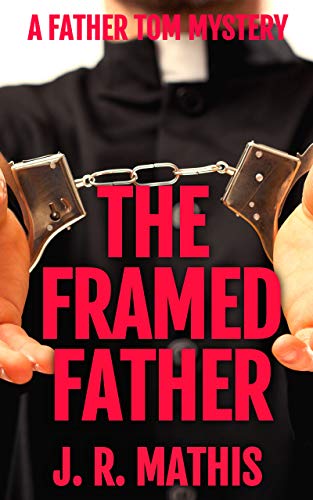
In the second book of the J. R. Mathis’s Father Tom mysteries, The Framed Father, our hero is called back to the town of Myerton, Pennsylvania, where he recently solved the cold case murder of the woman he was married to before he became a priest. He left the parish in the hands of Father McCoy, a callow young priest who seemed the most innocent and inoffensive of men. But accusations have reached the archbishop that Father McCoy has been carrying on with his attractive administrative assistant. So Father McCoy is sent off into retreat, and Father Tom must take over at St. Clare’s once again. But when scandal turns to murder, Father Tom will again team up with Helen, his ex-fiancee, now a police detective (who is improbably open to amateur help) to try to save the young priest’s name and liberty.

I reviewed the previous book in the series, The Penitent Priest, as morally upright and well-composed, but weakly and improbably plotted. I thought The Framed Father somewhat better. There are still too many coincidences, but I didn’t guess the solution this time.

No bad language, heavy violence, or sex scenes to caution you about. Matters of the Catholic faith are treated seriously, and there are good depictions of crises of faith. Father Tom is a little too much the intuitive detective for my personal taste, but the book wasn’t bad.

‘The Penitent Priest,’ by J. R. Mathis

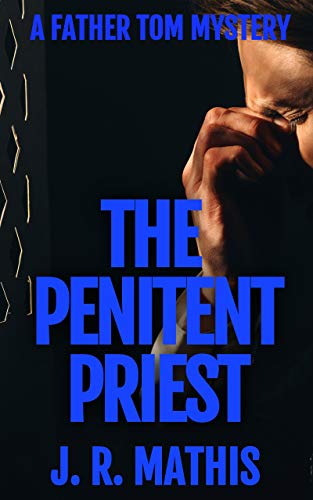
I probably wouldn’t have purchased J. R. Mathis’s mystery novel The Penitent Priest if I’d noticed that its tagline said “A Clean Murder Mystery.” (Puts me in mind of the old joke about “a nice old-fashioned murder with no immorality in it.”) When the first recommendation a book offers is its lack of dirty words and sex scenes, it’s not usually a guarantee of literary quality. But The Penitent Priest turned out better than I would have expected.

Father Tom Greer came to the priesthood late in life, after the murder of his beloved wife. So he’s somewhat nervous when the archbishop assigns him to temporarily replace the parish priest at St. Clare’s in Myerton, Pennsylvania. Myerton is where he lived as a married man and buried his wife, and where he abruptly left a number of old friends when he dropped out of sight afterwards. So he has some personal fences to mend.

But when an unseen stranger tells him secrets no innocent person should know in the confessional, Father Tom knows he has the opportunity to finally identify his wife’s killer. But he’ll also have to face his own fears and guilt.

I was impressed with the writing in The Penitent Priest. You rarely run into a novelist these days who can parse a decent English sentence and spell words right. The plotting, unfortunately, was less wonderful. As is not uncommon among starting authors, author Mathis has laid on too many coincidences. Why should the archbishop assign Father Tom to precisely this parish, considering his personal history and the fact that he’s still a person of interest in his wife’ murder? And is it really likely that the woman to whom Tom was engaged before he met his wife should show up as a police detective here?

Also, the big surprise at the end of the story might as well have been printed on the title page in big red letters.

But because I liked the writing, and because Father Tom is a good character, I bought the sequel.

William Gillette as Sherlock Holmes

https://youtube.com/watch?v=eFYd-Ip5kUI

What we have above is a genuine treasure of Sherlock Holmes lore. The original popular image of Sherlock Holmes came from Sidney Paget’s illustrations for the Strand Magazine in London (bald, long nose). But in American magazines, the foremost illustrator was Frederick Dorr Steele, who based his image on the handsome actor William Gillette, who played Holmes more than 1,300 times on stage in a play he wrote himself. Steele’s Holmes largely superseded Paget’s as the popular image of the great detective.

In 1916, Essanay Studios of Chicago filmed the play (with additions), and Gillette played the role yet again. This historic film was long believed lost, but in 2014 a print was discovered in France. This version had been released as a serial for the French audience, and included extra material not found in the American version. This French version has been splendidly restored, and the dialogue cards have been recreated using Gillette’s script. The orange and blue tinting is original.

Artist Paget bestowed Sherlock Holmes’ deerstalker cap on him, but it was Gillette who gave him the curved calabash pipe, which did not wiggle so much when the actor talked. I hadn’t heard about the re-discovery of this film, and am still astonished I can see Gillette himself in the role.

Like many an aging actor before and since, he’s playing younger than his actual age, with a love interest about old enough to be his daughter.