What would you do with omnipotence? What would you do if the universe had collapsed around you, everyone and everything had died, and you were now the omnipotent being who could put something back together again?
That’s the question in the final collection of issues in Jonathan Hickman’s lengthy story of Avengers, Illuminati, alien doomsdays, and multiversal collapse. (Finally, the end! See all previous posts by searching for Jonathan Hickman or other tags to this post.)
At the end of Time Runs Out, the Illuminati team run out of options and devised a lifeboat that they hoped would save enough people to restart the human race, if that chance ever presented itself because they weren’t equipped to recreate anything. The man who was equipped for the task was the Fantastic Four’s arch-rival Victor von Doom. You could say he was in the right place at the right time.
With the help of Doctor Strange and The Molecule Man (who were with him at the aforementioned right time), he pulled together as many fragments of the multiverse as he could or wanted to into a small, planetary reality lamely called Battleworld. What I read in this Secret Wars collection is the metanarrative that holds many other stories together. I had thought to say the world wasn’t filled with battle and you could hardly call what happens here a secret war, much less wars, but I didn’t read the many other issues tied to this this set. Who knows what madness ran around in its diapers over there?
But here Doom, having reconstructed bits and pieces of Earth and the known universe, reigns as a god. He seems to have gotten everything he’s always wanted–worship, unbridled power, and Susan Richards, his enemy’s wife. But after a few years, scientists discover a lifeboat ship and Thanos and his crew are onboard.
The story works, and I’m glad it’s over. The only unsatisfying part of the conclusion for me is the complete avoidance of the rebirth and reconciliation of Captain America and Iron Man. Since so much time was spent on them in the third act, I thought Hickman would bring them into the fourth act. But the story shifted to the Fantastic Four characters, which was compelling on its own, and the inclusion of two Spidermen added a nice spice.
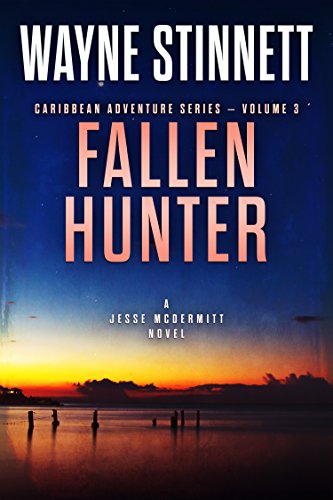
Saying that a series is losing my interest is not precisely the same thing as saying it’s lost its way. I have definite (and limited) tastes; lots of books that don’t interest me have wide and enthusiastic followings. So what I’m about to say about Wayne Stinnett’s Fallen Hunter shouldn’t be taken as a condemnation.
Series hero Jesse McDermitt is back on his private little island as Fallen Hunter begins. He’s still recovering from a personal loss, but now he feels ready to start engaging the world again. A friend’s wife tells him of a problem in her family. Her father, a shrimp fisherman, has gotten himself into trouble. He agreed to make a few deliveries for a drug smuggler to get his business over a tight spot, but now he wants out and the smugglers won’t let him go. In fact, they’re talking about more dangerous goods.
Jesse arranges to take over the shrimping operation for a while, presenting himself as an enthusiastic scoundrel eager to play ball with the smugglers. Then he learns that the “more dangerous” cargo they’re talking about is armaments for a terrorist group. That sends Jesse to his covert operations buddies, and they draft a plan to stop the terrorists.
In his spare time, Jesse meets an attractive local woman and begins dreaming of a new future.
My personal problem with Fallen Hunter was that it shifted the series (not surprisingly, in light of the previous book) into military thriller territory. As a large number of fighting men (and women) converge on Jesse’s island and start doing their operational stuff, I began to grow bored. That the second half of this book consisted largely of people pretending to be on a diving vacation, doing rather languid tourist things while waiting for the action to start, did not increase the suspense.
I was also annoyed, as before, by Jesse’s over-willingness to confide in people he hardly knows. And the final climax of the book was pretty melodramatic.
Still, I like the character enough to give him another chance. I’ll probably read the next book. But not right away.
I wanted to give you a thoughtful reaction to Ralph Ellison’s unfinished work, Juneteenth, at the appropriate time of the year, which is now, tomorrow being June 19, the day commemorating the announcement of the abolition of slavery in the States. But I couldn’t wade through it, only getting halfway. It’s a rambling novel that probably is best read in the company of well-read and thoughtful friends. Maybe, as you can tell from my recent posts, I’ve slouched away from that mindset.
“Ha, Bliss, so you remembered Eatmore, Old Poor John. Now that there was a great preacher. We did our circuit back there. Revivals and all. Don’t laugh at fools. Some are His. Holy, Holy, Holy, Lord God Almighty. Which of Eatmore’s did you preach ’em, Bliss? Which text?”
Dreamily the Senator smiled. “They needed special food for special spirits, I preached them one of the most subtle and spirit-filled–one in which the Right Reverend Poor John Eatmore was most full of his ministerial eloquence: Give a Man Wood and He Will Learn to Make Fire . . . Eatmore’s most Promethean vision . . .” Hot here.
The story focuses on Senator Sunraider, quoted above, and the man speaking to him, a preacher and father figure named Hickman. In the beginning, Hickman and forty-three black men and women arrive in Washington hoping to meet with the senator for a few minutes, but he doesn’t give them that moment over the next two days. Then he is shot from the gallery while giving a speech.
I believe the rest of the novel is spent running memories through the Senator’s mind while Rev. Hickman is talking to him beside his hospital bed. Calling him Bliss, the name he’d given him as a child, Hickman remembers long sermons and revival meetings he did with the senator as a pre-teen. Bliss would be carried into meetings in a white coffin and wait for the right moment in Hickman’s preaching to rise up with his little, white Bible and preach with him in heart-tugging drama. It scared the boy and thrilled the crowd.
At another time of their lives, they went from town to town trying to sell the idea of a movie that showcased the town’s best qualities. Bliss was a young man then and naturally he discovered young women everywhere he went.
The reverberating tone in what I read points toward the senator, though himself a white man who has argued against black American equality in public life, understanding that his black heritage has formed him as a man and an American. No matter what he wants to believe, he has been shaped by black hands and black, American grassroot experiences.
In the introduction, John Callahan, who edited the draft that become this book, writes, “On many levels Juneteenth is a novel of liberation . . . Ellison, who took part in more than one ‘Juneteenth ramble’ as a boy in Oklahoma, speaks of false as well as true liberation and of the courage required to tell the difference. Even in the face of deepest betrayal, Hickman keeps his word to stand by Bliss, although the little boy is now contained within the frame of a man whose public words and deeds repudiate Hickman’s acts of kinship and fatherhood.”
It’s tough reading and maybe there are or should be better novels to capture this idea of liberty for all of us, but I’d sooner say I’m just not the right reader for this novel at this time.
Aside from reading mysteries, I’ve also been watching several old B movies on Amazon Prime. This is my futile strategy for avoiding total despair. If the end is coming, I want it to catch me totally unprepared. Why should I perish all stressed out?
Anyway, I caught this old stinker, The Mystery of the 13th Guest. It stars an actor named Dick Purcell, who delivers probably the best performance of the film, which tells you nothing at all. He would later distinguish himself, sort of, playing Captain America.
The premise is that old Grandfather Morgan, 13 years ago, gathered his relatives and a couple close associates in his home, arranging them around the big dinner table. There were 13 places set, but only 12 people present. He tells them that he plans to leave his entire fortune to his granddaughter Marie, the only one of the lot who’s worth a plugged nickel. She’s only eight now, but he has entrusted his will to his lawyer, for Marie to open when she turns 21, 13(!} years from now.
Right on time, Marie arrives at the gloomy old mansion on her 21st birthday, and finds the electricity is still hooked up and the phone still working. She finds the table arranged just as it was 13(!) years ago. Then there’s a murder, and soon Private Eye Johnny Smith (Purcell) is on the case, dashing through hallways and secret rooms, running rings around the police.
What was awful about this film? The writing was terrible. The dialogue was awkward, and it got no help from the wooden actors.
The dumbest thing, however, was the portrayal of the police. One understands that every Sherlock Holmes needs a plodding Lestrade to show off against. But these cops belong in a home for the mentally deficient. If they’re the best brains on the force, the uniform guys must have trouble getting their pants on in the morning. The senior member of the team (played by Tim Ryan (also the main writer), a classic mugger who married Irene Ryan, best known as Granny Clampett on The Beverly Hillbillies) thinks he’s smart, but he’s really in awe of the amazing Johnny Smith. His subordinate, played by Frank Faylen (later Dobie Gillis’s father on TV) is barely sentient and keeps dozing off. Fortunately, Johnny is good buddies with the District Attorney, so he just takes over the investigation. And they let him. He even orders patrol cars dispatched, and the police hop to obedience.
Terrible movie. Just the thing to transport me to a simpler, less judgmental time, and give me a short respite from the Apocalypse.
You’ll like it, if you have sarcastic friends to watch it with, and do an MSTK3000 treatment.
Great! Walk away! It doesn’t matter. You’ll be back.
But make sure when you do come back–because you need me–that it’s on your knees. Both of you! Repentant!
Because I can’t save any of you, unless you realize that you need saving! And that I’m the only one on this entire planet who can do it!
In my last post on this apocalyptic Avengers series, Captain America went on a series of time jumps that appeared to clarify his moral compass. “I rescue the helpless. I raise up the hopeless.” That’s what he said. That’s what Captain America said.
And someone said to him that Tony Stark had caused a universal load of trouble for everyone and needs to be stopped.
The next set of issues, Avengers: Time Runs Out, Volume One, the story picks up eight months later, so yeah, a few gaps in the story would be fine. But why does Steve Rogers look thirty or forty years older and appear to have handed the mantle of Captain America to Sam Wilson (who is seen more on the character list page than any panel)? How did Thor lose his arm and what is this about being unworthy to wield Mjölnir? Did Bruce Banner take his own multiverse trip and bring back an alternate version of himself? As a casual comics reader, this is off-putting (there are other off-putting things I won’t mention).
The story told over this four volume collection doesn’t follow a linear pattern, which is mostly good. When you have so many characters doing so many things, it’s normal to tell the story slant with some flashbacks and revelations from conversations you didn’t see the first run through the timeline. Threats are reexamined and mysteries explored by characters revisiting what they understand and seeing it in new light. Hickman has an interesting, spralling story here.
But Steve Rogers is labeled the good man and life; Tony Stark is labeled the monster, death. And Rogers spends 90% of his time hunting his former friends and wanting to beat an apology out of Stark for lying about the end of the world. Stark is blamed for corrupting all reality and lying to the other Avengers that they had a chance to save Earth. “You knew we were all going to die!” Rogers charges him. “Say it! You lied about that and everything.” At one point, Rogers says that bringing the Illuminati team to justice was more important than anything else, completely forgetting that they would need to act when another planetary incursion comes. A little later he accused them of doing nothing over the last eight months to save the planet.
Of course, they had been knocking out various impossible things every day before taking an early lunch. That and running from their friends.
The story doesn’t run out at the end of Time Runs Out, Volume Four. No, sir. It just keeps going. Which is good in one sense, because the heroes had run out of options and everything actually dies. But I was left asking where was the man would not entertain necessary evils, who was committed to saving as many people as he could? When they learned of great cosmic destroyers–Rabum Alal, the Ivory Kings, the Mapmakers, and the Black Priests–how could they set that aside to blame everything on Tony Stark?
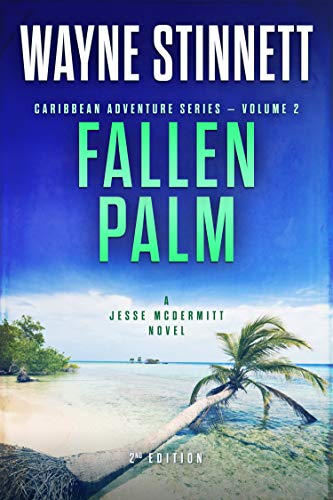
The second book in Wayne Stinnett’s Jesse McDermitt series was actually the first one published. I think there are some signs in Fallen Palm that the author is not yet completely sure of himself, but it’s nevertheless a pretty good story.
Jesse, retired Marine sniper, is living a solitary life on his private island in the Florida Keys, fishing, diving, and taking occasional charter jobs with his fishing boat. Jesse gets a visit from the son of the Marine who trained him and had been his good friend. His father, says “Deuce” the son, drowned while diving. Which makes no sense. He was too good and careful a diver to have gotten into that kind of trouble. He had been diving with a young partner, and that partner turns out to have sinister connections. Then Deuce tells him he’s part of a very hush-hush commando unit fighting the war on terror. Later (in the kind of coincidence that author Stinnett is prone to) that mysterious diving partner turns up in a terrorism probe. On top of that, Deuce’s boss in Washington very much wants to recruit Jesse for their unit.
Meanwhile, a fascinating woman, a fellow fishing professional, comes into Jesse’s life and touches him in a way he has not experienced in many years.
Fallen Palm is an enjoyable story, though I’m not sure Jesse’s character has been fully developed yet. I’m particularly troubled by Jesse’s approach to security – he reveals his secrets too easily, I think. And a shocking event at the end was no surprise to me at all.
Oh yes, Jesse gets a dog in this one. That part worked really well.
Recommended. I don’t recall if there was offensive language or not, so it can’t have been too shocking. Attitudes toward sexual morality and marriage are thoroughly secular.
I like stories about boats on the ocean. Not boats on lakes, which are commonplace where I live, but boats on the deep sea. Perhaps it’s an atavism out of being descended from Norwegian islanders, or more likely it’s just a quirk. In any case, such stories make me feel good. Bernard Cornwell used to write such books, but they didn’t sell, certainly not like the historical novels he moved on to.
I also miss John D. MacDonald and his Travis McGee series. I’m always looking out for a new McGee substitute; nobody quite fills the bill. But Wayne Stinnett’s Jesse McDermitt gives me some of the same vibe.
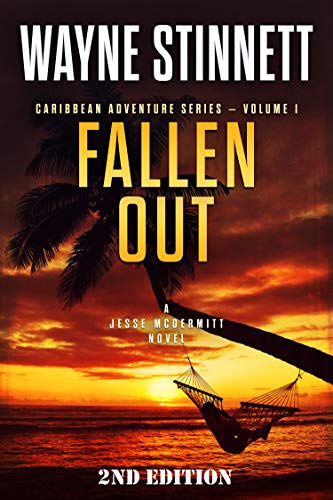
Fallen Out is the prequel (now the first volume) to the Jesse McDermitt series of thrillers. As it opens, we observe Gunnery Sergeant McDermitt retiring from the Marine Corps. He has a fair amount of money from an inheritance, but is unsure what to do with himself. As he notes, his chief job skill is killing people from up to a mile away.
But he has an old Marine Buddy running a bar in the Florida Keys, and he heads south to see him. While he’s visiting, someone mentions being a fishing charter captain to him. On a whim, he purchases a very nice, large boat, complete with souped-up motors, confiscated from drug runners, at a government auction. He also buys a very small island, planning to build a home there. Soon he’s becoming part of the Conch community, and enjoying his new life. Except that, sometimes, he misses the action.
Then one day he and a friend rescue a couple women from a group of men he suspects might be human traffickers. In time he becomes close to one of them. Then he and some of his friends move their boats into a river mooring to ride out a hurricane. And the traffickers show up again.
Fallen Out wasn’t great literature, but it was a fun story which I enjoyed a lot. Pure entertainment reading. And a very satisfying climax. I recommend it. Cautions for language and adult themes.
Father and son parted with little love between them. Many wished him a good voyage, but few a safe return.
I figured you were ready for a break from James Scott Bell novels, so I picked up an Icelandic saga I hadn’t read in a long time – Grettir’s Saga, (also known as The Saga of Grettir the Strong). My overall reaction is that I see why it’s generally listed among the great sagas, but it’s great in a different – and less interesting to me— way than some of the others.
Grettir is famed as the greatest Icelandic outlaw, because he lasted twenty years as a fugitive, longer than any other. As I’m sure I’ve mentioned before, outlawry in Iceland meant just that – being placed outside the law. Any man could kill you without breaking the law, and it was a crime to help you.
Grettir was the son of a farmer named Asmund, and distinguished himself from his youth by his unusual size and strength. His reported behavior at that stage – which strikes me as more historically reliable than a lot of stuff in this saga – shows him as not particularly admirable. He is a bully. He pushes people around and feels justified in taking their stuff, because he can get away with it.
In the saga story, the great decisive moment in his life is when he subdues and “kills” a ghost. If you’ve read my novels, you know that a Norse ghost wasn’t like our kind. They weren’t incorporeal wraiths. They were more like the Walking Dead – made strong by evil magic, and invulnerable. The only way to “kill” them was to cut off their heads.
Grettir challenges and kills a terrible ghost named Glam. Before his demise, Glam places a curse on Grettir – great bad luck and fear of the dark, meaning he needs company at night. One detects – possibly – a hint of what we’d call PTSD here. For the rest of his life, as Grettir puts it, “I can no longer live alone even to save my life.”
On a voyage to Norway, Grettir kills (accidentally, he claims) some Icelandic enemies. Coming home to Iceland, he finds himself outlawed. Thereafter he is dependent on a few people powerful enough and friendly enough to him to defy the law by providing him hiding places.
Eventually, accompanied by his brother Illugi and one slave, he takes up residence on an island called Drangey, where his hilltop refuge can only be reached by a ladder. In the end, just at the point where his “sentence” has reached its maximum length and would have become void, he and Illugi are killed in a treacherous attack.
I do not like Grettir’s Saga as much as I like several of the other major sagas, like Egil Skallagrimsson’s or Laxdæla. The magical quality I find in those tales, that of revealing interesting personalities whom the reader feels he gets to know a little, is completely lacking here. Grettir is a stock hero performing stock heroics in a stock story. The value of this account, I would guess, is largely in its displaying so many classic saga elements all in one place. The episodes of the story which show what I would guess to be somewhat true historical events, are fairly sordid and show Grettir in a bad light. The other episodes, where he fights all kinds of berserkers, monsters, trolls, ghosts, and witches, are boilerplate, set pieces that can be inserted into any saga when the story needed some action. (One even detects elements from Beowulf in one adventure.) His death is blamed, not on the fact that he’s fighting with a gangrenous leg, but on witchcraft. Even Grettir’s dialogue is unoriginal – all saga heroes deliver “one-liners” from time to time, but Grettir’s are mostly just traditional proverbs.
The saga writer gives one very interesting explanation why this story was found particularly worthy of preservation. Grettir, he says, is the only Icelander whose death was ever avenged in Constantinople. The last chapters tell the story of a brother of Grettir’s, who runs into the man responsible for his death while serving in the Byzantine Varangian Guard, and carries out a successful plan to even the score.
I was not very happy with this particular translation, which I bought for my Kindle and read this time. I’m not entirely sure which translation it is – it says Penguin Classics, but Penguin published two (is it pirated? I don’t know). As a translator myself, I found it often too literal. Many lines seem to be translated almost word for word, and the reader is expected to guess the meanings of the idioms. Even I had trouble figuring them out sometimes. And odd word choices were made – like translating “ghost” as “spook.” I can understand it in a way – they’re probably translating an Icelandic root to the current Norwegian word “spøkelse,” which does mean ghost. But “spook” in English lacks the gravity appropriate to the context.
Grettir’s Saga is worth reading for the serious saga fan, but I’d recommend reading others first. And get a different translation.
Talent pushed us toward Softness. Genius pushed us toward Hardness. John Dewey and the first progressive educators, the apparat of men and women who put together and extended the Social Security program, were people of talent who persistently and effectively Softened the Hard America of Theodore Dreiser.
I read an interview with Michael Barone in World magazine, focused on his latest book on party politics. I’ve wanted to learn more about the shifting history of U.S. political parties. It’s commonly said that Lincoln was a Republican, and the GOP has been holding a stained but righteous banner ever since, that Democrats don’t care for civil rights unless they can make political hay out of it (Bull Connor and his ilk were the ones opposing Martin Luther King way back when).
But it’s also common to hear that the parties have shifted, so I wanted to read a solid overview about some of that history. How America’s Political Parties Change (and How They Don’t)sounds like a good bet. I have yet to read yet, however, because my library system doesn’t have it. They had another book that was not about politics but about the character of our nation, which I put on hold many long, COVID-ridden weeks ago.
Hard America, Soft America: Competition vs. Coddling and the Battle for the Nation’s Future asks how a country that expects so little from its teenagers can send young men and women who are barely older into battlefields as hardened soldiers. The troops in Iraq, he says, were impressively well-trained and equipped to handle the dangers around them. How could American schools produce people like that?
He explores this idea over 150 pages, describing conditions in twentieth century America and how leaders acted and reacted to make life harder or easier on Their people. The quote above refers to life in Chicago as depicted in Dreiser’s Sister Carrie. That was Hard America; eighteen year olds had to get a job and pay the rent or lose themselves in a gutter. There was little margin for idleness. It was arguably too hard. Men who made their fortunes building railroads and industries did so by grinding up men who had few choices. They paid their communities back with great philanthropy from which we still benefit today: medical research, libraries, and museums. “These men felt a responsibility to use a large part of their wealth to benefit their fellow citizens, but they wanted to maintain the Hardness of America, which they believed was responsible for the countries great economic growth and creativity.”
Barone describes hardening or softening of different segments in our society, the intent of these efforts, and whether they paid off. Hardening generally means accountability and potential for achievement, the hard work and risk that goes into the wheel of progress to make a great, big, beautiful tomorrow. Softness means the lack of accountability, which may be the security to enjoy simple life but could also mean low standards and few achievements.
For example, at one point, economists believed three big players could drive the U.S. economy forward indefinitely. Business would do the work, Labor would oversee the prosperity of the workers, and Government would regulate and protect the field where all of this could take place. Competition? Who needs it? When the free market eventually found paths to American consumers, the big three were shocked (and slipping into bankruptcy).
With nationwide protests taking over our news channels, you may have seen images of George Romney at a civil rights march in Detroit in 1967. Barone touches on that time in his book; he was an intern with the mayor. Romney was governor of Michigan in July 1967 when Detroit suffered a week of riots. The local police couldn’t handle it, but the mayor feared the National Guard would make things worse. Romney and everyone with him were reluctant to call President Johnson for federal troops. What can of worms would be opened by inviting the U.S. military to handle local problems? So they tried the softer approach, just one act among many at a time when Americans all over the country “no longer felt morally justified in imposing hard penalties on crime.”
“But while the civil rights movement had sought to allow blacks into Hard America, the new public policies actually confined more Americans, black and non-black, into a Soft America where poverty and crime were chronic.”
Now we have much harder responses to crime and in some ways harsh reactions. We’ve condoned the brutal treatment and killing of civilians who have been merely accused minor offenses. The other day four officers stood on the edge of a lawn next to their cars, pistols drawn, confronting a pleading young man who had rolled through a traffic light. George Floyd was killed while being arrested for using a fake 20. Breonna Taylor was killed when officers raided the wrong apartment to conduct a warranted search at 12:30 a.m. These are serious problems, but perhaps more serious is the reluctance to reform from public officials.
Barone’s book shows that time and again methods for handling problems have unintended results, sometimes saving us from bad ideas, sometimes rolling in a new wave of grief.
Perhaps you’ve been wondering what I’ve been thinking about the recent tragic events that began in Minneapolis.
I’ve been reluctant to talk about it. Frankly, I’ve just been hunkered down, “sheltering in place,” as the saying goes. I’ve reduced my talk radio listening, because it’s just too sad and depressing. I’ve buried myself in light reading, which is why I’ve been doing so many book reviews lately.
I’ve actually seen none of the rioting. Property destruction was centered in the southern inner city, far from my home. Some damage has been reported in a suburb north of me, but the boarded-up store windows I’ve seen personally have been precautionary.
But the area of main damage in Minneapolis, around the intersection of Hiawatha Avenue and Lake Street, was my old stomping grounds. I lived in that area for much of my twenties. Not only am I familiar with some of the destroyed businesses, I even remember what businesses were there before them. Spent a lot of time waiting for buses around there, back before I owned a car.
The most famous casualty for readers is of course Uncle Hugo’s Science Fiction Bookstore. Uncle Edgar’s was its twin, serving the mystery market. Uncle Hugo’s was not only a cultural landmark but one of the seedbeds of the whole Fandom movement.
I wasn’t a regular customer at Uncle Hugo’s, but I’d been there a number of times. I participated in a book signing there once (that was where I met Lois McMaster Bujold).
And it was there I had gone way back in 1984, flush with the excitement of my first commercial short story sale, to Amazing Stories. I asked the owner to order me extra copies so I’d have a stock to give away (I wasn’t aware I could order them from the publisher – that’s how green I was). When I went to pick them up, he asked me to sign a couple copies he’d ordered for himself – “So I can show them to people when you’re rich and famous.”
If those copies still existed, they’re ashes now.
Another loss – not burned but trashed – was a local Scandinavian meat market and gift shop. I bought stuff from them every year. I think I won’t provide their name here, since I assume they’re ELCA Lutherans and wouldn’t care to be associated with me. But they’d been on Lake Street since the 1920s, back when the place was thick with Scandinavian immigrants. Over the decades, through multiple population changes, they’d stayed committed to the neighborhood.
No good deed goes unpunished, as the saying goes.
When the George Floyd tape was first released, I was horrified. But I also thought – just for a moment – that this might bring us all together, in common outrage.
Instead it gave a golden opportunity to the neo-Maoists.
Pray for us. Especially for the poor who, as always, pay the highest price for the ideological games of intellectuals.
Websites store cookies to enhance functionality and personalise your experience. You can manage your preferences, but blocking some cookies may impact site performance and services.
Essential cookies enable basic functions and are necessary for the proper function of the website.
Name
Description
Duration
Cookie Preferences
This cookie is used to store the user's cookie consent preferences.
30 days
These cookies are needed for adding comments on this website.
Name
Description
Duration
comment_author
Used to track the user across multiple sessions.
Session
comment_author_email
Used to track the user across multiple sessions.
Session
comment_author_url
Used to track the user across multiple sessions.
Session
These cookies are used for managing login functionality on this website.
Name
Description
Duration
wordpress_logged_in
Used to store logged-in users.
Persistent
wordpress_sec
Used to track the user across multiple sessions.
15 days
wordpress_test_cookie
Used to determine if cookies are enabled.
Session
Statistics cookies collect information anonymously. This information helps us understand how visitors use our website.
Google Analytics is a powerful tool that tracks and analyzes website traffic for informed marketing decisions.
Used to monitor number of Google Analytics server requests
10 minutes
__utmb
Used to distinguish new sessions and visits. This cookie is set when the GA.js javascript library is loaded and there is no existing __utmb cookie. The cookie is updated every time data is sent to the Google Analytics server.
30 minutes after last activity
__utmc
Used only with old Urchin versions of Google Analytics and not with GA.js. Was used to distinguish between new sessions and visits at the end of a session.
End of session (browser)
__utmz
Contains information about the traffic source or campaign that directed user to the website. The cookie is set when the GA.js javascript is loaded and updated when data is sent to the Google Anaytics server
6 months after last activity
__utmv
Contains custom information set by the web developer via the _setCustomVar method in Google Analytics. This cookie is updated every time new data is sent to the Google Analytics server.
2 years after last activity
__utmx
Used to determine whether a user is included in an A / B or Multivariate test.
18 months
_ga
ID used to identify users
2 years
_gali
Used by Google Analytics to determine which links on a page are being clicked
30 seconds
_ga_
ID used to identify users
2 years
_gid
ID used to identify users for 24 hours after last activity
24 hours
_gat
Used to monitor number of Google Analytics server requests when using Google Tag Manager
1 minute
_gac_
Contains information related to marketing campaigns of the user. These are shared with Google AdWords / Google Ads when the Google Ads and Google Analytics accounts are linked together.
90 days
Marketing cookies are used to follow visitors to websites. The intention is to show ads that are relevant and engaging to the individual user.
A video-sharing platform for users to upload, view, and share videos across various genres and topics.
Registers a unique ID on mobile devices to enable tracking based on geographical GPS location.
1 day
VISITOR_INFO1_LIVE
Tries to estimate the users' bandwidth on pages with integrated YouTube videos. Also used for marketing
179 days
PREF
This cookie stores your preferences and other information, in particular preferred language, how many search results you wish to be shown on your page, and whether or not you wish to have Google’s SafeSearch filter turned on.
10 years from set/ update
YSC
Registers a unique ID to keep statistics of what videos from YouTube the user has seen.
Session
DEVICE_INFO
Used to detect if the visitor has accepted the marketing category in the cookie banner. This cookie is necessary for GDPR-compliance of the website.
179 days
LOGIN_INFO
This cookie is used to play YouTube videos embedded on the website.