Years ago, author Randy Alcorn was a pastor, participating with his church in some resistance work at the local abortion clinic. For that work the courts penalized him and other members of the team thousands of dollars to be paid to the clinics. They would not pay. More court hearings came with more penalties, eventually landing the group in a jury trial before an angry judge.
“On February 11, 1991, nine of the twelve jurors agreed to award the abortion clinic $8.2 million dollars, averaging about $250,000 per defendant. It was the largest judgment ever against a group of peaceful protestors. “
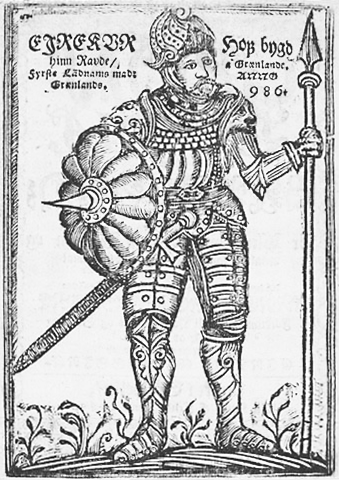
Scrupulously researched portrait of Erik the Red from Arngrimur Jonsson’s Gronlandia (ca. early 17th Century).
Sorry about the lack of a post last night. I actually posted one, and WordPress disappeared it. It vanished into the ether, like a childhood friend of Stalin. I don’t know what my sin was.
Let’s see if this one stays up.
Last night’s post wasn’t anything you’ll miss much, just a reminiscence from my childhood. Not even very dramatic. Maybe I’ll write about it again someday.
One of today’s big news stories is that President Trump, apparently, would like the US to purchase Greenland.
It ain’t gonna happen, according to the Danes. They have no need, or wish, to part with one of the very few remnants of their once-extensive empire.
And after all, people live in Greenland. I would hope they’d have a say in the matter.
Still, it’s an intriguing thought. It occurs to me that Donald Trump and Erik the Red, settler of Greenland, are kindred souls.
Both are larger-than-life characters, combative, practiced in self-promotion. The saga famously says that Erik called his country Greenland “because people would be more inclined to move there if it had a pleasant name.”
Thus he’s been called the first real estate developer.
I like to think that if Erik and Donald could meet, they’d take to one another right off. Sit down over some mead (though I understand Pres. Trump doesn’t drink) and talk deals.
I suspect Erik could have been talked out of Greenland, for
a sweet enough offer.
A multitude of stories of courage and endurance come out of World War II. Surely one of the most remarkable is that of Jan Baalsrud (pronounced “Yon Bowls-rood”), the subject of the book, The 12th Man by Astrid Karlsen Scott and Tore Haug. (If you see a book called Defiant Courage, it’s the same book. They changed the title to go with the release of a 12th Man movie a couple years back.)
Jan Baalsrud was one of a team of 12 saboteurs who sailed to Norway from Scotland in a fishing boat as part of a “Shetland Bus” operation in 1943. They were to deliver arms, munitions and supplies to the Resistance, and to attack some air bases. Tragically, a missed connection led to their betrayal, and a German patrol ship attacked them. They managed to blow their boat up, but the whole team except for Baalsrud were either killed on the spot or captured, tortured, and executed. Baalsrud himself escaped into the mountains with one foot bare and wounded.
Then followed months of working his way eastward toward the Swedish border through some of the roughest terrain in the world. He endured an avalanche, starvation, frostbite, gangrene (he amputated his own toes) and snow blindness. He received help and supplies from scattered farms along the way, but when he finally came to the great mountains around Manndalen he was unable to go further under his own power. He then became dependent on a team of Resistance sympathizers in the area who – in spite of killing weather and repeated missed appointments – refused to let this brave man die.
It’s a harrowing, almost unbelievable story. It was first publicized (I believe) by David Howarth in his book The Shetland Bus. Later he devoted a whole book, We Die Alone, to the tale.
Unfortunately (the authors report) Howarth didn’t get the
whole story. Apparently, the Norwegians he interviewed were suspicious of him,
and did not tell him everything they knew. Authors Scott and Haug spent five
years interviewing surviving participants and combing the records, in order to
provide what they believe to be an accurate account.
Sadly, their book isn’t very well written. Ms. Scott and Dr. Haug describe themselves as co-authors, but to me The 12th Man reads exactly like a bad translation (and I know bad translations). The phrasing is consistently Norwegian (hence awkward in English), the word choice poor. I wish I could say otherwise, but the book needed a good editor badly. I’m not quite satisfied with a few passages in Viking Legacy, but I felt better after reading this.
But if you can deal with the clumsy writing, it’s one heck
of a story. Cautions for intense situations.
‘That’s why the trade has a reputation for being a bit more easy-going than the proper navy. You’ll have heard it and you’ll hear it again. But only from those that don’t understand. There isn’t less discipline in the trade, Mr. Gilmour. If anything, the discipline here is the hardest of all. Self-discipline….’
I don’t generally read novels about World War II, but Gone To Sea In a Bucket by David Black starts in Norway, and so I noticed it. Not a bad book, either.
It opens during the Battle of Narvik, in 1940. Sub
Lieutenant Harry Gilmour is experiencing his first naval battle, but it’s not
much of an experience. Guided by aerial spotters, the ship he’s on is lobbing
cannon shells over the mountains from one fjord to another. They can’t even see
the enemy.
Harry Gilmour is making a poor start to his naval career. He
was brought in as part of a Navy program to increase the officer pool, outside
traditional training sources. But that doesn’t make him welcome to the “old navy”
hands. Harry’s not quite their sort.
But a compassionate senior officer intervenes. He informs Harry of openings in the submarine service (known to its members as “the trade”). It’s a different world there. The small crews and tight spaces make traditional navy discipline and separation of ranks impossible. Submarine service is dauntingly dangerous and physically demanding, but it gives Harry the best possible opportunity to develop his personal qualities – he discovers he’s hard-working, brave, and fiercely loyal. His service will bring him near death, and take his “boat” into a secret mission to the edge of the world.
I was not much impressed at the start of Gone To Sea In a Bucket. I thought the writing muddy and wordy, and I caught some grammar lapses. But it grew on me as I read. Once I got used to the author’s style it seemed to get better and better, until I found myself admiring various passages.
I also liked the treatment of the characters. Author Black
likes to give us a bad first impression of a character, and then gradually
reveal his or her story until we come to admire – or at least sympathize with –
them.
The Harry Gilmour series seems to be sort of a modern
Horatio Hornblower saga. I probably won’t be continuing with it, because I find
submarine stories kind of… claustrophobic. But if this is your kind of epic, I
would recommend it. Minor cautions for language and intense violence.
For a few days I was a rock star. Granted, I was a rock star with “selective appeal,” but a couple hundred people in Alexandria, Minnesota treated me like a celebrity.
The event was the Tre Lag Stevne. The Bygdelags (as I explained last week) are organizations composed of descendants of immigrants from various Norwegian regions. The three “lags” who met for the stevne (gathering) were groups from Gudbrandsdal, Hedemark, and Trondelag. They invited me to lecture twice on Thursday – once on the Lindisfarne raid in 793 AD, and again on the book Viking Legacy (which I translated; might not have mentioned that to you before).
The audience was attentive, smart (they laughed at my jokes) and appreciative. They descended on my book table like a flock of seagulls and snatched up every copy of Viking Legacy I brought. On top of the sales, I got an honorarium which was generous by my standards.
I have no complaints.
The next day I had to be in a meeting in Fergus Falls, just a little up the road, so I stayed a second night. I had some free time – and when Walker has free time in Alexandria, he can’t resist visiting the Kensington Rune Stone Museum. I’ve been there before, but I heard they’d made some changes.
Photo credit: Lars Walker
This is the stone itself. I have grave reservations about its authenticity, but you can’t deny it’s become a part of history in its own right.
Photo credit: Lars Walker
This display is the main thing I came to see. They did an upgrade to the museum a few years back, and decided to include a tableau about the real Vikings (even if the stone is genuine, it’s not a Viking artifact. Its date is 14th Century, long after the Viking Age ended). The person the museum hired to make costumes for the Viking family was my friend Kelsey Patton – who also made the Viking trousers and summer tunic I’m wearing in the top picture.
Photo credit: Lars Walker
Here’s a surprise – the museum has a Viking ship, in a barn outside. It’s a ¾ scale replica of a Viking knarr (a cargo ship), which was built as a project some years ago by the American Museum of Natural History. Somehow it ended up here.
An interesting and profitable few days. Thanks to everyone
who made it possible.
I’ve been thinking to write a thoughtful something about the third season of Marvel’s Jessica Jones. When I started watching it a few weeks ago, I noticed I had forgotten the big storyline from season two, but I remembered that I did not blog about it. Something wasn’t there. Maybe I wasn’t provoked enough (or maybe the sexual aspects of it held me back).
The third season continued to lean into that part of the story. Though Hogarth’s struggle was compelling, it was also awful and fairly ugly. The first season felt like Jessica’s gritty origin story, but now that season three is over, the whole series feels like her protracted story of coming into hero work. She needs Edna Mode to smack her around to help her find her destiny.
But I was talking about something else.
I have watched Stranger Things 3 more recently and may write something about the Upside Down, but Brooke Clark says pretending a TV series is a mature work of thoughtful deliberation does not redeem our interest in it.
Although we are trained to believe in books, we find ourselves watching shows about dragons, criminals, and covens. This leads to cultural status anxiety—a feeling that we aren’t really as sophisticated as we think, because when given the choice, we’d rather flip on HBO than pick up Middlemarch.
There are two ways out of this cognitive dissonance: we can admit our tastes aren’t really as elevated as we like to believe, or we can convince ourselves that television is actually an example of high culture.
We may not have gotten away from what W. H. Auden said decades ago in “The Poet & The City” : “What the mass media offers is not popular art, but entertainment which is intended to be consumed like food, forgotten, and replaced by a new dish. This is bad for everyone; the majority lose all genuine taste of their own, and the minority become cultural snobs.” (via Prufrock News)
Today I was a rock star. A rock star for a very small public, I’ll grant you, but I’ve rarely faced such an appreciative crowd as the people at the Lag Stevne at the Holiday Inn in Alexandria, Minnesota today.
The Bygdelags, as I explained yesterday, are groups of people whose ancestors came from various regions of Norway. Genealogy is one of their primary interests. So they like history, and they were primed and ready for a morning lecture on the 793 AD Lindisfarne raid, and an afternoon lecture on the book Viking Legacy and its themes.
They ate it up. They listened with rapt attention, laughed
at my jokes, and asked good questions afterwards.
And then they bought up my entire stock of Viking Legacy, plus a good number of West Oversea.
This summer, one of our favorite authors, Jared C. Wilson, has three ten-year anniversaries, and he reflects on those years at his blog. “It was an odd feeling at the time when Your Jesus is Too Safe became my first published book. I’d been trying ten years at that point trying to get published as a novelist.”
I write this from a motel in Glenwood, Minnesota. I’m speaking at a bygdelag meeting in Alexandria tomorrow, and I figured I’d take a room up here so I wouldn’t have to get up tomorrow before it was tomorrow. Glenwood is sufficiently close to Alex, and the rooms are a little cheaper here.
Bygdelags are an old institution among Norwegian-Americans. They started as social organizations for people who came from particular regions or neighborhoods in the old country. Nowadays (much consolidated due to falling membership) they’re largely about mutual support in genealogy. (Or so I believe; I may learn other things tomorrow.)
They asked me to do two lectures — morning and afternoon. They specified that they wanted to hear about the great 793 AD Lindisfarne raid (considered the start of the Viking Age) at 9:30 a.m. So I did some research and was happy to add to my store of knowledge. In the afternoon I’ll do my extended infomercial on Viking Legacy. My hope is to sell a lot of books.
Sorry, the lectures aren’t open to the public, as far as I know.
Today was a good day. I got some translation work, after a month of nothing. Oddly enough, it was in Swedish, which constituted a bit of a challenge. My boss said she understood some of it would probably baffle me. But I think I got most of it OK. If you can read Norwegian, reading Swedish is generally just a matter of lateral thinking. It took me about 5 ½ hours.
The weekend involved the great, biennial (means every other year; I still have to look it up) Walker Family Reunion. This year we held it in the Depot Park in Kenyon, Minnesota, instead of one of the old family farms. The Depot Park is next to the municipal swimming pool, which goes back all the way in time to my childhood. After the Chicago & Great Western Railroad tore up their line, the depot was given to the city as a picnic shelter, and moved across town. It’s decorated inside with a number of historical signs – the old apex of the false front of the Kenyon Opera House (a fancy name for the vaudeville theater), the scoreboard from the old ball field, the railroad crossing “X” sign, etc.
This was almost – but not quite – the year my generation got
to be the Old Folks. But one representative of my dad’s cousins showed up – using
a walker, but there and welcome. Then of course there’s the cousin who’s the
son of the youngest daughter in my great-grandfather’s family, who married
late. So he’s almost young enough to be my cousin, but is in fact my great uncle.
Or something.
Nice day, lots of food. Many stories told. “You still
working at the library?” they ask. No, other things are happening now. Movie
scripts? Really? And we always thought you were respectable!
Nothing went wrong at all, and yet when it was done I felt like I’d done nine rounds with Evander Holyfield. Hours and hours of human society. Oh, the humanity! I collapsed into bed and slept like an honest man.
Websites store cookies to enhance functionality and personalise your experience. You can manage your preferences, but blocking some cookies may impact site performance and services.
Essential cookies enable basic functions and are necessary for the proper function of the website.
Name
Description
Duration
Cookie Preferences
This cookie is used to store the user's cookie consent preferences.
30 days
These cookies are needed for adding comments on this website.
Name
Description
Duration
comment_author
Used to track the user across multiple sessions.
Session
comment_author_email
Used to track the user across multiple sessions.
Session
comment_author_url
Used to track the user across multiple sessions.
Session
These cookies are used for managing login functionality on this website.
Name
Description
Duration
wordpress_logged_in
Used to store logged-in users.
Persistent
wordpress_sec
Used to track the user across multiple sessions.
15 days
wordpress_test_cookie
Used to determine if cookies are enabled.
Session
Statistics cookies collect information anonymously. This information helps us understand how visitors use our website.
Google Analytics is a powerful tool that tracks and analyzes website traffic for informed marketing decisions.
Used to monitor number of Google Analytics server requests
10 minutes
__utmb
Used to distinguish new sessions and visits. This cookie is set when the GA.js javascript library is loaded and there is no existing __utmb cookie. The cookie is updated every time data is sent to the Google Analytics server.
30 minutes after last activity
__utmc
Used only with old Urchin versions of Google Analytics and not with GA.js. Was used to distinguish between new sessions and visits at the end of a session.
End of session (browser)
__utmz
Contains information about the traffic source or campaign that directed user to the website. The cookie is set when the GA.js javascript is loaded and updated when data is sent to the Google Anaytics server
6 months after last activity
__utmv
Contains custom information set by the web developer via the _setCustomVar method in Google Analytics. This cookie is updated every time new data is sent to the Google Analytics server.
2 years after last activity
__utmx
Used to determine whether a user is included in an A / B or Multivariate test.
18 months
_ga
ID used to identify users
2 years
_gali
Used by Google Analytics to determine which links on a page are being clicked
30 seconds
_ga_
ID used to identify users
2 years
_gid
ID used to identify users for 24 hours after last activity
24 hours
_gat
Used to monitor number of Google Analytics server requests when using Google Tag Manager
1 minute
_gac_
Contains information related to marketing campaigns of the user. These are shared with Google AdWords / Google Ads when the Google Ads and Google Analytics accounts are linked together.
90 days
Marketing cookies are used to follow visitors to websites. The intention is to show ads that are relevant and engaging to the individual user.
A video-sharing platform for users to upload, view, and share videos across various genres and topics.
Registers a unique ID on mobile devices to enable tracking based on geographical GPS location.
1 day
VISITOR_INFO1_LIVE
Tries to estimate the users' bandwidth on pages with integrated YouTube videos. Also used for marketing
179 days
PREF
This cookie stores your preferences and other information, in particular preferred language, how many search results you wish to be shown on your page, and whether or not you wish to have Google’s SafeSearch filter turned on.
10 years from set/ update
YSC
Registers a unique ID to keep statistics of what videos from YouTube the user has seen.
Session
DEVICE_INFO
Used to detect if the visitor has accepted the marketing category in the cookie banner. This cookie is necessary for GDPR-compliance of the website.
179 days
LOGIN_INFO
This cookie is used to play YouTube videos embedded on the website.