‘The Pretender: Rebirth,” by Steven Long Mitchell & Craig W. Van Sickle

The Pretender: Rebirth

I was a huge fan of the old TV series, The Pretender, starring Michael T. Weiss. It was, I felt, a refreshing concept – on top of the old, familiar theme of the Imposter, one who “becomes” whatever he chooses to be and operates well enough to fool others, you have the theme of an adult male encountering the real world for the first time – childlishly delighted to discover the Three Stooges, or aerosol cheese, or Pez candy. The character of Jarod, a genius combining superior intelligence with naivety, was an invitation to us all to stop and appreciate the wonders that surround us. His quest to find his mother, from whom he’d been kidnapped by the sinister “Centre,” where he was raised as a guinea pig, reminded us of the importance of family.

But the show wasn’t well served by its production team. Each season, Jarod would discover a chain of clues leading to his true identity, and would follow them up, and then the next season that chain would be completely abandoned for another, frustrating the fans. The scripts began to lose track of the original series concept. The show died. There was an attempt to revive it on the TNT network, but that plot was another pointless detour, with uncalled-for mystical accretions.

So I was interested to see that the show’s original creators, Steven Long Mitchell and Craig W. Van Sickle, had come out with a couple new Pretender books. The first is The Pretender: Rebirth. I read it with considerable enjoyment, though it’s flawed.

As in the TV version, Jarod, the Pretender, has escaped the Centre. Jarod is a rare genius, a young man with quick learning and empathy skills that allow him to “become” anything he chooses to be, with just a little research. Pursuing him are Miss Parker, sort of like Diana Rigg’s Emma Peel with a harder edge, and Sydney, the scientist who monitored Jarod through childhood, helped him develop his gifts, and became his father-figure.

It’s not enough for Jarod to search for his own origins. He also helps people whenever he can. Here Jarod is intrigued by a news story about a boy who disappeared in a river after an auto accident. Jarod doesn’t believe the boy is dead, and he has a strong suspicion where he is – or at least who can tell him where he is. All he needs to do is become a surgeon overnight, ingratiate himself with a prominent doctor with a grandiosity complex, and spring someone from a mental ward. Continue reading ‘The Pretender: Rebirth,” by Steven Long Mitchell & Craig W. Van Sickle

Coffee Is a Slow Poison, Voltaire

Dear Quote Investigator: Coffee enthusiasts enjoy sharing an anecdote about Voltaire who savored the aromatic beverage throughout his life. The famous philosopher’s physician warned him that coffee was a slow poison. He replied, “Yes, it is a remarkably slow poison. I have been drinking it every day for more than seventy-five years.”

But did this exchange occur between Voltaire and his doctor or was it someone else and someone else’s doctor? What are the facts interfering with this story? The Quote Investigator spells it out.

‘Live Wire,’ by Harlan Coben

Live Wire

Another Harlan Coben novel, this time in his Myron Bolitar series. Myron is a sports, literary, and actors’ agent, and for some reason he keeps getting involved in investigating crimes. This one hits closer to home than most.

Live Wire begins with an appeal from “Suzze T,” a tennis star client married to a rock star. Suzze recently gave birth to a baby, and someone posted a comment on her Facebook page, saying that the baby is “not his.” Just a troll, you’d think, but now her husband has disappeared. Can Myron find him and bring him back?

As he investigates the husband’s last known movements, Myron gets a look at a night club closed circuit surveillance recording, and sees a familiar face – his sister-in-law, Kitty, also once a tennis star. Myron hasn’t seen Kitty or his brother in fifteen years. Myron didn’t trust her, and made accusations. The last time he saw his brother, he broke his nose. Now he wants nothing more than to see him again and apologize.

But Kitty is hard to find, and she has secrets. And then somebody dies, and the whole mystery plunges into a tangle of old and toxic secrets, while a ruthless killer lurks in the background. Of course Myron has his own dangerous weapon, in the person of his best friend, Win Lockwood.

Live Wire is in many ways a heartbreaking story, well told. Coben’s usual themes of loyalty and family love are front and center. LW also serves as a launching pad for Coben’s young adult mystery series starring Myron’s nephew Mickey Bolitar. Recommended.

‘Stay Close,’ by Harlan Coben

Stay Close

I reviewed a miniseries created by Harlan Coben a few days back, and so I decided to read a couple more Coben novels. Stay Close was the first. Although it doesn’t follow the usual template for a Coben stand-alone, it had all the familiar elements. And you won’t hear me complaining.

We start with Ray Levine, an Atlantic City photographer at the bottom of his profession. Once a promising photojournalist, a traumatic event several years ago left him adrift. Now he’s – not a paparazzo – but a fake paparazzo. He follows the customers around with a camera, trying to make them feel like big shots on important days in their lives.

And then he gets a glimpse of Megan Pierce. Ray was in love with Megan once, when she was a stripper he knew as “Cassie.” Megan is a suburban wife now, with a pretty good life. Only sometimes she misses the excitement of the old days. And when she makes a discreet visit to a bar where she used to dance, she gets some very dangerous people furiously trying to locate her.

Finally there’s Broome, an old detective trying to solve old mysteries. All of these people have theories about a particular missing persons case. All their theories are wrong. The truth will shock them and put their lives, and those of their loved ones, at risk.

Harlan Coben excels at creating layered, relatable characters. Even the bad guys are understandable, and sometimes almost sympathetic. Except for a couple characters in this book who seemed over the top to me. A sociopathic couple who work as a hit team, and are apparently Mormon missionaries (or something similar) in their off hours. I found them a little hard to swallow.

But the book was exciting – in fact it was one of those I had to take in small doses, because of the constant peril to innocent people – and the conclusion was satisfying. Recommended with the usual cautions.

Duty done

My great adventure in the judicial system is over. Turns out this week is perhaps the best week in the year to be called for jury duty. We pulled one jury panel out of our pool, and that was yesterday. Nada today. The powers that be (apparently) looked at the calendar, said, “Nobody’s gonna start a trial on the Wednesday before Thanksgiving,” and told us all we could go home, our obligations fulfilled. Saved the county our (minimal) pay. Happy hint: If you want to make a group of people very happy, hold them confined for two days, then let them go unexpectedly.

Here’s a cute feature – there are two ways of responding to a jury summons in these parts. You can report physically, as I and the others in our pool did, and sit around for a week waiting for your name to be called. Or… you can call in before the first day and asked to be placed on the “call list.” If you’re on the call list, all you have to do is call the courthouse the day before and ask if you’ll be needed the next day. If they tell you no, you’re free for the day.

Ah, but there’s a catch. A diabolical one, worthy of a Democratic Party county.

The term of service is two weeks. The people who turn up corporeally sit around for a week (if not empaneled) and usually get to go home after that first week.

On the second week, they summon the call-in people. Who therefore have to come in after all.

And next week the docket will be choked with cases they postponed for the holiday this week.

I chose… wisely.

Day one in the belly of the beast

I completed my first day of jury duty, and have survived to tell you about it. It was a day of much adventure – not in the task itself, which was a yawner, but in a peripheral matter, transportation.

Minneapolis has made a conscious decision to discourage automobiles. So I figured I’d take the bus. There was a time when I rode buses a lot – but that was in another age. I found that today they’re discouraging buses as much as cars – there are very few bus shelters with schedules posted downtown. What the Oligarchs want, I think, is for the masses to rise up and demand more light rail. They love light rail in Minneapolis – unsurpassed opportunities for graft.

It’s been a long time since I stood at a bus stop on a chilly street in Minneapolis, watching for a bus that might come in a minute or an hour – who knows?

But that was later. I had gone online and planned my trip into town. That trip went fine, except that I got off the bus too soon and had to walk a few blocks to get to the Hennepin County Government Center, which towers like a vertical peanut butter sandwich over downtown.

My day in the juror pool is quickly described. Mostly nothing. We sat in the assembly room, a large carpeted room full of circular tables. After a while a judge gave us a greeting. Then we waited some more. Then the jury manager gave us an orientation talk and showed us a film. Continue reading Day one in the belly of the beast

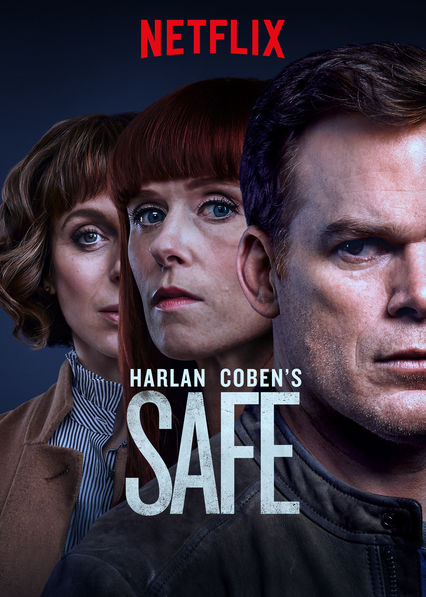
Netflix Review: ‘Safe’

Safe

Back in 2006, a French movie appeared, based on Harlan Coben’s novel Tell No One. I’ve seen it on Netflix. It’s a pretty good thriller. Coben says he agreed to sell the rights to the French company rather than taking an American offer, because the filmmakers understood the story – that it’s primarily a love story, not a mystery.

Although he takes his material overseas again (this time to England) for the miniseries Safe, available for viewing now on Netflix, I think it’s not as successful as the French movie. But it’s a pretty fair entertainment.

In spite of the uprooted location, Safe is a very recognizable Coben story. You’ve got a secure (in this case gated) upper middle-class suburban community, where neighbors are friends and everybody knows everybody’s business (or thinks they do). You’ve got a family friend who tells some of the kids that if they ever need a designated driver, call him night or day – no questions, no snitching to the parents. You’ve got a teenagers’ party that gets out of hand – a boy drowns. Then a girl disappears. Then the clues lead back to very old, buried secrets.

American actor Michael C. Hall plays Dr. Tom Delaney, widowed father of the missing girl. (His English accent sounds OK to me, but apparently the actual English have laughed at it.) His relationship with his daughter Jenny (Amy James-Kelly) has been strained, since her mother’s death from cancer. He desperately tries to trace Jenny’s movements on the night of the party, assisted by his best friend, a gay doctor, and his girlfriend, a police detective. Clues lead to drug dealing, concealment of a body, and a guilty secret shared by members of the close-knit community.

I found the solution, and the Big Surprise that followed it, a little improbable and forced. However, the series as a whole was compelling and I enjoyed it. Cautions for mature themes and a few obscenities.

‘Gentlemen, you can’t fight here! This is the war room!’

In my new life working from home, I’ve found I need background noise. I don’t generally work in silence. I need music at least. Talk radio can be better, depending on the show. Most of all I kind of prefer some kind of TV in the room. I think that’s because my intellect is so dizzying that focused concentration on just one thing would burn out my cerebral cortex. Or something.

Anyway, the H&I channel currently runs an interesting block of programming from 9:00 a.m. to 7:00 p.m., Central Time. They give you 9 hours of a single series on each weekday. Mondays are Nash Bridges, Tuesdays House, Wednesdays JAG, Thursdays Monk, and Fridays Numbers.

Of those five, I only really like House and Monk. Stories about damaged problem-solvers. Can’t imagine why.

I tolerate JAG, most of the time. I like its patriotism and pro-military bias. But from the first it was sexually egalitarian, which annoys me.

For instance. Continue reading ‘Gentlemen, you can’t fight here! This is the war room!’

‘Like to Die,’ by David Housewright

Like to Die

Another entertaining Mac McKenzie novel from David Housewright. Like to Die is the last book published to date in the series, and as it happens it’s the last I plan to read. The author tipped his hand at last. More on that further down.

Mac McKenzie, millionaire former St. Paul police detective, does investigative favors for friends from time to time. One of those friends is dating Erin Peterson, better known as “Salsa Girl” in spite of her blonde hair and blue eyes. Erin manufactures six highly regarded flavors of salsa in a factory in St. Paul, and business is great. But somebody super-glued her factory locks shut one night. Erin doesn’t think that’s worth calling Mac in for, but then someone does the same to the locks on her company trucks. So she agrees to let Mac look into things. But she’s strangely reluctant, and Mac realizes he doesn’t really know much about Erin at all.

Turns out Erin and her business have problems with a big distributor. Not to mention with a flaky partner, a Mexican drug cartel, and organized crime. Erin has deep, deep secrets.

I enjoyed Like to Die very much, for the most part. Mac is a splendid main character, and the cast of supporting players is vivid and fun – especially the enigmatic Erin.

But this time author Housewright reveals his politics, a topic on which he’s been pretty evenhanded in the past. A conservative Christian is portrayed in such a stereotypical manner that I wondered if I’d stumbled into a Saturday Night Live sketch, or a Lee Child novel. Also, the charge of racism, which Householder has aimed at Norwegians in the past, is now extended to Minnesotans in general. What’s up with that?

Anyway, I’m sure David Housewright doesn’t want my bigoted, conservative business, so I don’t plan to buy any more of his books.

Otherwise, it was great.

Research and re-writing

Today has been, and continues to be, a heavy work day. I have an assignment from Oslo, not for a translation, but a sort of research job. I’m scanning through a very long document, extracting relevant passages into a separate document.

Not uninteresting. And it will take a while. Which is nice, since my time for translation will be curtailed when I go on jury duty. That promises a healthier paycheck at the end of the month.

Today’s Writer’s Aggravation:

There’s an article in the current Writer’s Digest about finding time to write, and writing faster. And it’s a good article, all in all. Lots of handy tips that are likely to be useful to aspiring authors.

What annoys me is the closing line. It goes like this: “And with nine minutes a day, you can arrive at The Sound and the Fury (97,000 words) in just under four months.”

That’s inspiring, but overpromising, friend. I’ll grant that it might be possible to finish a first draft in four months, employing the methods suggested. But that first draft will not be a novel. You’ve still got another year (or six months, anyway) of revising. It’s great to finish a first draft. I’ve often said that getting that one thing done is (to my way of thinking) the most important milepost in the process of writing a book.

But books aren’t written – they’re re-written. Heaven help the agent who gets that 97,000 first draft in the email from some nine-minute-a-day writer who thinks that’s sufficient.

Book Reviews, Creative Culture