
‘The Day That Never Comes,’ by Caimh McDonnell

I was much taken with A Man With One of Those Faces, by Caimh McDonnell. I praised it here, and we even got the attention of his publisher in comments.

I won’t say that its sequel, The Day That Never Comes, was a disappointing book. It was a pretty good mystery/thriller, with the expected amount of slapstick humor. But… it didn’t work for me as well as its prequel.

In this outing our heroes, Paul Mulchrone, Brigit Conroy, and police detective Bunny McGarry, have just failed to start a private detective agency. It seemed like a good idea. Paul has finally moved out of his late aunt’s house, Bunny has been forcibly retired from the force, and Brigit has always wanted to be a detective anyway. But it all fell through. Paul sent Brigit… unfortunate photos from his cell phone on a drunken night, ending their engagement. And Bunny has now disappeared, his beloved car abandoned at a spot where many people commit suicide. But Bunny wouldn’t kill himself… would he?

Meanwhile Paul, left alone in the detective office, is approached by a Raymond Chandler-esque leggy blonde in a red dress, who wants him to follow her boyfriend, something he’s not actually sure how to do. And Brigit is certain Bunny wouldn’t commit suicide, so she’s looking for him. Though they don’t realize it at first, both their cases are related to the trial of three property developers who swindled thousands in the collapse of the Irish Celtic Tiger boom. After those three are acquitted, one of them is tortured to death. And that’s just the beginning of violence that will convulse all of Dublin.

The Day That Never Comes wasn’t a bad book, but it disappointed me. It was as if someone sat down with author McDonnell and said, “Now this time, tone down the funny writing. Concentrate on character development, back story, and social awareness.” There are plenty of humorous situations in the book, particularly slapstick arising from Paul’s adoption of a flatulent German Shepherd with an attitude. But the funny lines aren’t here. McDonnell’s Wodehouseian gift for hilarious phrasing isn’t much on display.

But it’s a perfectly fine humorous mystery. I recommend it, with cautions for the usual stuff.
Happy Valentine’s Day

My love for you is like a slough
of water flowing out
that soaks the town of Kilkey Down
whose folks pray for a drought.

That one’s for you, dear reader, but here’s another bound to enliven a lover’s heart. From Ogden Nash.

A flea and a fly in a flue
Were imprisoned, so what could they do?
Said the fly, “let us flee!”
“Let us fly!” said the flea.
So they flew through a flaw in the flue.

Isn’t that sweet? Here’s more on Ogden Nash in The Hindu.

Mimi Matthews has a few creative verses for telling someone who may or may not be interested in you to seek other pastures.

Don’t credit the advertisements
In paper or in serial,
You cannot manufacture charms
With ugly raw material.

Exploitation in Humanities Departments

There’s an idea that college professors should be free to pursue whatever interests them, to go wherever their professional curiosity takes them without concern for the market, but that’s close to the fantasy of fan-fiction, stories written for the fun of it without an eye on their publication (even though that too is changing).

Adjunct professor Kevin Birmingham brings up this point among others in his talk on the native exploitation by college humanities and English departments. On the one hand, adjuncts aren’t paid well.

An annual report by the American Association of University Professors indicated that last year “the average part-time faculty member earned $16,718” from a single employer. Other studies have similar findings. Thirty-one percent of part-time faculty members live near or below the poverty line. Twenty-five percent receive public assistance, like Medicaid or food stamps.

These teachers are easily hired, easily dismissed. Funding for actual classroom instruction has been declining, but administrative roles are increasing. Apparently, teaching students is a declining priority for many of our universities, which makes news of another closure more tolerable.

On the other hand, graduate programs are milling out Ph.Ds at a rate that far exceeds the need. Universities, Birmingham explains, have the only job market for these graduates, but they produce roughly four times the number of candidates for the available jobs and availability is shrinking.

English departments do this because graduate students are the most important element of the academy’s polarized labor market. They confer departmental prestige. They justify the continuation of tenure lines, and they guarantee a labor surplus that provides the cheap, flexible labor that universities want.

Like a migrant worker system.

Many market principles could be learned here. One broad one would be morality cannot be based on market realities (or just because you can do it doesn’t mean you should). Colleges exist to teach, and qualified teachers should receive the honor and compensation they are due. When you have the money to pay them well, you should.

But another one may be that if some universities don’t care to teach, others should be able to pick up that slack and grow, keeping a focus on their students’ well-being in mind and not treating them like grist for the sake of the program.

In person, one night only

In case you’re in the area…

I will be speaking on The Viking Sagas on Monday, February 13, 2016 for the Vennekretsen Lodge of the Sons of Norway in Anoka, Minn. They meet at Zion Lutheran Church, 1601 4th Ave., Anoka. The time is 6:30 p.m. for the lodge meeting, 7:00 for the program. I will be selling books.

Disclaimer: The ideas and opinions expressed in this lecture do not necessarily represent the ideas and opinions of Vennekretsen Lodge, the Sons of Norway, or of real persons, living or dead.

28 Recommendations of Black Children’s Books

For Black History Month, librarian and poet Scott Woods likes to recommend children’s books that don’t focus on boycotts, buses, or basketball. Here’s his list of “28 children’s picture books, most of them featuring Black children doing what all children do: play, make up stories, learn life lessons, and dream.”

These titles look like great fun for a library afternoon in the short seat section. I wonder how many of these my library has. (via K.A. Ellis)

Nevermore to forget…

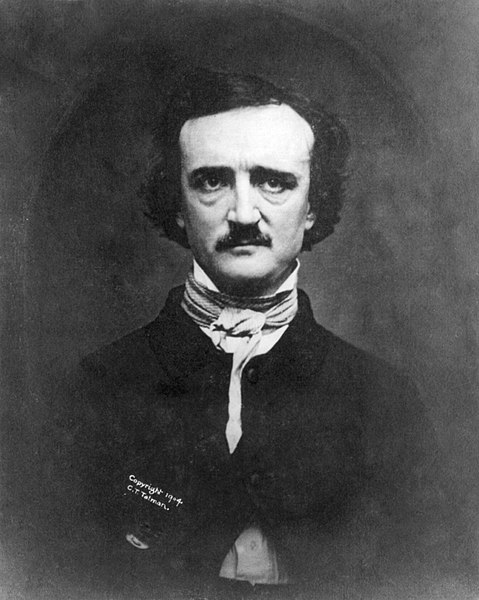
Edgar Allan Poe

A book I’ve had for many years is Louis Untermeyer’s A Concise Treasury of Great Poems, English and American, published in paperback in 1958. In his introduction to Edgar Allan Poe, Untermeyer notes, “The quality of his gift as well as the tragedy of his life is indicated in the words of Sir Francis Bacon which are on the Poe Memorial Gate at West Point: ‘There is no exquisite beauty without some strangeness in the proportion.'”

Oddly enough, that gate is not mentioned in Atlas Obscura’s list of 10 Places That Rejected Poe in Life but Celebrate Him in Death.”

Edgar Allan Poe pioneered a distinctly American brand of gothic horror and romanticism, and introduced the short story to the literary tradition. Yet throughout his career he never received much fame or money. “The Raven” was his best-known work, for which he was paid $9. Poe spent his life traveling up and down the Atlantic coast, working odd jobs and performing parlor readings to make ends meet, going from one failed relationship to the next. He ultimately died with no family, raving mad in the streets of Baltimore.

As if in an attempt to rectify Poe’s lack of success, numerous locations of import during his lifetime have been posthumously dedicated to him, or at least honor his presence there. Here are 10 places in the Atlas that trace the footsteps of America’s master of macabre.

Caimh McDonnell Listens to Audiobooks

Lars’ review of Caimh McDonnell’s first novel yesterday drew the attention of McDonnell’s publisher on Twitter. That lead to my discovery of this interview of McDonnell posted yesterday. Blommin’ Brilliant Books asked the comedian what genres he preferred.

Typically most of the novels I like to read either fall into the crime or sci-fi genres. Having said that, quite a lot of the ‘reading’ I do is actually audiobooks. I can often spend 16 or so hours in a week driving to gigs and I fill that time by devouring audiobooks. I think the influence of that can be seen very clearly in my writing. I write to be read out loud and I believe dialogue is usually the best way of conveying information. I have also read hundreds of TV and film scripts as I’m completely self-taught as a TV writer. People have said that dialogue is my biggest strength as a writer and I guess if you’ve spent as much time as I have forensically examining the work of Aaron Sorkin, that’s no great surprise – not that I’m anywhere close to his level.

He also said he drew one of his characters from an actual, living being. “Phil Nellis is heavily based on my friend and fellow comedian Phil Ellis. In fact, I did it specifically to annoy him.”

‘A Man With One of Those Faces,” by Caimh McDonnell

A Man With One of Those Faces

She was not a bad looking woman, truth be told; a couple of years older than himself, short brown bobbed hair, decent figure – she wouldn’t be launching a thousand ships any time soon but she’d undoubtedly create a fair bit of interest in a chip shop queue.

Paul Mulchrone is “A Man With One of Those Faces” – a face so ordinary that people frequently mistake him for other people. This comes in handy when he helps out in a Dublin hospice, sitting with dying old people, holding their hands, letting them imagine he’s a family member or a friend. He does this to fulfill the terms of his aunt’s will, which allows him to live in her house on a small stipend so long as he puts in a certain number of public service hours every month. It’s all fine until one night when Nurse Brigid Conroy persuades him to stay a little beyond his time with a particular old man, in return for a drive home. In the event, the old man tries to murder Paul with a knife he’s somehow acquired, and then drops dead.

Turns out the old man is a gangster whom everyone thought dead years ago, one who was involved in a legendary unsolved kidnapping. And his old partners in crime don’t know what he might have told Paul in those last moments. Best to kill him, just to be on the safe side. And Nurse Brigid too. Continue reading ‘A Man With One of Those Faces,” by Caimh McDonnell

Standing In for Thomas Pynchon

Comedian Irwin Corey, who regularly lampooned the educated classes, died this week at age 102. The NY Times tells a story of how he impersonated author Thomas Pynchon to receive the National Book Award for fiction in 1974.

No one in the crowd had any idea what the reclusive Mr. Pynchon looked like, and when Mr. Corey arrived to accept the award for him (the novelist had approved the stunt), many people thought they were getting their first look at Mr. Pynchon.

They soon learned otherwise. Beginning his remarks, as he often did, “However,” Mr. Corey referred to the author as “Richard Python” and said, “Today we must all be aware that protocol takes precedence over procedure.” He continued: “Marx, Groucho Marx, once said that religion is the opiate of the people. I say that when religion outlives its usefulness, then opium will be the opiate. Ah, that’s not a bad idea.”

The Times reported the next morning that Mr. Corey’s “series of bad jokes and mangled syntax” left “some people roaring with laughter and others perplexed.”

See Corey and hear his acceptance speech from the National Book Awards here.

In memory yet Green

Roger Lancelyn Green

My friend Dale Nelson recently sent me a couple old articles on Tolkien he thought might be of interest. One of them was from Amon Hen, the journal of the Tolkien Society, #44, May 1980. It was a piece by Roger Lancelyn Green, in which he reminisced on his friendship with the professor. Green has sometimes been identified as a member of the Inklings, but he does not claim that honor (or honour). His article includes the following delightful paragraph:

I never saw The Lord of the Rings before it was published, but heard a good deal about it from Lewis, who kept saying that if only Tolkien would finish it, it would be one of the great books of the century – “But Tollers just won’t finish it! Every time he gives himself a month’s holiday to do so, he begins by reading over what he has already written, and sees how he can better that, and spends most of his month on revising!”

Book Reviews, Creative Culture