Roots of Black History Month

Dr. Carter G. Woodson, founder of what has become Black History Month, wanted to spotlight the many social and academic achievements of African Americans.

“For serious, solution-oriented black conservatives today,” Chidike Okeem writes, “Woodson provided a model of how one can be enthusiastically pro-market, doggedly anti-Marxist economics, and do so while being unapologetically African. He demonstrated that endorsement of free market economics does not have to coincide with self-hatred and anti-blackness.”

“Black Americans have African ancestors who were marvelously accomplished, built civilizations, and were intrepid innovators. African Americans, despite a history of oppression, have demonstrated that same entrepreneurial spirit throughout American history.”

Where dragons walked

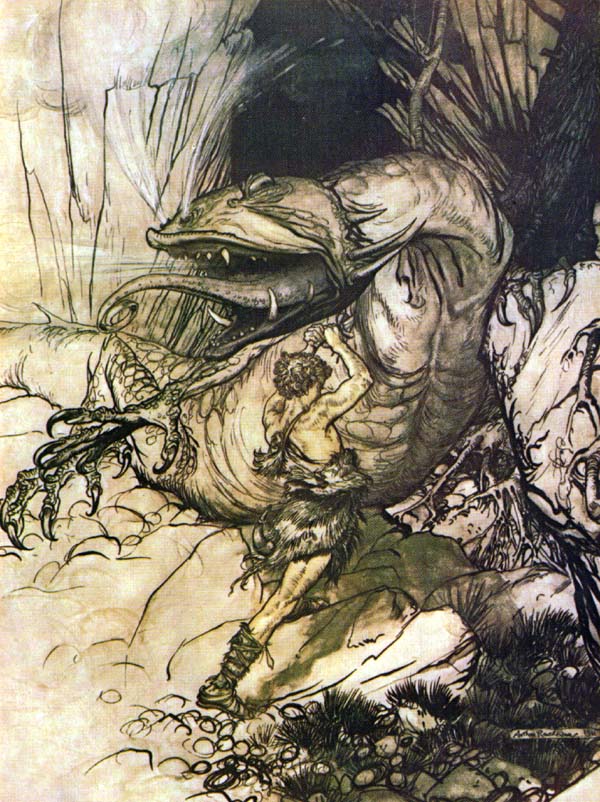
Siegfried and the dragon
Siegried slays the dragon, in an illustration by Arthur Rackham. This is one of the set of illustrations for Wagner’s Ring operas that fascinated C.S. Lewis as a boy.

An article at Wonders and Marvels suggests that the legends of medieval dragons in Germany, most particularly that of Siegfried the Dragonslayer, may arise from fossil tracks still visible in that country.

Notably, conspicuous fossil trackways of two types of massive dinosaurs are found in Germany. In 1941, the German paleontologist H. Kirchner speculated that observations of Triassic dinosaur tracks in sandstone near Siegfriedsburg in the Rhine Valley of western Germany might have been the inspiration for the legend about the dragon Fafnir’s footprints.

I share this, of course, purely for your amusement. All sensible people know that dragons survived in Europe well into the early medieval period, when they were slain by Christian saints.

Hat tip: Mirabilis.

Read Langston Hughes’ Stories

Justin Taylor recommends we read the short stories of Harlem Renaissance poet Langston Hughes.

“If racism and race-based slavery was America’s original sin,” Taylor says, “Hughes demonstrates that racism and the legacy of slavery were alive and killing us in the middle of the last century.”

But for a winter of heartache, we can still see a spring of hope.

For Hughes, humanity—sheer cussed humanness—is always breaking out and defying the lies of the racialist.”

Writing report, 2/1/17

Today was an unusual day, but not a bad one (which was fairly surprising. To me, it’s an axiom that Change is Bad).

I had to take a half vacation day, because it was the seasonal feast of the Sacred HVAC Inspection. The spirit of Natural Gas must be appeased, lest he smite the firstborn (that’s me) with carbon monoxide poisoning. Because this solemnity requires carving out a whole afternoon for the sake of about a half an hour of actual service, I figured I could do some writing. Somewhat to my surprise, I did.

My latest book is a challenge. I don’t know if I just got out of the habit of novel writing during my 2 ½ year detour Through the Looking Glass (i.e., in academia), or if I’m just getting old, my eye dimmed and my natural force abated.

But this week has been good. I’m facing one of those plot intervals that I hate. You’ve got a Big Event coming up (in this case an actual historical event that I can’t move around), and a space of time to fill leading up to it. Various plot threads need to be developed in that space, but it’s like building a bridge across a broad canyon – there’s a big space to fill and not a whole lot of attachment points.

But I’ve been working manfully on bridging that space this week, and – not easily, but steadily – I’ve been making progress. “Having once got my method by the end,” as John Bunyan said, “then ever as I pulled, it came.” The pulling can be hard, but the story is coming. And I think some of the stuff isn’t bad.

I’ve got a long way to go, though.

Reading Wiesel as Protesters March Outside

I’m glad we’re talking about refugees, immigration, and what loving our neighbors means in practical terms. I hope all of this becomes perpetual opportunities for the gospel, the life-transforming gospel, not just some shell of good wishes.

On Sunday in New York, a large group met at the Jewish Heritage Museum to read from Elie Wiesel’s Night to remember the Holocaust at the same time other New Yorkers were protesting the US administration’s policies on immigrants from terror-watch countries.

“By the end of the [Rwandan] genocide I lost my entire immediate family, my parents, my siblings, most of my family members,” Jacqueline Murekatete told the audience. “As any child of that time, I witnessed a lot of horrors, people being killed around me and losing my family…but I was fortunate that I had an uncle that lived here [America].

She said Wiesel inspired her as a teenager. Night “became a catalyst for the genocide prevention work that I do now.”

There cannot be a 1:1 comparison between Holocaust or Rwandan genocide and what is happening in Syria and other countries. We live in a different world now. I could understand if President Trump were to say, “We are working very hard to provide safe passage to select Syrian communities who are being targeted and have nowhere to run, because frankly, people, we went over there and made a huge mess, a gigantic, stupid mess.” But that’s not his stance today for reasons that should be completely understandable to everyone. There are enemies among us.

But perhaps Wiesel would not agree. In his Nobel acceptance speech, he said,

Silence encourages the tormentor, never the tormented. Sometimes we must interfere. When human lives are endangered, when human dignity is in jeopardy, national borders and sensitivities become irrelevant. Whenever men or women are persecuted because of their race, religion, or political views, that place must—at that moment—become the center of the universe.

New ‘Viking’ trailer

I’m weary of the world tonight. Can’t think of anything to write that I wouldn’t regret tomorrow.

So here’s the latest trailer for the new Russian Viking movie. My reenactor friends complain that the costumes aren’t accurate, but in my view they look punctilious compared to the costumes on the History Channel.

The latest news I’ve seen says international rights have been sold, but there’s been no announcement of a US release date.

‘The Unexpected Enlightenment of Rachel Griffin,’ by L. Jagi Lamplighter

The Unexpected Enlightenment of Rachel Griffin

I am manifestly on record as mistrusting a) books by women (in my experience they tend to do male characters badly), and b) modern Christian fantasy books (because by and large they are amateurish).

The Unexpected Enlightenment of Rachel Griffin by L. Jagi Lamplighter is both. And I loved it.

So sue me.

A kind of cross between Harry Potter and The Chronicles of Narnia (with just a tincture of Jane Austin), The Unexpected Enlightenment takes us to a world where, familiarly, a school of sorcery exists out of sight of the ordinary (here called Unwise) world. But there are differences – one being that, although the culture is recognizably like ours, nobody has ever heard of monotheism.

Rachel Griffin is the daughter of an English duke who is an important official in the Magical World. She is sent to Roanoke Academy for the Sorcerous Arts, which exists invisibly on an island in the Hudson River in New York. Rachel is a gifted child, younger than the other freshmen. She has never had serious friends, and dreams of acquiring real ones, like in the books she reads. She also hungers for knowledge – any and all knowledge. One of her gifts is a photographic memory.

At Roanoke she does make friends – and some Mean Girl enemies. Her friends include an Australian (!) princess, a boy who slew a dragon and sleeps on a bed of gold, and an aspiring reporter. Rachel’s memory gives her an advantage most magicians lack – when she reviews her memories, she can see invisible things that she missed the first time through. By means of this power, she is able to identify sinister, magical activities, and manages to save a friend from an assassination attempt. Trying to figure out the reason for this crime sets her on an investigation of mysterious currents moving beneath the surface of the school’s day by day activities. Eventually she realizes that something very big and very bad is being planned by someone… even as she falls for a handsome upperclassman… who may be evil. Continue reading ‘The Unexpected Enlightenment of Rachel Griffin,’ by L. Jagi Lamplighter

Skilled Reading

Mark ­Seidenberg says if you want to read well faster, you should ignore the speed reading people tell you. “The injunction to take in whole lines, paragraphs, or pages cannot be achieved by the human visual system, short of growing additional cells on one’s retina.” (via Prufrock)

‘Conan the Barbarian,’ by Robert E. Howard

Conan the Barbarian

Is it possible to be a great writer without being a good writer? I guess it depends on what you mean by great and good.

I consider Robert E. Howard one of the great fantasy writers, on a level lower than Tolkien but higher than most of the others. And yet his writing has many, many weaknesses. The whole, however, is greater than the sum of the parts.

Like most Baby Boomer Howard fans, I first discovered Conan – warrior, thief, pirate, mercenary, and king – through the old Lancer series of paperbacks, most of them with amazing Frazetta covers. That series printed all the Conan stories in what the editors considered proper biographical order. What purists don’t like about them is that the publishers, sensing a cash cow, padded the series out. Unfinished Conan stories were “completed.” Non-Conan Howard stories that could be wedged into the timeline were rewritten to make them Conan stories. And they added pure pastiches done by the editors.

This present collection, Conan the Barbarian, takes a bibliographical approach. All the Conan stories published in Howard’s lifetime are here, in the order published. That means that we begin with two stories of Conan at his pinnacle, as king of Aquilonia, then turn aside to a number of stories about his earlier adventures, and finally conclude with the novel The Hour of the Dragon, a last tale of King Conan (and in my opinion the best Conan story). The collection concludes with Howard’s essay, “The Hyborian Age,” in which he explains the rise and fall of the imaginary prehistoric world in which Conan lived, loved, and slew. Continue reading ‘Conan the Barbarian,’ by Robert E. Howard

On quoting the Old Testament

The refugee issue is one that perplexes me. I recognize the Christian duty of hospitality, and the Old Testament injunction to welcome the stranger and the sojourner.

But I’m not entirely sure the biblical situation is exactly analogous to our own. I’m not sure the Lord intended the Israelites to go out and bring in thousands upon thousands of Amalekites. And I’m pretty sure He never meant the welcome to expand to the point it has in Europe, where the strangers and sojourners are inexorably replacing the indigenous people.

I could be wrong, of course.

But what really surprises me is the liberal Christians I see on Facebook, who post Old Testament verses in support of their position.

Wh-what?

These are the same people who, for decades now, have been telling me that if I appeal to the Old Testament on any moral issue, I’m rationally obligated to stone people to death for wearing blended fabrics.

Have they noticed that they’ve just demolished 75 percent of their religious argument for homosexual marriage?

Book Reviews, Creative Culture