Are K-Cups Old Hat Now?

Day 161: The Chai Latte K-Cup.Quarterly earnings for Keurig Green Mountain are “disastrously bad,” according to this week’s reports, and with consumer complaints about the price of a Keurig 2.0 and its rejection of off-brand coffee pods, analysts are wondering if the single-serve coffee craze is over.

If you haven’t heard, the latest Keurig coffee machine, released last summer, was designed with a scanner in order to detect whether you were using Keurig-brand coffee pods or off-brand pods. If you were trying to save money by using cheaper, off-brand pods, the machine would say, “Oops! This pod was made in North Korea and will probably kill you, or worse, insult your palate. Throw it out, fool! Use only Keurig Brand coffee pods with coffee as fresh as if Moses, standing on Mt. Sinai, ground it himself.” Not only did the new machine of coffee magic reject off-brand pods, it also rejected K-cups that didn’t have the special Incan runes on the label.

Coffee drinkers found this design feature unhelpful and began to complain. Some joined a resistant movement to take back their freedom of brewing.

But these may not be the only reasons for the company’s earnings report slump. In a partnership with Coca-Cola, Keurig will soon release a single serve soda-pop machine that will cost way more than even a single can from an amusement park vending machine (if that’s possible). I’ve heard New York City has already taken steps to ban it. In a world that is decreasingly buying cokes (that’s what we call them in the South), who will want a custom coke machine in their man cave when they can have a fridge-full of craft beer for less.

Or water, which is what I’d ask for.

‘What Dies in Summer,’ and ‘BlackBird,’ by Tom Wright

I had trouble making up my mind about reviewing these two remarkable novels. I liked them, but didn’t entirely approve of them. But they didn’t offend me either. I guess I’ll just describe them and let you draw your own conclusions.

What Dies in Summer and Blackbird, by Tom Wright are connected novels, with the same main characters, but there’s enough separation to make them very distinct; not quite a series.

The central characters are Jim “Biscuit” Bonham, a teenager in Dallas in What Dies in Summer, and his cousin Lou Ann (“L.A.”), who comes to live with him and his grandmother. The two cousins are children of sisters who are both alcoholic, and are no longer able to live with their parents.

They’re poor, and you might almost describe them as “white trash,” except that their grandmother is a smart and good woman, determined to see that they grow up loved and well educated. They are both unusually intelligent, though Jim doesn’t believe it of himself.

Their story moves out of soap opera territory when, one day, out hunting returnable bottles, Jim and L.A. discover a murder victim – a girl their own age, raped, strangled, and left naked.

Two kids this smart can’t stay out of the investigation, and their inquiries bring them into serious danger from a surprising quarter. Continue reading ‘What Dies in Summer,’ and ‘BlackBird,’ by Tom Wright

Bookseller Offers Refund for ‘Go Set a Watchman’

A bookseller says the hype over Harper Lee’s Go Set a Watchman mislead readers, who are now expressing their disappointment in what was supposed to be a new classic.

Brilliant Books in Traverse City, Michigan, has said that its “dozens” of customers for Go Set a Watchman are owed “refunds and apologies” over the way the novel has been presented. “It is disappointing and frankly shameful to see our noble industry parade and celebrate this as ‘Harper Lee’s New Novel’,” the bookseller writes on its website. “This is pure exploitation of both literary fans and a beloved American classic (which we hope has not been irrevocably tainted). We therefore encourage you to view Go Set a Watchman with intellectual curiosity and careful consideration; a rough beginning for a classic, but only that.”

The Watchman

Spurgeon Walking the Dark Valley

Christian George is Curator of the Spurgeon Library at Midwestern Baptist Theological Seminary. He has written about Charles H. Spurgeon’s depression in this article, “Spurgeon Almost Quit,” and talks to Charles Morris of Haven Today about the subject here.

George quotes the great preacher as saying, “I have gone to the very bottoms of the mountains, as some of you know, in a night that never can be erased from my memory . . . but, as far as my witness goes, I can say that the Lord is able to save unto the uttermost and in the last extremity, and he has been a good God to me.”

Is There Beauty in Sodom?

What appears shameful to the mind, is sheer beauty to the heart. Is there beauty in Sodom? Believe me, for the great majority of people it is in Sodom and nowhere else.” — Dostoevsky, The Brothers Karamazov

Dmitri Karamazov, in the “Confessions of an Ardent Heart in Verse,” rants with great feeling about the two ideals of beauty that haunt the heart of man: the Ideal of Sodom, and the Ideal of Madonna. Dostoevsky expanded on this idea in one of his journals, calling the Ideal of Sodom the “Second Beauty” — the beauty which sin has in the eyes of those who are tempted to commit it.

Dostoevsky was criticized, of course, by those who felt that his works sank too far into the darkness without offering any “real” solutions to the problem of human sinfulness. D. H. Lawrence wrote that, “He is like the rat, slithering along in hate, in the shadows, and in order to belong to the light, professing love, all love,” while Freud lamented that “Dostoevsky threw away the chance of becoming a teacher and liberator of humanity; instead he appointed himself as jailer.” Such criticisms are typical of a certain critical tenor that sees literature, and art more generally, as a force for reworking the social order and rewriting the heart of man. It is a critical pose that leads to a kind of puritanism, and it is found just as commonly amongst atheistic reformers as amongst Christians.

Melinda Selmys writes about this second beauty and where the incarnation comes in.

The Nightmare of Tolkien’s Success

Who is the more enduringly important of the two? Tolkien wrote the greatest work, as evidenced by Germaine Greer’s backhanded compliment: “It has been my nightmare,” she snarled, “that Tolkien would turn out to be the most influential writer of the 20th century. The bad dream has materialized.” Lewis’s claims are broader. A half-century after his death, does any other writer turn up on so many shelves of good bookstores and libraries?

Michael Nelson reviews another one of those books about the Inklings. (via A&L Daily)

Birthday Meditation

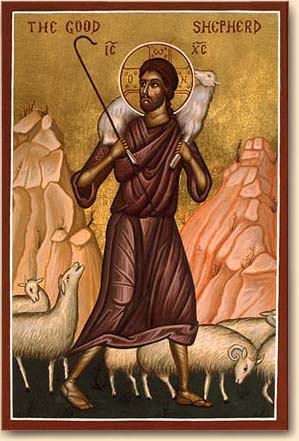
Icon of the Good Shepherd. Public Domain.

Listen to me, O house of Jacob,
all the remnant of the house of Israel,
who have been borne by me from before your birth,
carried from the womb;
even to your old age I am he,
and to gray hairs I will carry you.
I have made, and I will bear;
I will carry and will save. (Isaiah 46:3-5, ESV)

Today is my birthday. I will not tell you my age; suffice it to say that I have reached the age at which I expected to die, when I was a kid. (I place no prophetic weight on that expectation, by the way. Nothing else in my life has gone as I expected, why should this?).

The passage above is from a chapter that intrigues me, because its meaning is implicit. It’s not spelled out. You have to put two and two together. The message of the chapter as a whole is, “The heathen have to carry their gods from place to place with them. Our God carries us.”

This is the testimony of a man who has reached the full span of years he expected in his youth — Jesus Christ has carried me all the way. If I had not been carried, I would not have made it this far.

Edward Gorey’s Cover Art

“Commercial book cover design is a minor portion of Gorey’s award-winning legacy, but not a lesser art. His linear expression and droll comedy are integral ingredients. There are also covers that are stunning for their hidden allusions. The barren landscape, for example, on the cover of The American Puritans evokes an otherworldly quietude, but speaks to concealed psychological demons as well.”

Steven Heller writes about a part of the much-loved illustrator’s work that has been overlooked. “Gorey’s covers and jackets were not done anonymously or as mere throwaways, as many others were. Nor was this a strategic compromise until he found and embraced his true calling.”

I want to look into that Puritan book.

Book Reviews, Creative Culture