
Angel Sarkela-Saur and Andrew Saur have been painting with coffee for years. This video introduces them and their artwork. They mention sending their work to the U.S. Embassy to Malawi in the video. Now they are sending three pieces “Drained,” Dabble,” and “Voyage to Valhalla” to our ambassador to Columbia for a three year stay.
Is the Coffee World Getting Better?
With all the coffee choices we have now, are coffee farmers making more money or expanding their markets like they could not 20 years ago? It doesn’t appear so. Oscar Abello writes about the pitfalls of Fair Trade certification and the clash between what professes to do and reality.
If Fair Trade certified coffee is intended to be sold at a fair price to give workers a fair wage, then why are farms larger than 10 acres allowed to be certified, when they can afford to pay their workers better than small farms.
When Aida Batlle she took over her family’s 38-acre farm in El Salvador in 2002, it was too large for fair-trade certification, even though Batlle claims to pay her workers three times what everyone else is paying, plus transportation and food. After winning El Salvador’s inaugural Cup of Excellence competition in 2003, Aida became something of a celebrity in the “Third Wave” movement of coffee, even getting her own profile in the New Yorker.
One of Batlle’s longest-running buyers is Counter Culture Coffee, founded in 1995 in Durham, N.C. Ten years ago, Counter Culture was still mostly a smaller regional roasting company, trying to get a market foothold by handing out samples in grocery stores. Customers would ask why one coffee from Nicaragua was certified fair-trade and this other one from El Salvador (the coffee from Batlle’s farm) wasn’t. In reality, Batlle’s workers were among the highest paid of all of Counter Culture’s suppliers.
“The idea that this was somehow unfair because there’s no certification on it, no seal, was just maddening,” says Counter Culture Kim Elena Ionescu.
Maybe certification is merely another way to pay bureaucrats for the privilege to say what they want us to say.
In other news, Dunkin Donuts now offers a coffee-flavored doughnut, which makes me ask why they didn’t have this before. Particularly since DD is known for their coffee, I assumed they already had a coffee-flavored doughnut, just as I would assume they zip up their pants. When you notice you point it out like a mistake, not a new idea.
Coffee delenda est

Coffee week, huh? That’s what I get for being gracious, in a moment of weakness.
Getting into the spirit of the thing, I want to recommend to you Mark Helprin’s masterful novel, Memoir From Antproof Case. It’s a moving story about a man who goes into violent rages whenever he smells coffee, or sees anyone drinking it. Needless to say, he’s a sympathetic character.
I wanted to re-post my review, but it seems to be on the old blog, where I can’t search.
Also, on another note, I want to thank Loren Eaton for giving me a mention in his latest review. I have trouble commenting over there, so I’ll say it here.
Now get some sleep. Helpful hint: It helps if you lay off the caffeine.
Craft Coffee’s DNA of Your Taste Buds
It’s coffee week here on Brandywine Books. Come back everyday for wonderful posts and links to coffee-related information bound to bless your taste buds and have you leaping like Arabian goats.
Are you looking for new roasts to try? Startup company Craft Coffee already has a large database in pursuit of their goal to become the Pandora of coffee flavors. Fill out their survey, try their service, and they will apply their algorithms to your tastes to help you find a cup of coffee you love to death.
10 Fictional Coffee Scenes
Benjamin Obler has collected ten scenes or lines which include coffee, like this one from Muriel Spark’s The Comforters.
“Tell me about the voices,” he said. “I heard nothing myself. From what direction did they come?”
“Over there, beside the fireplace,” she answered.
“Would you like some tea? I think there is tea.”
“Oh, coffee. Could I have some coffee? I don’t think I’m likely to sleep.”
Isn’t it terribly English of the Baron to offer tea to Caroline, who’s just fled a religious centre (not a nunnery, not a retreat), has separated from her husband, and is now suffering delusions – hearing the clacks of typewriter keys and a voice narrating her very thoughts! Take comfort in tea. It is in character of the Baron to think so: he’s a man of affected intellectualism, calling the sections of his bookshop “Histor-ay, Biograph-ay, Theolog-ay,” and addressing everyone as “my dear”. But only coffee is up for the job. This is coffee as antidote to madness. What else to clear her head in this fix? They’ve already had Curaçao – that didn’t help. Coffee as realignment. Coffee to reconnect with your own synapses, to reset the senses and solidify reality in the forefront.
Of Norwegians and coffee

Coffee has been a subject of some uneasiness on this blog from the time I climbed on. There used to be a mission statement around here somewhere that said (I quote from memory), “Book reviews, creative culture, and coffee.” It’s no secret to any fair-minded reader that Phil has discriminated against me constantly because I don’t consume the vile stuff.
My isolation is increased by the importance of coffee in Norwegian-American culture. If I had a nickel for every time somebody has said to me, “What kind of Norwegian are you? You don’t drink coffee!” I’d be able to afford… a cup of coffee, I guess, because they cost a lot of nickels these days. But how did coffee get to be so important to Norwegians? I now know the answer, thanks to a book I’m reading.
I was recently given, as a birthday present, an interesting work by Kathleen Stokker, Remedies and Rituals: Folk Medicine in Norway and the New Land. It’s mostly about the superstitious – but sometimes scientifically valid – remedies Norwegians have used through history, and the sometimes celebrated, sometimes persecuted, but always feared people who practiced them.
One of the subjects covered is the use of brennevin (distilled spirits), which held an important place in folk medicine. That touches on the subject of the general use of alcoholic beverages in Norwegian history. The Norwegians, like all Europeans, were drinkers from the earliest times. But they mostly drank beer, and often quite weak beer. Later brennevin appeared, but its use was generally restricted to medicine and celebrations. But in 1817 a law was passed giving every Norwegian farmer the right to distill as much liquor as he liked whenever he wanted.
The result was disastrous. Celebrations became drunken brawls, ending in injury and death. Accidents increased. Productivity decreased. More and more individuals became hopeless slaves to drink.
By the mid-19th Century, people were forming temperance and abstention organizations, and the distillery law was repealed. One of the substitutes suggested to people who wanted to kick the brennevin habit was coffee: Continue reading Of Norwegians and coffee
Lauren Bacall on Writing Memoirs
Lauren Bacall wrote three memoirs over the years. The last one was released in 2005. She said of loving Bogart, “I’d suddenly had this fairy-tale life, at such a young age, who would have thought something like that could happen?”
“Writing a book is the most complete experience I’ve ever had,” she said.
Whit Stillman’s ‘The Cosmopolitans’
Whit Stillman’s next work will be on Amazon.com. A TV pilot episode for a potential series, “The Comopolitans,” will be available through Amazon Studios on August 28. See a cute preview here.
“This has elements of all three of the first films,” he tells Vanity Fair, referring to his 1990 debut, 1994’s Barcelona and 1998’s The Last Days of Disco. “It’s very much like the fourth film, of those three.” He says one has to earn a living, and TV is where one can do it.
He also says he doesn’t watch TV with violence and sex, “so it knocks out almost everything.” Others say he only watches TV on airplanes.
On the Job
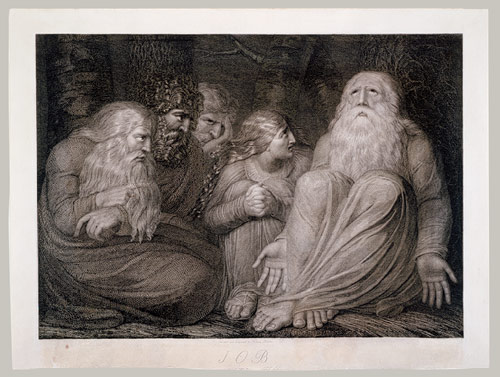
Job’s Tormenters, by William Blake, 1793.
Thought thunk today: The Book of Job is the oldest book in the Bible, one of the oldest books in the world.
What does it say about humanity that in the 8,000 years since, we haven’t managed to surpass it in terms of wisdom?
Update: Ori, tedious pedant that he is, pointed out that my numbers are off by slight margin of maybe 5,000 years.
I wish I were surprised. I’m always doing that with numbers. A counselor once told me that the problem wasn’t in my brain, but in my emotions. Somewhere along the line I developed a fear of numbers that blossomed into functional innumeracy.
But with education, support, and billions of tax dollars you can make a difference. Give today through the United Fund.
Or just buy one of my books. Or double that and buy three.
These Books Were Most Influential on Tolstoy
“This summer on my way to work,” writes The Public Humanist at The Valley Advocate, “I found something just for me in a box of cast-off books on a sidewalk in downtown Northampton . . . a yellowed and fragile New York Times Book Review clipping, from April 2, 1978: a list of the books that Tolstoy was most impressed by, organized by the age at which he read them.”
The list was written in 1891 and includes selections such as Puskin’s poems: Napoleon, Gogol’s Overcoat, The Two Ivans, Nevsky Prospect, Rousseau’s Confessions, all of Trollope’s novels, and all of the Gospels in Greek. (via Open Culture)