Craft Coffee’s DNA of Your Taste Buds

It’s coffee week here on Brandywine Books. Come back everyday for wonderful posts and links to coffee-related information bound to bless your taste buds and have you leaping like Arabian goats.

Are you looking for new roasts to try? Startup company Craft Coffee already has a large database in pursuit of their goal to become the Pandora of coffee flavors. Fill out their survey, try their service, and they will apply their algorithms to your tastes to help you find a cup of coffee you love to death.

10 Fictional Coffee Scenes

Benjamin Obler has collected ten scenes or lines which include coffee, like this one from Muriel Spark’s The Comforters.

“Tell me about the voices,” he said. “I heard nothing myself. From what direction did they come?”

“Over there, beside the fireplace,” she answered.

“Would you like some tea? I think there is tea.”

“Oh, coffee. Could I have some coffee? I don’t think I’m likely to sleep.”

Isn’t it terribly English of the Baron to offer tea to Caroline, who’s just fled a religious centre (not a nunnery, not a retreat), has separated from her husband, and is now suffering delusions – hearing the clacks of typewriter keys and a voice narrating her very thoughts! Take comfort in tea. It is in character of the Baron to think so: he’s a man of affected intellectualism, calling the sections of his bookshop “Histor-ay, Biograph-ay, Theolog-ay,” and addressing everyone as “my dear”. But only coffee is up for the job. This is coffee as antidote to madness. What else to clear her head in this fix? They’ve already had Curaçao – that didn’t help. Coffee as realignment. Coffee to reconnect with your own synapses, to reset the senses and solidify reality in the forefront.

Of Norwegians and coffee

Coffee has been a subject of some uneasiness on this blog from the time I climbed on. There used to be a mission statement around here somewhere that said (I quote from memory), “Book reviews, creative culture, and coffee.” It’s no secret to any fair-minded reader that Phil has discriminated against me constantly because I don’t consume the vile stuff.

My isolation is increased by the importance of coffee in Norwegian-American culture. If I had a nickel for every time somebody has said to me, “What kind of Norwegian are you? You don’t drink coffee!” I’d be able to afford… a cup of coffee, I guess, because they cost a lot of nickels these days. But how did coffee get to be so important to Norwegians? I now know the answer, thanks to a book I’m reading.

I was recently given, as a birthday present, an interesting work by Kathleen Stokker, Remedies and Rituals: Folk Medicine in Norway and the New Land. It’s mostly about the superstitious – but sometimes scientifically valid – remedies Norwegians have used through history, and the sometimes celebrated, sometimes persecuted, but always feared people who practiced them.

One of the subjects covered is the use of brennevin (distilled spirits), which held an important place in folk medicine. That touches on the subject of the general use of alcoholic beverages in Norwegian history. The Norwegians, like all Europeans, were drinkers from the earliest times. But they mostly drank beer, and often quite weak beer. Later brennevin appeared, but its use was generally restricted to medicine and celebrations. But in 1817 a law was passed giving every Norwegian farmer the right to distill as much liquor as he liked whenever he wanted.

The result was disastrous. Celebrations became drunken brawls, ending in injury and death. Accidents increased. Productivity decreased. More and more individuals became hopeless slaves to drink.

By the mid-19th Century, people were forming temperance and abstention organizations, and the distillery law was repealed. One of the substitutes suggested to people who wanted to kick the brennevin habit was coffee: Continue reading Of Norwegians and coffee

Lauren Bacall on Writing Memoirs

Lauren Bacall wrote three memoirs over the years. The last one was released in 2005. She said of loving Bogart, “I’d suddenly had this fairy-tale life, at such a young age, who would have thought something like that could happen?”

“Writing a book is the most complete experience I’ve ever had,” she said.

Whit Stillman’s ‘The Cosmopolitans’

Whit Stillman’s next work will be on Amazon.com. A TV pilot episode for a potential series, “The Comopolitans,” will be available through Amazon Studios on August 28. See a cute preview here.

“This has elements of all three of the first films,” he tells Vanity Fair, referring to his 1990 debut, 1994’s Barcelona and 1998’s The Last Days of Disco. “It’s very much like the fourth film, of those three.” He says one has to earn a living, and TV is where one can do it.

He also says he doesn’t watch TV with violence and sex, “so it knocks out almost everything.” Others say he only watches TV on airplanes.

On the Job


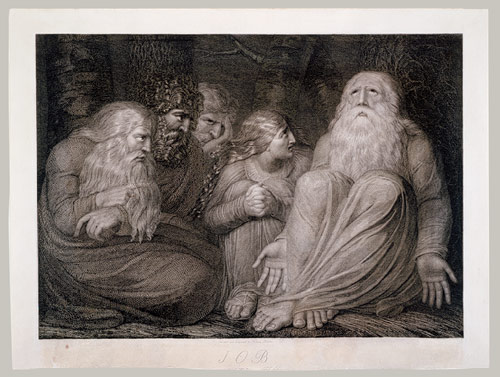
Job’s Tormenters, by William Blake, 1793.

Thought thunk today: The Book of Job is the oldest book in the Bible, one of the oldest books in the world.

What does it say about humanity that in the 8,000 years since, we haven’t managed to surpass it in terms of wisdom?

Update: Ori, tedious pedant that he is, pointed out that my numbers are off by slight margin of maybe 5,000 years.

I wish I were surprised. I’m always doing that with numbers. A counselor once told me that the problem wasn’t in my brain, but in my emotions. Somewhere along the line I developed a fear of numbers that blossomed into functional innumeracy.

But with education, support, and billions of tax dollars you can make a difference. Give today through the United Fund.

Or just buy one of my books. Or double that and buy three.

These Books Were Most Influential on Tolstoy

“This summer on my way to work,” writes The Public Humanist at The Valley Advocate, “I found something just for me in a box of cast-off books on a sidewalk in downtown Northampton . . . a yellowed and fragile New York Times Book Review clipping, from April 2, 1978: a list of the books that Tolstoy was most impressed by, organized by the age at which he read them.”

The list was written in 1891 and includes selections such as Puskin’s poems: Napoleon, Gogol’s Overcoat, The Two Ivans, Nevsky Prospect, Rousseau’s Confessions, all of Trollope’s novels, and all of the Gospels in Greek. (via Open Culture)

Fact-check Your Pastor and Politician

Bob Smietana suggests we may want to fact-check our pastor’s sermons, but don’t do it during the service.

(Did you know that the father of the inventor of penicillin did not save young Winston Churchill from drowning? The things you learn!

R.I.P. Robin Williams, 1951-2014


Robin Williams greets the troops on a USO tour.

You’ve probably already heard the news that Robin Williams is dead at the age of 63. I sat thinking about which of his movies I’ve seen, and I realized I’ve only seen one – Popeye, a film of which I am, as far as I know, the only fan in the world (it helps to appreciate it if you know about the original comic strip, not the animated cartoons).

But the man had an unquestionable gift. Nobody ever did “off the wall” improvisational, stream of consciousness comedy like he did. He always admired Jonathan Winters, but he was better than Winters. He hit the bullseye more often.

Reports are that he died by his own hand, having struggled with depression and substance abuse for many years. One always suspected that he needed artificial stimulation to maintain that manic comic delivery. But he also seemed to be able to work just fine when he had dried out. Still, we don’t know the pressures he was under. I can speak from experience about the pain of depression. Someone like me can always tell himself that if we achieved this or that we’d feel better. What do you do when you’ve reached the top and still don’t feel good about yourself?

I had always assumed – stereotypically – that Robin Williams was Jewish. But his Wikipedia page says he was raised Episcopalian, and remained a member of that church.

We sacramentalists put great faith in the keeping power of God’s grace in baptism and holy communion. Let us pray that Robin Williams has found his long-sought peace in the grace of the Lord Jesus.

Amazon: “Lower Prices!” Hachette: “Profit Margin!”

The Amazon.com dispute with Hachette continues with full page ads in the New York Times and emails aplenty. Hachette’s Michael Pietsch writes, “This dispute started because Amazon is seeking a lot more profit and even more market share, at the expense of authors, bricks and mortar bookstores, and ourselves.

“Both Hachette and Amazon are big businesses and neither should claim a monopoly on enlightenment, but we do believe in a book industry where talent is respected and choice continues to be offered to the reading public.”

Many authors are throwing their weight into the fray. “As writers–most of us not published by Hachette–we feel strongly that no bookseller should block the sale of books or otherwise prevent or discourage customers from ordering or receiving the books they want.” Amazon argues that when paperbacks came out, publishers hated them just like cheap ebooks.

In related news, Amazon is disputing its contract with Disney and withholding pre-orders on select movies.

You know, when you find everyone around you acts like a jerk, the reason could be the common denominator–you.

Book Reviews, Creative Culture