Get Your Political Quotient

Political scientist Tim Groseclose has a book on media bias in which he has tried to quantify and measure political leaning in politicians and voters. His book, Left Turn: How Liberal Media Bias Distorts the American Mind, points to a study showing a difference the decisions of young voters after three months exposure to either the NY Times or the Washington Times. Exposure to the NY Times actually resulted in more liberal views from the readers in the study.

Mr. Groseclose says he didn’t want to write just another book claiming to expose bias among reporters and broadcasters. He wanted a scientific book that proposed solutions. Among those solutions is determining your own political quotient. On his website [site defunct], you can take a 40-question quiz based on congressional roll-call votes in 2009 to see what your PQ is and how it compares to other politicians. This is not an easy quiz. The first two questions are a bit deep in the weeds, but I trudged through them to get a 7.7 PQ.

Even though this is all fairly interesting, I doubt it will change many minds. I hate thinking so cynically, but how many of us think about our civil responsibilities at all? Maybe a book like David Mamet’s The Secret Knowledge will shake us up a bit or one like Mark Steyn’s After America: Get Ready for Armageddon, if we haven’t already written him off, but modern political argument for most American voters seems to be built up from our preconceptions. We believe what we believe, and you’re a brainwashed nut-job if you don’t agree with us.

And yet the Christian in me still holds on to the hope that even this can get better. Maybe I can’t help believing America is exceptional in this way, that all of us really can have liberty and justice.

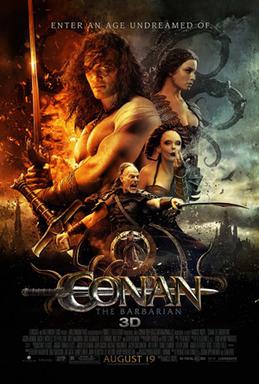
Film review: Conan the Barbarian

With this review, I consciously renounce all right to any respect as a film critic. I loved Cowboys and Aliens, which right-thinking people seem to despise, and now I’m going to admit to the world that I enjoyed the new Conan the Barbarian, which everybody except me and a few Facebook friends seems to loathe.

I’m going to start by moving my recommendation, which I usually leave for the end of the review, to the beginning. The good things I’m about to say about Conan the Barbarian should not be taken as an endorsement for most of our readers. This movie earns its “R” rating. There is much violence, and enough graphic, special effects-enhanced gore to please Odin’s ravens. Also considerable female nudity, often in situations involving bondage. I think this was a major error on the part of the filmmakers. They could have made a movie just as good without voluntarily reducing their paying audience through shock techniques and salaciousness.

On the other hand, the “R” rating is not inconsistent with the original material.

I approached Conan the Barbarian with something less than low expectations. I mistrusted the re-boot project from the first, and Michael Medved, whose opinion I respect, hated it. So I was pleasantly surprised when, somewhere along the way, I realized I was enjoying the show. Continue reading Film review: Conan the Barbarian

Survival story

I finished reading the history book from Kvalavåg (one of my ancestral homes in Norway) about which I wrote the other day. Most of it is stuff that wouldn’t interest you much, but there was one amazing paragraph in the section on the German occupation during World War II (my translation follows):

One of the leaders of the 14-man German troop was Konrad Grünbaum. He was actually of Jewish origin, and came from the city of Furth. His civil occupation was metal work, and he had been an active member of the Socialist Workers’ Youth. Before the war he himself had been in Dachau concentration camp. He had been accused of illegal work and sentenced to three years’ punishment. Through an error he came to Norway in ̀́41 and was promoted. Grünbaum himself said later that he had had very good relations with the people in Kvalavåg while he was there, up until 1943. People used to call him “the Englishman” because he spoke only English with the people. Others called him “Grandfather.”

What a bizarre story. I can only imagine the terrors he must have suffered, worrying in his bed that somebody in Personnel would notice his ethnicity and denounce him. And after the war, what must he have felt, when he pondered the cosmic lottery win that saved his life when so many others perished?

More on Blogging: Curiosity

Trevin Wax talks about what makes a blog interesting. He boils it down to curiosity. “Curiosity works itself out in two ways,” he notes.

  1. “The blogger provokes a sense of curiosity and wonder in his or her readers.”
  2. “The blogger has an innate curiosity that enables him or her to write from a unique perspective.”

Naturally, I’m sure he’s a big fan of BwB. I mean, how could he not be?

"Never mind," Black Death edition


“The Plague in the Stairway,” by Norwegian artist Theodor Kittelsen

You know how they taught you in school that the Black Plague was caused by fleas carried by rats?

At least according to one scholar, this is probably a slander on fleas and rats.

“The evidence just isn’t there to support it,” said Barney Sloane, author of The Black Death in London. “We ought to be finding great heaps of dead rats in all the waterfront sites but they just aren’t there. And all the evidence I’ve looked at suggests the plague spread too fast for the traditional explanation of transmission by rats and fleas. It has to be person to person – there just isn’t time for the rats to be spreading it.”

He added: “It was certainly the Black Death but it is by no means certain what that disease was, whether in fact it was bubonic plague.”

People at the time believed it was caused by “bad air.” Maybe they were right, if it was caused by human-to-human contact.

G. K. Chesterton would have loved that.

Film review: Twelve O'Clock High

I’m sure every one of you has seen the movie Twelve O’Clock High already, but I never saw it until last night. I know I write too much about movies in this books blog, but I want to meditate on the film a little bit, particularly as an exercise in storytelling. It’s a superior example of the art.

What you’ve got in Twelve O’Clock High is two layers of story going on at one time. There’s the surface story—the sort of thing a small boy watching it would come away with, and then there are the truths the story conveys, buried under the surface but identifiable if you’re looking for them.

The surface story is pretty simple. The 918th Heavy Bombardment Group, based in England at the very beginning of American participation in World War II, is suffering heavier than average losses. The men, and their commander, Col. Keith Davenport (Gary Merrill), think they’re jinxed. Their commanding general thinks the problem is more practical, and sends in hard-nosed Brig. Gen. Frank Savage (Gregory Peck) to whip the unit into shape. This he does, through hard—sometimes cruel—discipline. As the men learn to repress their individual fears and concerns and operate as a group, they manage to achieve their goals and lower their losses.

But that’s not the real story. The real story is what’s going on inside the men. I don’t mean any disrespect to John Wayne (frankly I think John Wayne could have handled the Frank Savage part just fine), but you understand what I mean when I say this isn’t the typical kind of war movie we associate with John Wayne. Gregory Peck’s Gen. Savage sometimes pushes the men too hard, and he’s not as confident as he seems. There’s a splendid little moment when his adjutant, Lt. Col. Stovall (Dean Jagger) says, “You know the difference between Col. Davenport and Gen. Savage? Gen. Savage is about this much taller.” In the end, Davenport’s and Savage’s roles get very neatly reversed.

Because the real message here is that war is impossible. Fighting in a war is like walking a tightrope while carrying ever heavier burdens, while crosswinds change at random. No man can bear the strain indefinitely. The strongest iron breaks at last, through constant fatigue.

A friend of mine who’s a combat veteran says this is the most realistic war movie ever made. That’s remarkable when you think that it was made in 1949, taking into account all the special effects advances that have been made since then, and changes in audience toleration for on-screen gore. What sets Twelve O’Clock High apart is outstanding storytelling, a profound understanding of the human heart.

Blogging Ain't About You

Jeff Goins writes, “When I first stated blogging, I was pretty proud of the fact that my writing was being published to a small audience and that they were actually reading it. It felt good to be acknowledged. Really what I was, though, was an insecure writer clinging to every pitiful page view.”

Ouch.

Anne Overstreet's "Surviving the Open Heart"

Jeffrey Overstreet’s wife, Anne, has a debut volume of poetry on the shelves at all the best bookstores near you. It’s called Delicate Machinery Suspended: Poems. Here’s the poem that contains that title.

The hotel fan’s one long drawn exhalation

disturbing the heat that has settled like dust

across the room, the square-cornered chair

the unsteady spool of table. You are broken

into pieces and lie scattered …

Read more

Political noodling

In case you’re a visitor to Brandywine Books, I need to make it clear that two political posts in one day is a great rarity here. One political post in a day is a rarity. Phil and I generally eschew political comments (we don’t even have a Politics category), in favor of the far less controversial subject of religion.

But I’ve been worried the last few days. First President Obama (peace be upon him) visits Cannon Falls, Minnesota, just up the road from Kenyon, my home town. The next day he’s in Decorah, where I spent a year at Luther College sometime around the Coolidge administration. It began to look as if he were stalking me. Perhaps he finally figured out that my tin foil hat prevents him from controlling my mind with his delta rays, and he’s trying to follow my trail instead. About thirty years in my rear view mirror, but that’s civil service work for you.

However, I remember that one of my high school classmates actually graduated from Luther College. So it’s probably him the president is stalking.

Whew. That was close.

If I understand the news reports correctly, a lot of people are saying Michele Bachmann isn’t qualified to be president, because she opens her mouth to eat a corn dog.

I have to assume that sophisticated, civilized people who attended Ivy League schools have some superior method of eating their corn dogs. If anybody knows what it is, I’d appreciate hearing about it, because I always end up dripping ketchup on my shirt.

But Rep. Bachmann’s campaign is over anyway, it seems to me. She confused the anniversary of Elvis Presley’s death with his birthday.

You can get away with a lot in American politics, but I’m pretty sure messing up your Elvis essentials takes you beyond the pale.

The nice thing about being beyond the pale, though, is that you can eat your corn dog any bloody way you like.