


I have now finished reading all four of “James Church”’s Inspector O novels. (“O,” by the way, is not an initial. It’s the man’s family name.) I can’t claim to understand them fully, but I unquestionably enjoyed them. They are tragic stories, but they didn’t depress me.
Quite remarkable books, all in all. I won’t forget them.
I’ve reviewed the first book, A Corpse in the Koryo
The second book, Hidden Moon
The third book, Bamboo and Blood
The final book, The Man with the Baltic Stare
Finn Now, Hemingway Next
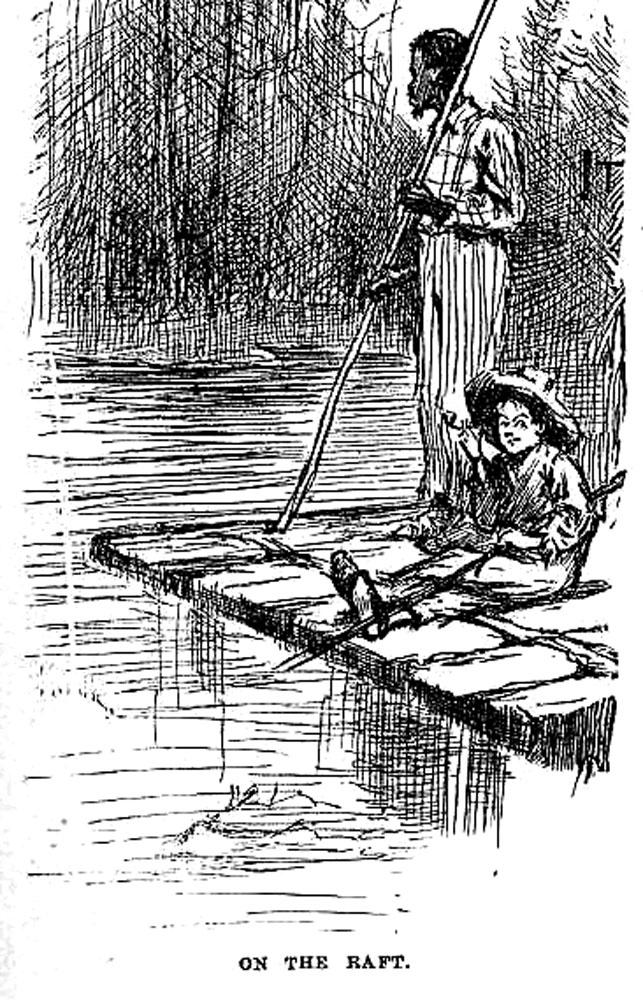
D.G. Myers picked up on the story Lars linked to yesterday, saying the word slave doesn’t have the humanity needed to communicate the story in Huckleberry Finn. If this scrubbing of the text flies, Hemingway’s Sun Also Rises may be next. We can’t have a character described as “superior and Jewish.” What would the Greeks say? (via Books, Inq)
"Huckleberry Fi" (n's removed)
This Is Just Too Weird Dept.: Tonight when I came home from work, precisely as I pulled Mrs. Hermanson into the garage to leave her for the night, her odometer turned over 100,000 miles.
I think there can be no question that this is a Sign and a Portent.
But of what, I wonder?
According to this article from Entertainment Weekly (Tip: Big Hollywood), NewSouth Books is bringing out a new edition of Huckleberry Finn, aimed at students. Every instance of the “n” word (you know the word I mean) has been changed to “slave.” And every instance of “Injun” has been changed to… something. They don’t say what.
“Is this really a big deal?” the columnist asks.
Yeah, I kind of think it is.
On the other hand, if this puts the book into the hands of kids who would not otherwise be allowed to read it due to forces beyond their control (overprotective parents and the school boards they frighten), then maybe we shouldn’t be so quick to judge. It’s unfortunate, but is it really any more catastrophic than a TBS-friendly re-edit of The Godfather, you down-and-dirty melon farmer? The original product is changed for the benefit of those who, for one reason or another, are not mature enough to handle it, but as long as it doesn’t affect the original, is there a problem?
My opinion (I could, of course, be wrong), is that if a student is old enough to understand the extremely sophisticated themes of Huckleberry Finn, he or she is old enough to understand that the “n” word, while always offensive, was in very common use in Mark Twain’s time, even by black people themselves. I think that’s a fact worth knowing. Educational, even.
“Ah ha!” says someone. “But you’re saying ‘n word’ yourself! You’re a hypocrite!”
“Silence, Imaginary Interlocutor!” say I (I might as well. Anthony Sacramone isn’t using the phrase much these days [I just tried to link to his dormant blog, but now it won’t let you in without a Google account]). The truth of the age I live in is that the “n” word is no longer in common use, except as an insult (and in rap lyrics). If I tried to use it in Mark Twain’s way, I’d be as false to my own world as it’s false to his to clean it up in Huckleberry Finn.
I hold (again, I could be wrong) that when it comes to speech, the Victorians were able to express themselves with far greater freedom than we enjoy today.
Lemony Snicket on Reading Poetry
Author Daniel Handler writes about reading and loving poetry.
If you were to walk into my living room on some weekend night, that would be creepy. But before I stood up alarmed and demanded to know what you were doing there, you would see me in a big black leather chair that, I’ve been told, is too big for the room. I’d be all dressed up, and reading poetry.
Looking Forward to 2011 Books
Sherry has some interesting books coming in 2011. (via Out of the Bloo)
Auld Lang Syne
Christmas/New Year’s went just fine. The family gathered, made merry, and departed without incident. I can’t think of any rational reason to think I messed up in any major way as a host. Which doesn’t, of course, stop me believing I did.
We got enough snow today to justify my going out and blowing it out of the driveway after work. Interesting snow. It was in no way sticky (it’s far too cold for that), and yet it tended to clump up in the chute anyway, having to be cleared out. Which could generally be done by jerking the front up and down, because the dry snow fell right out again.
A Facebook friend alerted me to this video of Sissel doing “Auld Lang Syne” (mostly in Norwegian). The version I first saw was somebody’s creative mash-up, incorporating a rather banal poem and pictures of cuddly forest creatures. Fortunately I was able to find a clean version:
I don’t like the androgynous look on Sissel at all, but I think I’ve never heard her in finer voice.
Happy New Year.
Writing Is Like Driving Sheep
C.S. Lewis on those who are born to write and how writing is like driving sheep down a road. “If there is any gate open to the left or right the readers will most certainly go into it.”
Toasting the Professor
Today at 9:00 p.m. local, we (meaning me and whoever wants to join me) are toasting Professor J.R.R. Tolkien on his birthday. There’s a Facebook page about it and you can read other laudatory comments at the Tolkien Society site.
So far, I'm doing pretty well

I’ve been remiss in making Achievable New Year’s Resolutions the last few years. As I’ve explained in the past, it’s my custom to celebrate a high self-esteem holiday by setting achievable goals for myself during the upcoming swing around the sun.
So here are my Achievable Resolutions for 2011:
I will not learn to speak Classical Korean.
I will not make a solo voyage across the Atlantic.
I will not ask my congressman (Keith Ellison) to recommend me for a place at West Point.
I will not go into the Organic Foods business, either wholesale or retail.
I will not throw a wooden shoe into a steam loom.
I will not go on an all-escargot diet.
I will not attempt to give a ninja a wedgie (I’ve learned my lesson on that one).
I will not sign a non-aggression pact with Germany.
I will not pursue the legendary White Buffalo.
I will not paint an armadillo blue.
I will not steal a manhole cover.
I will not play hard to get with Gabrielle Anwar.
And a happy New Year to you, too!
Fairy Tale as Crime Fiction Contest
John Kenyon has a short story contest announced on his blog, Things I’d Rather Be Doing. He calls for stories that update a fairy tale as crime fiction. This could be pretty good. Many fairy tales would make crime stories without any alteration at all. Snow White has at least two counts of attempted murder. Another story with Snow White and Rose Red has stalking, bribery, and a manhunt. Rumpelstiltskin has kidnapping. Many of them have what amounts to drug abuse.
Not to mention gnomes, the scariest, most wicked creatures in the whole forest. If you see a tiny cone-shaped hat while walking in the woods, don’t wonder, don’t call out, don’t get out your camera. Just run. Run like you’ve never run before.
