Tag Archives: James Scott Bell

‘Down These Streets,’ by James Scott Bell

He was my height—six feet—but if I curled up I could have fit into his chest.

I’m not a big fan of short story collections. Short stories are fine in their natural habitat, taken one at a time. But in bunches I find them bumpy reading – I get invested in a couple characters, and then they find their destinies and I have to jump into somebody else’s life.

Still, I do enjoy James Scott Bell’s writing. So I figured I’d pick up Down These Streets, his big (and I mean big – north of 700 pages) short story collection. (The title is inspired by a famous line from Raymond Chandler’s essay, “The Simple Art of Murder.”) He pretty much throws in everything, from hard-boiled tales to “twist” stories in the O. Henry tradition, to a series of light action stories about a hard-luck boxer named Irish Jim Gallagher (inspired by Robert E. Howard’s Sailor Steve Costigan), to flash fiction, including a few that are just re-tellings of old jokes.

I liked the hard-boiled stuff. The Irish Jim stories were fun, particularly one long in which the world, the devil, and the majesty of the law seem to have conspired to prevent his keeping an important date with his girl (this story, amazingly, features cameo appearances by both Marilyn Monroe and Dr. J. Vernon McGee – and how many stories can make that claim?).

Many of the shorter stories seemed to me rather slapdash, but they didn’t take long to read.

I didn’t love Down These Streets, but it kept me entertained for several days, and you may enjoy short stories more than I do.

Recommended. No profanity.

‘Romeo’s Truth,’ by James Scott Bell

I always look forward to a new entry in James Scott Bell’s Mike Romeo series. The latest volume, Romeo’s Truth, is (as I announced yesterday) adorned by a quotation from a review I did, on this blog, of a previous installment, placed first among the review blurbs at the front. Proving that not only is author Bell a good writer, but he recognizes fine criticism.

Mike Romeo, if you aren’t yet familiar with him, is a very big, strong man. He’s a former cage fighter and a self-educated genius. He goes about doing good in the world, kicking butt and quoting the classics.

In Romeo’s Truth, Mike is on a job for Ira, his lawyer boss, when he stops at a diner in California’s Central Valley. He observes a big guy beating up a little guy in the parking lot and (of course) steps in. This is the inciting incident that will soon have him involved in a simmering dispute between a local rancher and anti-meat agitators (in case you’re wondering, this book is entirely on the side of the carnivores). Soon his lawyer will have a new client (the little guy who got beat up, up on a murder charge), and a great need to tear the cover off a conspiracy of people who do not hesitate to blow up buildings or shoot people. No matter – getting Mike Romeo mad is one of the classic strategic errors.

Romeo’s Truth isn’t the best of the series, but it’s plenty of fun – a fine entry in a series which provides the joys of hard-boiled detective stories for audiences who prefer their fiction clean. Mike’s relationship with his new wife, Sophie, sometimes approaches the realm of the cutesy, but never goes quite that far. Self-awareness saves them from that.

My only real quibble is with a “fact” delivered in a throwaway line – Mike says that the Vikings had double-headed axes, which isn’t true.

That is, of course, unforgiveable. But otherwise, it’s a great story.

I am now a blurber

What was my surprise to open up James Scott Bell’s latest Mike Romeo novel, Romeo’s Truth, and find that one of my own reviews on this blog was quoted as the very first blurb at the front of the book?

James Scott Bell has produced gold in the Mike Romeo series, about a one-time cage fighter and certified genius on a quest for virtue. I want to be Mike Romeo when I get younger. Highly recommended.

My thanks to author Bell. I’m enjoying Romeo’s Truth.

‘Romeo’s Fire,’ by James Scott Bell

I was tired. Tired of thinking about death. I remembered something Kafka said, that the meaning of life is only that it stops. I wanted to punch Kafka in the face. But he’s dead too.

James Scott Bell’s Mike Romeo books are pleasant, fairly light action mysteries in the hard-boiled genre. James Scott Bell, a top-level Christian novelist, knows his business. His main character here is a former cage fighter who now works as an investigator for a wise old Jewish attorney in Los Angeles. Mike is a great reader, always quoting the classics.

In Romeo’s Fire, they have a new client, a homeless boy who killed another homeless man with a knife. He claims self-defense – it’s the use of a knife in California that got him in trouble. Mike’s boss thinks he can plead down to manslaughter and get the kid off with no jail time. They get him remanded to a group home, from which he promptly disappears. Now it’s Mike’s job to find their client.

One amusing element in this story was that after Mike gets arrested (of course he gets arrested. Doesn’t every private eye get arrested in every private eye novel?), he solves the problem the old-fashioned way, by just bulling through a police guard. He makes it work too.

Also notable is the realistic depiction of today’s Los Angeles, especially its homeless problem and impotent police protection. There are also Christian themes, which author Bell renders more palatable through making Mike a seeking agnostic.

The Mike Romeo mysteries are always fun. I recommend Romeo’s Fire, and James Scott Bell is a fine storyteller.

‘Sins of the Fathers,’ by James Scott Bell

But then the guy smiled. His teeth were like pylons coated with ocean grime.

I’m a great fan of James Scott Bell, one of our best Christian thriller writers (after Andrew Klavan, of course). But for me at first, Sins of the Fathers labored under a few handicaps.

First of all, there’s a female protagonist. I just avoid them in these days of Mary Sues (not that a male writer is likely to write a female Mary Sue.)

Secondly, the setting is early in the 21st Century, when conditions in our country (and specifically in Los Angeles, where this story is set) were somewhat different from today. This was the days of tough, lock ’em up LA prosecutors (I believe one of our current presidential candidates was part of this). It was a very different environment from what we see in California today.

Finally, this is an expressly Christian novel. It’s not the kind I generally prefer, where the Christianity is mostly subtextual (though Heaven knows I don’t practice what I preach in my own books).

So I was a little slow getting into Sins of the Fathers. But it won me over, decisively.

Lindy Field is a defense attorney, but she hasn’t worked in a while. She suffered a bitter defeat in the case of a minor she defended, and she suspects a police cover-up. She actually suffered a psychological breakdown, and hasn’t worked for a while.

But her legal mentor asks her to take on a fresh case. It’s a high profile one, concerning a boy who opened fire with a rifle on a middle school baseball game, killing several boys and one coach. Public anger is high. A powerful victims’ advocacy group is calling for the maximum penalty.

Even worse, the assistant DA who beat Lindy on the last case will be prosecuting this one.

But her mentor thinks she can win. Get a sentence of mental incapacity for the kid. He says he believes in her. So she takes the case.

It will lead to frantic social pressure, media scrutiny, and an attempt on her life. But Lindy – for personal reasons that are only gradually revealed – needs to hold on. She needs to save this kid.

In terms of characterization and plot, I’d say Sins of the Fathers is as good as any thriller novel I’ve ever read, whatever the intended audience. There were delightful surprises, and I was moved by the book’s resolution.

I’ll admit I thought there was a little too much “God talk.” People bringing up Christ and faith in casual conversation, so that the message of the book could be explicitly stated. Of course, this was nearly 20 years ago. Society was different then. You could probably discuss such things in an LA courthouse in those bygone days.

Anyway, if you’re looking for an overtly Christian thriller, written at the very highest level, I can wholeheartedly recommend Sins of the Fathers.

‘Romeo’s Justice,’ by James Scott Bell

This will be a short review – probably shorter than the book deserves. But I’m busy playing Viking in Minot, snatching a few minutes before bedtime, and I’m kind of tired (the festival is going fine; thanks for asking). Anyway, I love all the Mike Romeo books, so what is there new to say about Romeo’s Justice?

Mike Romeo, erudite Los Angeles private eye working for Ira, an ex-Mossad attorney, beats up an obnoxious type at the very start of the book, just to set the tone. The guy deserved it. Then he has a date with his girlfriend Sophie, who is learning to coexist with Mike’s forceful ways.

Ira asks Mike to take on a case from Noel Auden, a mother whose son recently (ostensibly) committed suicide. He had left their Catholic faith to explore spirituality at a school called the Roethke Spiritual Center, out near the Salton Sea. According to his suicide note, he did it because of global climate change, but Noel wants to be sure, in light of the seriousness of suicide in Catholic doctrine.

Mike goes out and starts poking around, asking questions. As you’d expect, there is pushback from some nasty characters, as well as from the police, most of whom are in the pay of a local energy tycoon. But that’s all in a day’s work for Mike Romeo.

Romeo’s Justice was not full of surprises, but it was full of Mike’s personality and Bell’s prose, the things that bring us back. Important issues are addressed. A resolution is found in the end.

Good book. Well worth the price.

James Scott Bell interview

Above, an interview — a few years old — with author James Scott Bell. Among the topics touched on are whether writers are born or made, and if a series character can have a character arc.

He mentions his blog, Kill Zone, which I wasn’t aware of. You can find it here.

The Moster Play, and other matters

I did something today I never do. I quit a book I actually liked. I’ve outgrown the idea that you have to finish every book you start reading. Life’s too short, especially at my age. So if I think a book is badly written, or if it offends me, I’ll just remove its download from my Kindle.

But why would I drop a book whose values please me, and which I find well-written?

Because I’m a wimp. Which will not surprise our regular readers.

I should at least give the author credit. He’s one of my favorites, James Scott Bell. The book is Can’t Stop Me. It’s about an ordinary guy, a lawyer and family man, who is suddenly targeted by an old college acquaintance who seems to have no purpose other than to force himself into his life. The stalker employs innuendo and suggestion to threaten the hero, always keeping within legal limits. The worst thing is, he happens to know the hero’s oldest and darkest secret.

This is an old book of Bell’s which he’s revised slightly for re-release. It shows some signs of being early work, but is overall very well written.

And it gave me the willies. This kind of story – the kind where ordinary people face dangers they’re not prepared for, really bothers me. I suppose it’s because I know I wouldn’t survive ten minutes in such a situation.

A writer ought to have thicker skin.

Anyway, if you’re braver than I am, I recommend it, even though I chickened out a third of the way through.

In other news, I remembered today that I need to renew my passport. I’d put it away with the unpaid bills so I wouldn’t forget it, and got so used to seeing it there that I forgot it. I should have done it earlier – now I’ll be passportless for a short while. Not that I expect to need it. I tend to use a passport one time before it expires. This one I’ll probably never use at all.

But I like to have one. I’m an international man of affairs, after all. I never know when I’m going to be summoned to receive a medal from the king of Norway.

But 130 bucks for a passport? I’m pretty sure my first one, back in the ’80s, cost $40.

Speaking of Norway, I mentioned Mosterøy in Norway in yesterday’s post, and said not to confuse it with Moster on Bomlø. I visited that Moster last summer too. It was the home of the mother of King Haakon the Good (who was related to Erling Skjalgsson’s family). They do a historical play in an amphitheater there every year (video above). My two guides, Tore-Ravn and Einar (the two on the left in the photo below, with the historic Moster Stone), are extras in the play, and take great pride in it.

James Scott Bell’s best writing advice

Still haven’t finished the book I’m reading for review. This would seem to argue that I’ve been busy and productive, but I don’t feel busy and productive. However, this is irrelevant. I learned long ago that my feelings are of very little practical use.

So, another video tonight. Here’s a short clip from one of my favorite authors, James Scott Bell. He’s talking about a discipline many writers have found valuable — giving yourself a daily quota of words to produce. Like compound interest, this practice yields remarkable results over time.

I have written this way at times in my long life, but it’s been a while. Most of the time, I can write only so much at a sitting. After my small ration of creativity has run out, I end up sitting at the keyboard, frustrated. I am then overcome with guilt and turn to drink and drugs.

Okay, I don’t turn to drink and drugs. But I understand the appeal.

Anyway, I just took up rising early to write, and that’s upped my output considerably. So get off my back, James Scott Bell.

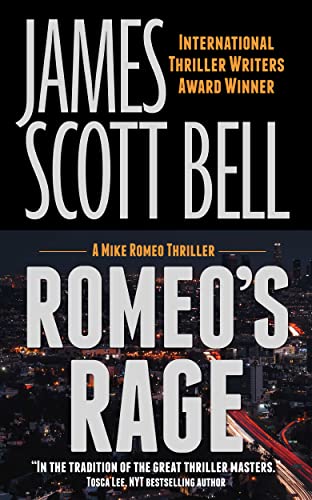
‘Romeo’s Rage,’ by James Scott Bell

Sometimes somebody has an idea that just works. When an author comes up with a series character who engages mind and heart, and places him or her in stories that mean something to the reader, he’s got gold. James Scott Bell has produced gold in the Mike Romeo series, about a one-time cage fighter and certified genius on a quest for virtue. Romeo’s Rage entertained me and moved me.

Mike Romeo gets a call from a friend, a reformed gang member who now does Christian ministry with urban youth. It’s a hush-hush thing – the friend knows about a “package,” a child being delivered for prostitution purposes. He doesn’t have to ask twice for help in intervening. Mike and his friend execute a professional extraction and get the little girl to an “underground railroad” site.

Then things turn bad. The girl is taken again, and Mike’s friend is killed. They underestimated the bad guys.

Mike was mad about this criminal operation from the start. Now he’s really mad. And they won’t like him when he’s mad.

As Mike makes his plans and implements them, he’s assisted and restrained (somewhat) by his boss, Ira Levin, a wheelchair-bound ex-Mossad agent and current lawyer. Also he’s reevaluating his relationship with his girlfriend Sophie. He truly loves her, but feels her being close to him will make her a target – if not now, someday. If he loves her, he feels, he’s got to break it off.

Of course, Sophie might have something to say about that herself.

I want to be Mike Romeo when I get younger. Romeo’s Rage was thrilling and moving. I shed manly tears. Highly recommended.