Yesterday and today have been quiet days for me, for reasons I won’t itemize. Suffice it to say I’ve been unwell, in a manner that makes leaving the house inadvisable. I think I’m beginning to recover now. No great distress, just… inconvenience.
And no, there’s no fresh news about my car. They told me the end of the month; kind of pointless to nag them until then. Maybe I’ll just keep the loaner and call it even.
But I’m working on my revisions to King of Rogaland. At this stage I’m working with red pen on a printed manuscript, rather on screen. There are two reasons for this. One is that ink on paper just reads differently for me. That’s an odd thing to say for someone who reads almost exclusively on Kindle. But I don’t feel I can “grasp” my manuscript until I’m literally grasping an inch or so of ream in my hands.
The second, more practical reason is that I often have to page back and forth to see if one passage about a character or subject matches things I’ve written about it elsewhere. Continuity, it’s called. I find that a whole lot easier to do with physical paper. Riffling through dead tree pages is different from scrolling through screen pages, and it feels less daunting.
What I’m doing at this stage is, I’m becoming a student of my own book. I wrote it all, but I wrote it in various moods and states of alertness. There are themes there I need to bring out, and rabbit trails I need eliminate. In a sense the book itself is telling me what it wants to be. I just have to listen to it.
Do I like what I’m reading?
As a matter of fact, I do. I even find it moving in spots.
“For a lot of people, the definition seems to change to fit the times and the culture of the moment. My definition doesn’t change. It isn’t about judges, who can be biased. It’s not about courts and laws that can be corrupted. To me, justice is nothing more or less than truth. Justice requires that the truth of Dr. Siphuncle’s actions must be revealed, and that he must suffer the consequences of that truth.”
Dean Koontz, who likes nothing better than changing things up, has given us a second “season” of novellas about his character known only as “Nameless.” But there are differences. In the first series, released back in 2019, we followed Nameless on his strange “assignments.” He is a man with no memory of the past (he suspects this was by his own choice). When he arrives in a town he finds a car waiting, and he has hotel reservations, a weapon, and support resources. He is given instructions about his assignment, which generally involves either exposing or killing some genuinely evil person who thinks himself untouchable. At the end of the first series, Nameless (and the reader) learned his true identity, along with the shattering causes that led him to this mission.
Now he’s back for Season 2, with his amnesia restored, carrying out missions following the same pattern. But things have changed a little. His missions seem less well-planned now. He encounters surprises – sometimes dangerous ones – that weren’t bargained for. And for some reason, arrangements of roses greet him in every hotel room he stays in. But strangest of all, he’s having disturbing premonitions, of a dystopian near-future in which a great popular movement of hatred and authoritarianism transforms America into a ruthless killing ground.
The stories have sufficient continuity that they could have been published as a single novel, albeit an episodic one. But the author and publisher have chosen to release them as novellas, and they work fine in that form. I enjoyed them very much, though be prepared for a few tears at the end.
Author Ian Rankin said his first two Inspector Rebus novels were based somewhat on Robert Louis Stevenson’s Dr. Jekyll and Mr. Hyde. Readers, he said, didn’t notice the similarities in Knots and Crosses, released in 1987, so he dropped all subtleties and screamed out parallels in Hide and Seek, released in 1990.
Sections begin with Jekyll-and-Hyde quotations. Character names are borrowed. The plot focuses on someone or something named Hyde. And there’s an anti-drug campaign gearing up in the background. It’s a much darker story than the other two Rankin novels we’ve reviewed here, which may point in the direct of future books. The next one deals with a cannibal–maybe I won’t jump into that one just yet.
In Hide and Seek, the police are called to a dilapidated row house, one of many squats for junkies and other homeless. They find Ronnie dead of an apparent overdose, arranged on the living room floor with a couple candles and a pentagram drawn almost perfectly on a near wall. Could this be the victim of some black coven’s ritual or did his hard life simply catch up to him?
Forensics reveal the drug found by the body were not the same as what was found in the body. This man injected himself with rat poison, so it would be natural to conclude his dealer wanted him dead. Plus the last person likely to have seen Ronnie alive claims he knew someone wanted him dead.
As Rebus is pulled off of all other cases in order to give time to the chief’s new anti-drug campaign, he has the time to ask questions and make requests of DS Brian Holmes for some shoe-leather work.
In one sense there is no case here. Someone unreliable is claiming foul play, and it doesn’t make sense that Ronnie would inject himself with poison. But maybe that’s all that happened and the pentagram is art on the wall. But what does Rebus’s gut tell him? It tells him to keep asking questions.
I’ve enjoyed what Rankin’s writing so far and intend to read more. I think they will improve as they go. He winks at us with his new Detective Sargent Holmes, a young, well-grounded officer who isn’t sure Rebus is trustworthy yet, and Chief Superintendent “Farmer” Watson, who sees the good in everyone he meets and drinks orange juice at a bar.
Rebus spent a little time looking for a new church between this book and the last, possibly having trouble finding one sufficiently gospel-free. Repentance is no good. Cheery optimism isn’t either.
There’s an odd description of a minor character as the most Calvinist-looking man in the room. That’s a Scottish way of saying someone is severe-looking, I think. Perhaps Americans would use “puritan” the same way. There’s also a mild defense of homosexuality, but it seems realistic, not advocative.
I watched Amazon Prime’s The Tomorrow War, starring Christ Pratt and Yvonne Strahovski. Everybody’s talking about it, and the praise has been about equal to the derision among my friends on Basefook.
I liked it fine. I’m not in a position to review it properly, because I had it on mainly as background noise while working on the new Erling book. I keep hearing about plot holes, and plot holes are a congenital problem in time travel stories. I have to admit I didn’t catch the holes. The story worked pretty well for me, and there was a satisfying resolution.
My problem with the movie was the same thing that keeps coming up in action movies (and books) everywhere nowadays – the equal participation of women in violence. I confess to my great, patriarchal sin – I hate seeing women slaughtered.
Now logically, in a situation like that in this movie, where the women are going to die horribly anyway if they lose, so they might as well fight, it makes logical sense.
But for me, it’s not entertainment. And I think it’s intended to desensitize us to violence against women, for political purposes.
So that was my problem with the story. Otherwise, I enjoyed it. Even teared up a little (in a manly way) at the end.
J. K. Simmons, as usual, was great.
Meanwhile, I came up with a new scene for the Erling book that pleased me quite a lot, in concept. Based on material in Flatey Book, mostly unknown to Heimskringla readers. Only I couldn’t figure out how to finish the scene, how to bring it home.
This morning, in the process of waking up, the resolution became clear to me.
And it rested on a point of theology I’d been contemplating the other day.
I haven’t written down any dates, but for the last ten years or so with all the push to stop using incandescent bulbs, I’ve purchased several CFLs that did not last as long as I thought they should. Has that been your experience as well?
I remember touring an energy-saving model home at a museum in Georgia and the guide saying CFLs were super longlasting. The Internet is saying they could last five to ten times longer than incandescent blubs. My wife almost derailed the guide by asking if their long life relied on leaving them on most of the time. Our CFLs have burned out just as quickly, if not more quickly, than regular bulbs, and maybe that’s because we turn off the lights when we leave the room, like our fathers taught us to do. (We’re not lighting the whole neighborhood, are we?)
As I type, it occurs to me the lights in this room have been in place for a very long time, at least long enough for me to forget when I put them in. They’re probably LEDs.
We wrote last year about the number of filaments Edison actually tested, because folklore has run away with that number. Today, I offer you a video that shows a light bulb that has been burning since 1901 and the story of a group of businessmen who conspired to keep light bulbs from becoming nigh-perfect.
Returning to the church, Gareth made his way back inside, through the paneled porch, and was aware immediately of the smell of the building, the tang of cold stone mixing with the sweet scent of varnished wood, of candles and books and history. He breathed deep, secretly hoping to take in some of the ancient peace that he always sensed buildings like this contained, as though they somehow saved up humanity’s prayers, acting as great spiritual batteries where people could go to be recharged somewhere.
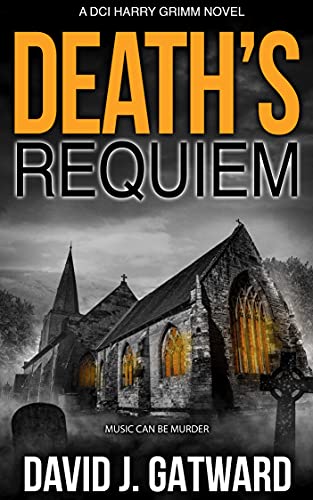
In the previous five books of David J. Gatward’s Harry Grimm series, we have seen how Inspector Grimm transferred from Bristol to the idyllic Wensleydale area of Yorkshire. A hulking, facially scarred veteran paratrooper, Harry was prepared to experience (and exploit) the natural fear he inspires in most people. But the easygoing crew in the town of Hawes resolutely refused to be intimidated by him. They welcomed him into their circle and their community, and he’s beginning to enjoy the life – and even the food. Death’s Requiem picks up the story during the worst snowstorm in years.
The nearby town of Askrig is the home of an internationally famous pop singer, Gareth Jones, who recorded “that Christmas song – you remember.” Following the death of his wife and a scandal that marred his clean public image, he has chosen to launch his new album with a concert in the church, where he used to be a choir boy. All his old friends gather for the concert, as well as a standing-room-only crowd of other locals. The concert is disrupted at one point by intruders dressed as Satanists, but they are soon gotten rid of. Otherwise, the concert is a triumph.
But the next morning, the female vicar finds a body hanging from a bell rope in the tower, surrounded by Satanic graffiti on the walls. Inspector Grimm and his team will need to untangle old relationships and long-buried secrets to solve the case and avert further murders.
The Grimm books are reliably enjoyable, and Death’s Requiem was no exception. My only problem with it was that it raised a familiar issue – it seems as if every form of entertainment is required to supply a minimum quota of homosexual characters today. In most cases, the creators choose to make them lesbians, because lesbians are less icky to many readers. That is the case in this book – and it’s mixed up with the issue of homosexuals in the church.
But I suppose I should be grateful anytime the church gets any positive mention at all.
Romans 8:20 says that God has subjected the universe to futility. And sometimes I try to game that futility. I dare the universe to frustrate me in a small way, so to speak, in order to sidestep some greater frustration.
As best I can recall, this never works. But it doesn’t stop me trying.
Case in point, my car, which remains immobile in the transmission shop lot, awaiting shifter cables. These cables are Chrysler products, and come from China. Apparently the two big Cs, China and Chrysler, are not playing well just now. Which is why I haven’t had my car for a full month.
The last time I’d called the shop about it, they said the latest delivery date they’d gotten from the dealer was July 7.
So, when an opportunity to drive down to Faribault and have lunch with some high school friends on the 7th showed up, I thought, “Ah ha! I shall agree to this appointment, which will give the Frustrating Universe the opportunity to have the shop people call me that day to say the parts have come in. And I won’t be able to pick the car up right away. Perhaps that’s enough inconvenience to tempt the universe’s Frustration Protocols!” So I drove down to Faribault in the loaner (a Honda Civic) today, and waited for the call.
No call. I called the shop after I got home and they told me the dealer is now saying maybe July 30.
I think the Frustrating Universe saw through my ruse, and took its revenge.
In any case, I had a nice lunch. We ate at a place called the Depot in Faribault; it’s the old Rock Island Railroad depot, converted into a popular bar and grill. (I expect my grandfather knew the place, though he worked for the Milwaukee Road.) I’d never been there before. My hamburger was excellent.
I have to admit I wasn’t entirely sure who everybody was. We’ve all changed beyond recognition since the 1960s. But we had plenty of Old Geezer Stuff to discuss. Aches, pains, operations, diagnoses, enforced diets. I came away actually feeling pretty healthy, if you grade on the curve. At least I haven’t had a stroke or a heart attack yet. (Is saying that a challenge to the Frustrating Universe?)
I shared with them a scene I’d just written for the new Erling novel. Old Steinulf (you may recall him from the earlier books) fights a young guy and kills him, but ends up on his back in the grass. He says, “Can somebody give me a hand up? When you’re old, it’s a lot easier to kill a man then to get up from the ground.”
The Marine, whose name was Peter, looked like he was made mostly of ax handles and shovelheads, bound together with thick rigger’s rope at the joints.
The enjoyable saga of Peter Ash, Nick Petrie’s itinerant, fresh-air hero, continues with Light It Up, a tale of legalized pot gone very wrong in Denver and its environs.
Peter, a combat-hardened Marine veteran, suffers from persistent claustrophobia caused by PTSD. In the last book he fell in love with a fiery woman named June, who has given him a year to readjust to indoor living. Then a friend, Henry Nygaard (Norwegian name; he’s from Minnesota) asks him to help him out with a problem in Denver. Henry’s daughter and her husband are running a business providing security for marijuana merchants – pot is legal in Colorado, but federal regulations force them to deal solely in cash, an irresistible magnet for crime. But the last cash delivery they were guarding disappeared entirely, along with Henry’s son-in-law. Peter shows up to help guard the next trip, and it goes very bad, very fast. Peter is left with a sense of obligation to find the criminals and bring them to justice, one way or another. But he has no idea the kind of power he’s up against.
The Peter Ash novels remind me a little of Stephen Hunter’s Bob Lee Swagger books, except that Peter is younger and his forte is hand-to-hand combat, not sharpshooting. But there is the same kind of honorable hero, slightly-over-the-top action, and slightly improbable endurance and triumph. Lots of fun. I’m not a fan of legalized pot, but I’m happy to report that the cannabis business doesn’t come out looking very admirable here.
Questions about the church and homosexuality show up, but no conclusions are drawn. All in all, great series, great book.
Thoughts sparked by Independence Day, and the noises thereabout:
Imagine you knew a man who never quit picking on his wife. Whenever you’re with them, he’s criticizing her. Telling her to stand up straight; you could lose a little weight; why don’t you take a cooking class; what do you do all day – the house is a mess! Constantly compares her to other women – why can’t you be like Sally? Or Phyllis? Or Amy? “You know, the fact is, my wife isn’t the sharpest knife in the drawer.”
So you take him aside and say, “Buddy, you’ve got to lighten up on your wife. You’re killing her spirit. You need to show her some love.”
And he’s offended. “What do you mean, I need to show her love! I love her to death! Everything I do and say is for her! I’m just trying to improve her!”
Would you consider that guy a good husband? Would you admire his love for his wife?
Of course not. He’s an abuser. An emotional abuser certainly, and very possibly a physical abuser too.
As I’ve mentioned (probably too often), I have some personal experience with an abuser. I’ve learned some sure marks of domestic abuse:
Abusers proclaim their love in principle – they’re offended if you question their love. “I love this person more than anybody else in the world. That’s why I have to be so hard on them. To help them be better.”
The Abuser will go on to explain that he would love to be nicer to the Victim. He dreams of being nicer to the Victim. But the Victim is so perverse, so uniquely stupid and evil, that he’s not able to go that way. The peculiar difficulty of the situation requires unusual, severe discipline. Purely for the Victim’s own good, you understand.
It seems to me this kind of behavior is apparent in the world of citizenship too.
There are people out there – lots of them, and some of them enjoy a lot of power – who say, “Well, yes, I never speak of the United States without criticism. I emphasize America’s faults, failures, and sins, and gloss over its virtues and achievements. I never compare it to other countries except unfavorably. But that’s because this wicked, vile, racist, oppressive country (which I love) has always covered up its sins in the past. If we don’t bring those sins out into the open now – put them in the spotlight, rub everyone’s face in them – we can’t do justice to history.
“I love America so much that I will show my love for it by condemning it, beating it up, throwing excrement on it. If I were to compromise and give America a moment’s affirmation, the whole project of Fundamental Transformation would fail. Because up until I showed up, nobody ever knew or taught anything about slavery.
“After all, that’s how you demonstrate love, by helping the loved one improve. By constantly denigrating them. My abuse proves my love for this vile, wicked country. Which I love so much.”
Does this analogy mean that all liberals are abusers? Not at all. There’s another category – Enablers.
Enablers disagree (quietly) with the Abusers, but haven’t the nerve to stand up to them. Because then the Abuse might fall on them. Better to let the abuse continue, and keep the peace. If you just appease the Abuser, maybe he’ll be satisfied and settle down. It’s not that big a deal.
Appeasement has always worked in the past, after all.
When we talk about race and American citizenship, we must ask whether the currently fashionable standoffishness characteristic of much elite thinking about blacks’ relationship to the “American project” — as exemplified, for example, by the New York Times’ 1619 Project — truly serves the interests, rightly understood, of black Americans. I think not. Indeed, I think a case can be made for unabashed black patriotism, for a forthright embrace of American nationalism by black people. The “America ain’t all it’s cracked-up to be” posture that one hears so much of these days is, in my view, a sophomoric indulgence for blacks at this late date. In fact, our birthright citizenship in what is arguably history’s greatest republic is an inheritance of immense value.
He makes these four points, which you can read on 1176unites.com.
The founding of the United States (1776) was vastly more significant for world history than the first arrival in America of African slaves (1619).
The Civil War has a significant freedom legacy.
Black Americans have been transformed and marvelously transformed themselves in the 20th century.
Consider what achieving “true equality” for black Americans actually entails, an immeasurable amount of work.
Websites store cookies to enhance functionality and personalise your experience. You can manage your preferences, but blocking some cookies may impact site performance and services.
Essential cookies enable basic functions and are necessary for the proper function of the website.
Name
Description
Duration
Cookie Preferences
This cookie is used to store the user's cookie consent preferences.
30 days
These cookies are needed for adding comments on this website.
Name
Description
Duration
comment_author
Used to track the user across multiple sessions.
Session
comment_author_email
Used to track the user across multiple sessions.
Session
comment_author_url
Used to track the user across multiple sessions.
Session
These cookies are used for managing login functionality on this website.
Name
Description
Duration
wordpress_logged_in
Used to store logged-in users.
Persistent
wordpress_sec
Used to track the user across multiple sessions.
15 days
wordpress_test_cookie
Used to determine if cookies are enabled.
Session
Statistics cookies collect information anonymously. This information helps us understand how visitors use our website.
Google Analytics is a powerful tool that tracks and analyzes website traffic for informed marketing decisions.
Used to monitor number of Google Analytics server requests
10 minutes
__utmb
Used to distinguish new sessions and visits. This cookie is set when the GA.js javascript library is loaded and there is no existing __utmb cookie. The cookie is updated every time data is sent to the Google Analytics server.
30 minutes after last activity
__utmc
Used only with old Urchin versions of Google Analytics and not with GA.js. Was used to distinguish between new sessions and visits at the end of a session.
End of session (browser)
__utmz
Contains information about the traffic source or campaign that directed user to the website. The cookie is set when the GA.js javascript is loaded and updated when data is sent to the Google Anaytics server
6 months after last activity
__utmv
Contains custom information set by the web developer via the _setCustomVar method in Google Analytics. This cookie is updated every time new data is sent to the Google Analytics server.
2 years after last activity
__utmx
Used to determine whether a user is included in an A / B or Multivariate test.
18 months
_ga
ID used to identify users
2 years
_gali
Used by Google Analytics to determine which links on a page are being clicked
30 seconds
_ga_
ID used to identify users
2 years
_gid
ID used to identify users for 24 hours after last activity
24 hours
_gat
Used to monitor number of Google Analytics server requests when using Google Tag Manager
1 minute
_gac_
Contains information related to marketing campaigns of the user. These are shared with Google AdWords / Google Ads when the Google Ads and Google Analytics accounts are linked together.
90 days
Marketing cookies are used to follow visitors to websites. The intention is to show ads that are relevant and engaging to the individual user.
A video-sharing platform for users to upload, view, and share videos across various genres and topics.
Registers a unique ID on mobile devices to enable tracking based on geographical GPS location.
1 day
VISITOR_INFO1_LIVE
Tries to estimate the users' bandwidth on pages with integrated YouTube videos. Also used for marketing
179 days
PREF
This cookie stores your preferences and other information, in particular preferred language, how many search results you wish to be shown on your page, and whether or not you wish to have Google’s SafeSearch filter turned on.
10 years from set/ update
YSC
Registers a unique ID to keep statistics of what videos from YouTube the user has seen.
Session
DEVICE_INFO
Used to detect if the visitor has accepted the marketing category in the cookie banner. This cookie is necessary for GDPR-compliance of the website.
179 days
LOGIN_INFO
This cookie is used to play YouTube videos embedded on the website.