All posts by Lars Walker

Return of the Cruiser

My long automotive nightmare is over. I find it almost impossible to believe. I’d grown accustomed over the last 3 ½ months to thinking of my old PT Cruiser as a long-ago dream, like lost love or a chance to play Hamlet. But it happened at last, though not without drama. (I was sure I had a picture of my car I could post here, but it appears I don’t. Don’t want to take one now, because it’s been sitting in a lot all summer and looks kind of grungy. Imagine, if you will, a white PT Cruiser with woody panels.)

The call came just after 7:00 this morning. The lady at the auto shop said my car was done and ready to pick up. She said they’d actually gotten a call the other day from the supplier, saying we’d have to wait another two weeks, but (as usual) they didn’t know what they were talking about. The part (a shifter cable) showed up yesterday, and they’d installed it and it was working.

I drove over, submitted my credit card, and got my keys back. The bill was steep – north of $1200. I have the money, thanks to the Lord’s provision, but it would put a big dent in my bank account.

The next step was to install new license plates. They’d actually expired back in July – not merely the tabs, but the metal plates themselves. I’d brought a screwdriver, but I found the screws were corroded, and some of them wouldn’t move at all. Finally got a mechanic (a young woman, just to make it humiliating) to do the job for me.

Then I discovered that the radio didn’t work anymore. I don’t know what it is about this garage and car radios – the one in the loaner I’d been driving didn’t work either. A guy checked the fuses, said they seemed all right. He’d have to take the dashboard off and check the ground wire. Couldn’t do it right away, could I bring it back at 1:00 this afternoon?

I took the car home, then drove it back at the time appointed. This time, thankfully, it didn’t take too long. He said it was a fuse after all. The diagram in the car, he said, was wrong. I said I wasn’t in the least surprised.

I was glad to have my wheels back, but sad about the cost. And what do you know? I opened my mail today, and there was a property tax refund from the state, covering the bulk of the bill.

Proof that God lets His rain fall upon the unjust.

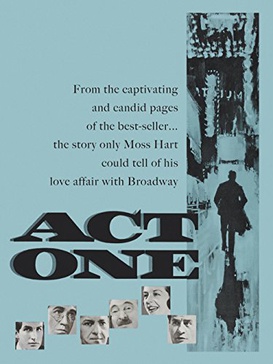
‘Act One,’ by Moss Hart

It is a childish game I have always played and have never been able to resist—a game of arranging life, whenever possible, in a series of scenes that make perfect first-act or third-act curtains.

Wikipedia’s biographical article on Moss Hart, author of the autobiography, Act One, includes what seems to me a very telling detail. In the book, Hart describes his relationship with his aunt Kate, an eccentric semi-delusional who fancied herself a grand dame. She shamelessly sponged off her family, dressed in an affected “fashionable” style assembled from other people’s cast-offs, and was devoted to her nephew Moss. It was she who introduced him to the theater (cheap seats, of course), and who nurtured his fascination with that world. In the book, Hart tells how Aunt Kate died, tragically, while his first produced play was in rehearsals. She never knew of it, because he’d saved it as a surprise.

In actual fact, according to Wikipedia, Aunt Kate lived on for some time, becoming increasingly eccentric. Finally she turned on her nephew, breaking in on his play rehearsals and wrecking scenery. Once she set a fire backstage.

Now that I’ve finished Act One, it seems clear why Hart “edited” this scene of his life. The whole book is a lesson in storytelling. The truth spoiled the mood of the act, so he fixed it, as a good playwright does.

Moss Hart was born into an impoverished Jewish family in New York City (not apparently a religious family – they celebrate Christmas and he speaks occasionally of his love for lobster). His immigrant grandfather had come from a prosperous English family, but broke with them and emigrated. When his profession (cigar making) fell to automation, he was left without a living, a severe humiliation. Young  Moss was the child on whom he lavished his attention. After his death, Aunt Kate took his place.

Thanks to Aunt Kate, Moss knew he wanted to be part of the theater, a ticket out of the poverty he hated, though he wasn’t sure what he’d do in the business. He tried, and abandoned, acting. Eventually he and a friend took jobs as social directors at a Jewish “summer camp,” an established cultural tradition in those days. These jobs were mostly about arranging entertainment, and Moss learned a lot, eventually becoming the best paid social director in the old “Borscht Belt.” But then he came up with an idea for his first comedy. Without his knowledge, a friend sent the play to the Broadway producer Sam Harris, who amazed him by calling him to ask if he’d mind collaborating with George S. Kaufman to bring the play up to professional standards.

George S. Kaufman was like a god to Hart. The rest of the book is a journey through the writing and production process for that single play. They “fixed it,” and tried it out in Atlantic City. The audience liked the first act, but it went downhill from there. Convinced they still have a salvageable show, the pair plunge into re-write after re-write, as out-of-town audiences continue to fail to find it funny. Then Kaufman gives up. Hart despairs. And then he has an inspiration and persuades Kaufman to give it one last re-write before the New York opening in four days. Then the big payoff.

Act One is a brilliant drama, disguised as an autobiography. I’m not sure how much to trust it in terms of facts, in light of the Aunt Kate episode, but the mechanics of storytelling are exemplified beat for beat, and they work wonderfully. Act One is a fascinating, amusing, bittersweet and ultimately triumphant personal story. It’s a masterful short course in plotting for a writer in any discipline.

Highly recommended.

On historical characters in movies

It’ll be a day or two until my next book review. I’m reading Act One, the autobiography of Moss Hart, the renowned Broadway playwright and director. It came up as a bargain e-book on Amazon, and it’s about two things I like – writing and the theater. It is an interesting book, and I’ll have much to say about it when I’ve finished reading.

The book was made into a biographical movie in 1963. I didn’t see it, of course (we rarely saw movies in our family), but I caught part of it on TV at some point over the years. My perception of the film (which got mediocre reviews) is marked by an article I saw in Parade Magazine at the time of the release. At least I’m pretty sure the article was about this movie. There’s a scene that exactly corresponds to what it described.

According to the article, when they were casting the parts of famous people who only appear briefly, they hired some of those people’s actual children to play them. I’m pretty sure a son of Robert Benchley played him in the scene where there’s a gathering in George S. Kaufman’s apartment. (Might have been Nathaniel, but I can find no mention of it online). There were others as well — I forget who. IMDb says nothing about this casting gimmick, but I like to believe I remember correctly.

There’s a formula in the movie business, I read somewhere: “When you’re casting famous real-life characters, the smaller the part, the more they must resemble the person they’re playing.”

That sounds paradoxical, but it makes sense in practice. When you’re dealing with a lead, you’ve got the whole length of the production to convince the audience that (taking an example purely at random) Kyle MacLachlan is Franklin Roosevelt. But when you bring somebody on for a minute as, oh, Humphrey Bogart, you don’t want the viewer to be diverted from following the story to ask, “Is that supposed to be Bogey?”

The movie that jumps to my mind when I consider this rule is “The Plainsman,” a 1936 film by Cecil B. DeMille, which stars Gary Cooper as Wild Bill Hickok. Except in height, Coop bears no resemblance whatever to Hickok. His nose is the wrong shape, his hair is way too short, and there’s no mustache at all (Hollywood, after World War I, adopted a long-standing tradition of erasing almost all mustaches from historical characters. Only the Hippie Era shook them off it). But Buffalo Bill Cody wears the proper long hair and imperial goatee. As does General Custer.

I’m not sure how they managed to preserve Buffalo Bill’s beard and hair style in 1944’s movie, “Buffalo Bill,” starring Joel McCrae. But they got away with it. I suppose Buffalo Bill’s appearance was so iconic they couldn’t escape it.

Note to future producers: If a movie is ever made of my life, you have my permission to cast somebody thinner and taller to play me. But you need to keep the pigtail in the older scenes.

‘Romeo’s Town,’ by James Scott Bell

I didn’t grow up here, but when you come to stay in L.A. it adopts you. It’s a wild crazy aunt of a town, dressed up in boas and bangles and laughing too loud, sometimes getting angry for no apparent reason and throwing a screaming fit, only to calm down and pull you in for a forgiving embrace even though you haven’t done anything to be forgiven for.

I genuinely love James Scott Bell’s Mike Romeo novels. As I’ve said too many times already, there aren’t a lot of Christian writers today who can write a story worthy to play with the big kids in the industry. Bell’s books are that good, and they manage to keep the language mostly PG. Mike Romeo is a particularly interesting hero, a genius, a Harvard drop-out, a martial arts expert and former cage fighter. He’s on a spiritual journey, facilitated now by his new employer, a disabled Jewish lawyer named Ira for whom he serves as investigator.

As Romeo’s Town opens, Mike rescues a clerk in a bookstore from a knife-wielding attacker, braining him with a large volume on Shakespeare by Harold Bloom. Almost predictably, it’s Mike who ends up in trouble with the law. Then he and Ira go to see a new client, a teenaged boy attending an elite private school, who has confessed to dealing drugs. His mother, who hired them, thinks the boy is covering for another student. Mike’s investigation (punctuated by frequent fights, sometimes to the death) leads him into the intersection between the social elite and the narcotics rackets. With some nasty surprises for him personally. Plus a reunion with the love of his life.

Mike Romeo is a fascinating character, and (in my opinion) author Bell does hard-boiled narration better than anybody writing today, but with a sly personal slant. Highly recommended.

Time and turkey

Photo credit: Mark Miller, Creative Commons license, Wikimedia Commons.

I was thinking today (as one does from time to time) that, for a guy my age, I don’t feel all that bad. (Sorry, identity thieves, but I won’t tell you exactly how old I am.) I have my aches and pains, and I could bear to drop the weight of a pretty large dog, but I honestly expected to be in more pain at this age.

There are little reminders, though. I told you about losing my keys last weekend. Further along in the week, I lost them again. It was one of those dumb senior moment things – I had the keys in one hand, and something (I forget what, of course) in the other hand that I meant to throw away. What I figured out, after searching an hour for the keys, is that I’d dropped the keys in the trash basket, and put the trash… somewhere. Who knows?

I told myself I hadn’t had much sleep the night before. Yeah, that’s the reason.

Another reminder of a different kind came this past Saturday. I’d had a visitation of a vivid memory of a meal I used to order, about 45 years ago, at a restaurant in a St. Paul suburb that shall remain nameless. I wondered if the place still existed, Duck Duck Go’d the name, and what do you know? It’s still there (later intelligence informs me the place has been in business since 1969. The only other place I used to eat at back then that still exists is Perkins). I checked the menu, and my beloved Turkey Dinner was still on it. So I arranged with a friend to go eat there.

Maudlin back story: I’m not entirely sure how I and my then roommate started eating at this particular Chinese restaurant. (I won’t give you the name; this story might reflect badly on them, and I’m pretty sure that would be unfair.) I have an idea we went with The Girls Next Door: the four very pretty, Christian co-eds who rented apartments in the next house over. It was the nicest situation I’ve ever been in, girl-wise, until I made the mistake of falling in love with one of them.

This particular girl, who shall also remain nameless, had grown up in what we used to call the Orient. So I suspect going there was originally her idea. I wasn’t into Chinese food yet, back then. But I was into her. However, when we got there (Sunday lunch; you must imagine me in my brown tweed church suit), we discovered they had a small American menu. I ordered the turkey dinner, as did my roommate. It was really delicious, like mother used to make. As long as we still lived in the Cities, even after the Girls Next Door had scattered like so many golden birds, we’d go there for the turkey dinner.

So, 45 years later, I went back. I ordered the turkey dinner.

It didn’t taste at all as I remembered it.

I am not so arrogant as to think the cooking had deteriorated. I’m pretty sure I have a more sophisticated palate now. I’ve had better turkey dinners and gotten used to them. Perkins is very good. Boston Market, which is no longer around here, was excellent.

I’m not sure if I’m better off knowing that my memories misled me. Maybe I’d be happier just remembering an idealized meal.

Come to think of it, maybe I’m happier imagining an idealized Girl Next Door, too.

‘The Causes of the Depression,’ with Robert Benchley

Mark Twain seems to have better staying power, but my choice for America’s greatest humorist remains Robert Benchley. He’s not much read anymore, but I cherish hopes that he’ll be rediscovered. You can also see him now and then in old movies, which nobody knows about anymore either.

The other day I shared a Great Depression song. Tonight, I’ll share one of Bob Benchley’s short subjects, “The Causes of the Depression.” Here you see him in his standard comic persona, the well-meaning regular guy with minimal situational awareness.

Those who know about his life remember primarily his membership in the legendary Algonquin Round Table group of wits. They also remember his drinking (which was serious, and interfered with his work) and his serial philandering with a string of Broadway starlets.

Oddly, according to a biography I read some years back, he originally went to New York a devout Christian and a fervent Prohibitionist. He rapidly discovered the pleasures of the flesh, however.

In spite of that, it was said of him that he never tolerated blasphemy when he and his friends were trading quips, however drunk they might be. He would make it clear that he did not appreciate that sort of thing.

‘Three Little Pigs,’ by Alex Smith

I’ve been following Alex Smith’s exciting Robbie Kett thriller series. Book Three, Three Little Pigs, rounds out a narrative cycle in the series.

My review of the first book was, in retrospect, conspicuously lacking in perception. I described the book as psychologically extreme, rather than physically extreme. The second book proved me wrong, in spades, and Three Little Pigs takes it even further. Hero DCI Kett doesn’t actually pull needles out of his arm and stagger out of an ICU unit (as so many thriller heroes are wont to do), but that’s about the only extreme he doesn’t go to in this excruciatingly suspenseful story.

As you may recall, Robbie Kett is a London Metropolitan police detective who was dispatched to the more bucolic city of Norwich after his wife Billie was forcibly abducted and disappeared without a trace, five months back. Robbie had been obsessing over the investigation, and his superiors thought it would be best to get him away and let cooler heads look for her. However, he’s seen plenty of action in Norwich – he’s still healing up from wounds he sustained two books ago, not to mention the ones from the second book.

Then a call comes from London. A woman has been found in a weird, abandoned house that seems to have been set up for cult practices. She’s still in shock in the hospital and not talking, but it looks as if they have a real lead now. Robbie is back in London like a shot. His orders are clear – he can observe, but isn’t to interfere with the investigators. As if that’s going to happen.

As Robbie plunges into things, he’s surprised to find clues where no one has before. Granted, he goes to extremes nobody else will, but it almost looks as if the others weren’t really trying. As he functions as a loose cannon in the investigation, earning repeated reprimands and finally house arrest, he begins to dimly glimpse how big the forces involved here are, and to realize there’s nobody he can trust. Nobody at all.

This book nearly killed me as a reader. The stakes started high and kept rising. What looked like a major resolution toward the end turned out to be only the start of new horrors. Three Little Pigs is a page-turner, without a doubt. As is common in such stories, a certain lack of plot logic hardly counts.

Recommended, if you can handle the tension. Cautions for language and serious perversity.

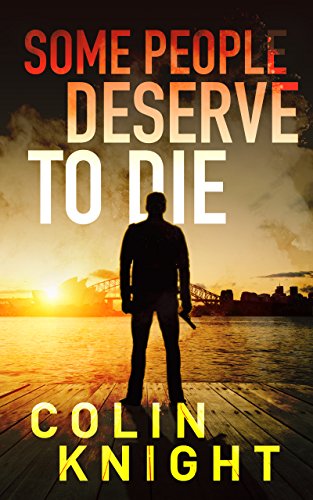
‘Some People Deserve to Die,’ by Colin Knight

I think most readers will find few surprises in Colin Knight’s Some People Deserve to Die. It’s a fairly standard revenge story, but it’s told in a compelling way.

Alan Davies is discovered homeless on the streets of Toronto, strung out on booze, drugs, and guilt. After he dries out in a hospital, he discovers he’s actually fairly wealthy now. What he’ll do next is a no-brainer – he’ll get revenge on the people who ruined his life.

As a boy in a small town, Alan was a nerd, a target of bullies. One day those bullies tricked him into committing an act that left him permanently shamed. It didn’t help that his father had died that same year, and his sister had committed suicide. So he went on the road. His wanderings took him first to the South Pacific paradise of Vanuatu, where he got involved with the local drug trade and learned to be a thug. When that went sour, he fled to the North Atlantic to work on an offshore oil rig. Then he followed his drilling team to Nigeria, where they stepped into a hellish world of crime, corruption and bestial cruelty. That led him to a stint as a mercenary, and finally to a quest for oblivion on the streets of Toronto. Then, at last, to his neat, professional, ruthless revenge project. And a shocking discovery.

The revenge story is a difficult challenge for a Christian reviewer. Forgiveness doesn’t enter into this story, but things don’t work out quite as Alan planned, so forgiveness may be conspicuous by its absence. (Though I wasn’t quite sure how to think about the conclusion.) I knew what was coming pretty much all the way through, but the storytelling kept me fascinated (in spite of some typos).

Moderately recommended, if you have a strong stomach for violence and rough language.

‘The Assistant,’ by Kjell Ola Dahl

It’s not often I finish reading a book with the feeling of, “Glad that’s over.” But that was my response to The Assistant, a stand-alone novel by Kjell Ola Dahl, one of the big guns of Scandinavian Noir.

There are two parallel narrative threads in this book. In 1924, a young man with the non-Norwegian name of Jack Rivers works as a driver for a bootlegger. Though a thrill-seeker and a bit of a rogue, Jack would rather be doing something legal. But there’s a depression on, and he takes what work he can get. Eventually he will be arrested by the incorruptible policeman Ludvig Paaske, who nevertheless takes a liking to him. Jack has a sense of honor and is faithful to his friends, something those friends do not reciprocate.

In 1938, Jack is out of prison, now working as an assistant for Paaske, who has become a private detective. Paaske is approached, in the classic Hard-boiled manner, by a beautiful woman who wants him to follow her husband. She suspects he’s being unfaithful.

Her husband, it turns out, is the bootlegger Jack used to work for, now a successful businessman and politician. And the wife is not being entirely honest. Both Jack and Paaske will have reunions with women they cared about in the past, and each will worry that the other is being manipulated. In addition, Nazi agents are involved.

The Assistant is a moodier and more thoughtful book than the average mystery. I suspect it might be more evocative in the original Norwegian. This translation seemed good to me at first, but seemed to deteriorate as it went along. Sometimes it was ploddingly literal (a vice hard to avoid, as I can say from experience). And sometimes it seemed like a rush job to me, the author having given up on finding the right words. The first time someone made coffee in a “pan,” I thought it was due to their poverty, but eventually I realized the translator must have blanked on the words “pot” and “kettle” all through. And the parliament is referred to as “Stortinget,” which is technically correct but won’t be familiar to many English-language readers.

I need to mention that a Labor Party speech gets fact-checked by Paaske at one point (that’s rare in a Norwegian book), and one character’s Christian piety is  treated with respect.

But I didn’t believe this story. It was operatic – the main characters make great, Quixotic gestures that seem both irrational and out of character. And the two different timelines share so much in location, characters and action that they were hard to keep straight.

Also, the ending just left me floundering.

I can’t really recommend The Assistant.

Victorious in Victoria

I thought about taking a picture at the Nordic Music Festival in Victoria, Minn. this past Saturday. But it would have been pretty much like other pictures I’ve posted of the event in the past, made less interesting by the lack of my Viking tent. I’m still driving the loaner car, which isn’t big enough to carry the thing, and the guy who’s hauled my stuff for me to the last couple events wasn’t able to be there. So I showed up with my Viking clothes, my books for sale, a couple weapons, and my magnetic personality only.

And actually it worked out pretty well. There’s something to be said for minimalism, it seems.

The festival wasn’t held last summer, needless to say. Crowds were down this year compared to the past, but those who came had a good time. The weather was beautiful, a little warm but with a pleasant breeze. Everybody who made the trek seemed happy to be there, relieved to get a furlough from lockdown.

And I sold books. Very substantial sales. I’ve always marked this festival as one of those events where books didn’t move, but they moved this year. The main difference was that I was at the table under the canopy with all the other Vikings, rather than enthroned in solitary splendor with my tent, sunshade, and Viking chest.

Maybe I need to find ways to make myself more accessible.

The very thought gives me the willies.

Anyway, it was all a success, for me at least. Packing up was easy, and then I drove the half hour back home. And had a nasty shock.

I couldn’t find my house keys. I’ve never hooked them to the loaner car’s keys, because I’ve always told myself this arrangement wouldn’t last much longer (three months now and counting).

That didn’t mean I couldn’t get into my house. I have a spare key. You don’t get as old as I am, with the short-term memory I’ve got, without learning the uses of redundancy. But there’s an assortment of keys on that ring, and I wasn’t sure exactly what else I’d be losing access to.

It was getting dark by then, so I figured I’d put off searching the car until morning. Maybe the keys were in the car. Maybe they’d fallen into one of my boxes.

But what haunted me through the night was the growing conviction that the most likely scenario was that I’d dropped the keys, either into the grass on our camp site, or in the parking lot while packing my car.

Which would mean driving a half hour either way back to Victoria to hunt for them. Almost assuredly without success. Either they’d be lost in the grass, or somebody would have carried them off.

But in the morning, I checked the car again. And behold, they’d fallen into the crack between the driver’s seat and the console. (One of the disadvantages of wearing a pouch, as the Vikings did – the console forces the pouch to turn 90 degrees, making it easy for stuff to spill out.)

Great relief on my part. But oddly, throughout the day, I had attacks of the sudden conviction that there was something I was supposed to be worrying about. I’d turned on my WORRY switch, and it has no OFF position. You just have to wait for the fuse to burn out.