All posts by Lars Walker

‘The Einstaat Brief,’ by Blake Banner

Book three of Blake Banner’s interesting – and modestly impressive – Cobra series is The Einstaat Brief. Once again we follow our hero, “ethical” assassin Harry Bauer, as he fights international evil.

This time out, Harry is facing a situation he never looked for. He’s in love, with a beautiful, red-haired Texas girl. He knows he can’t bring her into the life he’s living, but he figures he’s done enough killing, even in good causes. He’s going to retire, and move with her to a ranch in Wyoming.

Then a team comes to kill him, and they seem to be government agents. Harry’s superiors at Cobra make him an offer he can’t refuse – one last emergency job, and he can retire and they’ll guarantee his and the girl’s safety.

The job is a rush assignment, without adequate preparation time. Harry will have to improvise. He is to infiltrate a luxury resort hotel in Andorra, and assassinate three of the world’s most powerful internet moguls. These three are plotting to inject an algorithm into the world wide web which will give them control of all the world’s markets. But money isn’t their goal. They want to manipulate international economies in order to incite wars in the Third World – to control overpopulation.

Harry manages to get in, but he interprets his instructions freely – he steals the men’s laptops, and kidnaps one of them. But when he gets home, he finds a more dangerous, personal challenge in store.

I am enjoying this series, but this is the last installment available to date. Another is coming in December. Fun reading, with cautions for a high body count and mature language.

‘Dying Breath,’ by Blake Banner

Here we slowed, but not much, and moved, hooting and honking, among cars and motorized rickshaws, in a city that looked like it was built in the twenty-fifth century to be inhabited by people from the fifth century.

Book 2 in Blake Banner’s Cobra series, about elite assassin Harry Bauer, is Dying Breath. It’s as much fun as the first one.

As I read the Cobra books, I’m reminded, in a way, of Ian Fleming’s James Bond. Except that I like Bauer better than Bond (though I’ll admit I’ve only read a couple Bond books). I find James Bond kind of flat as a character. Harry Bauer is an interesting person, and he occasionally hints at opinions I can get behind. On the heroic indestructibility scale, he’s certainly Bond’s equal.

As I mentioned in my last review, Harry Bauer is a former commando, now employed by a super-secret, non-governmental security organization to take out the worst people in the world. His latest assignment seems relatively straightforward – to infiltrate a New York hotel and execute two Chinese scientists who are working on a plague that could become pandemic.

But, as any reader will expect, things don’t go according to plan. The set-up isn’t what Harry expected, and he ends up on a quest that takes him from New York to Casablanca to Bangkok, and which will introduce him to an intriguing femme fatale with lots of deadly secrets.

What any reader of this book will note is that it’s relevant in a very particular way. A moment of recognition comes packed inside at no additional charge. You’ll know what I mean.

I noted one plot problem: Harry makes use of an EMP (Electro-magnetic pulse) machine to knock out electronic systems, but they don’t seem to affect his or his partner’s cars. This is not explained.

Highly recommended as entertainment. Morally problematic in diverse ways.

‘Dead of Night,’ by Blake Banner

The maître d’ sat me next to a table of noisy, overdressed beautiful people; the kind who leave their plastic surgeon’s designer label hanging out of the tucks behind their ears.

Harry Bauer, hero of Blake Banner’s Dead of Night, is an American and an orphan. Somehow his wanderings led him to Britain, where he joined the Special Services. He’s a valued and effective commando, until the night in Afghanistan when he nearly kills a prisoner – an Al Qaida leader who raped, tortured, and murdered an entire village. He gets kicked out of the service, and is soon back home in New York without job prospects.

There is one party willing to hire a guy like him for security work, however, in spite of his hazy military record – a Russian gangster. Harry goes to work for him, but he goes in with a plan – one that will leave a lot of bad guys dead, and Harry considerably richer.

But then he’s detained by some mysterious agents, who escort him to an interview with the head of a secret, international security operation called Cobra. Cobra is not directly sponsored by any government. Its sole purpose is killing – eliminating the worst of the worst, whom the law cannot touch. Harry agrees to join them with little hesitation. Especially because his first target is the same terrorist he had to let go in Afghanistan.

Trouble is, the CIA is holding that monster as an information source, and Harry will have to get through them to get to his target.

Piece of cake.

I occasionally read military action thrillers, but they aren’t my favorite reading fare. But Dead of Night went down real easy with me. I finished it quickly, and had a good time with it. The action never lags, the prose is good (it even made me chuckle occasionally), and Harry comes through as a complex, fully developed character. I hastened to buy the second volume in the series.

I hesitate to recommend this book wholeheartedly, because it’s very bloody, and the body count is high. There’s also the moral question of revenge and whether it’s right to kill just because the victim “needs killing,” so to speak. So the moral ambivalence here is greater than in your average mystery. And, of course there’s always the language and adult themes.

But it sure was a fun read.

‘The Reluctant Detective,’ by Tom Fowler

C. T. Ferguson is the scion of a wealthy Baltimore family (his given name is, I kid you not, Coningsby). His only distinctions are skills at martial arts and computer hacking. He just returned from three years in Hong Kong, during which he helped some dissidents out and spent a horrific 19 days in a Chinese prison, before being deported.

Now he wants nothing more than to spend his parents’ money, but they are determined to make something of him. They’ve offered him a deal – work for free at some occupation that helps people, and they’ll provide a generous allowance. After some dithering, he settles on becoming a private eye. Thus he is The Reluctant Detective.

C. T. doesn’t really know anything about private investigation, beyond what he’s learned from TV and novels. But he sets up his office and goes to work. His first case is, as might be expected, a domestic. Alice Fisher is convinced her husband is cheating on her. C. T. uses his hacking skills to examine the husband’s life, does some discreet surveillance, and decides the man is faithful – even devoted. But now he’s curious about Alice, the wife. There are certain irregularities in her life that make him suspicious about what this whole exercise is in service of. Then somebody gets killed, and C. T. is hip deep in trouble and danger.

The Reluctant Detective wasn’t awful. The prose was generally good, which is a distinction in our times. But two elements kept me from getting engaged in the story.

First of all, I didn’t like the hero/narrator. C. T. never comes to life as a character, or inspires sympathy. His actions and thoughts seem uncoordinated, not rising from any central motivational core. I had the idea the author might have intended him to be a modern Lord Peter Wimsey, but Dorothy Sayers did it better. Perhaps C. T. needs to get a monocle.

Secondly, I didn’t believe the story. The author seems to be as clueless about the law, police procedure, and what a private detective does as his hero is. He seems to think that P.I.s carry some kind of official authority. He thinks a private citizen can just waltz into a police station and drop into an interrogation observation room without being challenged. And he greatly overestimates the willingness of cops to invite P.I.s into their investigations (even when, as in the case, the cop is the P.I.’s cousin). He also raises intuition to the level of evidence, which just doesn’t wash.

I read The Reluctant Detective all through, and that sets it above a lot of other books. But I really don’t recommend it. Cautions for language, as you’d expect.

Quarantine journal

The book I’m reading now is taking a while, so what shall I say to you tonight? Went out for a walk this morning and exchanged a few words with a neighbor I barely know. That counts as a major social event these days. Alert the Society columnists!

Went out for lunch (the daily deal at Red Lobster), and then stopped on the way home to do my civic duty and get my flu shot.

Consumer report: I preferred the nanorobots they included in last year’s vaccine. Those gave me dreams of the University of Timbuktu, and produced a compulsion to vote for the Green Party, though it was an election off-year. So far this year’s nanorobots have only turned my toenails teal, and I think I detect the beginnings of a vestigial tail, for which I can think of no good practical use.

I streamed an old movie, “In a Lonely Place,” with Humphrey Bogart and Gloria Grahame. It’s about a screenwriter with homicidal inclinations, who may or may not be preparing to kill his fiancée at the end. I can’t say that it matches my own experience in the film industry, but my participation has been limited so far. Once I start doing power lunches with producers, I may see more action.

‘Elsewhere,’ by Dean Koontz

There was a time to take refuge in the arms of those you loved, and there was a time to stand up to great evil and not be bowed. If you didn’t know the difference, then you were doomed to perish about two-thirds of the way through the story, when the narrative needed a jolt of violence and emotion. (As a reader who hoped one day to be a writer, she was always alert to authors’ techniques.)

Dean Koontz is back with a new adventure, entitled Elsewhere – this one is sort of a sci-fi/fantasy cross. It’s very much in the familiar Koontz style, but (also in his style) it’s significantly different from his other books in concept. Also, there’s no mystical dog in this one (there is a pet mouse, but it has no special powers).

Jeffy Coltrane and his daughter Amity are mostly happy in their life in Suavidad Beach, California. He repairs and sells antique Bakelite radios, and she is a smart, well-adjusted kid. Their great sorrow is the disappearance of their wife and mother, Michelle, some years ago. Michelle abandoned them to pursue a career in music, and they have never heard from her since.

One day Jeffy gets a visit from a local eccentric, a homeless but fastidious man they call Spooky Ed. Ed gives Jeffy a box, which he says contains “the key to everything.” He is to hide it somewhere, and if Ed doesn’t return for it, he’s to sink it in the sea in a barrel of concrete.

Then a group of armed men who claim to be official invade their house, searching for the “key.” Jeffy and Amity are suddenly forced to consider the possibility that Creepy Ed knew what he was talking about. They take the “key” out of the box and examine it. It gets activated, and suddenly they’re transported to an alternate universe. This universe appears pretty much the same as the one we know, but it turns out to have a few sinister differences. Soon they’re flitting from universe to universe, trying to not get separated and to escape a dangerous enemy who considers them expendable and understands the multiverse better than they do.

Elsewhere scared me to death, and touched my heart. In other words, it’s pretty much what you pay your money for when you buy the Koontz brand. A couple political points are hinted at, but they were points I liked, so I didn’t mind. It’s a charming and compelling novel. Cautions for language.

Just like Roald Amundsen

It occurred to me more than once over the last few days (but never at a useful time) that I misled you last week. I told you I’d be gone Thursday and Friday, to do a lecture at a church school in Iowa. Then you doubtless came to this page in breathless anticipation of my absence, and there I was, reviewing as usual. Without so much as an apology.

I apologize.

What happened was the weather, something of which we have no lack in Minnesota. When I got up on Thursday morning, prepared to pack and go, I learned that several inches of icy snow were predicted that day. I didn’t like the sound of that – offhand, I can only remember one instance in my life when I actually spun out on a highway and ended up in the ditch, but I’m sure there must have been more. It’s a distressing feeling, like somebody inside one of those YouTube disaster clips, where you watch one idiot after another sliding their cars into one another on a slick, downhill street.

So I called the school and asked if we could reschedule. The pastor was amenable, and we moved it to Monday (today, in case you’re not certain after months in lockdown). Then I looked at the weather forecast, identified Saturday as a likely driving day, and moved my trip to then.

What happened subsequently in Iowa is that an almost identical storm blew up on Sunday night. So when I got up this morning, I learned that my car would have to be scraped off, and the highways were slick. Better leave early to compensate for slow travel.

I left about an hour and a half before showtime (the trip should have taken about 40 minutes), and drove like an old man (a clever ruse on my part). Road surfaces varied, but I opted for caution at all points. I still got to the school in plenty of time.

The lecture went well. The students pretended to be interested as I talked about the conversion of the Vikings in Norway, and even asked questions. Lots of questions.

My personal favorite question was, “Would you stop talking so we can look at your stuff?”

I smiled kindly and ignored the young man. The questions went on for some time, but finally they ended, and the students got a chance to examine my “stuff”: I had brought my helmet, sword and shield for them to peruse. Nobody, I am happy to report, attempted to kill anybody else with them.

Then back to where I was staying. It was past noon by now, and the sun had kissed the road surfaces, improving their general disposition. I drove home to Minnesota at normal speeds, and stopped off in Kenyon, my boyhood home, to examine the family cemetery plot for personal reasons. The grass was covered with about an inch of snow, but the stuff had melted off the granite marker stones so that they could be read. In case I’d forgotten who they were. Which I hadn’t. Grandpa and Grandma, Uncle Vernon and Aunt Marcene whom I never knew, and Aunt Jean whom I knew very well indeed.

I stopped at the gas station where my dad used to buy most of his gas, and ran into an old high school friend. This gave me a chance to brag about “Atlantic Crossing” (I may not have mentioned it before, but I helped translate this excellent miniseries, coming to PBS Masterpiece this spring).

Now I’m home. It was nice to take a Viking trip of any kind at least once this summer. Thanks to Scarville Lutheran School for their hospitality. Also to my brother and his wife, for the bed and meals variety. Now all I need to do is unpack, which may take several days unless I work up some energy. I’ve taken road trips two weekends in a row now, and I’m not sure I can handle the wear and tear.

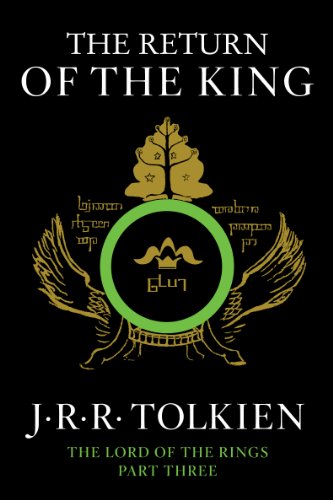
Reader’s report: ‘The Return of the King’: The Scouring of the Shire

‘We’re not allowed to,’ said Robin.

‘If I hear not allowed much oftener,’ said Sam, ‘I’m going to get angry.’

Blogging my way through The Lord of the Rings, final installment from The Return of the King.

I have come to the end of the story. For each reader of The Lord of the Rings hereafter, I expect, one of the final impressions of reading the saga must be the Scouring of the Shire, made conspicuous by its absence from the Peter Jackson movies.

I’m not going to look back and check, but I’ll bet the last time I did this pilgrimage on this blog, I remarked on this very subject. I can see why, for dramatic reasons, a filmmaker might leave the Scouring out the story. It makes for a substantial anticlimax, which might detract from the eucatastrophe of the defeat of Sauron.

But I have an idea there might be other reasons.

Moviemakers today, it would be redundant to say, are generally leftists. The Scouring is highly problematic for leftists, particularly in these times. The same people who read the books as Hippies in the ‘60s, and cheered when Merry, Pippin, and Sam tear down all the signs posted by the Chief’s men, are now Woke leftists. There’s nothing Woke leftists today love more than lots of cautionary signs – No Smoking, No Firearms, No Automobiles (Tolkien wouldn’t have minded that one), No Pets, Please Recycle, Masks Must Be Worn.

There’s a quotation making the rounds in which Tolkien says that his political views tend toward Anarchism. He didn’t mean 19th Century, bomb-throwing Anarchism, of course. Those guys assassinated kings, and Tolkien loved kings. He meant something more like what we call Libertarianism today (I’m not a Libertarian myself, so I have my own issues here). The fans of the movies, who often believe (I suspect) that it’s all about environmentalism, probably don’t enjoy reading about the hobbits tearing signs down and smoking all over the place (in the movie they suggest that pipeweed is really marijuana, but they’re wrong). But Tolkien’s environmentalism is different from that of today’s left. The professor loved trees, but he didn’t love wilderness as such. In the time of the King, he writes:

…the evil things will be driven out of the waste-lands. Indeed the waste in time will be waste no longer, and there will be people and fields where once there was wilderness.

Tolkien’s ideal world is a world of villages, solidly middle-class and bourgeois.

One other point is even more delicate. The Shire needs scouring because Saruman has filled it with foreigners. Men of low character who bully the hobbits and have no respect for their property or traditions.

For today’s England, and for most of the West, that’s a subject best left alone.

Reader’s report: ‘the Return of the King’: Happy endings

And he sang to them, now in the elven-tongue, now in the speech of the West, until their hearts, wounded with sweet words, overflowed, and their joy was like swords, and they passed in thought out to regions where pain and delight flow together and tears are the very wine of blessedness.

Blogging my way through The Lord of the Rings, now reading The Return of the King.

I’ve gotten through the hardest part. The ring is destroyed, Sauron is fallen; his followers are scattered and defeated. The great evil has passed, and the world begins to heal under the wise power of the King and the White Wizard.

Tolkien’s essay on Fairy Stories emphasizes the importance of the Eucatastrophe – the surprising happy ending. The eucatastrophe doesn’t work unless the dramatic tension is intense. All must seem lost. Any hope that remains must be no hope at all. “We must do without hope,” as one of the characters says. Only after the good side has lost hope and continues fighting merely out of a stubborn determination to die on the right side, if the right must fall – only then can you have a real eucatastrophe.

It seems to me that most writers – and I am certainly one of them – are a little shy about happy endings. We know how to pile up the obstacles; we know how to frustrate our heroes and test them past the point of despair. But when – beyond all expectation – they triumph in the end, we’re not sure what to do with the victory. Mustn’t do an end zone dance, after all.

Tolkien does an end zone dance. He knows that the drama doesn’t exist for its own sake. It exists for the sake of the happy ending, just as the saga of humanity itself exists only for the sake of Christ’s Kingdom. The Return of the King should be read side by side with the Book of Revelation.

He describes in loving detail how friends are reunited, the wounded are healed, the land is cleansed, the pollution is washed away, and justice is restored. He understands that after the sufferings his characters (and the reader, vicariously) have endured, they well deserve a reward.

I need to bear this in mind as I work on my latest Erling book. My current story actually involves a happy ending with historical warrant. I need to be less shy about rejoicing and vindication.

Like most modern people, I know more about depression than rejoicing. More about ambivalence than victory. I need to look to the Word of God to guide me in subcreation.

Sissel, and a short break

https://youtube.com/watch?v=hijYMFrLYRw

I’m going to have to give you a little bit of Sissel tonight, and then I’ll be gone for a couple days. I have to go out of town tomorrow to do a lecture, and today I got a (relatively) big translating job I have to finish before I leave. So I must post and run.

The song is a Norwegian classic. The tune is by the violinist Ole Bull, a world celebrity in his time. The words are by Jorgen Moe. The title is “The Seter Girl’s Sunday.” A seter was a mountain pasture, where livestock were kept over the summer, so they could graze there and take pressure off the home meadows. Servant girls would be sent up with the animals, and would commonly spend long periods of time up there, sometimes in relative solitude.

The girl in the song is watching the sun, knowing that when it reaches a certain point above the mountains, the folks at home will be hearing the church bells and heading to church. It’s an important social time in a country community, and she is lonely.

Kind of like someone under lockdown.