
Category Archives: Uncategorized

Paintings Unlike the Others

David Herman writes about seeing the more personal work of his father, the Polish painter Josef Herman. “He belonged to a great tradition of European artists who from the mid-19th century depicted the dignity of labour: from Courbet, Millet and Van Gogh to the Flemish Expressionists and the German artist, Käthe Kollwitz in the early 20th century,” he states, describing the way critics and admirers have known him.

But then sketches and paintings of a different nature were discovered.

“Everyone in these newly discovered drawings and paintings was recognizably Jewish. The palette was completely different: dark blue skies, a white crescent moon, pale faces with dark, haunted eyes.”
Let’s Not Get Cynical Here

“Satire can be dangerous and harmful. It can breed a dehumanizing cynicism which becomes an end in itself,” writes Carl Truman, but it is also “vital to healthy democracy. Where it exists, it is a sign that power is being resisted. Where it is permitted, it is a sign of freedom and a gauge of the ability of those in charge to allow criticism.”

And from our political desk, we’re hearing reports that the administration who said the world doesn’t respect the United States enough to stand with us did not respect the world enough to stand with them during yesterday’s solidarity march in Paris. The secretary of state said, essentially, “Just because I couldn’t attend your ball games or birthday parties doesn’t mean I don’t love you, son. Why does this always have to be about you?”

Don’t Know? Ask a Librarian, They Once Said.

What did people ask the New York Public Library before they could search the Internet for made-up answers? The librarians have opened their file to reveal all.

When a question couldn’t be answered immediately, they would be filed away, because that’s what librarians do–they file junk. “Some are amusing (‘Is it possible to keep an octopus in a private home?’), while others are heartbreaking (‘Is it proper to go to Reno alone to get a divorce?’).”

Other questions include:

  1. Where can I rent a beagle for hunting (1963). We also had requests to rent a guillotine.
  2. Has the gun with which Oswald shot President Kennedy been returned to the family?
  3. Are Plato, Aristotle, and Socrates the same person?

I remember calling my local library to ask if they knew whether Sean Connery had died the day before. Someone in my workplace thought they had seen that, and we couldn’t get away with saying that it should be all over the news if it had happened, so since it isn’t, it didn’t. (via Prufrock)

Great Britain Is Eating Its Greatness

Where is British culture today? Here’s a depressing report from Hal G.P. Colebatch.

In August 2004, it was revealed that the National Lottery had raised £16 billion, enough to fund not merely the British but the US space program nearly twice over. The journalist Bruce Anderson commented that many liberals two hundred years ago believed that if mankind could only liberate itself from its worship of gods and its deference to kings, barbarism would inevitably give way to the reign of reason and virtue: “In one respect the liberals have had their way: gods and kings are not what they were. Instead, we have lottery tickets, astrology and pop music.”

Apparently Britons are more sports and pop-culture obsessed than you might imagine, and parts of the church aren’t helping.

After the 2008 Olympics, many British commentators wrote as if the fact that British athletes had won a relatively large number of medals was somehow a sign of national recovery and renewal. The preparation of these athletes had largely been paid for by National Lottery money, in other words by a decadent tax levied on the stupid and the desperate.

In 2008 the 1948 London Olympics were estimated to have cost about £20 million in 2008 terms; the 2012 London Olympics were estimated at the same time to be costing £10 billion, that is 500 times as much. This showed an official sense of priorities for which the only term was insanity.[8] Great intellectual or scientific achievers, or moral heroes, were by comparison so ignored that no comparison with the adulation heaped upon sports stars and entertainers was even possible.

…

In July, 1998, following England’s defeat by Argentina in the World Cup, the Bible Society, with the backing of the Archbishop of Canterbury, called on the nation to forgive David Beckham for having been sent off during the match, as though some vast moral or spiritual issue was involved. Dr David Spriggs, the director of the Bible Society and a Baptist minister, said, in words from which, to quote Peter Simple, satire might slink away ashamed: “What is so important is that David has faced up to his mistake, and asked the forgiveness of his team-mates and the whole nation …” The BBC made a “Where-were-you-when-it-happened?” documentary about this match, as if it had been a great historical event.

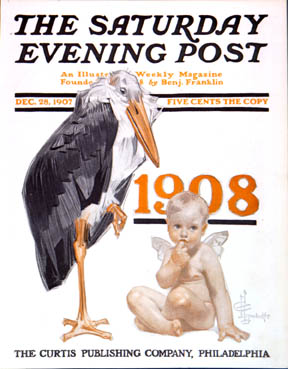
New Year, whether we like it or not


Illustration by J. C. Leyendecker

The Walker Christmas was celebrated this past Saturday, at my palatial home of Blithering Heights. This was timely in meteorological terms, since the earth, though appropriately hard as iron (or at least hard as lead), was bare on Christmas day, but plentiful snow fell on Saturday morning, auguring well for our celebration. Even more than the fortune cookies at the Chinese restaurant where we adjourned for lunch, in traditional Norwegian fashion.

And now the New Year approaches, like the Avenger of Blood in the Pentateuch. I feel more at home with the New Year as I grow older, probably because I come more and more to resemble the New Year’s baby. My festivities are taking the form of a few days off from work, working instead on a translation project while I have a little time off from grad school. My new year’s resolution is to spend less time relaxing. Prospects appear good.

Ah, 2015. God willing, it will be the year I’ll complete all my course credits, leaving only the Comprehensive Tests to be gotten through — some time in early 2016, I suppose. But just finishing class work is enough to give me a future and a hope. All my friends are retiring, it’s true, but everyone knows you retire and you drop dead the next day. At this rate I’ll live forever.

Have a blessed calendar change.

Revisiting the Closing of the American Mind

R.R. Reno wrote about Allan Bloom’s book, Closing of the American Mind: How Higher Education Has Failed Democracy and Impoverished the Souls of Today’s Students, on its twentieth anniversary in 2007.

The most important question in peoples lives—that is to say, the question of how they should live—remains largely unconnected to the sophisticated intellectual training that continues to take place in the classroom. I can often get students to “share” their moral “opinions,” and often with a certain warmth of conviction. I can also get students to analyze classical arguments for or against various accounts of the good life. But I find it difficult to induce students to take a passionate and rational interest in fundamental questions.

I am most interested in the students who are wounded and unmoored by the this kind of training or the atmosphere in which it takes place. Some students may be able to withhold their moral convictions in college and keep them intact, but some lose those convictions through a lack of exercise. If they do not actually lose them, they may find them shifted by the many sympathetic voices for immorality among their peers.

Quoting John Paul II, Reno states, “We should beware ‘an undifferentiated pluralism,’ he writes, for an easy celebration of ‘difference’ undermines our desire for truth and reduces everything to mere opinion.”

Sony Hackers: English You Write Much?

The Language Log is talking about whether the language used in threats issued by the hackers of Sony Pictures reflects a particular native language or is a hoax. “Kevin McCready surmises that the hacker threat was ‘…written by someone who has strong command of English but is pretending they don’t. In particular it would be interesting to see if grammatical errors conform to those a Korean might make.‘”

The text of the original threat isn’t uniform. Here are the second and third sentences: “Soon all the world will see what an awful movie Sony Pictures Entertainment has made. The world will be full of fear.”

A commenter claiming to be a native Korean speaker says it looks Korean to him. He writes, “Some people seem to be saying that ‘Soon all the world will see what an awful movie Sony Pictures Entertainment has made’ seems to be too good to have been produced by the same writer of some of the other lines, but this sort of expression (‘all the world will see’) would not be out of place in Korean either.”

Hunter Baker on the Ruin of Christian Higher Ed

Dr. Hunter Baker observes, “All universities, and certainly Christian ones, face a landscape in which students have been largely replaced by consumers.” He says in his latest book, if Christian colleges try to be like their secular counterparts, they will fail on almost every level, particularly in their stated mission. On the other hand, if they integrate the worship of the Most High with every academic discipline, they will distinguish themselves and accomplish their mission. “Christian colleges can successfully argue that the best education connects with the mind, the body, and the soul.”

This Is Abusive

“All abuse, whether laser-tipped irony or bare-knuckle fisticuffs, is best delivered coolly, without huffing and puffing. The best abuse looks effortless, the work of a ninja not a WWF wrestler.” Patrick Kurp talks about An Anthology of Invective and Abuse from 1929.